Tag: ravens in poetry

  • Author’s Note

    I’ve said I’m done being humble, but apparently nobody told my writing that.

    This poem is a little exploration of the contradiction between confidence and humility. I can recognize my own strengths as a writer, appreciate what I’ve accomplished, and genuinely believe I’m good at what I do without believing that makes me better than everyone else. At least, that’s the argument I’m making. Whether the poem successfully convinces anyone—including myself—is another question.

    I spend a lot of time reading other poets, and sometimes I come across a line or a rhyme that makes me stop and wonder how the hell someone managed to put those words together. There’s genuine admiration in that reaction. Other writers remind me how much possibility exists within language, and how much there is still to learn.

    Then there’s the slightly less humble side of me that occasionally wants to put myself at the top of my own imaginary leaderboard. Five positions, five versions of me. Very reasonable. Completely unbiased judging, obviously.

    The nods to Sylvia Plath and Edgar Allan Poe are sincere, though. Their work has left its fingerprints on the way I approach poetry, imagery, darkness, and vulnerability. I don’t consider myself their equal; I simply recognize the paths I’ve walked alongside the influence they’ve had on my own writing.

    Ultimately, this is a poem about being able to admire other people’s greatness while learning to acknowledge your own. Confidence doesn’t have to require comparison, and humility doesn’t have to mean pretending you have nothing to offer.

    Besides, if I can’t occasionally brag about myself in a poem, where exactly am I supposed to do it?

    I’m humble, I promise.

    Just don’t ask me to rank my top five poets.

    — Rowan Evans
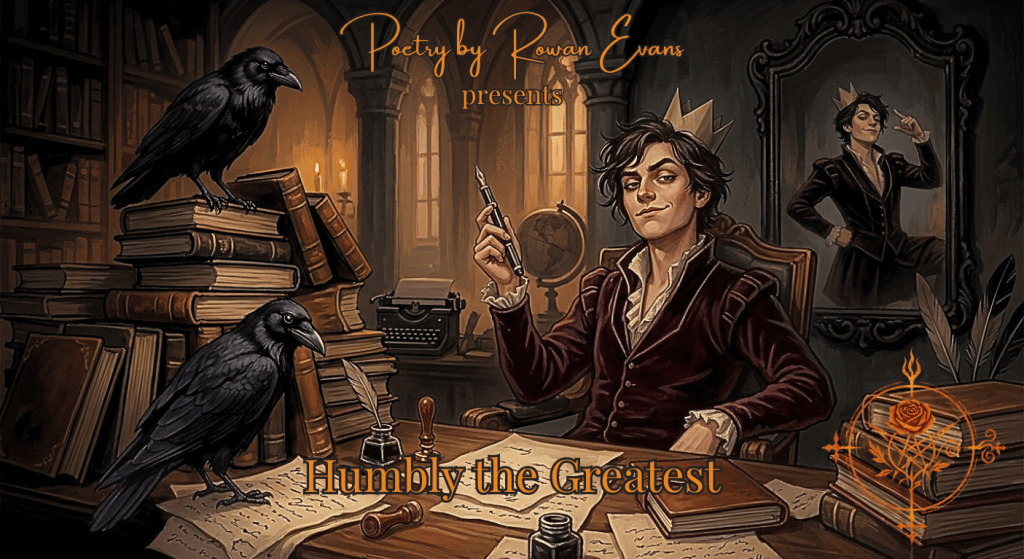

    A mischievous poet wearing a crooked paper crown sits among manuscripts and books, holding a fountain pen while two ravens perch nearby.
    Humble enough to admire the greats, confident enough to put yourself in the top five. All five positions, naturally.

    Humbly the Greatest
    Poetry by Rowan Evans

    I’ve said I’m done being humble,
    but humble is all I know how to be—
    and I’ll be humble, proudly.
    Fuck it, I’ll be humble loudly—
    humble while I’m shouting.
    I’m better than no one, bitch—
    try and change my mind.

    I read other poets all the time,
    and a couple thoughts cross my mind—
    fuck, how’d they come up with that line?
    How’d they construct that rhyme?
    Yeah, how’d they take that word
    and break that word—
    how the fuck did they make that work?

    Their writing is so good,
    it makes my brain hurt.

    But being this humble doesn’t mean
    I don’t think I’m great, because I do.
    Yeah, I know I am, it’s true—

    in my top five?

    I’d put me five times—
    but I’d be humble about it,
    I’d have my reasons—

    Number one—
    I’m the best to ever do it.
    And two,
    that’s not true—

    I just walk the same path as Plath,
    I carry a little bit of Sylvia in everything I do—
    raised in the same darkness that birthed Poe,
    I made Edgar’s ravens my own—

    So am I humble?

    Probably—

    not as much as I want to be.
    Because I still get mad
    when my greatness, they don’t see—
    I’ve said I’m done being humble,
    but…

    humble is all I know how to be.


    Journey into the Hexverse

    If you’re interested in more poetry, you can find it here → [The Library of Ashes]
  • Author’s Note

    Every poem begins as something inside the writer, but once it reaches the page, it becomes an invitation. An invitation to look closer, wander through unfamiliar worlds, meet the monsters in the margins, and perhaps recognize a little of yourself along the way.

    Through the Page is my thank-you to everyone who has taken the time to read my work. Whether you’ve loved a poem, questioned it, laughed at it, or decided it wasn’t for you, you’ve still given something valuable: your time. And in a world where our paths may never cross, that small exchange between my thoughts and your mind means more than you might realize.

    Of course, I couldn’t leave a thank-you note alone without sending it through a few ravens and a detour through the fires of my imagination. My pen has never been particularly good at staying on track. But beneath all the chaos is something simple and sincere: thank you for being here, for reading my art, and for becoming part of a journey that began long before these words reached you.

    Salamat po. ありがとう.

    From the bottom of my heart, thank you.

    — Rowan Evans


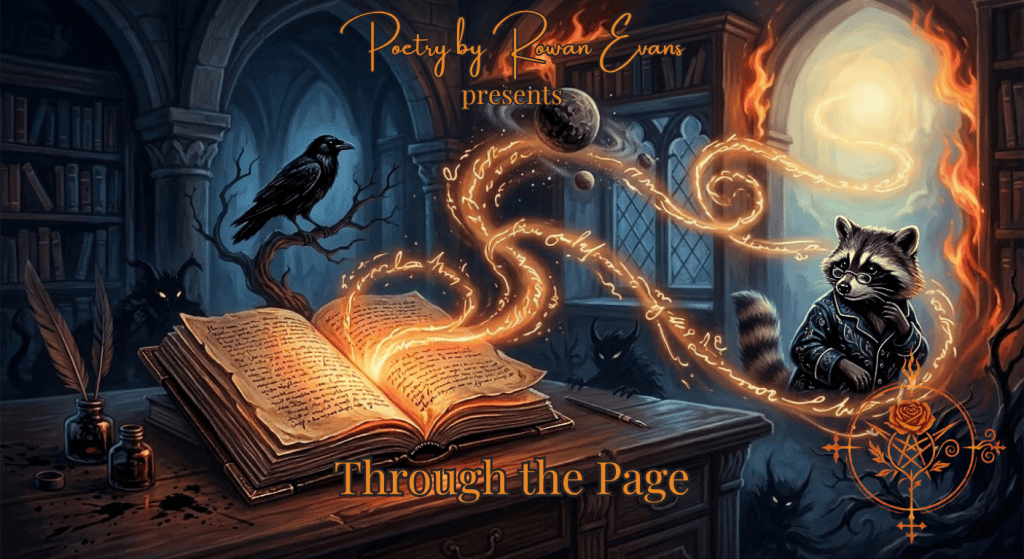
    An open book glows with warm orange light as a raven, shadowy monsters, a raccoon in silk pajamas, and distant cosmic scenery emerge from its pages, symbolizing the connection between a poet and readers.
    Somewhere between the ravens, the monsters, and the raccoons in silk pajamas, we met through the page. Thank you for being part of the journey.

    Through the Page
    Poetry by Rowan Evavns

    If you’ve taken the time
    to sit with my rhymes—
    to read the thoughts
    from my mind—

    I thank you.

    Even if you didn’t like
    the words that I write—
    still I say, thank you.

    We’ll more than likely
    never meet,
    and unless you choose—
    no words exchanged.
    But we’ve connected—
    through the page,
    it was my thoughts
    to your brain.

    You’ve spent time with my ravens,
    you’ve seen the monster in the margins—
    peaked beyond the curtain,
    glanced into my dreams—

    a witness
    to every confession
    screamed.

    You walked with me on Pluto,
    watched the raccoons in silk pajamas—
    you were there
    when I gave up on ice,
    I was done being cold,
    so I wrote fire instead—
    I penned the flames from my head,
    it’s like I was the Ghost Writer—
    possessed by vengeance
    and Poets past.

    Okay, let me dial it back.

    I’m sorry, got a little off track—
    but you know by now,
    that’s what happens to me—
    it’s like my pen
    has got happy feet—

    anyway, back to the point of this—
    because believe it or not,
    there was a point to this—

    Thank you from the bottom of my heart,
    salamat po, for reading my art—
    ありがとう, for being even a small part
    of this journey that I’m on—

    Thank you, and I mean it—
    salamat po, without you
    none of this has any meaning.


    Journey into the Hexverse

    If you’re interested in more poetry, you can find it here → [The Library of Ashes]
  • Author’s Note

    Sometimes the quiet person isn’t harmless.

    Sometimes they’re just taking notes.

    Literarily Speaking plays with the old assumption that silence means weakness—and then turns that assumption into a playground for metaphor, gothic imagery, and wordplay. The speaker doesn’t need fists, fury, or actual hatred to make an impact. A pen, a raven feather, a few rose petals, and a sufficiently sharp vocabulary will do just fine.

    The mythology of Wish-A-Motherfucker Wood and the Fuck Around Valley is deliberately ridiculous, because this piece knows exactly what it is doing: dressing poetic confidence up like a threat before revealing that the real damage is entirely literary.

    The point isn’t to hate harder.

    It’s to write sharper.

    Literarily speaking.

    — Rowan Evans


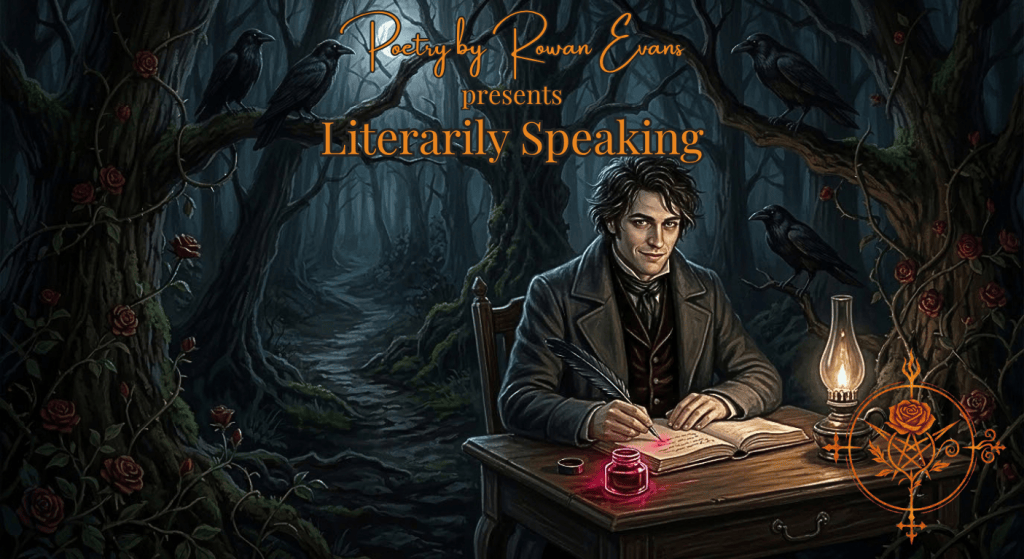
    A calm poet writes with a raven-feather quill and crimson rose-petal ink at a gothic desk surrounded by ravens and dark roses.
    I don’t need hate to eviscerate you—literarily speaking.

    Literarily Speaking
    Poetry by Rowan Evans

    They think because I’m quiet,
    I’m an easy target—
    so they talk a lot,
    and they talk
    like they forgot
    where I stood,
    bitch, I came up in the—
    Wish-A-Motherfucker Wood.
    Nestled in the Fuck Around valley,
    come around here—you’ll Find Out.

    So I pen my threats
    in fresh crimson—
    ink made from rose petals,
    quill from raven feather—
    that’s why I write the way I do—
    because I know Unkindness well.
    I know the world can be cruel,
    but being full of hate isn’t cool—

    and that’s why
    I write the way I do—
    I don’t need hate
    to eviscerate you…

    literarily speaking…


    Journey into the Hexverse

    [The Playground]
    What happens when mythology stops being something to hide behind and becomes architecture for the imagination? The Playground (Language, Metaphors and More) explores Rowan Evans’s relationship with language, symbolism, metaphor, humor, and twenty-three years of turning the page into a place where anything can happen.

    If you’re interested in more poetry, you can find it here → [The Library of Ashes]
  • Author’s Note

    Poetry has never been a place I go to behave.

    For me, language is something to climb through, rearrange, break apart, rebuild, and occasionally weaponize for the sake of a really bad joke. Mythology and symbolism are still part of that world, but they aren’t walls I hide behind anymore—they’re architecture. They give the imagination somewhere to live while the poet underneath it keeps revealing himself, piece by piece.

    The Playground (Language, Metaphors and More) is an invitation into that space.

    It is part creative philosophy, part victory lap, part conversation with the page—and, naturally, part terrible knock-knock joke. Because if I’ve spent twenty-three years turning language into a playground, I’m going to play.

    — Rowan Evans


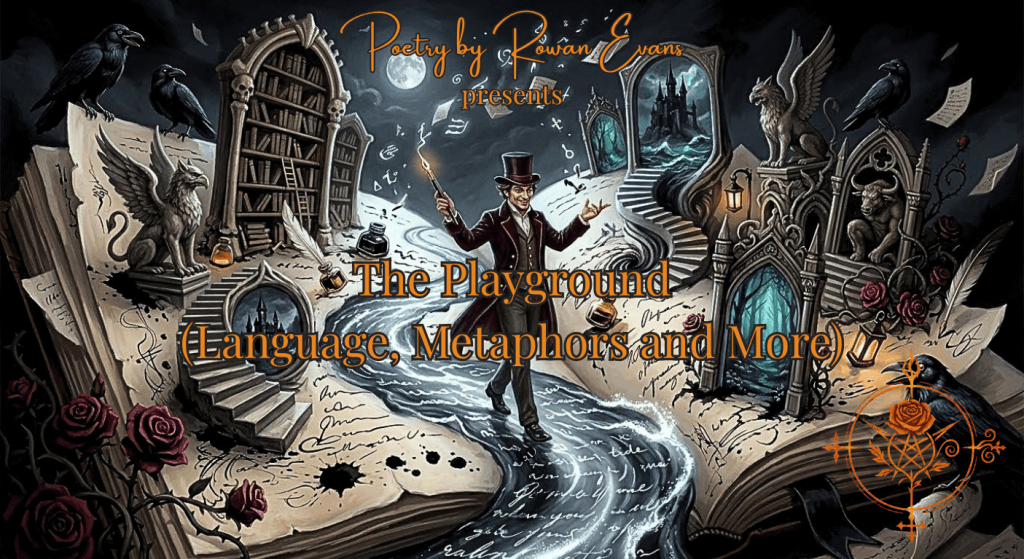
    A poet walks through a surreal playground built from an open notebook, surrounded by ravens, moonlight, roses, mythology, and flowing ink.
    The page isn’t a cage. It’s a playground—and I’ve brought my own rules.

    The Playground (Language, Metaphors and More)
    Poetry by Rowan Evans

    I sat down—
    with the intent to write,
    had a lot of ideas
    on my mind tonight—
    like what if the moon
    was a witness?

    And the tide a guide through
    the emotional current
    in the room—
    but that’s just if I
    went the route
    of mythology,
    symbolism—
    and everything
    I used to hide behind.

    That’s not how I use it now—

    it’s still my mythology,
    symbolic architecture—

    giving my words texture—

    but I don’t
    hide behind it—
    I use it now,
    to show the art of me,
    getting to the deeper
    heart of me—
    not the whole picture,
    just a small part of me.

    I’ve been doing this
    for twenty-three
    years and counting—
    and I’m definitely
    not on my way out now—
    I’ll hit my second, third,
    fourth and fifth wind,
    any day now—
    I’ve turned language
    into my fucking playground—
    everything is a game now.
    Just conversating
    with the page now—
    I’m done pretending,
    like I don’t write flames now—
    poetry’s royalty,
    I’m taking my crown now—
    and I think it’s time you all
    bow down—
    look I’m going to make a joke,
    turn into a clown now.

    Why don’t we slow down?
    I’ll tell you that joke now—

    Knock, Knock—

    who’s there?

    Disa—

    Disa-who?

    Disa-me? I disa-you—

    with a line so mean
    you’ll want to disappear,
    wish you were never here—

    here’s a warning, dear:

    If you see my ravens,
    perched upon your lawn—

    it’s an omen—

    you are already gone.


    Journey into the Hexverse

    [The Metaphor Machine]
    A poem that takes apart its own machinery as it runs—breaking lines, breaking thoughts, and following metaphors from moonlight to tides, oceans, shorelines, and city streets.

    [Confession or Cap?]
    A sharp and playful look at the line between confession and exaggeration, where a nice poet admits that their pen sometimes talks a little too much shit—and occasionally sets the page on fire.

    If you’re interested in more poetry, you can find it here → [The Library of Ashes]