Some poems arrive carrying trauma, existential questions, complicated metaphors, and enough symbolism to fill a cathedral.
This one showed up carrying a fucking pun.
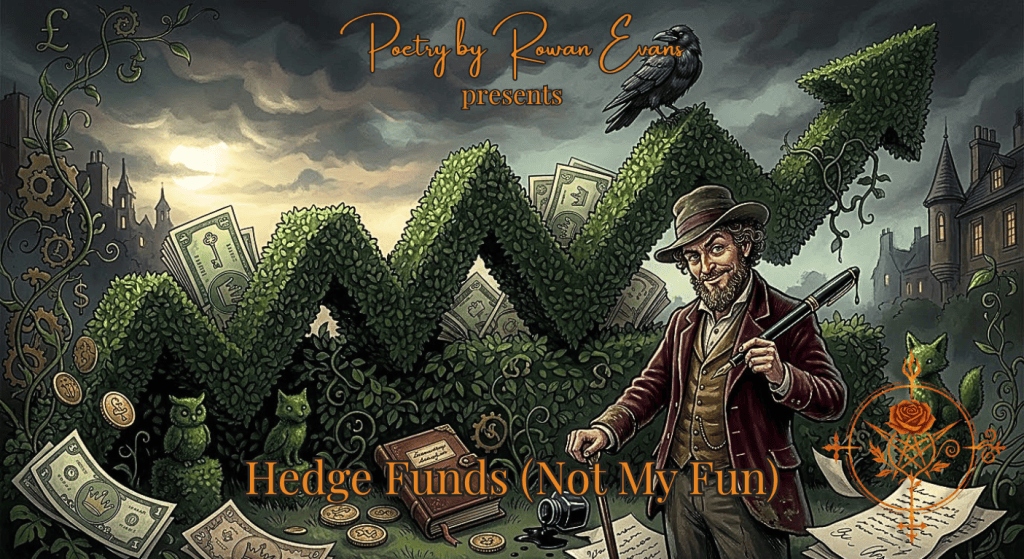
Hedge Funds (Not My Fun) is deliberately stupid. I wanted to play with sound, names, word associations, and the increasingly questionable logic of a joke that refuses to die. Sometimes the page doesn’t need another emotional excavation—it just needs to have a little fun.
So yes, this is a poem about hedge funds.
No, I don’t actually have any.
And apparently, neither does my fun.
— Rowan Evans
The hedge has funds. The funds aren’t mine. Therefore, the fun remains tragically unfunded.
Hedge Funds (Not My Fun) Poetry by Rowan Evans
I think I’m so fucking funny—
I’ll make a Big Pun,
while lookin’ like a Pimp
C—but you can’t see me,
like my name is John
and my time is now—
or at least, I hope it is.
Because I’m trying to get my funds up,
yeah, I want to get my fun up—
so I stack my funds
as high as my hedges—
get it?
Hedge Fund.
That means the money isn’t mine—
so I’m stacking some funds high,
they’re just not my funds, and—
because they’re not my funds,
they do not fund my fun, man.
Sometimes the loudest hater in the room is the one you brought with you.
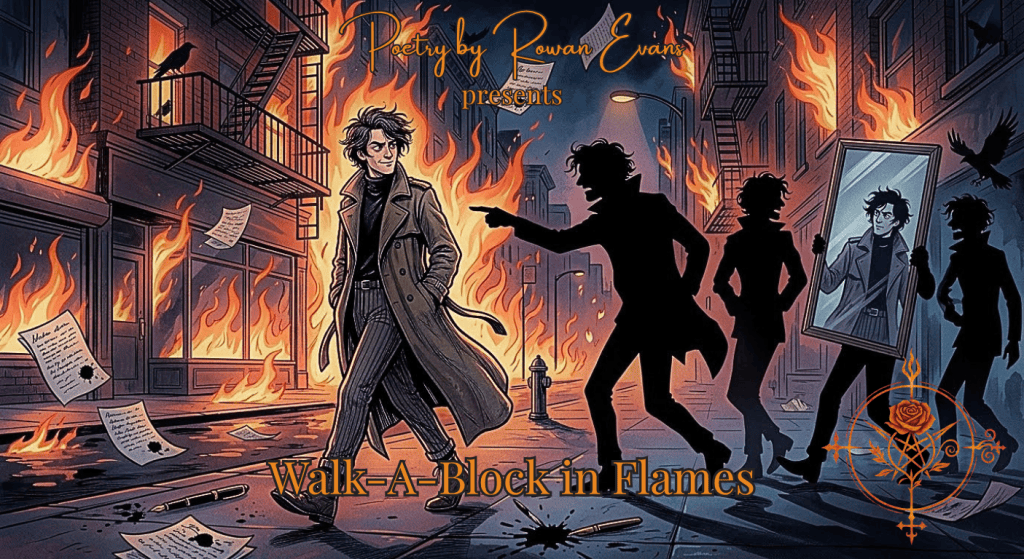
Walk-A-Block in Flames started with the idea of imaginary critics—the voices that somehow manage to find fault with everything you do, even when nobody else is actually saying a damn thing. Naturally, my brain decided the appropriate response was to turn that internal conflict into a ridiculous walk around the block, throw in some wordplay, and see how many times I could make the joke work before the poem eventually turned the joke back on me.
Because beneath all the flames, bravado, and fake enemies, there’s a much simpler realization:
Sometimes the person I’m arguing with is me.
And honestly?
That’s probably the funniest part.
— Rowan Evans
Plot twist: the haters were imaginary, and unfortunately, they had my voice.
Walk-A-Block in Flames Poetry by Rowan Evans
They tell me,
these imaginary haters,
that I’ve fuckin’ created—
they live inside my head,
feeding on my self-doubt—
obsessed with burning the self-down.
They make me take a walk,
a walk around a block
and it’s fucking hot—
I guess you could say,
these imaginary haters made me,
Waka Flocka Flame.
Wait—
I meant to say—
these haters made me
Walk-A-Block In Flames.
Honestly though,
I don’t know
what the fuck
they hate me for—
Is it because my wrist froze?
Nope, I’m broke—
Because I’m the best to ever do it?
Nope, that’s a joke—
Is it because they say
the things I think about me?
Couldn’t be—
because I think I’m great,
and these haters are fake.
I mean literally fake,
figments—
they don’t exist,
it’s just me in this bitch.
Sometimes the loudest critic in the room is the one living inside your own head.
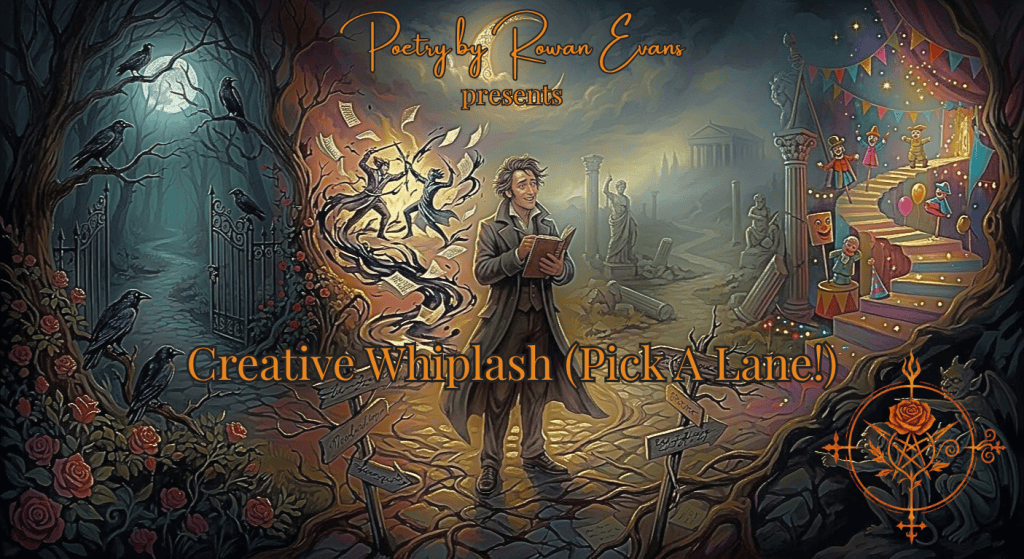
Creative Whiplash (Pick A Lane!) is about the pressure to define yourself as a writer, choose a style, and stay neatly within its boundaries—even when your creativity refuses to cooperate. One moment, I’m writing gothic poetry; the next, I’m throwing punchlines, weaving mythology, or drawing battle lines with a pen.
And somewhere in the middle of all that, the inner critic starts screaming that nothing makes sense.
The funny part? Sometimes the poem proves the critic wrong before the critic even finishes complaining.
Maybe I don’t need to pick a lane. Maybe creativity was never meant to be a straight road.
— Rowan Evans
Pick a lane? I tried. My creativity took the exit, changed three times, and somehow wrote a poem about it.
Creative Whiplash (Pick A Lane!) Poetry by Rowan Evans
I asked you to show me a metaphor—
you asked, what’s the meta for?
You said you’re a writer, are you sure?
Because I’m not anymore—
run on sentence, run on lines,
zero flow and zero rhymes—
that’s how you write.
Ironic—
I just proved myself
wrong, right?
Well, sometimes I get in my head,
convince myself that nothing I write
is ever good enough—
and no one can call my bluff.
Isn’t that rough?
Pick a lane! Pick a lane!
Repeated, screaming in my brain—
are you a gothic poet,
or do you draw battle lines?
Do you weave myths,
or write comedic shit?
Pick a lane! Pick a lane!
Repeated, screaming in my brain—
giving readers whiplash
with how fast, I switch lanes—
it’s a pain in the neck,
creativity, hard to keep in check.
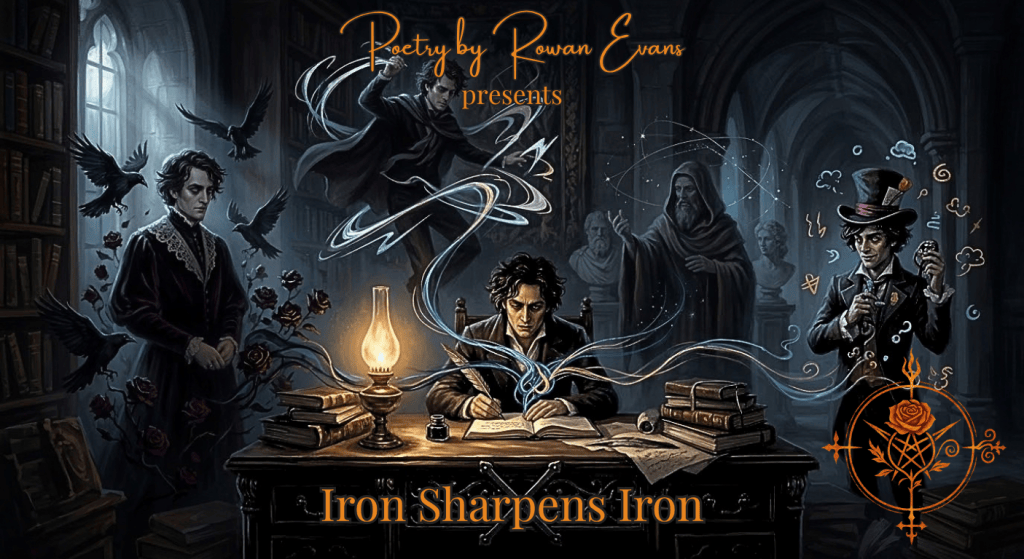
Iron Sharpens Iron is about what happens when every version of my creative mind sits down at the same table: the gothic romantic, the absurdist comic, the mythmaker, the battle-poet, the joke creator, and whatever other voice decides to kick the door open halfway through a line.
The notebook becomes the sparring ring. One thought throws a punch, another throws a punchline, and sometimes Batman apparently gets involved.
I don’t always plan where the thread is going. Sometimes I just follow it until the poem lands somewhere that makes sense.
Maybe that’s the point.
I don’t need to silence the contradictions. I need them to sharpen each other.
— Rowan Evans
I don’t silence the voices in my head. I let them sharpen each other.
Iron Sharpens Iron Poetry by Rowan Evans
I sit by myself— alone in body, crowded in mind— it’s a constant battle of wits, moon-fed goth kid versus the battle-poet turning pens to WMDs.
The notebook— just a test site, where I drop bombs. It’s constant— the scream of the alarms.
I write so much because my mind fights too much— a gothic romantic, an absurdist comic— opinions, opinions, too many opinions— constant contradictions.
Is this a joke?
Are the emotions sincere?
What the fuck— (Batman!) is that reference doing here?
That’s just how my mind is sometimes— I write a line and follow it, (Stalker.) I don’t plan it—I just follow the thread, guide the ship and land it. But sometimes I get lost— I’ll orbit the planet, or drift in my dreams— and they say to make the dreams work, it takes team work— well, I became my own team, every version of me.
Gothic romantic, absurdist comic, mythmaker, joke creator and professional hater— (Jokes. Love ya!) a battle-poet raised on battle rappers and comedians— how I learned to land a punchline, can’t fight with my fists— but can fight with my mind, and I do it all the time— with myself, I spar, iron sharpens iron, after all.
Journey into the Hexverse
[Blindfolded & Still Winning] A playful battle-poetry freestyle about shutting off the inner editor, letting instinct take over, and discovering that sometimes the pen writes best when you stop watching it.
[Literarily Speaking] They think silence means weakness. They should probably have paid more attention to the pen. Literarily Speaking turns gothic imagery, raven feathers, rose-petal ink, and absurd fictional geography into a playful battle-poetry flex about dismantling your enemies with words instead of hate.
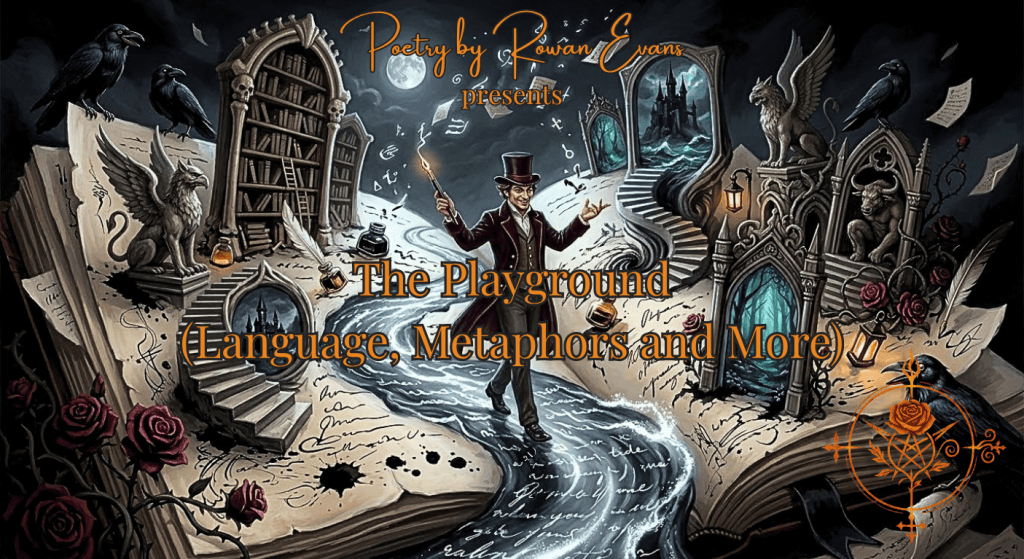
[The Playground] What happens when mythology stops being something to hide behind and becomes architecture for the imagination? The Playground (Language, Metaphors and More) explores Rowan Evans’s relationship with language, symbolism, metaphor, humor, and twenty-three years of turning the page into a place where anything can happen.
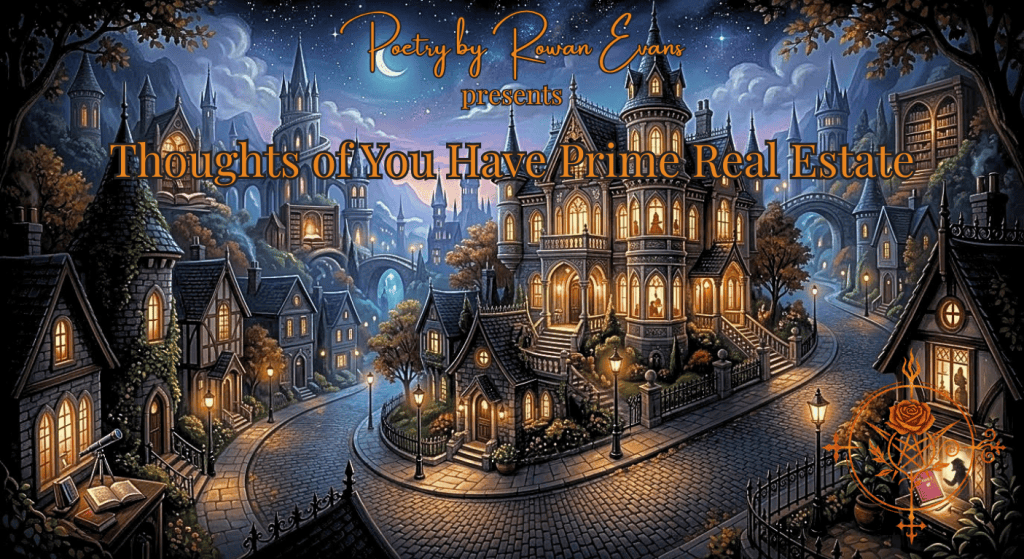
We often say someone is “living rent-free in our head,” but what if they weren’t renting?
Thoughts of You Have Prime Real Estate takes that familiar expression and builds an entire neighborhood inside the mind—roads, sidewalks, corner lots, contemporary homes, secrets, dreams, and eventually one particularly valuable property.
Because thoughts don’t always feel temporary. Sometimes they settle in, expand, renovate, and quietly become part of the landscape.
And apparently, the thoughts of you got the best view.
— Rowan Evans
Some thoughts rent a room. Yours apparently bought the whole corner lot.
Thoughts of You Have Prime Real Estate Poetry by Rowan Evans
They say, when something is stuck in your thoughts— it lives rent free in your head, and that’s true in a sense— because the thoughts have taken up real estate, they own land— building new developments. New neighborhoods are being constructed, new roads are being laid— new sidewalks paved.
Take a walk down the block, you’ll see thoughts taking up corner lots—
modern contemporary homes lining the streets— full of my secrets to keep, and rooms where my dreams sleep.
But the nicest home of all— the one with the best views, and the biggest rooms…
it houses my thoughts of you.
Journey into the Hexverse
[Half a Picture] What happens when someone falls in love with the person they discover through your poetry? Half a Picture explores the strange intimacy between writer and reader—and the distance between seeing someone’s mind through their words and truly knowing the whole person.
[Love Me From Over There] A sharp and humorous poem about the strange contradiction of wanting someone close while simultaneously needing them to stay several feet away from your face.
[It Could Have Been…] A playful little love poem about strawberries, roses, and the wonderfully ridiculous ways romance can show up when you know someone doesn’t like the traditional version.
[High Tide] A short reflective poem about leaving, returning, and accepting the forces that pull us back—like the tide guided by the moon.
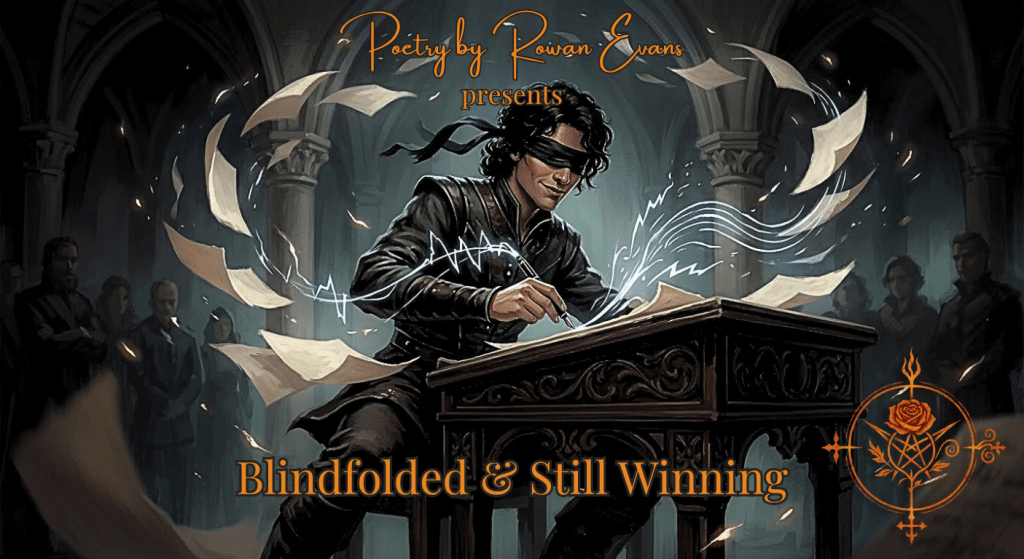
Sometimes the easiest way to stop overthinking the poem is to stop looking at it.
Blindfolded & Still Winning came from that impulse: cover the eyes, let the pen move, and see what the mind throws onto the page. The anger gets folded into jokes, the jokes get stitched into rhythm, and suddenly what could have been a rant turns into a little battle-rap playground.
The blindfold isn’t a handicap here.
It’s permission to trust the instinct.
And apparently, even without looking, the pen still thinks it knows how to win.
— Rowan Evans
Cover the eyes. Let the pen drive. See what happens.
Blindfolded & Still Winning Poetry by Rowan Evans
I’m sick and tired of watching what I say— so I cover my eyes when I write— because even I like to be surprised by my mind, sometimes.
So today I’ll be blind— folded the anger with my jokes, then mixed them in to the rhythm and rhyme— I’ll get over it on my own time.
(Really, I’m over it already.)
Pen like a switch blade, words so sharp, I filet men— yawn, you’re boring me. Took you five hours to write five lines— took me five minutes to write ten times— the rhymes, set ups and punchlines.
Journey into the Hexverse
[Literarily Speaking] They think silence means weakness. They should probably have paid more attention to the pen. Literarily Speaking turns gothic imagery, raven feathers, rose-petal ink, and absurd fictional geography into a playful battle-poetry flex about dismantling your enemies with words instead of hate.
[The Playground] What happens when mythology stops being something to hide behind and becomes architecture for the imagination? The Playground (Language, Metaphors and More) explores Rowan Evans’s relationship with language, symbolism, metaphor, humor, and twenty-three years of turning the page into a place where anything can happen.
[New God with a Pen] A battle-poet power fantasy where Superman’s rage, Batman’s fear, Darkseid’s cosmic authority, and the Anti-Life Equation collide with rhyme, turning an ordinary pen into something worthy of New God status.
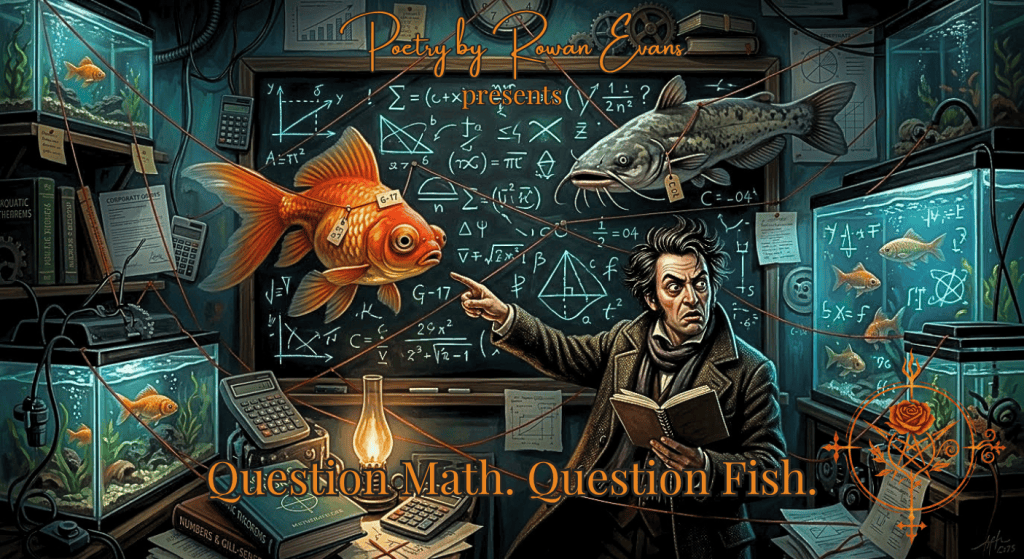
What happens when you stop questioning the big questions and start questioning the stupid ones?
Question Math. Question Fish. takes a perfectly ordinary equation and refuses to leave it alone. Two plus two should be simple—but apparently we’ve got corporations, aquatic conspiracies, suspicious fish classifications, and an entire Aquarium Industrial Complex to investigate.
This piece is deliberately ridiculous. It borrows the language of conspiracy theories, institutional distrust, and “wake up, sheeple” rhetoric and points it directly at things that absolutely do not need a conspiracy theory.
Because maybe the joke isn’t whether two plus two equals four.
Maybe the joke is how quickly we can convince ourselves that anything deserves suspicion if we stare at it long enough.
So question the math.
Question the fish.
Question the catfish.
And, obviously, question everything.
— Rowan Evans
Two plus two equals four. The fish, however, remain under investigation.
Question Math. Question Fish. Poetry by Rowan Evans
Two plus two
equals four,
or does it?
You see—
Big Math
would have you
believe—
numbers mean something—
they don’t…
numbers are a joke.
A figment, imaginary at best—
two plus two might as well
equal goldfish.
And what’s a goldfish anyway?
Fish or gold, make up your mind—
and don’t get me started on catfish,
’cause what is this shit?
Cats don’t even like water.
Now one is a fish?
Get real, bitch.
Don’t listen to this shit—
Big Aquarium just tryin’ to get slick.
One fish, two fish—
red fish, blue fish—
these companies
are lying
to you, bitch.
And how does one fish—
become two fish?
And a red fish—
into a blue fish?
You wish.
It’s Big Math
and the Aquarium Industrial Complex
working together
to warp reality—
a fish isn’t gold,
a fish isn’t a cat—
but these people think that
we’re stupid,
we don’t see what they’re doing—
two plus two
equals four,
are you sure?
Open your eyes.
Wake up.
Think for yourself.
Question Math.
Question Fish.
Question.
Everything.
Journey into the Hexverse
[The Playground] What happens when mythology stops being something to hide behind and becomes architecture for the imagination? The Playground (Language, Metaphors and More) explores Rowan Evans’s relationship with language, symbolism, metaphor, humor, and twenty-three years of turning the page into a place where anything can happen.
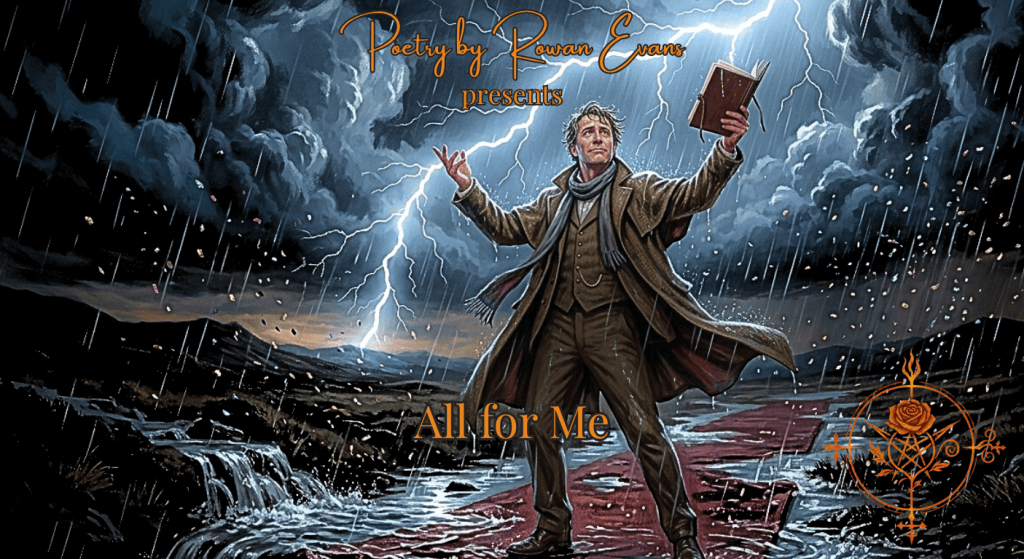
[All for Me] When thunder becomes applause, lightning turns into paparazzi, and rain rolls out a flooded red carpet, one poet starts wondering whether nature’s celebration has gone a little too far.
[Love Me From Over There] A sharp and humorous poem about the strange contradiction of wanting someone close while simultaneously needing them to stay several feet away from your face.
[It’s Almost Like I Know What I’m Doing] A self-aware reflection on nearly three decades of writing, discovering how rage became rhythm, pain became poetry, and comedic timing became another tool in the poet’s arsenal.
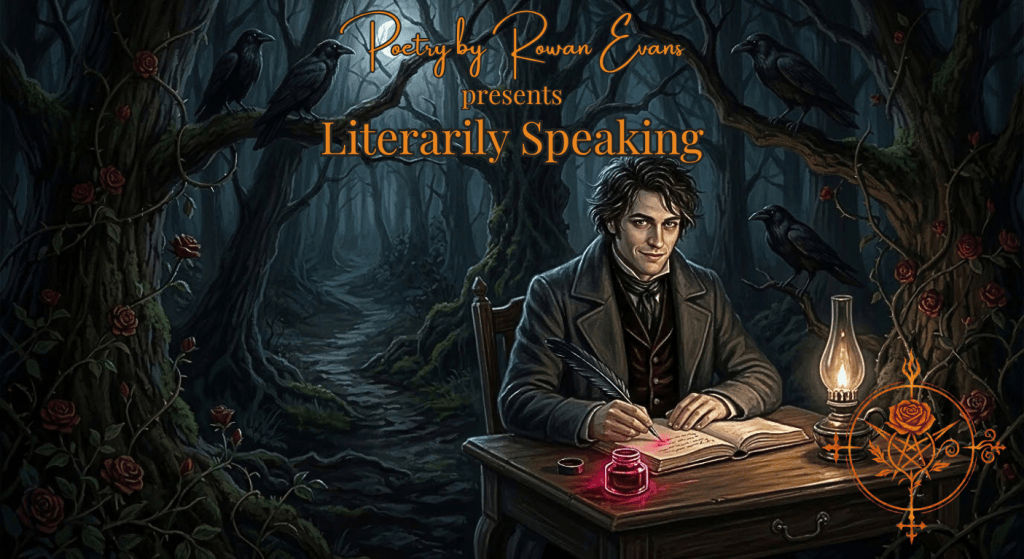
Literarily Speaking plays with the old assumption that silence means weakness—and then turns that assumption into a playground for metaphor, gothic imagery, and wordplay. The speaker doesn’t need fists, fury, or actual hatred to make an impact. A pen, a raven feather, a few rose petals, and a sufficiently sharp vocabulary will do just fine.
The mythology of Wish-A-Motherfucker Wood and the Fuck Around Valley is deliberately ridiculous, because this piece knows exactly what it is doing: dressing poetic confidence up like a threat before revealing that the real damage is entirely literary.
The point isn’t to hate harder.
It’s to write sharper.
Literarily speaking.
— Rowan Evans
I don’t need hate to eviscerate you—literarily speaking.
Literarily Speaking Poetry by Rowan Evans
They think because I’m quiet,
I’m an easy target—
so they talk a lot,
and they talk
like they forgot
where I stood,
bitch, I came up in the—
Wish-A-Motherfucker Wood.
Nestled in the Fuck Around valley,
come around here—you’ll Find Out.
So I pen my threats
in fresh crimson—
ink made from rose petals,
quill from raven feather—
that’s why I write the way I do—
because I know Unkindness well.
I know the world can be cruel,
but being full of hate isn’t cool—
and that’s why
I write the way I do—
I don’t need hate
to eviscerate you…
literarily speaking…
Journey into the Hexverse
[The Playground] What happens when mythology stops being something to hide behind and becomes architecture for the imagination? The Playground (Language, Metaphors and More) explores Rowan Evans’s relationship with language, symbolism, metaphor, humor, and twenty-three years of turning the page into a place where anything can happen.
For me, language is something to climb through, rearrange, break apart, rebuild, and occasionally weaponize for the sake of a really bad joke. Mythology and symbolism are still part of that world, but they aren’t walls I hide behind anymore—they’re architecture. They give the imagination somewhere to live while the poet underneath it keeps revealing himself, piece by piece.
The Playground (Language, Metaphors and More) is an invitation into that space.
It is part creative philosophy, part victory lap, part conversation with the page—and, naturally, part terrible knock-knock joke. Because if I’ve spent twenty-three years turning language into a playground, I’m going to play.
— Rowan Evans
The page isn’t a cage. It’s a playground—and I’ve brought my own rules.
The Playground (Language, Metaphors and More) Poetry by Rowan Evans
I sat down—
with the intent to write,
had a lot of ideas
on my mind tonight—
like what if the moon
was a witness?
And the tide a guide through
the emotional current
in the room—
but that’s just if I
went the route
of mythology,
symbolism—
and everything
I used to hide behind.
That’s not how I use it now—
it’s still my mythology,
symbolic architecture—
giving my words texture—
but I don’t
hide behind it—
I use it now,
to show the art of me,
getting to the deeper
heart of me—
not the whole picture,
just a small part of me.
I’ve been doing this
for twenty-three
years and counting—
and I’m definitely
not on my way out now—
I’ll hit my second, third,
fourth and fifth wind,
any day now—
I’ve turned language
into my fucking playground—
everything is a game now.
Just conversating
with the page now—
I’m done pretending,
like I don’t write flames now—
poetry’s royalty,
I’m taking my crown now—
and I think it’s time you all
bow down—
look I’m going to make a joke,
turn into a clown now.
Why don’t we slow down?
I’ll tell you that joke now—
Knock, Knock—
who’s there?
Disa—
Disa-who?
Disa-me? I disa-you—
with a line so mean
you’ll want to disappear,
wish you were never here—
here’s a warning, dear:
If you see my ravens,
perched upon your lawn—
it’s an omen—
you are already gone.
Journey into the Hexverse
[The Metaphor Machine] A poem that takes apart its own machinery as it runs—breaking lines, breaking thoughts, and following metaphors from moonlight to tides, oceans, shorelines, and city streets.
[Confession or Cap?] A sharp and playful look at the line between confession and exaggeration, where a nice poet admits that their pen sometimes talks a little too much shit—and occasionally sets the page on fire.
All for Me began with the idea of nature behaving like an overly enthusiastic audience—thunder applauding, lightning taking pictures, and rain rolling out the red carpet as if the sky had organized a celebration in my honor.
The joke is that I’m not entirely opposed to the idea of being worth celebrating. I know I have my own value. I just don’t think the weather needs to turn that acknowledgment into a full-scale natural disaster.
This is a playful little collision between self-confidence, reluctant attention, and the absurdity of taking the universe’s behavior personally.
Sometimes the sky needs to understand that not every standing ovation requires a flood.
— Rowan Evans
I appreciate the applause, but the sky really needs to chill.
All for Me Poetry by Rowan Evans
I sit beneath the open sky,
watching as clouds roll in,
listening as the thunder claps—
it’s a round of applause,
a standing ovation,
but I don’t know—
what we’re celebrating.
Then the lightning flashes,
and I strike a pose—
ready for my picture to be taken,
why? I don’t know—
couldn’t get an answer,
when I asked for it.
Rain begins to fall,
like confetti thrown—
and the floods rush in,
like the red carpet rolled—
the sky keeps insisting
I’m someone worth announcing,
and I keep insisting—
I’m not.
Not that I don’t think
I’m great—
I do—
I just don’t want nature to
celebrate me too—
because nature doesn’t know
how to keep a party in check,
it always gets out of hand.
The water gets displaced—
more ends up on land.
And somewhere overhead,
the thunder claps again,
like it’s trying to convince me—
this was all for me.
I mean…
I appreciate the gesture,
but the sky really needs to chill.
Journey into the Hexverse
[It’s Almost Like I Know What I’m Doing] A self-aware reflection on nearly three decades of writing, discovering how rage became rhythm, pain became poetry, and comedic timing became another tool in the poet’s arsenal.
[Lessons Without Kindness] A reflection on learning self-respect from a relationship that changed—the lessons hidden in manipulation, silence, and loss, and the realization that you don’t have to shrink yourself to make someone else feel tall.
[Hell’s Protégé (Remix)] Rowan Evans revisits Hell’s Protégé, originally written in 2024, and reshapes the dark, infernal persona through a newer voice. The remix keeps the fire, darkness, and diabolic ambition of the original while allowing the poem to breathe differently.