Tag: emotions

  • Author’s Note

    Some people use shuffle as background noise.

    I use it as a compass.

    I’ve noticed over the years that when I stop trying to control what song comes next and simply let the algorithm decide, the music often mirrors something I was already feeling—or something I hadn’t admitted I was feeling yet.

    One song can pull me inward. Another can make me laugh. Another can unlock a memory I hadn’t thought about in years. It’s less about the songs themselves and more about how music has always been one of the languages my mind speaks most fluently.

    This poem isn’t really about playlists.

    It’s about trust.

    Trusting art to take me somewhere I didn’t expect to go, and accepting that sometimes the best way to understand myself is to stop choosing the destination and simply listen.

    Rowan Evans


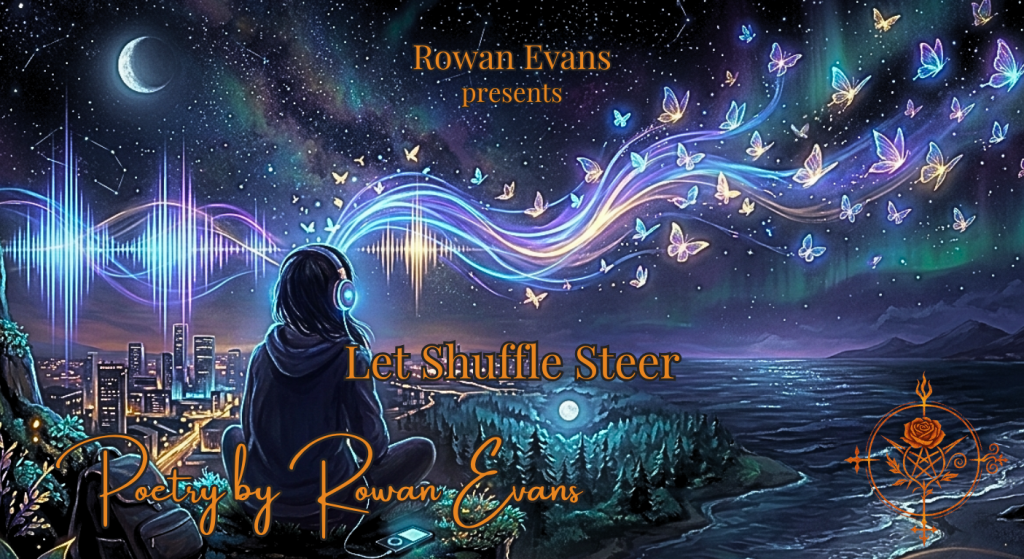
    A person wearing headphones sits beneath a night sky as glowing soundwaves wrap around them like a chrysalis, transforming into butterflies while surreal landscapes fade into one another.
    Sometimes the best guide isn’t a map—it’s the next song that shuffle decides you need.

    Let Shuffle Steer
    Poetry by Rowan Evans

    I sit—
    lost in my head again,
    letting the music hit.
    It carries me
    from one emotion
    to the next.
    Sometimes—
    I don’t know
    where it’ll take me.

    Shuffle’s got a mind of its own—

    and it’s like it knows
    what I need to hear,
    right when I need
    to hear it.

    It’s like—
    shuffle sees me,
    then shuffle reads me—

    oh, you want to get introspective?
    Here is a song—
    that’ll make you want to look inside.

    Oh, you need to get aggressive?
    Here is a song—
    that’ll make you want to go riot,
    take the pen and get violent.

    It’s like you need to cry,
    and take a walk down memory lane?
    Here is a song,
    and it’s fuel for that pain.

    I like to ride the soundwaves,
    I don’t fight it, I let the music hit—
    I can feel my whole persona shift
    with a change in beat.
    It’s like the music is
    a fast acting chrysalis—
    you see, the music wraps around me
    and I begin to change.
    It’s nothing strange—

    it’s just the way music affects me.

    It enters the bloodstream,
    my DNA rearranges—
    something fundamental changes.
    Not just the surface,
    but marrow deep.

    So I let shuffle steer—
    it knows the roads
    I don’t admit to.
    It makes me go
    where I’m meant to,
    even when I don’t see the map.


    Journey into the Hexverse…

    [A Heart That Echoes in Another Language]
    A poetic journey through music across Japan, Korea, China, and the Philippines, exploring how sound becomes identity, memory, and emotional geography.

    [Sound as a Vessel]
    “Sound as a Vessel” is a free verse poem about music as emotional architecture, exploring how international artists and soundscapes shaped identity, creativity, memory, and poetic voice.

    [The Music Holds Me Upright]
    A reflective free verse poem about using music, writing, and rhythm to navigate anxiety, depression, and emotional overwhelm.

    [Global Takeover]
    What if home isn’t a place—but something you build from the music you love? Global Takeover blends sound, culture, and identity into one borderless space.

    If you’re interested in more poetry, you can find it here → [The Library of Ashes]
  • Author’s Note

    This poem began with an image.

    Not a line. Not a metaphor.

    An image.

    A single figure standing alone, staring into the distance like the opening shot of a film.

    At first, the poem exists entirely outside the body. The speaker is observed rather than understood. We see the wind. The trees. The dirt beneath their feet. We hear a voice describing loneliness from a distance.

    Then the question arrives:

    “Is that the truth or the depression talking?”

    For me, that’s the moment the camera moves.

    The poem stops observing the speaker and starts inhabiting them.

    Everything before that question is external.

    Everything after it is internal.

    The scenery gives way to self-examination. The loneliness becomes less important than the act of interrogating it. The poem begins pulling apart its own construction, examining how emotions become images and how images eventually become language.

    In many ways, this piece accidentally became a poem about my entire creative process.

    I’ve spent twenty-three years translating feelings into words.

    Not just the dramatic emotions. Not just love, grief, or heartbreak.

    Everything.

    The strange moments. The passing thoughts. The questions that linger longer than they should.

    The title came from that realization.

    Because that’s what poetry has always felt like to me.

    Translation.

    An emotion enters one side of the mind.

    An image emerges from the other.

    And somewhere in between, a poem happens.

    Rowan Evans


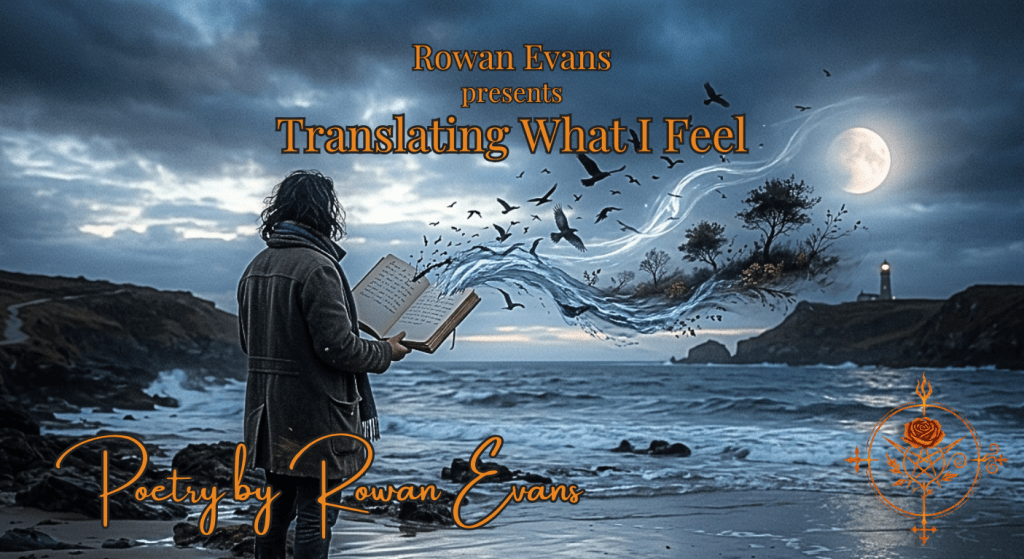
    A solitary poet stands by the shoreline at dusk as ink transforms into waves and moonlight, symbolizing emotions becoming poetry.
    Every poem begins as a feeling before it becomes a language.

    Translating What I Feel
    Poetry by Rowan Evans

    I stand, staring into the distance,
    alone in this instance—
    it’s just me and the breeze,
    running through the trees.

    I can feel cold dirt and stone
    beneath my feet.

    Wind brushes skin,
    feather-light
    like finger tips—
    it reminds me
    of how alone I am.

    Is that the truth
    or the depression talking?

    Because sometimes
    I feel alone
    when there are people
    around me.

    That last stanza
    moved like the tide.

    A long line—
    followed by one shorter,
    then longer again.

    Even when I don’t say it,
    the ocean imagery arrives.
    I don’t even have to try—
    it just pours out of me,
    like a dam breaking.

    Everything held back,
    rushes forth as the pen
    hits the page.

    You get the opening lines,
    that’s where the truth slips.
    Mid-stanza
    is where the truth sits.
    Then one or two lines
    to really make the truth hit.

    You see—
    this is the creative side of me.
    I feel something then translate it
    inside of me,
    from data to image
    then I spit it in ink on the page.

    I’ve spent 23 years
    translating what I feel—
    love, loneliness and rage…

    happiness and pain.

    Two sides of the coin,
    they’re different
    but the same.

    So there I stood…

    staring into the distance,
    unsure if I was alone in that instance—
    it was just me and the thoughts
    running through my mind.

    Slowly being translated
    into poetic lines.


    Journey into the Hexverse…

    [Where Music Becomes Weather]
    Some songs feel like storms. Others feel like shelter. Where Music Becomes Weather explores how music shapes emotion, memory, and the landscapes we carry within us.

    [Returning to My Bones]
    Some dreams fade the moment we wake. Others leave behind emotions that linger long after reality returns. Returning to My Bones explores the strange grief of leaving a dream that felt real enough to matter.

    [Recognizes Home]
    A free-verse poem exploring the difference between love as dependency and love as choice. It challenges the idea that love must be need-based, instead centering the quiet strength of choosing someone while still remaining whole on your own.

    If you’re interested in more poetry, you can find it here → [The Library of Ashes]
  • Author’s Note

    I’ve always had a difficult time describing what music actually does to me.

    People often say a song makes them feel happy, sad, nostalgic, or energized.

    That has never felt quite specific enough.

    Music feels physical.

    Some songs settle over me like fog.

    Some arrive like thunderstorms.

    Some feel like walking outside after rain when the air still smells different.

    And then there are the songs that somehow collapse time.

    They don’t simply remind me of childhood.

    They return me to it.

    Not through memory alone, but through sensation.

    The warmth of pavement beneath bare feet.

    The way summer evenings seemed endless.

    The strange certainty that tomorrow would always have enough time.

    That’s what fascinated me while writing this piece.

    Not the songs themselves, but the environments they create inside us.

    The weather of memory.

    The emotional climates we revisit every time a familiar melody begins.

    I’ve always believed that poetry and music are close relatives.

    One speaks through rhythm.

    The other through silence between the notes.

    Both have the remarkable ability to transport us somewhere we cannot physically return to.

    This poem is my attempt to describe that journey.

    Not through genres or artists.

    Through atmosphere.

    Because sometimes music doesn’t just soundtrack our lives.

    Sometimes it changes the forecast within them.

    Rowan Evans


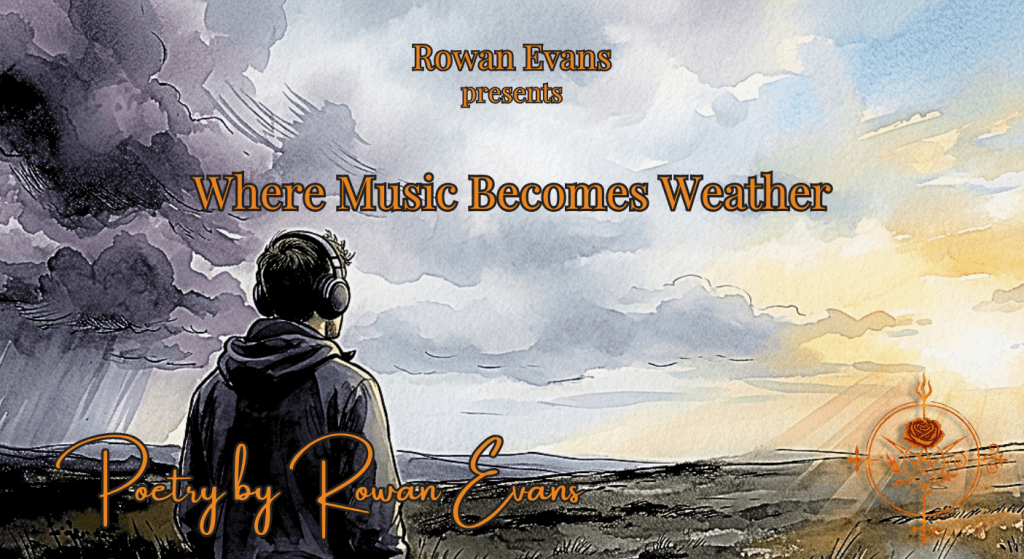
    A person wearing headphones stands beneath a sky shifting from storm clouds to warm sunlight, symbolizing how music changes emotions and memories.
    Some songs don’t just play. They change the weather inside us.

    Where Music Becomes Weather
    Poetry by Rowan Evans

    I put my headphones on,
    hit the button—
    noise cancelling.
    Then I let the music play,
    let it lead my emotions
    whatever which way.

    I drift through different soundscapes—
    crossing borders in sound,
    watching emotion mix with ink
    like paint on the canvas.

    Certain songs
    feel like humidity.
    They put a heavy feeling
    in your chest,
    it almost makes it hard
    to catch your breath.

    Other songs
    feel like clouds.
    The way they hold me
    in soft hands.
    And I feel safe,
    because they hold me close
    but in motion—
    like a slow dance.

    But then
    there are those songs—
    the ones that feel
    like warm concrete
    on bare feet.
    Like time travel,
    I’m back in my childhood.

    Back when summer felt endless,
    and every day was measured
    by the position of the sun.

    Before I knew what nostalgia was—
    only that certain songs
    felt familiar before I’d ever heard them.


    Journey into the Hexverse…

    [A Heart That Echoes in Another Language]
    A poetic journey through music across Japan, Korea, China, and the Philippines, exploring how sound becomes identity, memory, and emotional geography.

    [Sound as a Vessel]
    “Sound as a Vessel” is a free verse poem about music as emotional architecture, exploring how international artists and soundscapes shaped identity, creativity, memory, and poetic voice.

    [The Music Holds Me Upright]
    A reflective free verse poem about using music, writing, and rhythm to navigate anxiety, depression, and emotional overwhelm.

    [Global Takeover]
    What if home isn’t a place—but something you build from the music you love? Global Takeover blends sound, culture, and identity into one borderless space.

    [I’ll Be There to See Your Sunrise]
    Love has never come easily to me. This poem explores the fear, vulnerability, and quiet courage required to stay emotionally present when connection begins to matter deeply. “I’ll Be There to See Your Sunrise” is about choosing love despite the risk of heartbreak—and promising to remain long enough to witness someone fully.

    If you’re interested in more poetry, you can find it here → [The Library of Ashes]

  • Author’s Note

    I’m writing this for myself as much as for anyone else. Depression is a beast that convinces me not to exist, that twists my sadness into rage and makes even the smallest things unbearable. I need this reminder: these feelings are heavy, but they are not permanent.

    Right now, I’m in the thick of depression—the kind that makes everything feel heavier than it should, the kind that tells you nothing will ever change. It’s a hell of a beast, whispering permanence into what I know are only temporary storms.

    This poem is me fighting back against that lie. A reminder to myself that emotions are not stone; they are waves. They crash, they recede, they come again—but none of them last forever.

    If you’re reading this and carrying something heavy too, know that you’re not alone in it. These are temporary emotions. Even when it feels impossible to believe, the tide does turn.


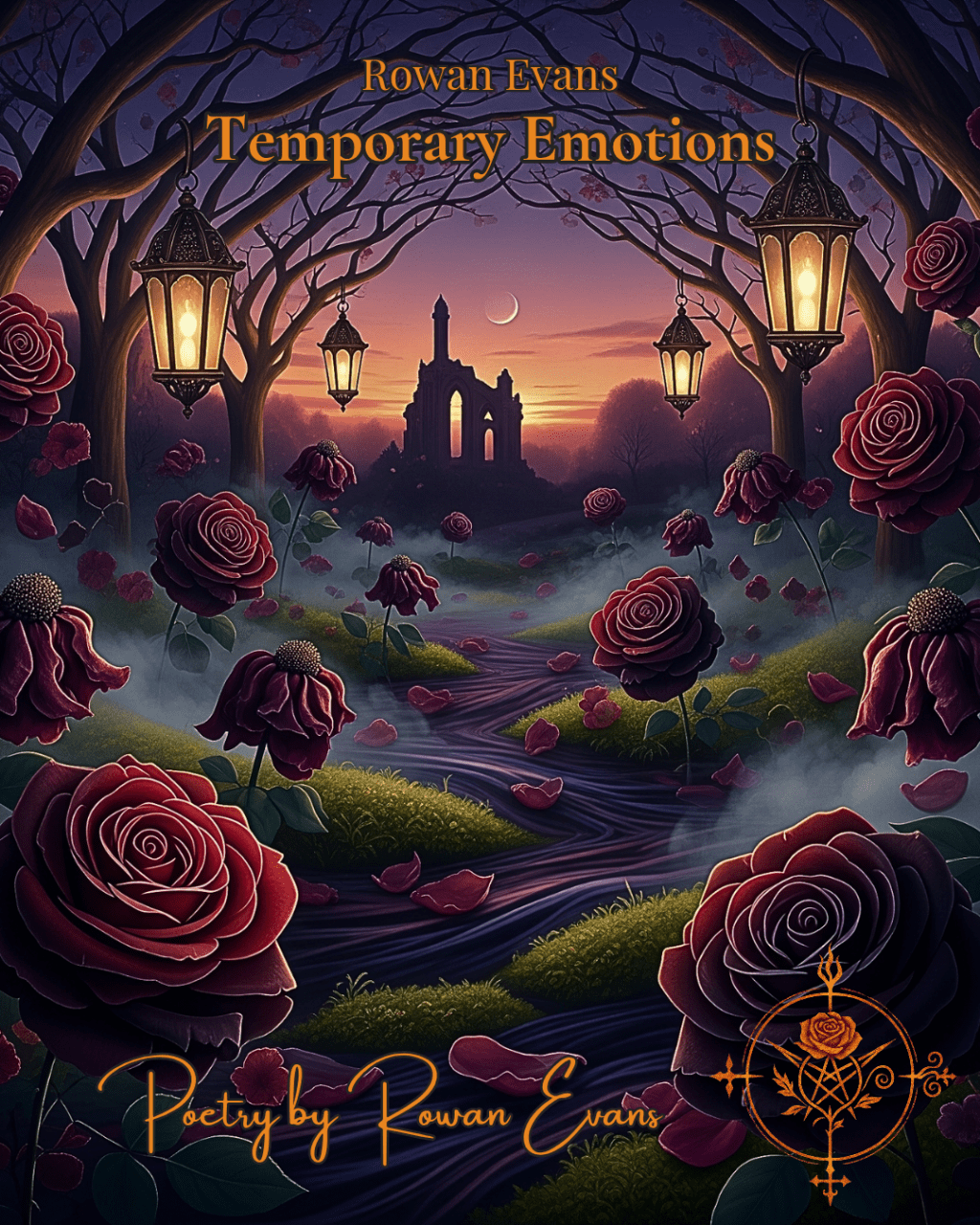
    A surreal twilight garden with lanterns and dark roses, symbolizing depression and the fleeting nature of emotions.
    Even the heaviest emotions are temporary—like shadows, they fade with the dawn.

    Temporary Emotions
    Poetry by Rowan Evans

    In the garden of feelings, where shadows bend and sway,
    Petals of joy and sorrow bloom, then fall away.
    A riot of colors, fleeting, alive—
    Whispers of truth hum beneath the hive.

    Emotions are lanterns, trembling with light,
    Flickering through darkness, fragile as night.
    They waver, they vanish, dissolve in the air—
    Here for a heartbeat, then gone without care.

    Do not carve choices in unyielding stone
    When tides of the heart shift and pull you alone.
    Bend, stumble, sway, but do not yield—
    Even shadows retreat when dawn is revealed.

    Feelings crash like waves on jagged, dreaming shores;
    Grief gnaws the marrow, hope rises and soars.
    Night bows to dawn in its ghostly fire,
    Ash gives way to a tender desire.

    Though emotions may bind with chains cold and tight,
    Time’s patient fingers restore your sight.
    Let them flow like rivers in spring—
    Do not dam the heart; let truth take wing.

    Seek a friend, a page, a mirror to speak,
    Pour your pulse into ink, let your spirit leak.
    Feelings, like seasons, shimmer, then flee;
    The storm may roar, but it teaches to be.

    Step into the tide, feel its swell and its pull;
    The ebb is as sacred as the full.
    Remember, dear heart, this gentle decree:
    All that you feel will one day set you free.

    In this shifting garden, where shadows and sun entwine,
    Each fleeting heartbeat can burn, can shine.
    Ride the currents, let the day sway—
    Tomorrow blooms anew in its spectral ballet.


    Closing Note

    If you’re reading this and carrying the same weight, know this: we don’t have to conquer the beast today. We just have to outlast it. These storms will pass, and when they do, we’ll still be here—tired, maybe, but alive. And sometimes, that is enough.