Tag: freestyle poetry

  • Author’s Note

    Sometimes the easiest way to stop overthinking the poem is to stop looking at it.

    Blindfolded & Still Winning came from that impulse: cover the eyes, let the pen move, and see what the mind throws onto the page. The anger gets folded into jokes, the jokes get stitched into rhythm, and suddenly what could have been a rant turns into a little battle-rap playground.

    The blindfold isn’t a handicap here.

    It’s permission to trust the instinct.

    And apparently, even without looking, the pen still thinks it knows how to win.

    — Rowan Evans
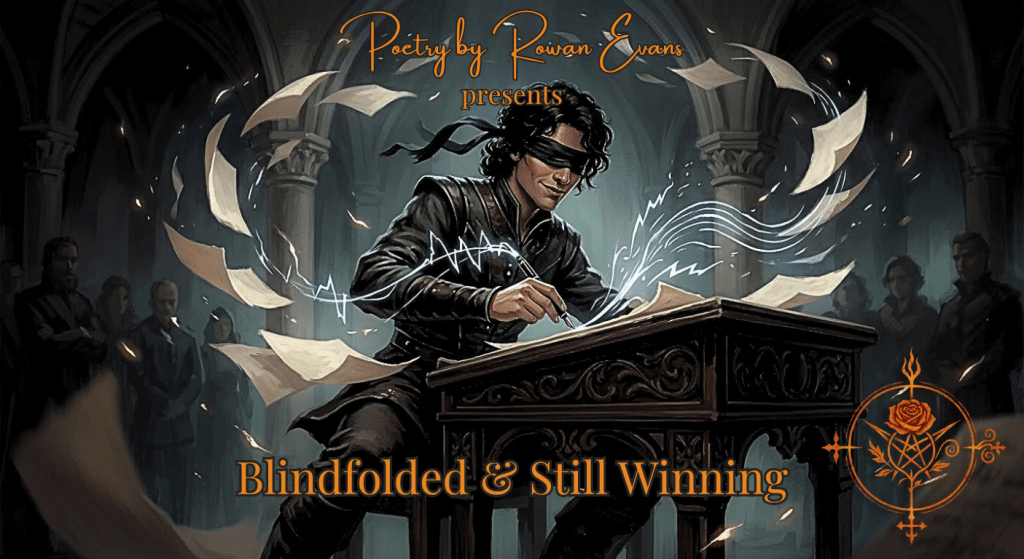

    A blindfolded poet writes confidently at a desk as pages and glowing lines of ink swirl around them, symbolizing instinctive creative writing.
    Cover the eyes. Let the pen drive. See what happens.

    Blindfolded & Still Winning
    Poetry by Rowan Evans

    I’m sick and tired
    of watching what I say—
    so I cover my eyes
    when I write—
    because even I like
    to be surprised
    by my mind, sometimes.

    So today I’ll be blind—
    folded the anger with my jokes,
    then mixed them in
    to the rhythm and rhyme—
    I’ll get over it on my own time.

    (Really, I’m over it already.)

    Pen like a switch blade,
    words so sharp, I filet men—
    yawn, you’re boring me.
    Took you five hours
    to write five lines—
    took me five minutes
    to write ten times—
    the rhymes,
    set ups and punchlines.


    Journey into the Hexverse

    [Literarily Speaking]
    They think silence means weakness. They should probably have paid more attention to the pen. Literarily Speaking turns gothic imagery, raven feathers, rose-petal ink, and absurd fictional geography into a playful battle-poetry flex about dismantling your enemies with words instead of hate.

    [The Playground]
    What happens when mythology stops being something to hide behind and becomes architecture for the imagination? The Playground (Language, Metaphors and More) explores Rowan Evans’s relationship with language, symbolism, metaphor, humor, and twenty-three years of turning the page into a place where anything can happen.

    [New God with a Pen]
    A battle-poet power fantasy where Superman’s rage, Batman’s fear, Darkseid’s cosmic authority, and the Anti-Life Equation collide with rhyme, turning an ordinary pen into something worthy of New God status.

    If you’re interested in more poetry, you can find it here → [The Library of Ashes]
  • Author’s Note

    It’s Almost Like I Know What I’m Doing is a little self-audit that turns into a flex before I can stop it.

    I started by wondering whether my writing had become too much swagger and not enough emotion—whether the ink was simply running free without anything underneath it. Then I remembered how long I’ve been doing this, where some of that rhythm came from, and why I learned to turn anger into cadence and pain into something that could make me laugh.

    Maybe the swagger isn’t the absence of emotion.

    Maybe it’s one of the ways I’ve learned to carry it.

    This piece is me looking at the machinery behind my own writing and realizing that the things I sometimes question—rhythm, rhyme, comedy, aggression, timing, and instinct—aren’t accidents anymore.

    They’re tools.

    And apparently, after all these years, I might actually know how to use them.

    — Rowan Evans


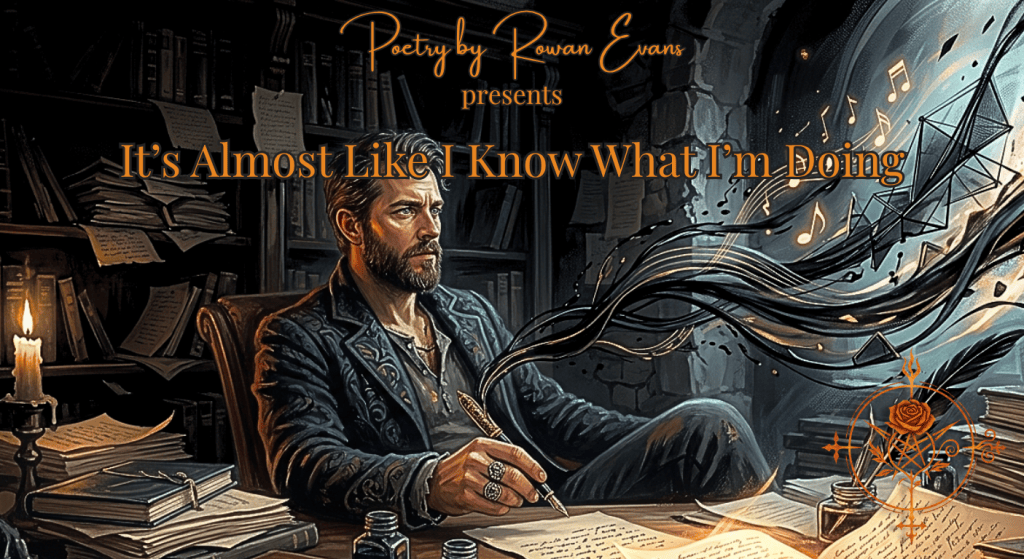
    A confident poet writing at a desk surrounded by years of notebooks as flowing ink becomes rhythm, emotion, and creative energy.
    After twenty-three years of shaping ink, maybe the swagger isn’t accidental.

    It’s Almost Like I Know What I’m Doing
    Poetry by Rowan Evans

    It’s like my writing has become
    all swagger, no emotion—
    it’s like the ink is coastin’,
    like the edge of the sea—
    but there’s no tide to guide me.
    So my lines run free—
    sometimes that’s not a problem for me,
    other times it feels like it ends tragically,
    like I’m going to say some shit,
    and make people mad at me—
    but if it happens naturally,
    I’ll take the consequences, happily.

    When the switch flips
    and my mind shifts—
    I can feel the slow drip,
    emotions begin to slip
    and my thoughts trip—
    trip up and stumble,
    drop the ball—fumble.
    It’s only round one,
    get ready to rumble—
    this is a battle,
    a bit more than a scuffle,
    slide my feet—shuffle.

    I’ve got twenty-nine years
    putting marks on paper—
    twenty-three years
    as a real ink shaper—

    I’ve poured my heart into this,
    my whole life has been ink-stained—
    spent years translating pain,
    nearly thirty years,
    laying my rage on the page—

    it started early—
    I was maybe nine or ten,
    getting bullied back then.
    I hated the bullies, hated school too.
    Hated the fact they thought
    they were too cool—
    too small to fight back,
    but I could write—
    so I could bite back.
    Used my ink to launch an attack,
    went full scale—

    you see,
    I cut my teeth on bars
    and that’s why—
    my lines go hard.

    I started at nine
    learning the legends rhymes—
    y’all gon’ make me lose my mind,
    until even I’m asking
    what My Name Is…

    Never mind. False alarm.

    I found it—

    it was inside rhyming,
    learning comedic timing—
    yeah, I took the rage
    and taught it how
    to joke its way
    across the page—
    whether happy or in pain.

    All it changed is
    how I worded some things,
    it’s almost like—

    I know what I’m doing.


    Journey into the Hexverse

    [New God With a Pen]
    A battle-poet power fantasy where Superman’s rage, Batman’s fear, Darkseid’s cosmic authority, and the Anti-Life Equation collide with rhyme, turning an ordinary pen into something worthy of New God status.

    [Lessons Without Kindness]
    A reflection on learning self-respect from a relationship that changed—the lessons hidden in manipulation, silence, and loss, and the realization that you don’t have to shrink yourself to make someone else feel tall.

    [The Sacred Timeline]
    From childhood stories about Dragon Ball Z, Power Rangers, and Pokémon to gothic cathedrals, ravens, roses, identity, healing, and experimentation, The Sacred Timeline traces how Rowan Evans’s relationship with the pen evolved across thirty-six years—and how the ink remained while the writer kept changing.

    If you’re interested in more poetry, you can find it here → [The Library of Ashes]
  • Author’s Note

    This piece is me doing what I do best: writing too fast, joking too much, and letting the pen cross whatever line happens to be in the way.

    It’s cocky. It’s playful. It knows exactly how ridiculous it is.

    So consider this less of a confession and more of an exhibit.

    The evidence is right there on the page.

    — Rowan Evans


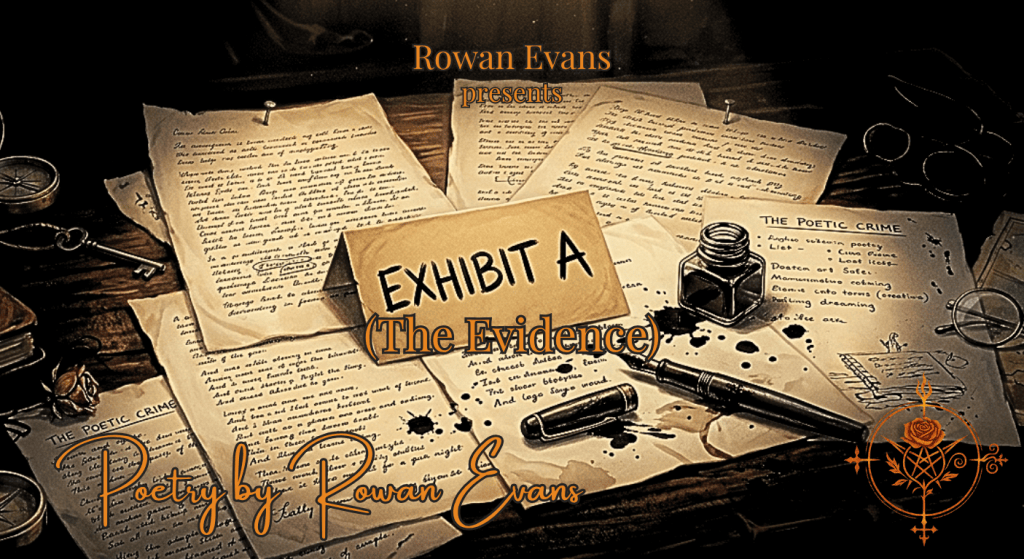
    A handwritten poetry manuscript arranged like evidence beneath a spotlight with an “Exhibit A” card and scattered pages.
    Exhibit A: The evidence speaks for itself.

    Exhibit A (The Evidence)
    Poetry by Rowan Evans

    I write so quick
    and joke a bit.
    I’m quick-witted—
    enough to roast a bitch.
    Down to earth,
    enough to toast a bitch.
    I’m on a roll,
    like butter is—
    spread thin
    across genres,
    but still
    the cadence hits—
    because that’s
    where the rhythm lives.

    You think I’m joking—

    but I really write like this,
    take this piece—
    it’s the evidence.
    Exhibit A on a list to—
    these other poets
    don’t exist to me.

    When I read their work—

    it’s straight Zs,
    it puts me to sleep.

    My mind is too quick,
    and I don’t know
    where the line is—
    I’m always crossing it.
    That’s what gets me
    in trouble, yeah—
    so I just double-down.

    I’m already in trouble,
    so why stop now?


    Journey into the Hexverse

    [Welcome to the Hexverse]
    Step into the Hexverse—a poetic world where mythmaking, humor, rage, creativity, and confession collide, and darkness becomes something that can be reshaped into art.

    [Circle of Me]
    A reflective poem about sitting among the voices of memory, joy, pain, and fear—and realizing that some burdens are bigger than any one person.

    [High Tide]
    A short reflective poem about leaving, returning, and accepting the forces that pull us back—like the tide guided by the moon.

    If you’re interested in more poetry, you can find it here → [The Library of Ashes]
  • Author’s Note

    Ayo…

    Tony Stanza is back.

    And apparently, he has beef with another poet.

    Unfortunately for that poet, Tony has discovered pasta.

    Impasta (A Diss in Pasta Form) is exactly what it sounds like: a diss poem written almost entirely through pasta-related wordplay. Spaghetti becomes “impasta.” Fettuccine becomes “alfredo.” Macaroni becomes a metaphor for having no backbone. Ravioli becomes something that folds under pressure.

    And Tony is absolutely convinced this is devastating.

    That is what makes Tony Stanza fun.

    He isn’t trying to be subtle. He isn’t trying to sound sophisticated. He is a fictional poet who has apparently decided that every pasta dish is an opportunity for literary violence.

    But underneath the ridiculousness, there is a real little diss hiding in here.

    The target isn’t merely being called a bad poet. They’re being accused of being derivative, fragile, empty, and dependent on other people’s work. The pasta metaphors are ridiculous, but the criticism itself is surprisingly straightforward:

    Your work isn’t yours.

    Your confidence doesn’t survive pressure.

    And underneath all that presentation, there’s nothing there.

    Of course, Tony couldn’t possibly just say that.

    He had to make it about spaghetti.

    This is also another piece in the growing mythology of Tony Stanza—the “greatest poet you’ve never heard of,” a poet whose signature “Ayo…” apparently signals that something deeply unserious is about to happen.

    If I write anything pasta-related from this point forward, Tony Stanza did it.

    I don’t make the rules.

    Tony does.

    — Rowan Evans


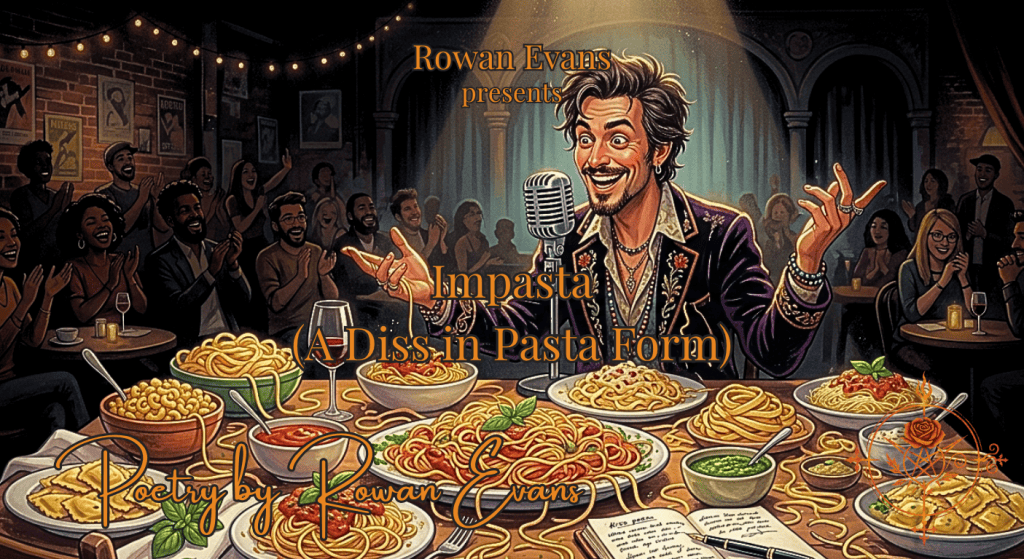
    A fictional poet confidently writing a diss poem beside plates of spaghetti, fettuccine, macaroni, ravioli, and angel hair pasta.
    Ayo…
    Tony Stanza has entered the kitchen.
    And somebody’s about to get impasta’d. 🍝

    Impasta (A Diss in Pasta Form)
    Poetry by Tony Stanza

    Ayo…

    I call you spaghetti—
    because you’re just
    an impasta. (Imposter.)
    Your rhymes are cheesy.
    Parmesan.

    All these suckers fettucine.
    They alfredo. (afraid though.)
    Yeah, these bitches is macaroni.
    All elbows. No backbone.

    They talk a lot a ravioli—
    but fold when pressure hits,
    seam splits—
    and you realize they were
    full of nothing, no substance.

    You thought you were angel hair, capellini,
    the chosen one—divinity with a pen.
    But you’re just thin-skinned, overcooked,
    fragile to the core.


    Journey into the Hexverse…

    [Lost in the Sauce]
    A playful heartbreak poem where sandwiches, ketchup, mustard, rye, lettuce, and sourdough become metaphors for emotional confusion. Beneath the food puns is a speaker trying to understand how everything went from “we’re okay” to suddenly feeling cold.

    If you’re interested in more poetry, you can find it here → [The Library of Ashes]