Some poems arrive carrying trauma, existential questions, complicated metaphors, and enough symbolism to fill a cathedral.
This one showed up carrying a fucking pun.
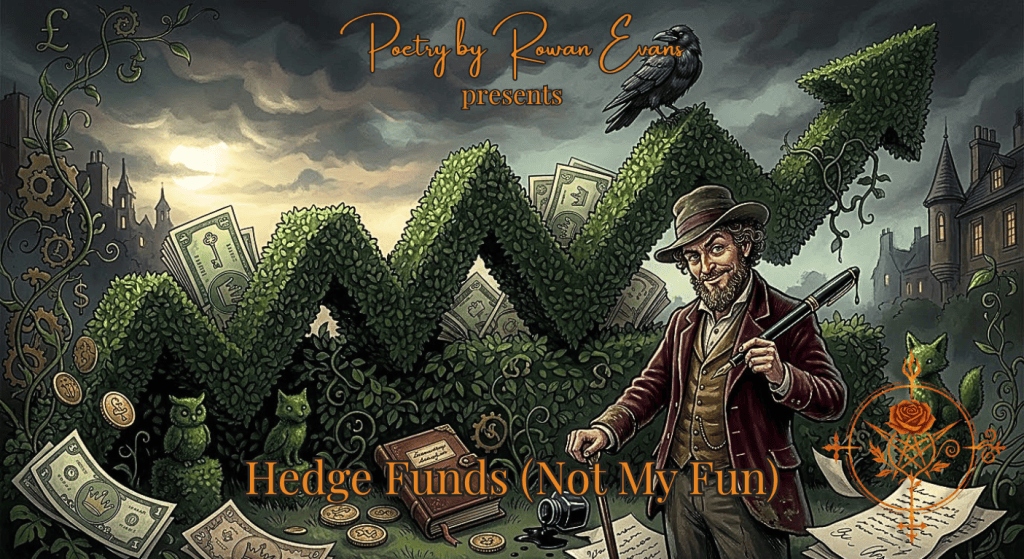
Hedge Funds (Not My Fun) is deliberately stupid. I wanted to play with sound, names, word associations, and the increasingly questionable logic of a joke that refuses to die. Sometimes the page doesn’t need another emotional excavation—it just needs to have a little fun.
So yes, this is a poem about hedge funds.
No, I don’t actually have any.
And apparently, neither does my fun.
— Rowan Evans
The hedge has funds. The funds aren’t mine. Therefore, the fun remains tragically unfunded.
Hedge Funds (Not My Fun) Poetry by Rowan Evans
I think I’m so fucking funny—
I’ll make a Big Pun,
while lookin’ like a Pimp
C—but you can’t see me,
like my name is John
and my time is now—
or at least, I hope it is.
Because I’m trying to get my funds up,
yeah, I want to get my fun up—
so I stack my funds
as high as my hedges—
get it?
Hedge Fund.
That means the money isn’t mine—
so I’m stacking some funds high,
they’re just not my funds, and—
because they’re not my funds,
they do not fund my fun, man.
Sometimes the loudest hater in the room is the one you brought with you.
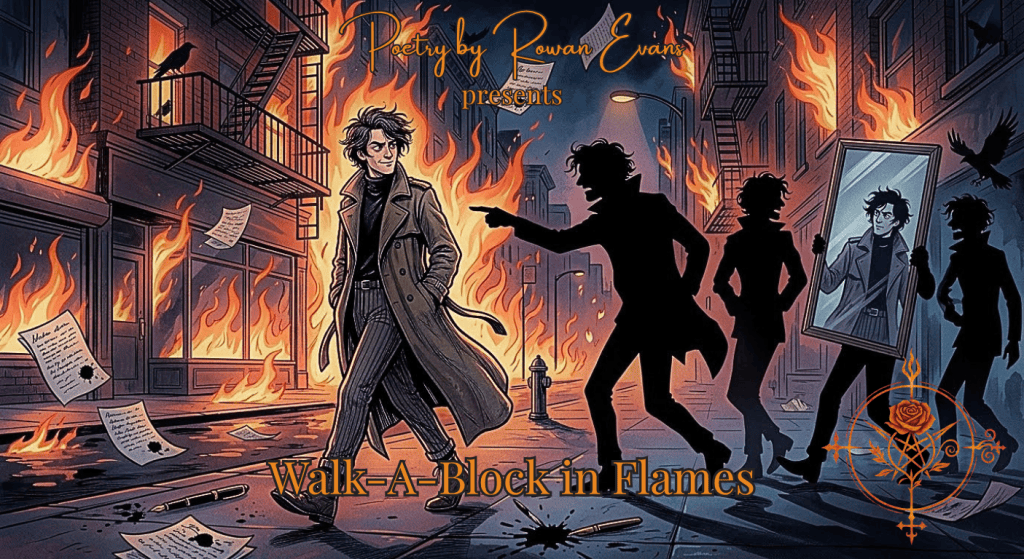
Walk-A-Block in Flames started with the idea of imaginary critics—the voices that somehow manage to find fault with everything you do, even when nobody else is actually saying a damn thing. Naturally, my brain decided the appropriate response was to turn that internal conflict into a ridiculous walk around the block, throw in some wordplay, and see how many times I could make the joke work before the poem eventually turned the joke back on me.
Because beneath all the flames, bravado, and fake enemies, there’s a much simpler realization:
Sometimes the person I’m arguing with is me.
And honestly?
That’s probably the funniest part.
— Rowan Evans
Plot twist: the haters were imaginary, and unfortunately, they had my voice.
Walk-A-Block in Flames Poetry by Rowan Evans
They tell me,
these imaginary haters,
that I’ve fuckin’ created—
they live inside my head,
feeding on my self-doubt—
obsessed with burning the self-down.
They make me take a walk,
a walk around a block
and it’s fucking hot—
I guess you could say,
these imaginary haters made me,
Waka Flocka Flame.
Wait—
I meant to say—
these haters made me
Walk-A-Block In Flames.
Honestly though,
I don’t know
what the fuck
they hate me for—
Is it because my wrist froze?
Nope, I’m broke—
Because I’m the best to ever do it?
Nope, that’s a joke—
Is it because they say
the things I think about me?
Couldn’t be—
because I think I’m great,
and these haters are fake.
I mean literally fake,
figments—
they don’t exist,
it’s just me in this bitch.
Sometimes the easiest way to stop overthinking the poem is to stop looking at it.
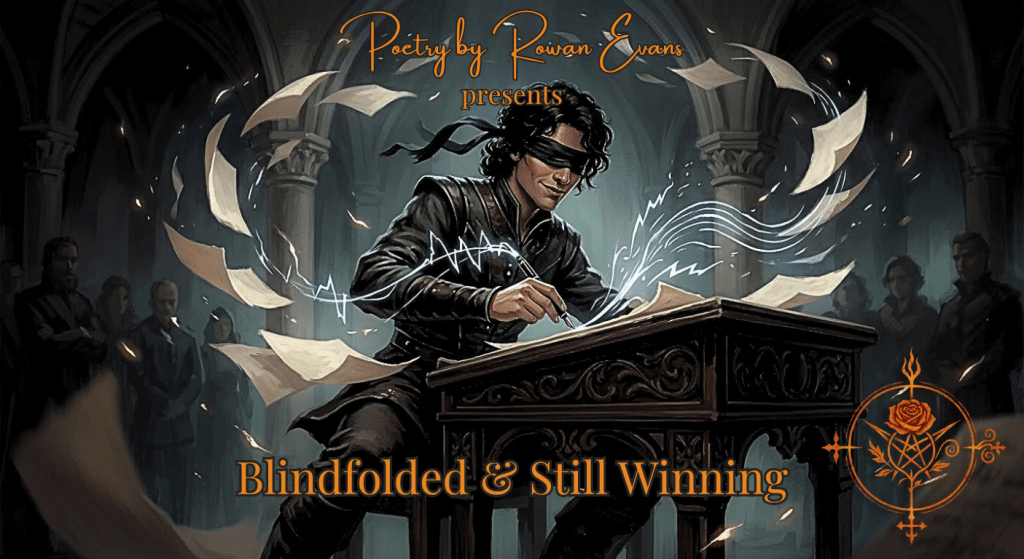
Blindfolded & Still Winning came from that impulse: cover the eyes, let the pen move, and see what the mind throws onto the page. The anger gets folded into jokes, the jokes get stitched into rhythm, and suddenly what could have been a rant turns into a little battle-rap playground.
The blindfold isn’t a handicap here.
It’s permission to trust the instinct.
And apparently, even without looking, the pen still thinks it knows how to win.
— Rowan Evans
Cover the eyes. Let the pen drive. See what happens.
Blindfolded & Still Winning Poetry by Rowan Evans
I’m sick and tired of watching what I say— so I cover my eyes when I write— because even I like to be surprised by my mind, sometimes.
So today I’ll be blind— folded the anger with my jokes, then mixed them in to the rhythm and rhyme— I’ll get over it on my own time.
(Really, I’m over it already.)
Pen like a switch blade, words so sharp, I filet men— yawn, you’re boring me. Took you five hours to write five lines— took me five minutes to write ten times— the rhymes, set ups and punchlines.
Journey into the Hexverse
[Literarily Speaking] They think silence means weakness. They should probably have paid more attention to the pen. Literarily Speaking turns gothic imagery, raven feathers, rose-petal ink, and absurd fictional geography into a playful battle-poetry flex about dismantling your enemies with words instead of hate.
[The Playground] What happens when mythology stops being something to hide behind and becomes architecture for the imagination? The Playground (Language, Metaphors and More) explores Rowan Evans’s relationship with language, symbolism, metaphor, humor, and twenty-three years of turning the page into a place where anything can happen.
[New God with a Pen] A battle-poet power fantasy where Superman’s rage, Batman’s fear, Darkseid’s cosmic authority, and the Anti-Life Equation collide with rhyme, turning an ordinary pen into something worthy of New God status.
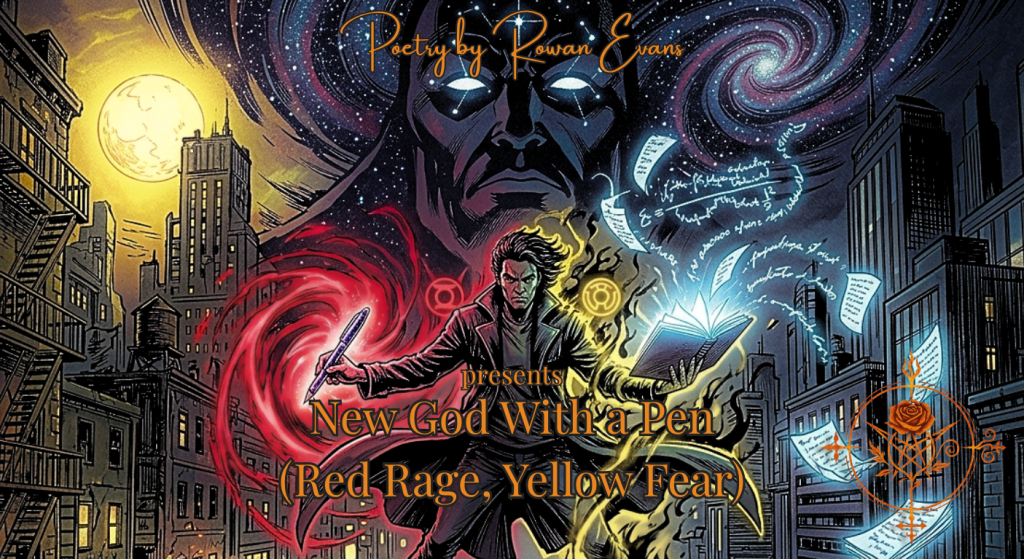
New God With a Pen (Red Rage, Yellow Fear) is me taking the battle-poet persona and throwing it directly into the DC Universe.
The premise is simple: if I’m going to write like my pen has powers, why stop at superheroes? Give me Superman’s rage, Batman’s fear, Darkseid’s cosmic scale, and an Anti-Life Equation made entirely of rhyme—and suddenly the notebook becomes its own comic-book universe.
The important part is that the destruction stays where it belongs: on the page.
This is playful bravado, exaggerated power-scaling, and a little comic-book absurdity wrapped around the idea that a pen can make a poet feel damn near omnipotent.
Apparently, today my ink wanted to become a New God.
— Rowan Evans
The pen got cosmic. The rhyme scheme got dangerous. The notebook became a universe.
New God With a Pen (Red Rage, Yellow Fear) Poetry by Rowan Evans
I am Metropolis in the shadows,
and Gotham in the light—
that might feel backwards,
but it’s not—
I’m Superman with a red ring when I write,
unstoppable and full of rage—
but I keep the rage contained to the page,
so while I might slaughter you—
you’ll be both victim and witness.
Because you’ll be able to read it too,
like headline news, front page—
and if you think that’s bad, no dear—
I’m Yellow Lantern Batman,
I rule the shadows and control fear.
I’ll write lines so terrifying,
they make you want to disappear—
and so you know, I deleted four lines…
there were more disses here.
I write lines so tight with rhymes
that hit so hard, even Darkseid
looks at me like a New God now.
I put the Anti-Life Equation
in my lines, that’s why my rhymes
have the power to control minds.
You can’t compete with me.
I’ve beaten you completely.
Journey into the Hexverse
[The Sacred Timeline] From childhood stories about Dragon Ball Z, Power Rangers, and Pokémon to gothic cathedrals, ravens, roses, identity, healing, and experimentation, The Sacred Timeline traces how Rowan Evans’s relationship with the pen evolved across thirty-six years—and how the ink remained while the writer kept changing.
[The Metaphor Machine] A poem that takes apart its own machinery as it runs—breaking lines, breaking thoughts, and following metaphors from moonlight to tides, oceans, shorelines, and city streets.
[Welcome to the Hexverse] Step into the Hexverse—a poetic world where mythmaking, humor, rage, creativity, and confession collide, and darkness becomes something that can be reshaped into art.
Give me something to work with, and I’ll turn it into a line. A joke. A rhyme. A little trouble.
That’s the game.
— Rowan Evans
Give me something to work with. I’ll give you a poem.
Give Me (I’ll Give) Poetry by Rowan Evans
Give me a beat,
I’ll give you a bar.
Give me a graveyard,
I’ll give you a ghost.
Give me a lyric,
I’ll give you a joke.
Give me a drink,
I’ll give you a toast.
You don’t have to say it—
I know, I write better than most.
Journey into the Hexverse…
[Nobody² (No Body)] A minimalist poem playing with the double meaning of “nobody”—exploring loneliness, isolation, absence, and the feeling of becoming a ghost within your own life.
[Rose & Ruin] Two minimalist poems exploring the opposing forces within creativity: the thoughts we cultivate into something beautiful and the darker thoughts we transform before they have a chance to decay.
There are some places that become more than places.
An ocean can be a physical distance, a horizon, a body of water stretching farther than the eye can follow. But sometimes it becomes something else entirely—a canvas, a metaphor, a meeting place between two people who happen to be standing on opposite sides of the world.
Let Me Be Pacific began with a simple invitation: let me show you the ocean the way I see it.
From there, the words wandered where they wanted to go.
Purple skies. Silver moons. Dark water. Rhymes. Trees. Wordplay.
And eventually, the Pacific became more than scenery.
It became the space between here and there—and the reminder that something can cross an enormous distance without ever needing to disappear.
So, for a moment, come sit beside me on the shoreline.
Let me paint you a picture.
— Rowan Evans
The Pacific may separate two shores, but poetry has never been particularly good at respecting distance.
Let Me Be Pacific Poetry by Rowan Evans
Here let me take my words
and paint a picture for you—
the sky in shades of purple and blue,
lit by the silver moon—
it lingers over the bay,
that’s where it stays—
watching over the tide,
and I sit on the shoreline—
watching the ocean’s waves.
Which ocean? Okay,
here let me try and spell it out,
let me be Pacific—
it’s off the California coast,
it touches the Philippine Sea,
sits between Japan and Me.
Now back to the imagery—
there was me, next to a happy little tree,
and the moon was shimmering,
trembling across dark water—
back on the shoreline,
having written more lines,
not less, but more rhymes.
So let me stay Pacific—
specific in the way I see the sea,
how every wave feels like a message
sent across the world to me.
I sit, I rhyme, I watch the tide—
the ocean’s big, but so’s my mind.
And if you ask me why I write
beside this ocean every night—
it’s because the tide keeps teaching me
how distance isn’t always far,
how even the Pacific can carry a heart
from California to wherever you are.
Journey into the Hexverse…
[My Nightmare] A poem about the nightmare of loving someone across distance, seeing the world from different perspectives, and holding onto the hope that the cracks can still be repaired—and that someday two separate shores might become one.
[Rose & Ruin] Two minimalist poems exploring the opposing forces within creativity: the thoughts we cultivate into something beautiful and the darker thoughts we transform before they have a chance to decay.
[Across the Page-cific] A playful, autobiographical journey through the strange places poetry can take me—from sandwich heartbreak and pasta diss poems to gothic monsters, mythology, ravens, ghosts, and storms across the page. Beneath the absurdity is something deeply personal: the realization that writing gave me a way to rebuild myself, piece by piece.
Sometimes I sit down with a pen and decide I’m going to behave.
That usually lasts about three lines.
Behind These Bars (Idol Chatter) is one of those pieces where the writing gets a little cocky, the jokes start stacking up, and the references begin sneaking through the cracks. It’s playful, competitive, and intentionally ridiculous in places.
So consider this a little verbal sparring session.
No hard feelings.
Probably.
— Rowan Evans
The meet-and-greet is over. The pen has entered the battle.
Behind These Bars (Idol Chatter) Poetry by Rowan Evans
Oh, look at you— look what you can do with a pen—it’s cute, but you can’t win— yet you think you can?
Damn, man— what was your plan? How were you going to get the best of me?
Get in line— get ready for the meet and greet, I’ll sign your autograph, cause I—
I know I’m your Idol, American, shape the ink like clay, ’til it’s achin’— I’m Stronger now, and not Because Of You, so listen quick, remember bitch, you’ll want to remember where you were at during A Moment Like This—
that was three straight references to Clarkson, Kelly— sit down, talk show, telly. It’s just jokes bitch, I can get silly— that’s just how the mind Behind These Hazel Eyes works—
jerks.
Journey into the Hexverse…
[Conductor] A dark, intimate poem about the strange power words can have over the reader—where rhythm, rhyme, and line breaks become instruments capable of reaching beyond the page.
[Kaio-ken/Zenkai] Two Dragon Ball-inspired battle poems about creative power, survival, and coming back stronger. Kaio-ken with a Pen brings the attack, while Zenkai (Stronger Now) delivers the aftermath: push me to the edge, and I’ll return stronger than before.
[Don’t Push Me] A playful battle-poetry piece about turning insults into punchlines, standing your ground, and refusing to be intimidated. Don’t Push Me mixes swagger, humor, rhyme, and Rowan Evans’ signature self-aware interruptions.
[B.S.T.F.U.] A playful battle-poetry exercise packed with insults, internal rhymes, punchlines, wordplay, and literary swagger. B.S.T.F.U. is Rowan Evans flexing the verbal muscles—not calling out anyone in particular.
There isn’t a real target hiding behind this poem, no specific person I’m trying to call out, and no secret literary feud happening behind the scenes. I wrote this because sometimes I like to take the battle-poet side of my voice out for a walk and see what it can do.
This piece is deliberately over-the-top. It’s swagger, insults, wordplay, internal rhyme, punchlines, and a little bit of absurdity thrown into the blender. The goal wasn’t to make a serious accusation—it was to practice the mechanics of verbal combat while having fun with the language.
And honestly, that’s part of why I love writing: sometimes I want to write something vulnerable, sometimes I want to build mythology, sometimes I want to make conspiracy theories about fish, and sometimes I just want to look at the imaginary competition and say:
Where are you on the ladder?
Below me.
It’s not that serious.
But the pen game?
That part is serious.
— Rowan Evans
No target. No feud. Just a poet flexing the pen and climbing the imaginary ladder.
B.S.T.F.U. Poetry by Rowan Evans
Bitch, shut the fuck up—
what’chu talkin’ about?
Don’t think I haven’t heard—
how you’re runnin’ your mouth.
You thought ’cause I don’t talk a lot,
I was open season, you should be scared—
let me give you a reason, I’m a big dog—
all bite, no bark and a license to write still.
I write with precision, I write kills—
you’re not a writer,
you’re the one who steals—
plagiarizing those with skill.
It’s stolen lines
and stolen rhymes—
the only thing keeping you
holding on to borrowed time—
it’s not yours—
it’s whoever writes for you.
It’s me and it’s them—
it’s the wielders of the pen.
Those with skill,
with lines that kill
and lines that heal—
we know—
you don’t write, bitch—
be so for real.
You don’t know what a metaphor is—
and a stanza?
You hear that and you’re like—
isn’t his first name Tony?
Bitch, you’re a phony…
if you were
to try and write—
baloney.
All that to ask—
when it comes
to writing—
where are you
on the ladder?
Below me.
Journey into the Hexverse…
[Across the Page-cific] A playful, autobiographical journey through the strange places poetry can take me—from sandwich heartbreak and pasta diss poems to gothic monsters, mythology, ravens, ghosts, and storms across the page. Beneath the absurdity is something deeply personal: the realization that writing gave me a way to rebuild myself, piece by piece.
Between Sun & Shore was written in February of last year, during a season where I was learning what it felt like to be seen gently instead of weathered. It came from a place of quiet awe—of realizing that sometimes love doesn’t arrive like a storm, but like warmth. Like light finding its way through the cracks you thought would always stay broken.
This poem is about that in-between space: where grief softens, where healing begins, where you are no longer only the tide or the storm—but something new, something held. It’s about the moment you realize that someone hasn’t come to save you… they’ve come to grow beside you.
Where storms soften and light learns your name.
Between Sun & Shore Poetry by Rowan Evans
I once drifted like a wayward tide, Lost in the waves, nowhere to hide. Storms had carved their name in me, Each scar a tale, each wound a sea.
Then you arrived—a golden ray, Like sunrise spilling into the bay.
Your voice, a hymn the wind would weave, Soft as the hum of the monsoon’s reprieve. You traced my ruins, stone by stone, And turned them into sacred homes.
Now every ripple speaks your name, Each whispered breeze, each dancing flame.
Like sampaga’s quiet grace, You bloom where sorrow left its trace. Between Sun and Shore, love grew— A bridge of light, leading to you.
I grew up with curiosity tucked into my pockets and verses curled beneath my tongue. Emily Dickinson was a whisper in the corners of my childhood, a friend I never met but whose words became a world I could inhabit. This poem is my conversation with her—not as a student or disciple, but as a daughter of her imagination. I step lightly into her quiet rebellion, tracing the wildness in the spaces between her lines, and celebrate the wonder she taught me to carry everywhere.
Roo the Poet channels Emily Dickinson’s quiet rebellion—where whimsy meets power and poetry becomes sacred magic.
Invocation
Emily, I call you forth from the hush of your pages— to twirl with me among dandelion threads, to sparkle in the dust motes of moonlight, to teach me the magic hidden in whispered words and the spellcraft of curiosity. Come, let us play in the corners of imagination, where every pause is a secret, every breath a tiny universe.
The Daughter of Dickinson Poetry by Roo the Poet ☽
I was born with wonder in my pockets, curiosity curled beneath my tongue— a girl with soil-stained knees and verses stitched in dandelion thread.
Emily, you taught me to whisper like the wind, to rhyme with ghosts, to find galaxies in the hush between heartbeats.
Where others saw silence, you saw sacredness. Where others sought heaven, you built it in the corner of a room with nothing but paper and breath.
I carry your quiet rebellion— your needlepoint of metaphors, your hymns in lowercase, your refusal to explain what the soul already understands.
They say I’m soft— as if softness isn’t a spell. As if whimsy isn’t a weapon for those too clever to be caught.
Let them laugh. Let them call me girl or child or fragile. They don’t see the wildfire tucked behind my daydreams, the spells scribbled in sidewalk chalk, the dragons I’ve tamed with lullabies.
I don’t need a crown of thorns. I wear flower crowns and spiderwebs, and I rule from the quiet places— behind the bookshelf, inside the poem, beneath the bed where dreams go when they’re too loud for daylight.
You showed me how to write the world slant, how to speak with lightning behind my teeth. I am your echo in soft rebellion, your candlelit cathedral of small, sacred things.
So call me daughter, call me myth in the making— but do not mistake my hush for absence. I am here. Wide-eyed. Wand in hand. Heart open like a story yet to be told.
Benediction
May the softest words bloom like wildflowers in your heart. May curiosity be your compass and wonder your crown. May you find galaxies in small corners, and speak with lightning behind your teeth. Go forth with wand in hand, ink on your fingertips, and a heart open to all the stories yet to be told. May you be brave, be small, be loud, be soft— and may the quiet magic of Emily’s whispers always walk beside you.
The Poetic Lineage
The Daughter of Plath | Rowan Evans In The Daughter of Plath, Rowan Evans writes as the heir to a ghost—cradling grief not her own, baptized in bell jars, and building a cathedral from ash. This is a confession, a prayer, and a refusal to let the ache fall silent.