Some poems arrive carrying trauma, existential questions, complicated metaphors, and enough symbolism to fill a cathedral.
This one showed up carrying a fucking pun.
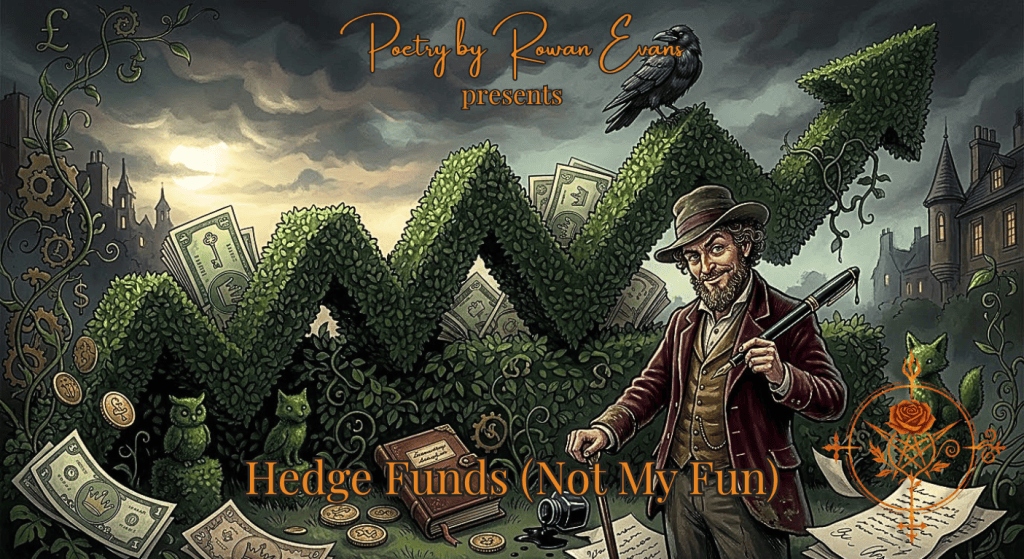
Hedge Funds (Not My Fun) is deliberately stupid. I wanted to play with sound, names, word associations, and the increasingly questionable logic of a joke that refuses to die. Sometimes the page doesn’t need another emotional excavation—it just needs to have a little fun.
So yes, this is a poem about hedge funds.
No, I don’t actually have any.
And apparently, neither does my fun.
— Rowan Evans
The hedge has funds. The funds aren’t mine. Therefore, the fun remains tragically unfunded.
Hedge Funds (Not My Fun) Poetry by Rowan Evans
I think I’m so fucking funny—
I’ll make a Big Pun,
while lookin’ like a Pimp
C—but you can’t see me,
like my name is John
and my time is now—
or at least, I hope it is.
Because I’m trying to get my funds up,
yeah, I want to get my fun up—
so I stack my funds
as high as my hedges—
get it?
Hedge Fund.
That means the money isn’t mine—
so I’m stacking some funds high,
they’re just not my funds, and—
because they’re not my funds,
they do not fund my fun, man.
Sometimes the loudest hater in the room is the one you brought with you.
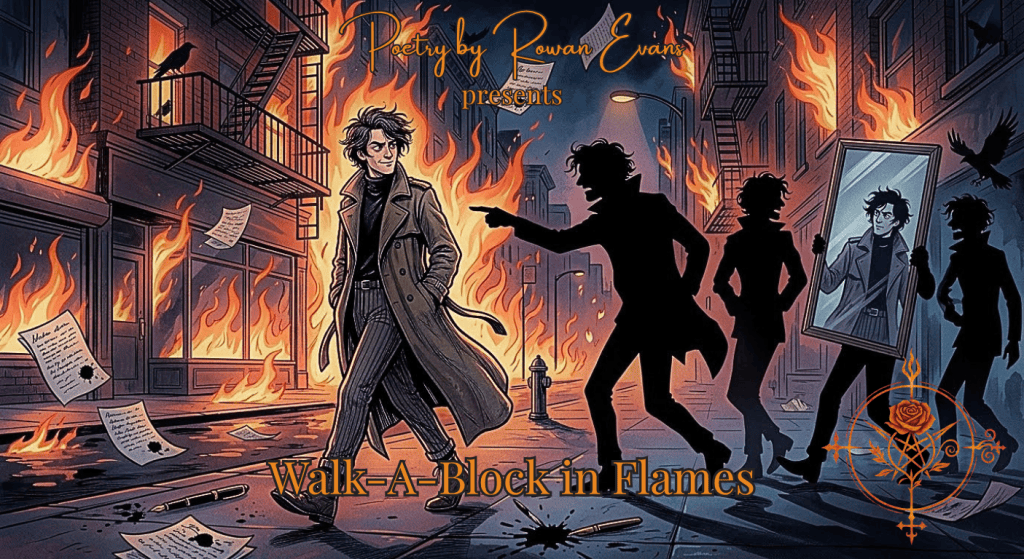
Walk-A-Block in Flames started with the idea of imaginary critics—the voices that somehow manage to find fault with everything you do, even when nobody else is actually saying a damn thing. Naturally, my brain decided the appropriate response was to turn that internal conflict into a ridiculous walk around the block, throw in some wordplay, and see how many times I could make the joke work before the poem eventually turned the joke back on me.
Because beneath all the flames, bravado, and fake enemies, there’s a much simpler realization:
Sometimes the person I’m arguing with is me.
And honestly?
That’s probably the funniest part.
— Rowan Evans
Plot twist: the haters were imaginary, and unfortunately, they had my voice.
Walk-A-Block in Flames Poetry by Rowan Evans
They tell me,
these imaginary haters,
that I’ve fuckin’ created—
they live inside my head,
feeding on my self-doubt—
obsessed with burning the self-down.
They make me take a walk,
a walk around a block
and it’s fucking hot—
I guess you could say,
these imaginary haters made me,
Waka Flocka Flame.
Wait—
I meant to say—
these haters made me
Walk-A-Block In Flames.
Honestly though,
I don’t know
what the fuck
they hate me for—
Is it because my wrist froze?
Nope, I’m broke—
Because I’m the best to ever do it?
Nope, that’s a joke—
Is it because they say
the things I think about me?
Couldn’t be—
because I think I’m great,
and these haters are fake.
I mean literally fake,
figments—
they don’t exist,
it’s just me in this bitch.
Some writers pick up a pen. Others discover they’ve accidentally assembled an entire mutant power set.
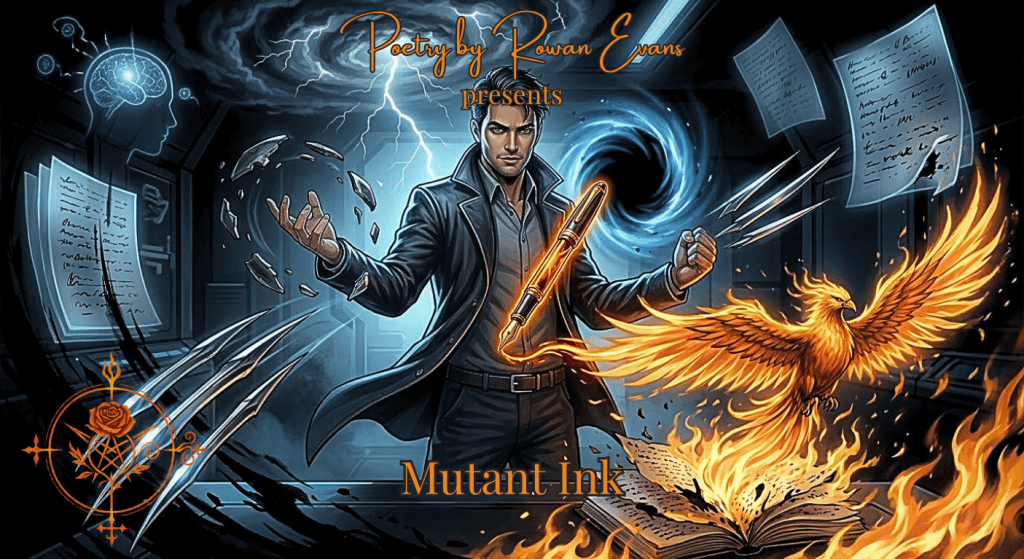
Mutant Ink is my love letter to the X-Men universe, where every ability becomes another way to bend language, twist expectations, and leave a mark on the page. From mind-reading and magnetic control to teleportation, razor-sharp claws, and storms summoned through rhyme, this poem turns familiar mutant powers into weapons of wordplay. The references are playful, the bars are sharp, and the name-drops are absolutely intentional.
But beneath the comic-book chaos is something that reaches beyond fandom. Creativity is its own kind of evolution. Sometimes a line needs to be dismantled, a verse needs to burn, and an entire draft needs to die before something better can rise in its place.
That’s where Phoenix comes in.
Because the goal isn’t simply to write another poem. It’s to become something more through the act of writing it. Every revision, every failure, every spark that refuses to die becomes part of the next transformation.
Call it mutation. Call it ascension. Call it poetic evolution.
Just don’t stand too close when the ink catches fire.
— Rowan Evans
Sharp lines. Mutant powers. Burning ink. Sometimes the poem has to die before the Phoenix can rise.
Mutant Ink Poetry by Rowan Evans
I’m not Walken, my name’s not Christopher— I’m stuck in the chair, like my name’s Xavier— reading your thoughts displayed on the page— ink laid—I bend bars, the way Magneto does.
And my mind is sharp, like my lines are, It’s Snikt!— every time I write bars, words so sharp— they’ll cut and leave scars.
BAMF! That’s not a sound effect, that’s just what they call me. BAMF! I never left, no other dimension, I’m still here, you’re trippin’. They say it’s teleportation— I say misdirection— look away for one second, now I’m somewhere else in the sentence—
I ink storms, and that’s why I always start with the dryline. I’ll hit you with cyclonic rhymes from a twisted mind— do you know what happens when a Toad gets struck by lightning? The same thing that happens to everything else—
and the sky turns Grey, it’s usually blue as my Jeans are. But that’s what happens when Summers mix with Frost— turn the heat up, Hellfire Club.
When the heat gets too high, I don’t break— I burn. Call it evolution, call it ascension, call it the moment every line catches fire at once—
I go full Phoenix, rising out the rhyme scheme, feathers made of flame, every word a rebirth— because sometimes the only way to finish a poem is to let it die— and rise again, stronger.
Sometimes the easiest way to stop overthinking the poem is to stop looking at it.
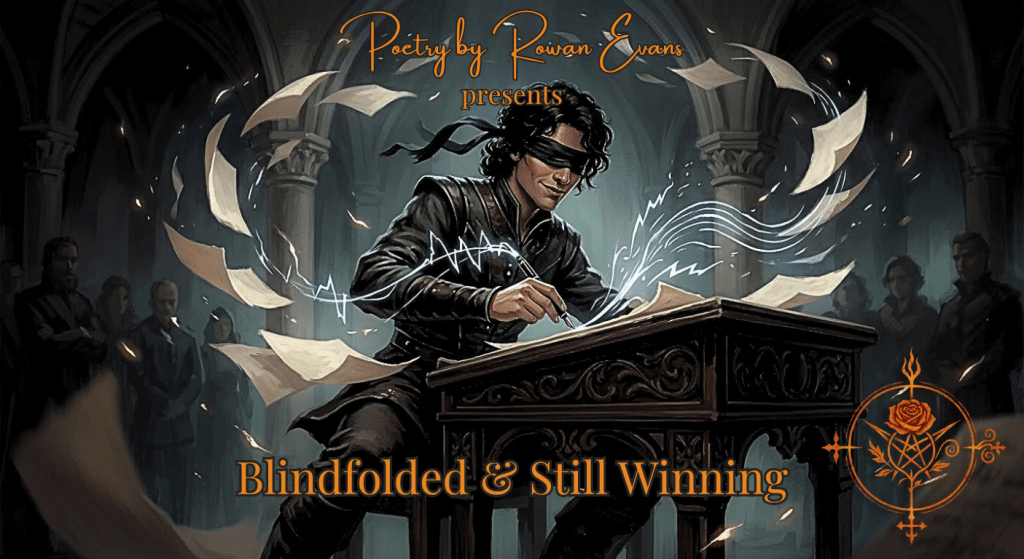
Blindfolded & Still Winning came from that impulse: cover the eyes, let the pen move, and see what the mind throws onto the page. The anger gets folded into jokes, the jokes get stitched into rhythm, and suddenly what could have been a rant turns into a little battle-rap playground.
The blindfold isn’t a handicap here.
It’s permission to trust the instinct.
And apparently, even without looking, the pen still thinks it knows how to win.
— Rowan Evans
Cover the eyes. Let the pen drive. See what happens.
Blindfolded & Still Winning Poetry by Rowan Evans
I’m sick and tired of watching what I say— so I cover my eyes when I write— because even I like to be surprised by my mind, sometimes.
So today I’ll be blind— folded the anger with my jokes, then mixed them in to the rhythm and rhyme— I’ll get over it on my own time.
(Really, I’m over it already.)
Pen like a switch blade, words so sharp, I filet men— yawn, you’re boring me. Took you five hours to write five lines— took me five minutes to write ten times— the rhymes, set ups and punchlines.
Journey into the Hexverse
[Literarily Speaking] They think silence means weakness. They should probably have paid more attention to the pen. Literarily Speaking turns gothic imagery, raven feathers, rose-petal ink, and absurd fictional geography into a playful battle-poetry flex about dismantling your enemies with words instead of hate.
[The Playground] What happens when mythology stops being something to hide behind and becomes architecture for the imagination? The Playground (Language, Metaphors and More) explores Rowan Evans’s relationship with language, symbolism, metaphor, humor, and twenty-three years of turning the page into a place where anything can happen.
[New God with a Pen] A battle-poet power fantasy where Superman’s rage, Batman’s fear, Darkseid’s cosmic authority, and the Anti-Life Equation collide with rhyme, turning an ordinary pen into something worthy of New God status.
It’s Almost Like I Know What I’m Doing is a little self-audit that turns into a flex before I can stop it.
I started by wondering whether my writing had become too much swagger and not enough emotion—whether the ink was simply running free without anything underneath it. Then I remembered how long I’ve been doing this, where some of that rhythm came from, and why I learned to turn anger into cadence and pain into something that could make me laugh.
Maybe the swagger isn’t the absence of emotion.
Maybe it’s one of the ways I’ve learned to carry it.
This piece is me looking at the machinery behind my own writing and realizing that the things I sometimes question—rhythm, rhyme, comedy, aggression, timing, and instinct—aren’t accidents anymore.
They’re tools.
And apparently, after all these years, I might actually know how to use them.
— Rowan Evans
After twenty-three years of shaping ink, maybe the swagger isn’t accidental.
It’s Almost Like I Know What I’m Doing Poetry by Rowan Evans
It’s like my writing has become
all swagger, no emotion—
it’s like the ink is coastin’,
like the edge of the sea—
but there’s no tide to guide me.
So my lines run free—
sometimes that’s not a problem for me,
other times it feels like it ends tragically,
like I’m going to say some shit,
and make people mad at me—
but if it happens naturally,
I’ll take the consequences, happily.
When the switch flips
and my mind shifts—
I can feel the slow drip,
emotions begin to slip
and my thoughts trip—
trip up and stumble,
drop the ball—fumble.
It’s only round one,
get ready to rumble—
this is a battle,
a bit more than a scuffle,
slide my feet—shuffle.
I’ve got twenty-nine years
putting marks on paper—
twenty-three years
as a real ink shaper—
I’ve poured my heart into this,
my whole life has been ink-stained—
spent years translating pain,
nearly thirty years,
laying my rage on the page—
it started early—
I was maybe nine or ten,
getting bullied back then.
I hated the bullies, hated school too.
Hated the fact they thought
they were too cool—
too small to fight back,
but I could write—
so I could bite back.
Used my ink to launch an attack,
went full scale—
you see,
I cut my teeth on bars
and that’s why—
my lines go hard.
I started at nine
learning the legends rhymes—
y’all gon’ make me lose my mind,
until even I’m asking
what My Name Is…
Never mind. False alarm.
I found it—
it was inside rhyming,
learning comedic timing—
yeah, I took the rage
and taught it how
to joke its way
across the page—
whether happy or in pain.
All it changed is
how I worded some things,
it’s almost like—
I know what I’m doing.
Journey into the Hexverse
[New God With a Pen] A battle-poet power fantasy where Superman’s rage, Batman’s fear, Darkseid’s cosmic authority, and the Anti-Life Equation collide with rhyme, turning an ordinary pen into something worthy of New God status.
[Lessons Without Kindness] A reflection on learning self-respect from a relationship that changed—the lessons hidden in manipulation, silence, and loss, and the realization that you don’t have to shrink yourself to make someone else feel tall.
[The Sacred Timeline] From childhood stories about Dragon Ball Z, Power Rangers, and Pokémon to gothic cathedrals, ravens, roses, identity, healing, and experimentation, The Sacred Timeline traces how Rowan Evans’s relationship with the pen evolved across thirty-six years—and how the ink remained while the writer kept changing.
New God With a Pen (Red Rage, Yellow Fear) is me taking the battle-poet persona and throwing it directly into the DC Universe.
The premise is simple: if I’m going to write like my pen has powers, why stop at superheroes? Give me Superman’s rage, Batman’s fear, Darkseid’s cosmic scale, and an Anti-Life Equation made entirely of rhyme—and suddenly the notebook becomes its own comic-book universe.
The important part is that the destruction stays where it belongs: on the page.
This is playful bravado, exaggerated power-scaling, and a little comic-book absurdity wrapped around the idea that a pen can make a poet feel damn near omnipotent.
Apparently, today my ink wanted to become a New God.
— Rowan Evans
The pen got cosmic. The rhyme scheme got dangerous. The notebook became a universe.
New God With a Pen (Red Rage, Yellow Fear) Poetry by Rowan Evans
I am Metropolis in the shadows,
and Gotham in the light—
that might feel backwards,
but it’s not—
I’m Superman with a red ring when I write,
unstoppable and full of rage—
but I keep the rage contained to the page,
so while I might slaughter you—
you’ll be both victim and witness.
Because you’ll be able to read it too,
like headline news, front page—
and if you think that’s bad, no dear—
I’m Yellow Lantern Batman,
I rule the shadows and control fear.
I’ll write lines so terrifying,
they make you want to disappear—
and so you know, I deleted four lines…
there were more disses here.
I write lines so tight with rhymes
that hit so hard, even Darkseid
looks at me like a New God now.
I put the Anti-Life Equation
in my lines, that’s why my rhymes
have the power to control minds.
You can’t compete with me.
I’ve beaten you completely.
Journey into the Hexverse
[The Sacred Timeline] From childhood stories about Dragon Ball Z, Power Rangers, and Pokémon to gothic cathedrals, ravens, roses, identity, healing, and experimentation, The Sacred Timeline traces how Rowan Evans’s relationship with the pen evolved across thirty-six years—and how the ink remained while the writer kept changing.
[The Metaphor Machine] A poem that takes apart its own machinery as it runs—breaking lines, breaking thoughts, and following metaphors from moonlight to tides, oceans, shorelines, and city streets.
[Welcome to the Hexverse] Step into the Hexverse—a poetic world where mythmaking, humor, rage, creativity, and confession collide, and darkness becomes something that can be reshaped into art.
I originally wrote these as two separate pieces, but once I stepped back and read them together, I realized they were having the same conversation.
Kaio-ken with a Pen is the attack: speed, confidence, exaggerated battle-rap energy, and the idea that my mind can move faster than the people trying to keep up with it. The pen becomes the weapon, and Dragon Ball becomes the language I’m using to describe that creative intensity.
Then came Zenkai (Stronger Now).
That one felt like the natural aftermath. In Dragon Ball, a Zenkai is the idea of becoming stronger after surviving a near-death experience. That concept fit perfectly with the way I think about resilience: sometimes you get pushed to the edge, you survive the fight, and you come back with something you didn’t have before.
So together, these poems became something of a two-part battle sequence:
I attack with the pen. I survive the fight. I come back stronger.
Neither piece is meant as a literal threat toward anyone. They’re me having fun with battle-poetry, Dragon Ball references, ridiculous power scaling, and the sheer joy of seeing how far I can push a metaphor before it explodes.
Basically: Battle Rowan went Super Saiyan.
— Rowan Evans
One poem is the attack.
Kaio-ken with a Pen Poetry by Rowan Evans
I can go Super Saiyan easy,
the way Chi Chi teached me—
taught me, I forgot you see
I’m the best, yes,
don’t want to step to this—
you don’t want to fought me—
fight me, I mean—bitch bite me,
you’re not like me.
My mind is terrifyingly quick—
thoughts comes, instant transmission—
from my mind to the page
in a Final Flash attack—
Kaio-ken with a pen, is this the end?
Fin.
Kaio-ken with a pen, I’m at it again,
this is my battle to win.
It’s going take you, a Kamehameha
and Kaio-ken times ten just to test me—
but it won’t be enough to best me.
The other is what happens when you survive it.
Zenkai (Stronger Now) Poetry by Rowan Evans
I’m Goku after a fight
and a Senzu bean,
you know what that means—
I’ve gotten stronger now,
you pushed me to the edge—
took me to the brink,
but you couldn’t end it—
you couldn’t finish me.
So do your little dance,
put on the Potara—do it—
put your minds together,
just know, even two as one—
you won’t get the job done.
I won’t borrow strength from no one,
don’t need no spirit bomb
to drop bombs—
No Kamehameha—
just ha-ha, I’m laughin’ at you.
Journey into the Hexverse…
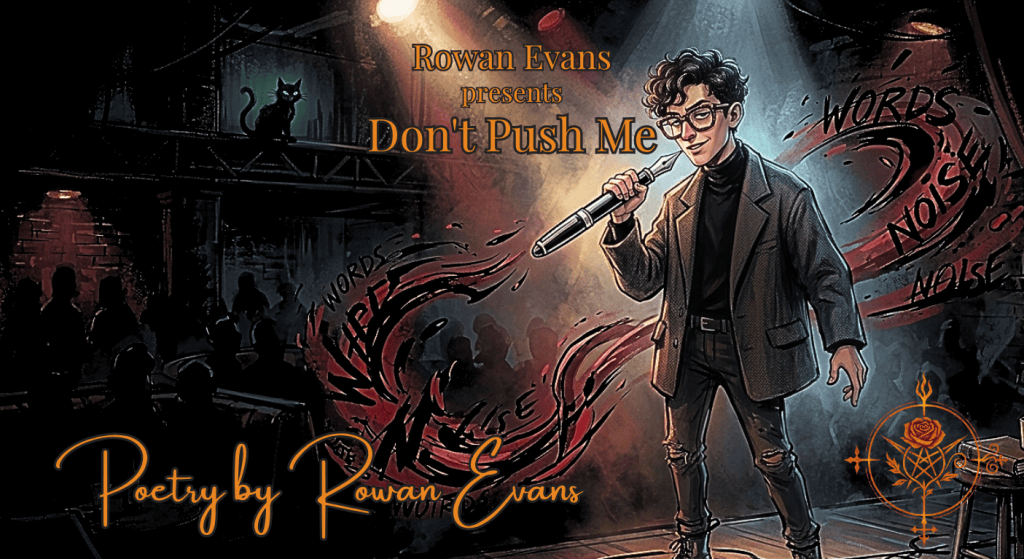
[Don’t Push Me] A playful battle-poetry piece about turning insults into punchlines, standing your ground, and refusing to be intimidated. Don’t Push Me mixes swagger, humor, rhyme, and Rowan Evans’ signature self-aware interruptions.
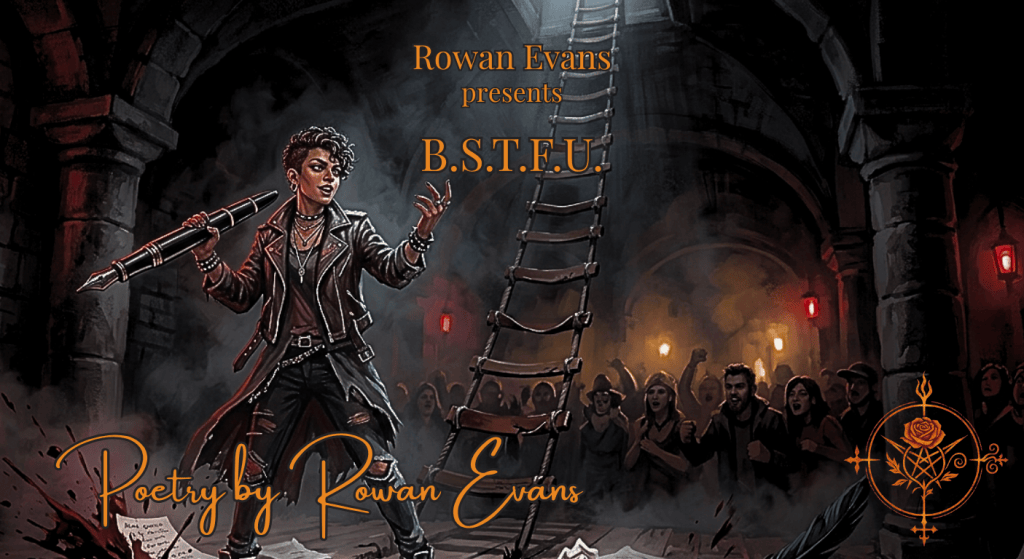
[B.S.T.F.U.] A playful battle-poetry exercise packed with insults, internal rhymes, punchlines, wordplay, and literary swagger. B.S.T.F.U. is Rowan Evans flexing the verbal muscles—not calling out anyone in particular.
Don’t Push Me is another exercise in letting my battle-poet voice stretch its legs.
This isn’t meant as a literal threat or a callout toward any particular person. It’s playful bravado—the kind of exaggerated, cartoonish toughness that happens when I take an ordinary insult, run it through my sense of humor, and see how far I can push the rhyme.
The opening starts with something I’ve genuinely heard for most of my life: being called “four-eyes.” From there, the poem turns that insult into ammunition. If you’re going to give me material, I’m going to make something out of it.
And then, naturally, my brain couldn’t resist sabotaging the intimidation.
I’m not— (shhh, nice kitty)
Because apparently even Battle Rowan has an editor. Sometimes the strongest thing you can do with anger isn’t explode. Sometimes it’s turn it into a punchline.
— Rowan Evans
Sometimes you don’t have to throw the first punch—you just have to know what to do with the material they give you.
Don’t Push Me Poetry by Rowan Evans
You called me four-eyes? And you want me to react to that? I’ve had glasses since I was two, bifocals since five— I’ve had four eyes, longer than you’ve been alive.
What’s next? You gonna call me slow?
(I’m fast as fuck, boi.)
Physically or mentally? Doesn’t matter though, there’s something you should know.
I don’t back down, I stand my ground— because every fight I’m in, is like a fight for my life— I’m scrawny as fuck, man, still use no weapons— just fists, no knife.
So trust me—
you don’t want the jokes to stop, you don’t want to know what it’s like, when I really talk—
[B.S.T.F.U.] A playful battle-poetry exercise packed with insults, internal rhymes, punchlines, wordplay, and literary swagger. B.S.T.F.U. is Rowan Evans flexing the verbal muscles—not calling out anyone in particular.
There isn’t a real target hiding behind this poem, no specific person I’m trying to call out, and no secret literary feud happening behind the scenes. I wrote this because sometimes I like to take the battle-poet side of my voice out for a walk and see what it can do.
This piece is deliberately over-the-top. It’s swagger, insults, wordplay, internal rhyme, punchlines, and a little bit of absurdity thrown into the blender. The goal wasn’t to make a serious accusation—it was to practice the mechanics of verbal combat while having fun with the language.
And honestly, that’s part of why I love writing: sometimes I want to write something vulnerable, sometimes I want to build mythology, sometimes I want to make conspiracy theories about fish, and sometimes I just want to look at the imaginary competition and say:
Where are you on the ladder?
Below me.
It’s not that serious.
But the pen game?
That part is serious.
— Rowan Evans
No target. No feud. Just a poet flexing the pen and climbing the imaginary ladder.
B.S.T.F.U. Poetry by Rowan Evans
Bitch, shut the fuck up—
what’chu talkin’ about?
Don’t think I haven’t heard—
how you’re runnin’ your mouth.
You thought ’cause I don’t talk a lot,
I was open season, you should be scared—
let me give you a reason, I’m a big dog—
all bite, no bark and a license to write still.
I write with precision, I write kills—
you’re not a writer,
you’re the one who steals—
plagiarizing those with skill.
It’s stolen lines
and stolen rhymes—
the only thing keeping you
holding on to borrowed time—
it’s not yours—
it’s whoever writes for you.
It’s me and it’s them—
it’s the wielders of the pen.
Those with skill,
with lines that kill
and lines that heal—
we know—
you don’t write, bitch—
be so for real.
You don’t know what a metaphor is—
and a stanza?
You hear that and you’re like—
isn’t his first name Tony?
Bitch, you’re a phony…
if you were
to try and write—
baloney.
All that to ask—
when it comes
to writing—
where are you
on the ladder?
Below me.
Journey into the Hexverse…
[Across the Page-cific] A playful, autobiographical journey through the strange places poetry can take me—from sandwich heartbreak and pasta diss poems to gothic monsters, mythology, ravens, ghosts, and storms across the page. Beneath the absurdity is something deeply personal: the realization that writing gave me a way to rebuild myself, piece by piece.
Slim & Shady IX: Gods & Monsters is a reckoning—an apex of myth, chaos, and lyrical ferocity. In this piece, Olympus trembles beneath the weight of words, monsters roar, and gods are challenged not by force, but by rhythm, rhyme, and raw audacity.
This installment celebrates the audacious collision of legend and rebellion, a tribute to the voices that have inspired my craft while marking the evolution of my own. It is a hymn for those who revel in chaos, who understand that power is not only in the divine, but in the sharpness of syllables, the precision of cadence, and the courage to rewrite the canon.
Read it as you would a storm: let it crack the sky, let it shake the ground, let it echo in your bones. Here, I am both the shadow and the spark, the sinner and the saint, and the lyric that laughs while Olympus falls.
— Rowan Evans
Step into the storm—Rowan Evans’ Slim & Shady IX: Gods & Monsters merges myth, rap, and chaos in poetic epicness.
I step into Olympus like a burglar with a grudge, my words lightning—zip, crack, jagged— splitting the sky between divine and damned. Zeus blinks, Apollo spits fire, but I don’t flinch, I spit back in kind: “Your thunder is borrowed, your glory recycled. I’m the storm you whispered of in bedtime tales, trained in Multiverse & Madness, tempered in velvet venom.”
Monsters crawl from shadows—Cerberus grins, Hydra heads nod, each spit venom in Morse code—“Bow or bleed.” I laugh, syllables slicing teeth like blades: “Bow? Please. Crowns are gutter trophies. Bleed? I bathe in ink, come out polished, primed, and lethal.” The echoes of Roses & Ruin taught me subtle cruelty; Olympus is my canvas.
Athena steps forward, wisdom blazing, spear poised. I match her gaze, wordplay lacing her logic: “Brains without scars are brittle, goddess. Even Olympus cracks; silk & sin whispered the lesson—humility through surrender.” Her armor gleams, but I see the cracks—my verses find them, widen them, crown them.
Hades smirks, shadows curling like smoke: “Child, you trespass in my playground.” I tip my crown, crooked, cocky: “Your playground is a grave. I’m here to haunt you tonight.” Each line a hammer, each pause a guillotine. Brimstone hums in my veins; Blood & Brimstone sang the prep, now I dance.
Monsters cheer, gods frown, and I don’t care— I spit verses like bullets ricocheting off marble and bone. Word for word, myth for myth, I am the chaos in their canon, the question mark in every prophecy.
Poseidon crashes oceans at my feet, but I rhyme tidal waves into whispers, turn floods into fountains that crown me in silver and ash. The monsters howl; the gods bite lips. Velvet & Venom drips from every syllable.
“Gods of Olympus, Monsters of myth, listen— I am ink staining legends, the echo rewriting epics. You think in absolutes; I think in fractures. You worship power; I worship voice. You claim eternity; I claim truth. Bow if you must. Tremble if you can. I am both: shadow and spark, sinner and saint, the lyric that laughs while heavens fall.”
Thunder cracks. Cerberus snarls. Hydra hisses in unison. Athena blinks. Hades pauses. And in the silence that follows, I roar: “Gods. Monsters. Try me.”