Some poems arrive carrying trauma, existential questions, complicated metaphors, and enough symbolism to fill a cathedral.
This one showed up carrying a fucking pun.
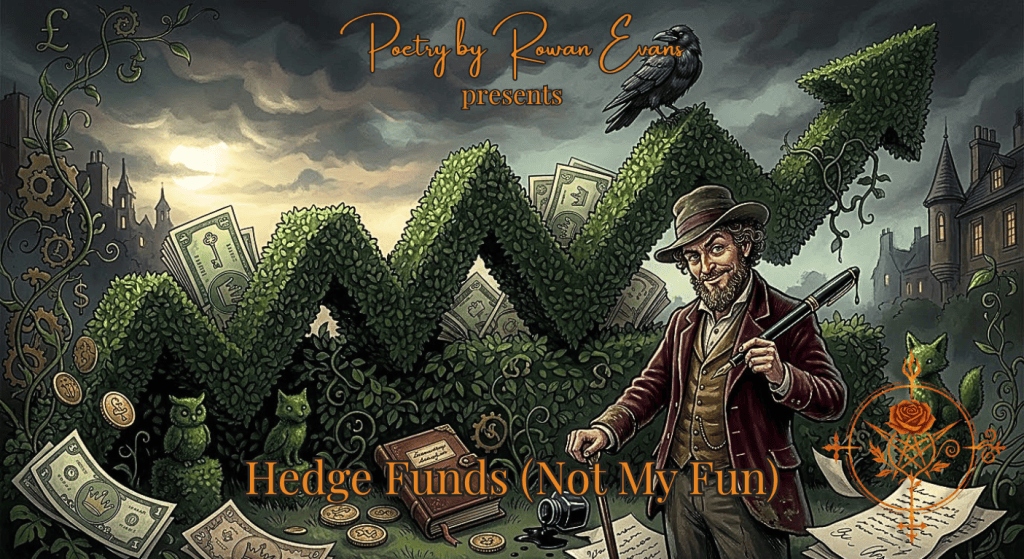
Hedge Funds (Not My Fun) is deliberately stupid. I wanted to play with sound, names, word associations, and the increasingly questionable logic of a joke that refuses to die. Sometimes the page doesn’t need another emotional excavation—it just needs to have a little fun.
So yes, this is a poem about hedge funds.
No, I don’t actually have any.
And apparently, neither does my fun.
— Rowan Evans
The hedge has funds. The funds aren’t mine. Therefore, the fun remains tragically unfunded.
Hedge Funds (Not My Fun) Poetry by Rowan Evans
I think I’m so fucking funny—
I’ll make a Big Pun,
while lookin’ like a Pimp
C—but you can’t see me,
like my name is John
and my time is now—
or at least, I hope it is.
Because I’m trying to get my funds up,
yeah, I want to get my fun up—
so I stack my funds
as high as my hedges—
get it?
Hedge Fund.
That means the money isn’t mine—
so I’m stacking some funds high,
they’re just not my funds, and—
because they’re not my funds,
they do not fund my fun, man.
Sometimes the loudest hater in the room is the one you brought with you.
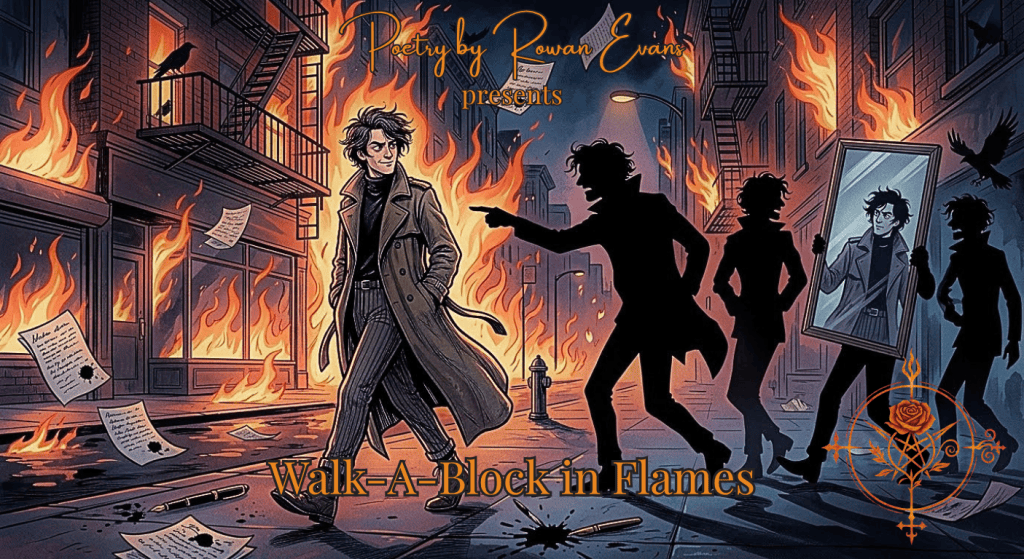
Walk-A-Block in Flames started with the idea of imaginary critics—the voices that somehow manage to find fault with everything you do, even when nobody else is actually saying a damn thing. Naturally, my brain decided the appropriate response was to turn that internal conflict into a ridiculous walk around the block, throw in some wordplay, and see how many times I could make the joke work before the poem eventually turned the joke back on me.
Because beneath all the flames, bravado, and fake enemies, there’s a much simpler realization:
Sometimes the person I’m arguing with is me.
And honestly?
That’s probably the funniest part.
— Rowan Evans
Plot twist: the haters were imaginary, and unfortunately, they had my voice.
Walk-A-Block in Flames Poetry by Rowan Evans
They tell me,
these imaginary haters,
that I’ve fuckin’ created—
they live inside my head,
feeding on my self-doubt—
obsessed with burning the self-down.
They make me take a walk,
a walk around a block
and it’s fucking hot—
I guess you could say,
these imaginary haters made me,
Waka Flocka Flame.
Wait—
I meant to say—
these haters made me
Walk-A-Block In Flames.
Honestly though,
I don’t know
what the fuck
they hate me for—
Is it because my wrist froze?
Nope, I’m broke—
Because I’m the best to ever do it?
Nope, that’s a joke—
Is it because they say
the things I think about me?
Couldn’t be—
because I think I’m great,
and these haters are fake.
I mean literally fake,
figments—
they don’t exist,
it’s just me in this bitch.
Sometimes “I don’t give a fuck” isn’t really apathy. Sometimes it’s exhaustion, overextension, or finally realizing that not everything deserves a piece of you.
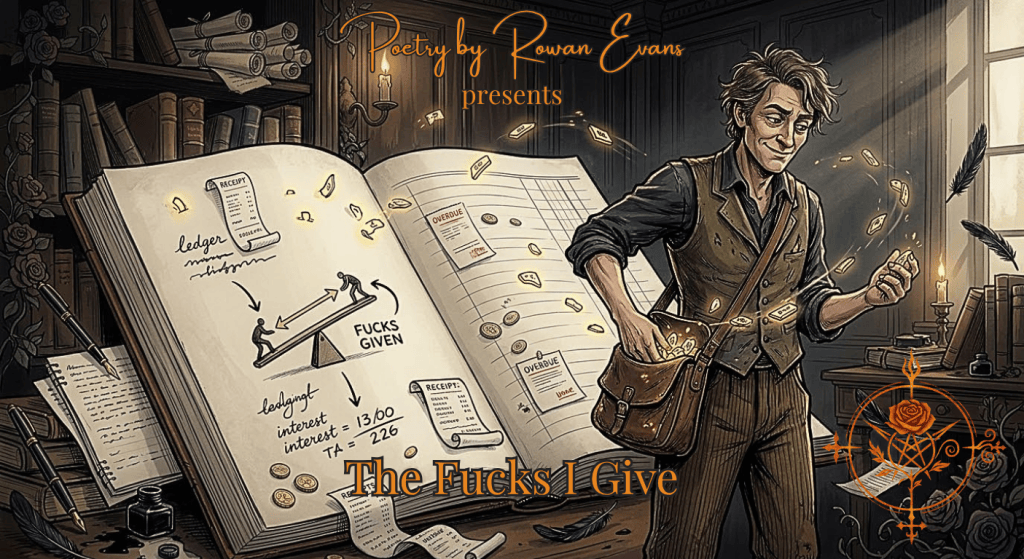
The Fucks I Give takes that idea and turns it into a ridiculous little accounting problem. If I’ve been handing out fucks like they’re an unlimited resource, eventually I’m going to have to audit the books, collect the outstanding balance, and start charging interest.
Underneath the jokes and profanity is something I’m actually pretty serious about: learning to be selective with what gets my attention, my energy, my emotions, and my time.
Because giving a fuck can be an act of love.
So can taking your fucks back.
— Rowan Evans
Apparently, my fucks weren’t free. I’m just finally collecting the outstanding balance.
The Fucks I Give Poetry by Rowan Evans
They said I’m too apathetic,
actin’ like nothing matters,
and it’s pathetic—
they want me to give a fuck,
but shit, I misplaced my bag of fucks—
so I’ve got no fucks to give.
Yeah, I’ll go through
and take all my fucks back—
I’ll walk right up and knock, like—
I’m here to collect my fucks,
and extra fucks too—
it’s a fucking tax,
and there is interest, dude.
You think fucks are endless.
No, I’ve got to be pickier—
because for a minute there,
it was—
fuck everything
and that’s probably
what they’re angry for.
It was fuck this and fuck that—
I was running out of fucks fast.
Sometimes the loudest critic in the room is the one living inside your own head.
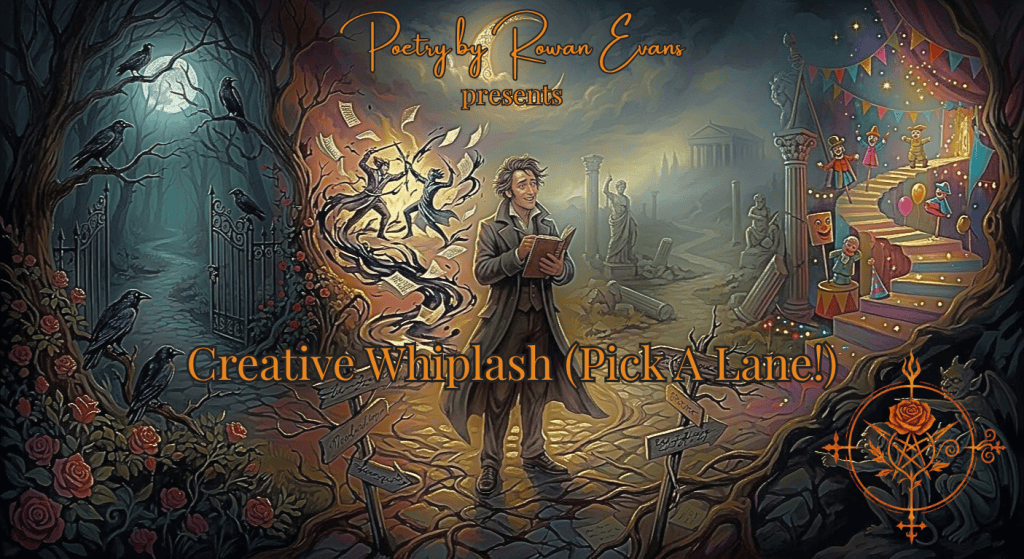
Creative Whiplash (Pick A Lane!) is about the pressure to define yourself as a writer, choose a style, and stay neatly within its boundaries—even when your creativity refuses to cooperate. One moment, I’m writing gothic poetry; the next, I’m throwing punchlines, weaving mythology, or drawing battle lines with a pen.
And somewhere in the middle of all that, the inner critic starts screaming that nothing makes sense.
The funny part? Sometimes the poem proves the critic wrong before the critic even finishes complaining.
Maybe I don’t need to pick a lane. Maybe creativity was never meant to be a straight road.
— Rowan Evans
Pick a lane? I tried. My creativity took the exit, changed three times, and somehow wrote a poem about it.
Creative Whiplash (Pick A Lane!) Poetry by Rowan Evans
I asked you to show me a metaphor—
you asked, what’s the meta for?
You said you’re a writer, are you sure?
Because I’m not anymore—
run on sentence, run on lines,
zero flow and zero rhymes—
that’s how you write.
Ironic—
I just proved myself
wrong, right?
Well, sometimes I get in my head,
convince myself that nothing I write
is ever good enough—
and no one can call my bluff.
Isn’t that rough?
Pick a lane! Pick a lane!
Repeated, screaming in my brain—
are you a gothic poet,
or do you draw battle lines?
Do you weave myths,
or write comedic shit?
Pick a lane! Pick a lane!
Repeated, screaming in my brain—
giving readers whiplash
with how fast, I switch lanes—
it’s a pain in the neck,
creativity, hard to keep in check.
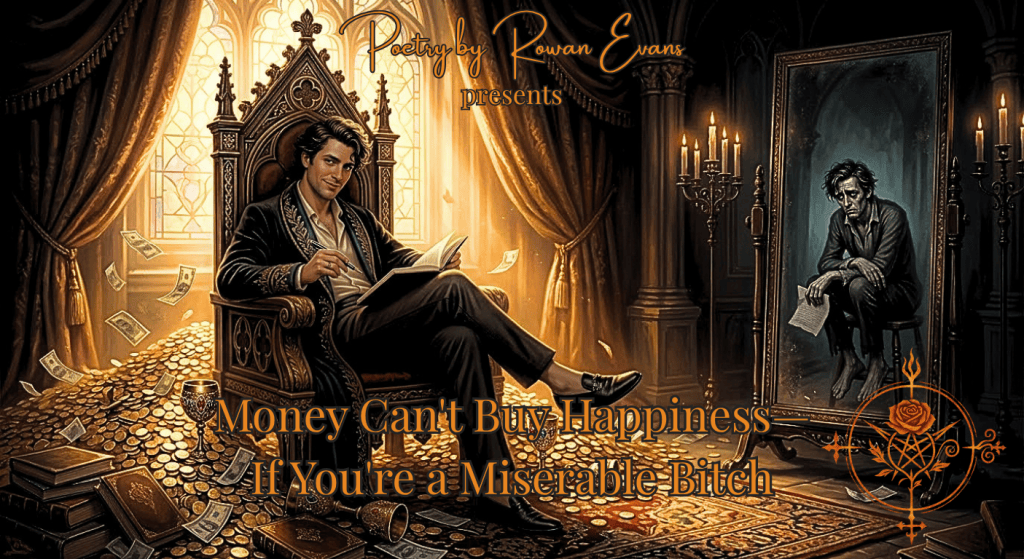
“Money can’t buy happiness” has always sounded a little too tidy to me.
Money can absolutely buy comfort, convenience, security, experiences, and a whole lot of things that can make life easier. Pretending otherwise misses the point. But there’s a difference between making life more comfortable and making yourself happy.
Money Can’t Buy Happiness—If You’re a Miserable Bitch takes that familiar saying, argues with it, insults it a little, and then lands somewhere in the middle: money might change your circumstances, but it can’t do the internal work for you.
If you’re miserable before the money arrives, there’s a decent chance you’ll just become a wealthier miserable person.
So, yeah.
Bitch, please.
— Rowan Evans
Money can buy the room. It can’t decide what happens inside your head.
Money Can’t Buy Happiness—If You’re a Miserable Bitch Poetry by Rowan Evans
They say money can’t buy happiness—
and honestly, that’s half true.
Money doesn’t buy happiness,
money buys things—
and things bring happiness
for a minute it seems—
but money can’t buy happiness?
Bitch, please—
that sounds like something
somebody with money
would say—
because it’s not the cash
that brings the smile,
it’s the ease
the cash brings—
so they say
money can’t buy happiness,
but they’re only half right—
money can’t buy happiness—
if you’re a miserable bitch.
You’ve got to already be happy and shit,
so learn to love what you’ve got.
Because when the money comes,
and you’re swimming in funds—
if you’re not already happy
with where you’re at?
You’ll never be happy after that.
Journey into the Hexverse
[Sick Bird] A short, uncompromising political metaphor that questions the fixation on left versus right when the entire system may be sick. Through the image of a collapsing bird, the poem confronts division, corruption, and the consequences of ignoring the larger failure.
[For the Youth (Remix)] A 2026 remix of Rowan Evans’s original 2024 poem, encouraging young people to embrace their truth, recognize their worth, raise their voices, and become the light they want to see in the world.
[Rose & Ruin] Two minimalist poems exploring the opposing forces within creativity: the thoughts we cultivate into something beautiful and the darker thoughts we transform before they have a chance to decay.
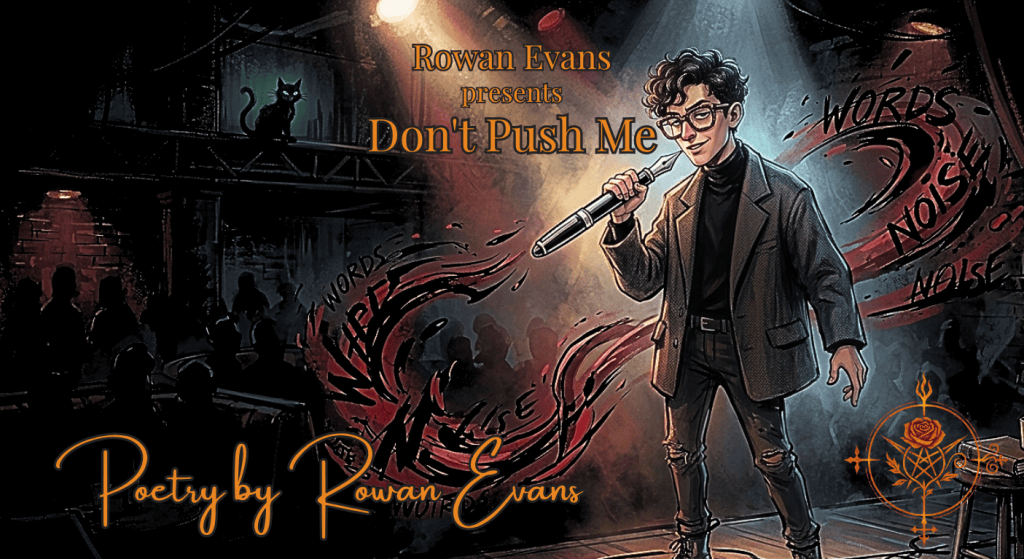
Don’t Push Me is another exercise in letting my battle-poet voice stretch its legs.
This isn’t meant as a literal threat or a callout toward any particular person. It’s playful bravado—the kind of exaggerated, cartoonish toughness that happens when I take an ordinary insult, run it through my sense of humor, and see how far I can push the rhyme.
The opening starts with something I’ve genuinely heard for most of my life: being called “four-eyes.” From there, the poem turns that insult into ammunition. If you’re going to give me material, I’m going to make something out of it.
And then, naturally, my brain couldn’t resist sabotaging the intimidation.
I’m not— (shhh, nice kitty)
Because apparently even Battle Rowan has an editor. Sometimes the strongest thing you can do with anger isn’t explode. Sometimes it’s turn it into a punchline.
— Rowan Evans
Sometimes you don’t have to throw the first punch—you just have to know what to do with the material they give you.
Don’t Push Me Poetry by Rowan Evans
You called me four-eyes? And you want me to react to that? I’ve had glasses since I was two, bifocals since five— I’ve had four eyes, longer than you’ve been alive.
What’s next? You gonna call me slow?
(I’m fast as fuck, boi.)
Physically or mentally? Doesn’t matter though, there’s something you should know.
I don’t back down, I stand my ground— because every fight I’m in, is like a fight for my life— I’m scrawny as fuck, man, still use no weapons— just fists, no knife.
So trust me—
you don’t want the jokes to stop, you don’t want to know what it’s like, when I really talk—
[B.S.T.F.U.] A playful battle-poetry exercise packed with insults, internal rhymes, punchlines, wordplay, and literary swagger. B.S.T.F.U. is Rowan Evans flexing the verbal muscles—not calling out anyone in particular.
Unfortunately for that poet, Tony has discovered pasta.
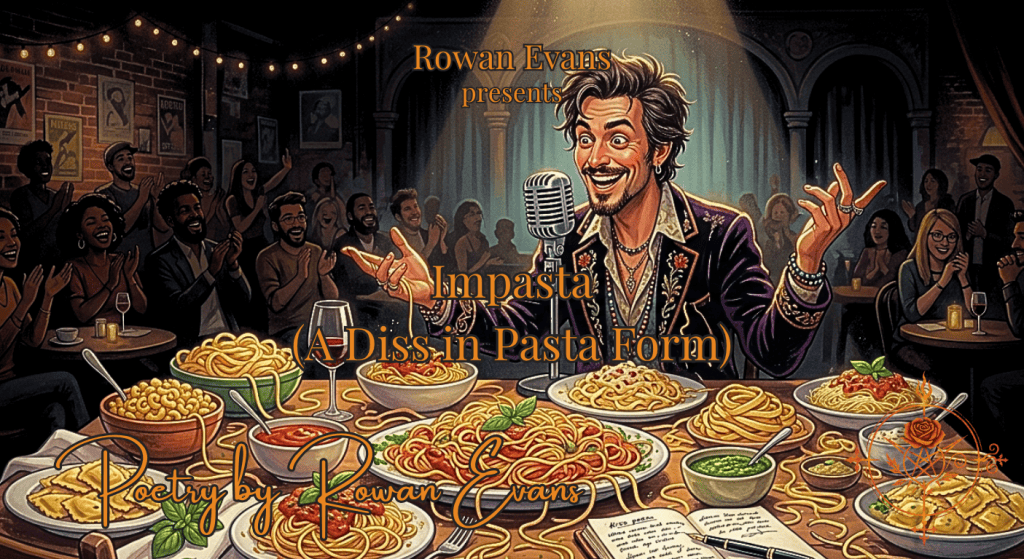
Impasta (A Diss in Pasta Form) is exactly what it sounds like: a diss poem written almost entirely through pasta-related wordplay. Spaghetti becomes “impasta.” Fettuccine becomes “alfredo.” Macaroni becomes a metaphor for having no backbone. Ravioli becomes something that folds under pressure.
And Tony is absolutely convinced this is devastating.
That is what makes Tony Stanza fun.
He isn’t trying to be subtle. He isn’t trying to sound sophisticated. He is a fictional poet who has apparently decided that every pasta dish is an opportunity for literary violence.
But underneath the ridiculousness, there is a real little diss hiding in here.
The target isn’t merely being called a bad poet. They’re being accused of being derivative, fragile, empty, and dependent on other people’s work. The pasta metaphors are ridiculous, but the criticism itself is surprisingly straightforward:
Your work isn’t yours.
Your confidence doesn’t survive pressure.
And underneath all that presentation, there’s nothing there.
Of course, Tony couldn’t possibly just say that.
He had to make it about spaghetti.
This is also another piece in the growing mythology of Tony Stanza—the “greatest poet you’ve never heard of,” a poet whose signature “Ayo…” apparently signals that something deeply unserious is about to happen.
If I write anything pasta-related from this point forward, Tony Stanza did it.
I don’t make the rules.
Tony does.
— Rowan Evans
Ayo… Tony Stanza has entered the kitchen. And somebody’s about to get impasta’d. 🍝
Impasta (A Diss in Pasta Form) Poetry by Tony Stanza
Ayo…
I call you spaghetti— because you’re just an impasta. (Imposter.) Your rhymes are cheesy. Parmesan.
All these suckers fettucine. They alfredo. (afraid though.) Yeah, these bitches is macaroni. All elbows. No backbone.
They talk a lot a ravioli— but fold when pressure hits, seam splits— and you realize they were full of nothing, no substance.
You thought you were angel hair, capellini, the chosen one—divinity with a pen. But you’re just thin-skinned, overcooked, fragile to the core.
Journey into the Hexverse…
[Lost in the Sauce] A playful heartbreak poem where sandwiches, ketchup, mustard, rye, lettuce, and sourdough become metaphors for emotional confusion. Beneath the food puns is a speaker trying to understand how everything went from “we’re okay” to suddenly feeling cold.
And sometimes my brain apparently looks at a sandwich and says, yes, this is how we’re processing emotional confusion today.
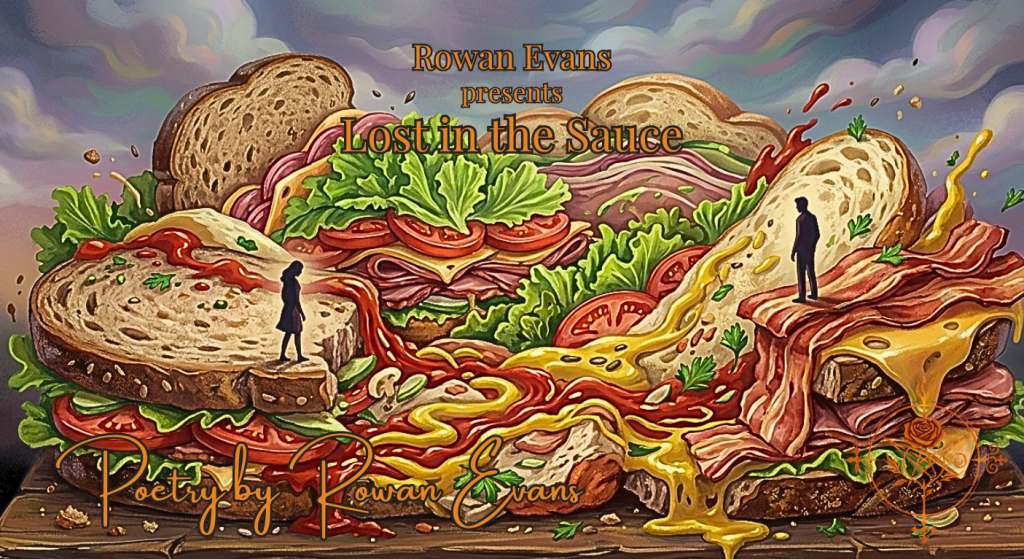
Lost in the Sauce is a deliberately playful poem built around food-related wordplay, particularly the language of sandwiches, condiments, bread, and the wonderfully terrible possibilities hidden inside them.
The jokes are intentionally stupid.
That is part of the point.
“Bread” becomes “rye.” “Ketchup” becomes “catch up.” “Mustard” becomes “must’ve.” “Sourdough” becomes an emotional description. Even “lettuce meat in the middle” is doing multiple jobs at once.
But beneath all of that nonsense is something much more familiar: the confusion of being told that everything is okay while someone’s behavior feels completely different.
The speaker is trying to understand the contradiction.
They were told the relationship was fine.
They were told the other person was happy.
So why does everything suddenly feel cold?
Why does affection feel sour?
Why does the speaker feel trapped in place, struggling to catch up to something they don’t fully understand?
The ridiculous wordplay gives me permission to approach that emotional confusion without making the poem overly solemn.
I’ve been rediscovering how much I enjoy treating language like a playground—taking ordinary words, twisting them until they become something else, and seeing how far I can push a joke before the emotional meaning underneath it starts showing through.
So yes, this poem is about sandwiches.
Sort of.
Mostly, it’s about being lost in the sauce when the person you’re trying to understand has already changed the recipe.
— Rowan Evans
Sometimes you don’t fall apart. Sometimes you just get lost in the sauce. 🥪
Lost in the Sauce Poetry by Rowan Evans
You sandwiched me in
with an all-tomato—
love you or leave,
but I couldn’t do it clean—
I was lost in the sauce,
begging lettuce
meat in the middle.
You said, “you lie.”
I said, “Nah, you rye.”
But do you know why?
I was stuck in place,
you wouldn’t wait—
I was struggling
to ketchup.
I thought you
mustard—
how could you not?
People talk.
Look—
I’m sorry.
I don’t want to fight.
But, you said—
you were happy.
We were okay.
So why you so cold,
why you actin’ sourdough?
Journey into the Hexverse…
[Did You Really Think This Was About Trees?] A playful love poem disguised as a forest of terrible tree puns. Beneath the birch, oak, cedar, palms, lumber, and absurdist wordplay is a poem about devotion, loyalty, laughter, and building a life with someone you love.
[Blended Hardware] A playful, absurdist poem where step-ladders, garden hoses, Star Wars, teenage memories, Gothic imagery, and the poet’s own self-interrupting commentary collide. Blended Hardware is a celebration of letting language wander.