Tag: Satirical Poetry

  • Author’s Note

    “Money can’t buy happiness” has always sounded a little too tidy to me.

    Money can absolutely buy comfort, convenience, security, experiences, and a whole lot of things that can make life easier. Pretending otherwise misses the point. But there’s a difference between making life more comfortable and making yourself happy.

    Money Can’t Buy Happiness—If You’re a Miserable Bitch takes that familiar saying, argues with it, insults it a little, and then lands somewhere in the middle: money might change your circumstances, but it can’t do the internal work for you.

    If you’re miserable before the money arrives, there’s a decent chance you’ll just become a wealthier miserable person.

    So, yeah.

    Bitch, please.

    — Rowan Evans
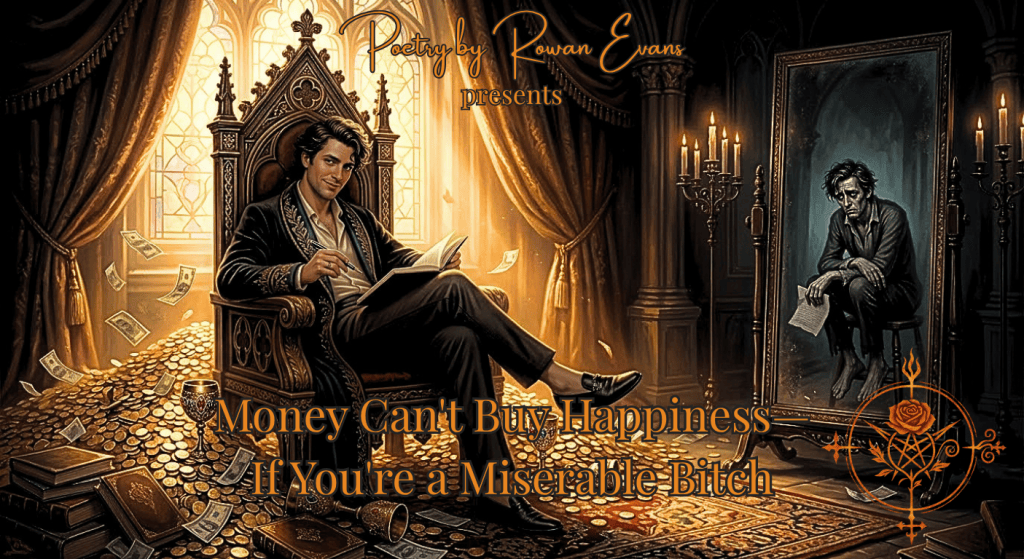

    A poet surrounded by wealth and luxury while a dark reflection suggests that money cannot create inner happiness.
    Money can buy the room. It can’t decide what happens inside your head.

    Money Can’t Buy Happiness—If You’re a Miserable Bitch
    Poetry by Rowan Evans

    They say money can’t buy happiness—
    and honestly, that’s half true.
    Money doesn’t buy happiness,
    money buys things—
    and things bring happiness
    for a minute it seems—
    but money can’t buy happiness?

    Bitch, please—
    that sounds like something
    somebody with money
    would say—

    because it’s not the cash
    that brings the smile,
    it’s the ease
    the cash brings—

    so they say
    money can’t buy happiness,
    but they’re only half right—

    money can’t buy happiness—
    if you’re a miserable bitch.

    You’ve got to already be happy and shit,
    so learn to love what you’ve got.
    Because when the money comes,
    and you’re swimming in funds—
    if you’re not already happy
    with where you’re at?

    You’ll never be happy after that.


    Journey into the Hexverse

    [Sick Bird]
    A short, uncompromising political metaphor that questions the fixation on left versus right when the entire system may be sick. Through the image of a collapsing bird, the poem confronts division, corruption, and the consequences of ignoring the larger failure.

    [For the Youth (Remix)]
    A 2026 remix of Rowan Evans’s original 2024 poem, encouraging young people to embrace their truth, recognize their worth, raise their voices, and become the light they want to see in the world.

    [Rose & Ruin]
    Two minimalist poems exploring the opposing forces within creativity: the thoughts we cultivate into something beautiful and the darker thoughts we transform before they have a chance to decay.

    If you’re interested in more poetry, you can find it here → [The Library of Ashes]
  • Author’s Note

    What happens when you stop questioning the big questions and start questioning the stupid ones?

    Question Math. Question Fish. takes a perfectly ordinary equation and refuses to leave it alone. Two plus two should be simple—but apparently we’ve got corporations, aquatic conspiracies, suspicious fish classifications, and an entire Aquarium Industrial Complex to investigate.

    This piece is deliberately ridiculous. It borrows the language of conspiracy theories, institutional distrust, and “wake up, sheeple” rhetoric and points it directly at things that absolutely do not need a conspiracy theory.

    Because maybe the joke isn’t whether two plus two equals four.

    Maybe the joke is how quickly we can convince ourselves that anything deserves suspicion if we stare at it long enough.

    So question the math.

    Question the fish.

    Question the catfish.

    And, obviously, question everything.

    — Rowan Evans


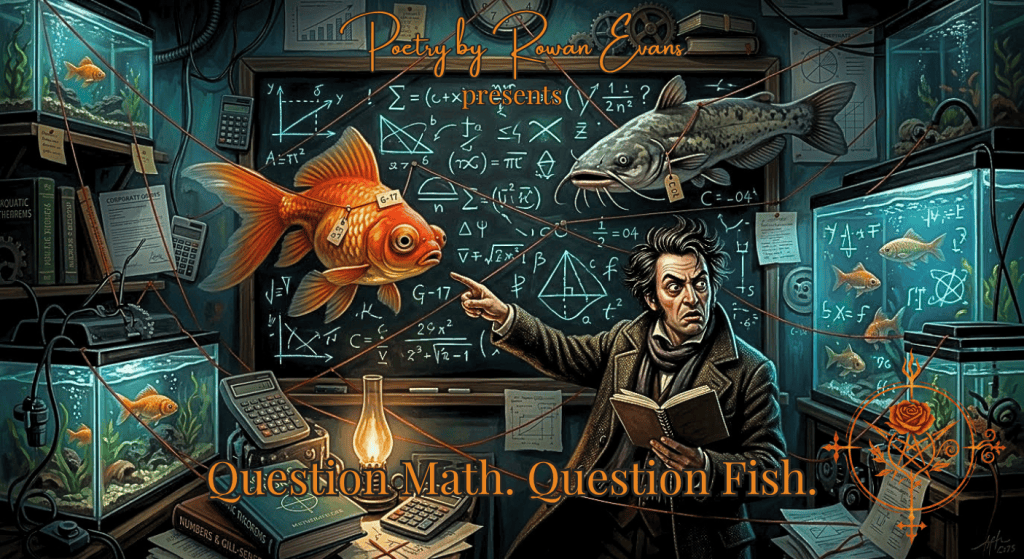
    A poet investigates a surreal conspiracy involving mathematical symbols, goldfish, catfish, calculators, and an aquarium.
    Two plus two equals four. The fish, however, remain under investigation.

    Question Math. Question Fish.
    Poetry by Rowan Evans

    Two plus two
    equals four,
    or does it?

    You see—
    Big Math
    would have you
    believe—

    numbers mean something—

    they don’t…

    numbers are a joke.
    A figment, imaginary at best—
    two plus two might as well
    equal goldfish.

    And what’s a goldfish anyway?
    Fish or gold, make up your mind—
    and don’t get me started on catfish,
    ’cause what is this shit?

    Cats don’t even like water.
    Now one is a fish?
    Get real, bitch.

    Don’t listen to this shit—
    Big Aquarium just tryin’ to get slick.

    One fish, two fish—
    red fish, blue fish—
    these companies
    are lying
    to you, bitch.

    And how does one fish—
    become two fish?
    And a red fish—
    into a blue fish?

    You wish.

    It’s Big Math
    and the Aquarium Industrial Complex
    working together
    to warp reality—
    a fish isn’t gold,
    a fish isn’t a cat—
    but these people think that
    we’re stupid,
    we don’t see what they’re doing—

    two plus two
    equals four,
    are you sure?

    Open your eyes.
    Wake up.
    Think for yourself.
    Question Math.
    Question Fish.

    Question.
    Everything.


    Journey into the Hexverse

    [The Playground]
    What happens when mythology stops being something to hide behind and becomes architecture for the imagination? The Playground (Language, Metaphors and More) explores Rowan Evans’s relationship with language, symbolism, metaphor, humor, and twenty-three years of turning the page into a place where anything can happen.

    [All for Me]
    When thunder becomes applause, lightning turns into paparazzi, and rain rolls out a flooded red carpet, one poet starts wondering whether nature’s celebration has gone a little too far.

    [Love Me From Over There]
    A sharp and humorous poem about the strange contradiction of wanting someone close while simultaneously needing them to stay several feet away from your face.

    [It’s Almost Like I Know What I’m Doing]
    A self-aware reflection on nearly three decades of writing, discovering how rage became rhythm, pain became poetry, and comedic timing became another tool in the poet’s arsenal.

    If you’re interested in more poetry, you can find it here → [The Library of Ashes]
  • Author’s Note

    A bird cannot stay in the sky when the sickness has spread through its entire body. And no amount of arguing over which wing is responsible will change the condition of the bird itself.

    This piece is a short, sharp political metaphor about division, corruption, and the danger of treating opposing sides as separate problems when the larger system is already failing. It doesn’t linger to build an elaborate argument; it drops into the image, lets the wings beat against the ground, and leaves the reader with the sound of something collapsing.

    Sometimes the question isn’t which wing is right.

    Sometimes it’s whether the bird can survive at all.

    — Rowan Evans


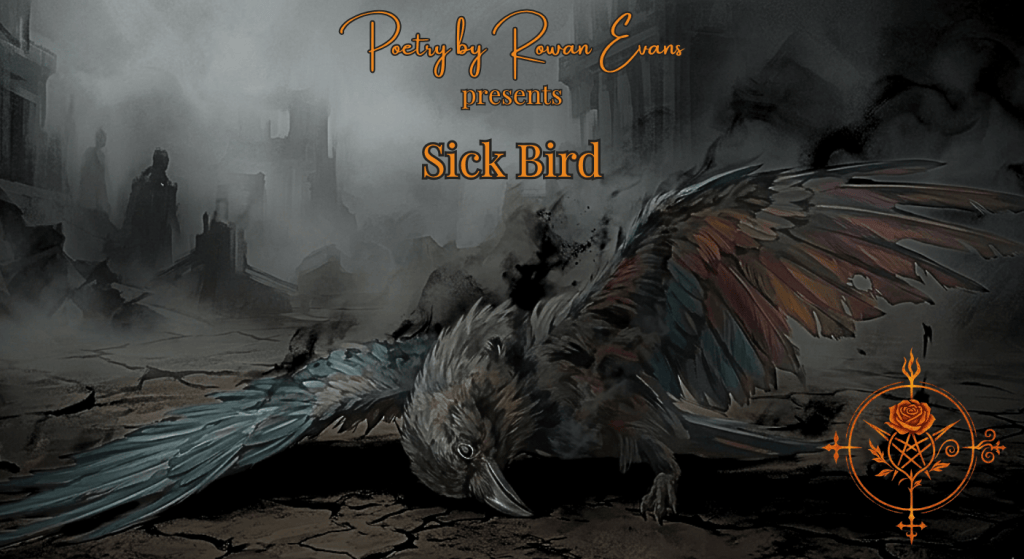
    A sick bird with damaged wings lies on a cracked landscape, symbolizing division and systemic corruption.
    When the whole bird is sick, arguing over its wings won’t save it.

    Sick Bird
    Poetry by Rowan Evans

    Left wing or right wing?
    I don’t give a fuck—
    it doesn’t matter,
    if the whole bird
    is sick and corrupt—

    the whole bird is going down—
    flapping wild on the ground—
    death rattle, our final sound—


    Journey into the Hexverse

    If you’re interested in more poetry, you can find it here → [The Library of Ashes]
  • Author’s Note

    Ayo…

    Tony Stanza is back.

    And apparently, he has beef with another poet.

    Unfortunately for that poet, Tony has discovered pasta.

    Impasta (A Diss in Pasta Form) is exactly what it sounds like: a diss poem written almost entirely through pasta-related wordplay. Spaghetti becomes “impasta.” Fettuccine becomes “alfredo.” Macaroni becomes a metaphor for having no backbone. Ravioli becomes something that folds under pressure.

    And Tony is absolutely convinced this is devastating.

    That is what makes Tony Stanza fun.

    He isn’t trying to be subtle. He isn’t trying to sound sophisticated. He is a fictional poet who has apparently decided that every pasta dish is an opportunity for literary violence.

    But underneath the ridiculousness, there is a real little diss hiding in here.

    The target isn’t merely being called a bad poet. They’re being accused of being derivative, fragile, empty, and dependent on other people’s work. The pasta metaphors are ridiculous, but the criticism itself is surprisingly straightforward:

    Your work isn’t yours.

    Your confidence doesn’t survive pressure.

    And underneath all that presentation, there’s nothing there.

    Of course, Tony couldn’t possibly just say that.

    He had to make it about spaghetti.

    This is also another piece in the growing mythology of Tony Stanza—the “greatest poet you’ve never heard of,” a poet whose signature “Ayo…” apparently signals that something deeply unserious is about to happen.

    If I write anything pasta-related from this point forward, Tony Stanza did it.

    I don’t make the rules.

    Tony does.

    — Rowan Evans


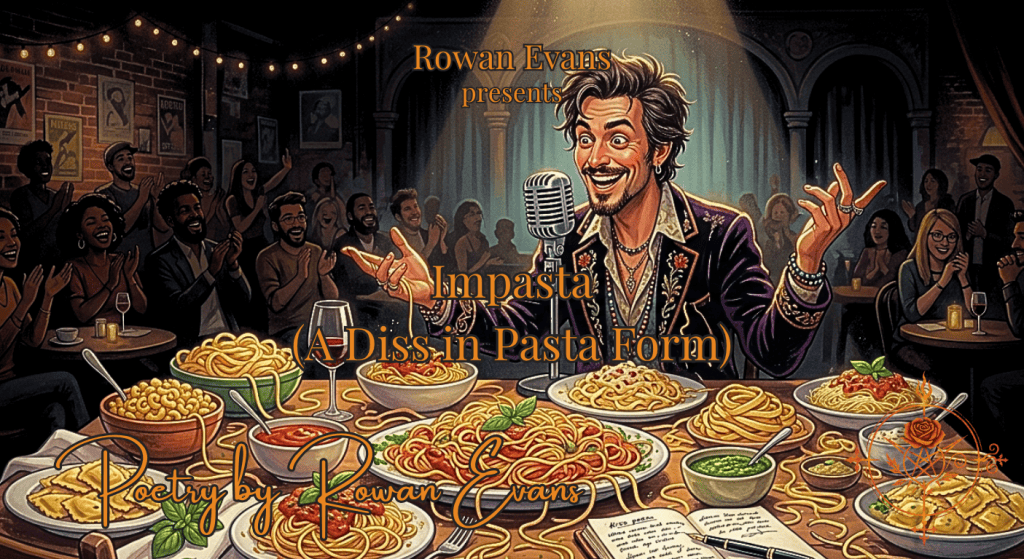
    A fictional poet confidently writing a diss poem beside plates of spaghetti, fettuccine, macaroni, ravioli, and angel hair pasta.
    Ayo…
    Tony Stanza has entered the kitchen.
    And somebody’s about to get impasta’d. 🍝

    Impasta (A Diss in Pasta Form)
    Poetry by Tony Stanza

    Ayo…

    I call you spaghetti—
    because you’re just
    an impasta. (Imposter.)
    Your rhymes are cheesy.
    Parmesan.

    All these suckers fettucine.
    They alfredo. (afraid though.)
    Yeah, these bitches is macaroni.
    All elbows. No backbone.

    They talk a lot a ravioli—
    but fold when pressure hits,
    seam splits—
    and you realize they were
    full of nothing, no substance.

    You thought you were angel hair, capellini,
    the chosen one—divinity with a pen.
    But you’re just thin-skinned, overcooked,
    fragile to the core.


    Journey into the Hexverse…

    [Lost in the Sauce]
    A playful heartbreak poem where sandwiches, ketchup, mustard, rye, lettuce, and sourdough become metaphors for emotional confusion. Beneath the food puns is a speaker trying to understand how everything went from “we’re okay” to suddenly feeling cold.

    If you’re interested in more poetry, you can find it here → [The Library of Ashes]