Tag: relationship poetry

  • Author’s Note

    This poem came from a simple thought: if you love someone, you have to love the person—not merely the role you want them to play.

    A Person First pushes back against the idea that protection, tradition, or romance gives someone permission to control another person’s voice, choices, or identity. A partner is not an accessory to display or a puppet to move around. She is a person first—with her own voice, her own wings, and her own agency.

    Love should make room for someone to sing.

    — Rowan Evans
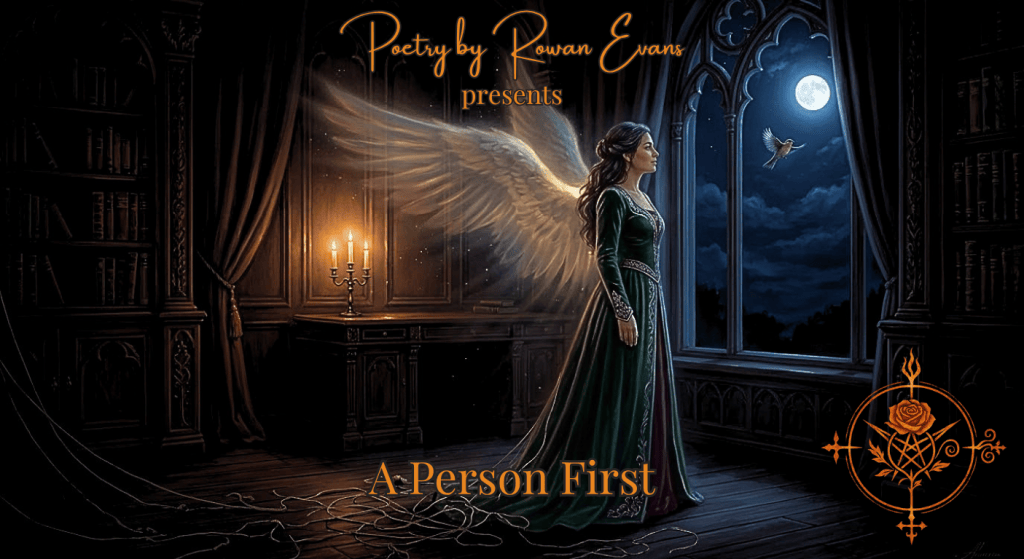

    A woman standing beneath moonlight as a songbird flies free and broken puppet strings fall away, symbolizing autonomy and freedom.
    Love her as a person, not as a role you can control.

    A Person First
    Poetry by Rowan Evans

    I’ve been stuck on this thought,
    it’s been on my mind a lot—
    why when some guys say they love women,
    does it feel like they really don’t love women?
    It’s like they’ve got a songbird,
    but they don’t want to hear her sing—
    like they’ve got an angel,
    but they want to clip her wings—

    even in traditional gender roles,
    you are not supposed to control—
    protection doesn’t mean silence,
    you’re supposed to be a team—
    if you think otherwise,
    you’re entirely misguided—

    because she is a person first—

    not an accessory,
    and if that’s something
    you can’t see—
    then you don’t want a wife,
    just a puppet on strings.


    Journey into the Hexverse

    [Half a Picture]
    What happens when someone falls in love with the person they discover through your poetry? Half a Picture explores the strange intimacy between writer and reader—and the distance between seeing someone’s mind through their words and truly knowing the whole person.

    [Caged Birds Don’t Bow (Remix)]
    A defiant remix of Rowan Evans’ “Caged Birds Don’t Bow,” confronting control, possession, and insecurity through the imagery of a bird breaking free from its cage and reclaiming its wings.

    If you’re interested in more poetry, you can find it here → [The Library of Ashes]
  • Author’s Note

    There comes a point in certain conversations when the words have already worn themselves thin. Promises become repetitions, explanations become excuses, and the silence between two people starts saying more than either of them can manage.

    “If You Want to Go” steps into that moment—the moment when frustration stops begging to be understood and starts letting go. Its voice is blunt, impatient, and tired of pretending that another conversation will somehow change what has already been made clear.

    Sometimes, the hardest part of walking away isn’t opening the door.

    It’s finally refusing to stand in front of it, waiting for someone to decide.

    — Rowan Evans


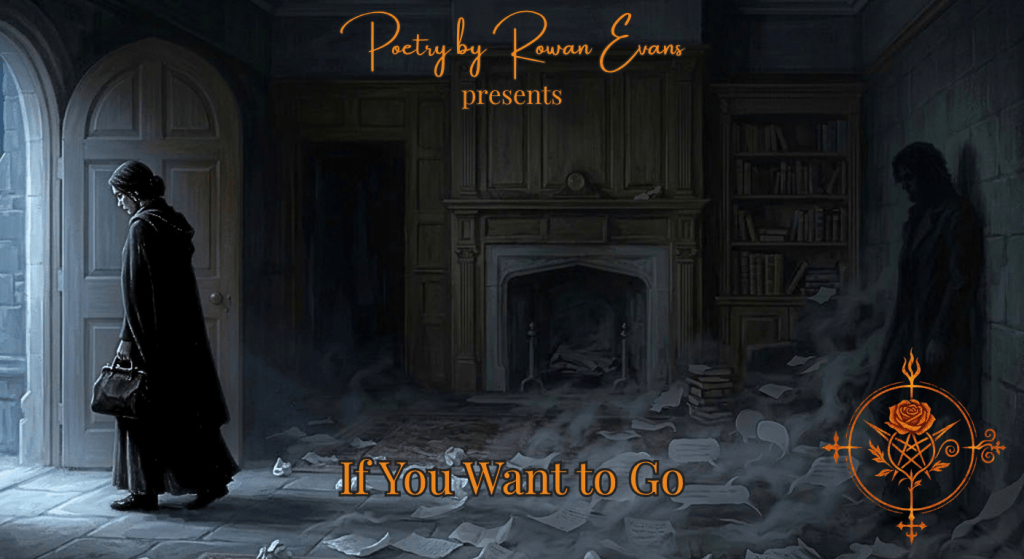
    Two figures stand apart in a shadowed room beside an open doorway, symbolizing emotional exhaustion and the choice to let someone leave.
    When the words become excuses, sometimes letting go says enough.

    If You Want to Go
    Poetry by Rowan Evans

    If you want walk—

    then walk—

    we don’t have to waste our time,
    we don’t have to talk—
    I don’t want to listen to another empty line,
    it’s just excuses—talking is useless—

    What?

    Now you’re mad?

    Why—
    because I gave you
    what you wanted?

    If you want to go,
    then go—
    what do we keep doing this for?

    We don’t have pretend anymore—


    Journey into the Hexverse

    [You Still Pop Into My Brain]
    Sometimes, someone from your past still wanders into your thoughts—not because you want them back, but because they once held a place in your everyday life. A reflective poem about disappointment, growth, and the strange persistence of memory after moving on.

    If you’re interested in more poetry, you can find it here → [The Library of Ashes]
  • Author’s Note

    Some people leave your life in a single, dramatic moment. Others fade through a series of small decisions, subtle disappointments, and lessons you never asked to learn. And sometimes, long after you’ve moved forward, a familiar name still wanders through your thoughts—not because you want them back, but because they once occupied a place in your everyday life.

    This piece sits in that strange space between moving on and remembering. It doesn’t reach backward with longing or anger. It simply acknowledges that even when someone no longer belongs in your life, the mind may occasionally forget to stop looking for them.

    — Rowan Evans


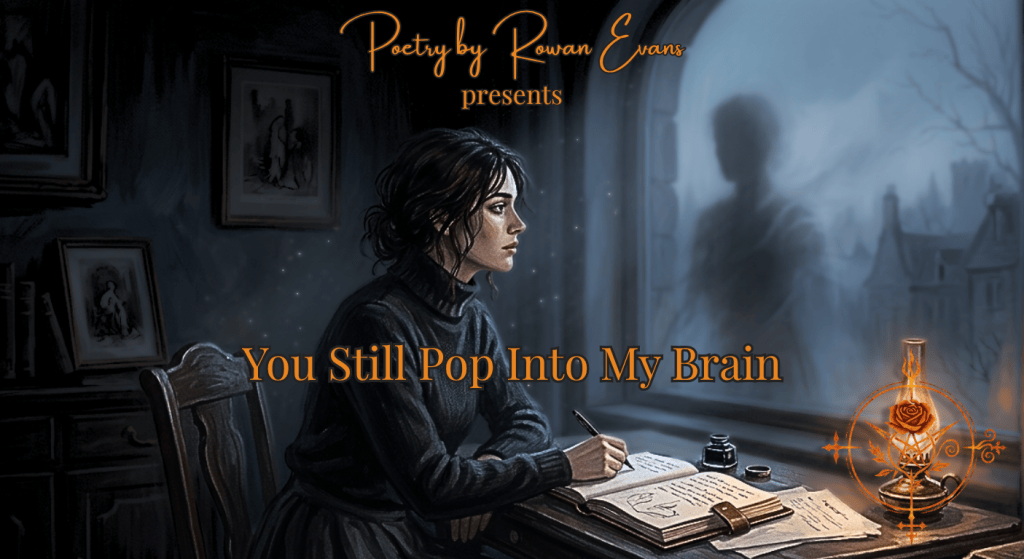
    A poet sits beside a window with an open notebook as a fading silhouette outside represents a lingering memory from the past.
    Some memories still visit. They just don’t feel like home anymore.

    You Still Pop Into My Brain
    Poetry by Rowan Evans

    You look at me now,
    and see—
    someone better than
    who I used to be—
    but that’s all
    thanks to you—
    if I hadn’t learned the lessons,
    if you hadn’t switched up
    and made me see—
    you were never the one for me.

    It didn’t come all at once,
    it came in steps for me,
    you began to pull away, gradually—
    it was little things at first,
    you’d do things you thought would hurt—
    introduced me to him,
    just so you could flirt—
    thinking I’d see it,
    and feel like dirt—
    but it didn’t work.

    Because for me,
    it was whatever—
    we weren’t officially together.
    We never talked, exclusive—
    so who would I be
    to be mad to begin with?

    No, I wasn’t mad—
    I was more like your parents,
    just disappointed
    in who you had become.

    You used to be someone
    in my life—
    I used to reach for my phone
    every time something happened—
    wanting to tell you,
    and sometimes I still do.
    It’s a strange feeling
    because it’s been so long—
    and it feels so wrong,
    that you sometimes—

    still pop into my brain.

    But it’s not the same—
    it’s not how it used to be.


    Journey into the Hexverse

    [Lessons Without Kindness]
    A reflection on learning self-respect from a relationship that changed—the lessons hidden in manipulation, silence, and loss, and the realization that you don’t have to shrink yourself to make someone else feel tall.

    [Circle of Me]
    A reflective poem about sitting among the voices of memory, joy, pain, and fear—and realizing that some burdens are bigger than any one person.

    If you’re interested in more poetry, you can find it here → [The Library of Ashes]
  • Author’s Note

    Love Me From Over There is about wanting someone’s presence without necessarily having the emotional bandwidth for their presence to be… aggressively present.

    Sometimes being overwhelmed doesn’t mean you want to disappear from everyone you love. Sometimes you just want your person nearby, occupying the same little corner of the universe, while respectfully maintaining a distance that prevents you from launching yourself into the sun.

    So this poem takes that contradiction and lets it be funny.

    I don’t want to be alone.

    I just want you to love me from over there.

    — Rowan Evans


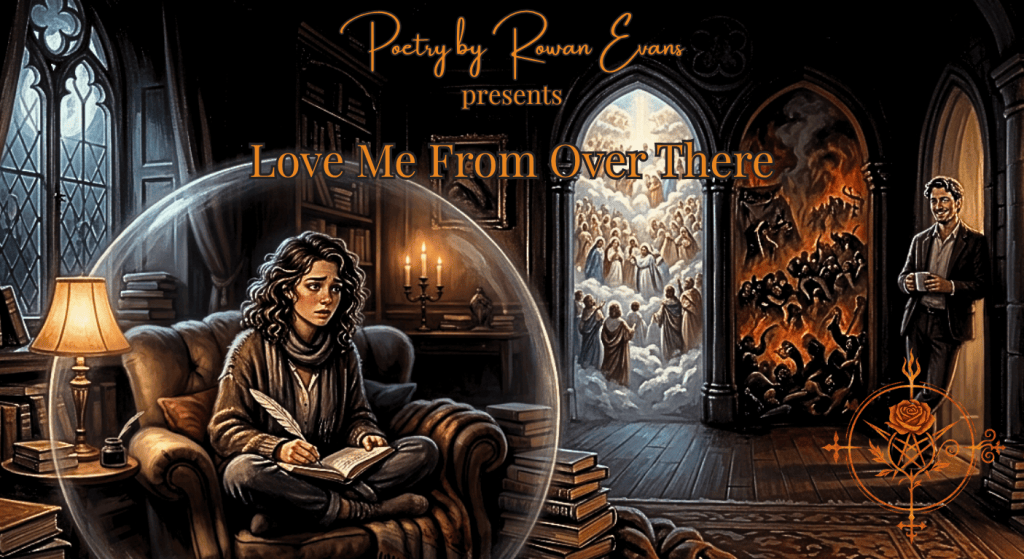
    A poet sitting comfortably in a quiet room while a loved one waits affectionately at a respectful distance.
    I want you here. I just need you over there.

    Love Me From Over There
    Poetry by Rowan Evans

    I’m feeling like I’m stuck in purgatory—
    but that’s fine though,
    I’m not really a fan crowds, so—
    I feel like Heaven would be too crowded,
    and Hell would be way too rowdy—
    see I’m more of a laid-back loner,
    not that I want to be alone all the time—

    I just want to be left alone all the time—

    it’s like, don’t bother me
    and I won’t bother you—
    I’ll live like that
    in the afterlife too—

    basically—
    what I’m saying is—
    I want you here
    but don’t speak to me.
    I don’t mean to be mean—
    I just mean, I want you in my space…

    not in my fucking face.

    Back up.


    Journey into the Hexverse

    [It’s Almost Like I Know What I’m Doing]
    A self-aware reflection on nearly three decades of writing, discovering how rage became rhythm, pain became poetry, and comedic timing became another tool in the poet’s arsenal.

    [The Metaphor Machine]
    A poem that takes apart its own machinery as it runs—breaking lines, breaking thoughts, and following metaphors from moonlight to tides, oceans, shorelines, and city streets.

    [It Could Have Been…]
    A playful little love poem about strawberries, roses, and the wonderfully ridiculous ways romance can show up when you know someone doesn’t like the traditional version.

    If you’re interested in more poetry, you can find it here → [The Library of Ashes]
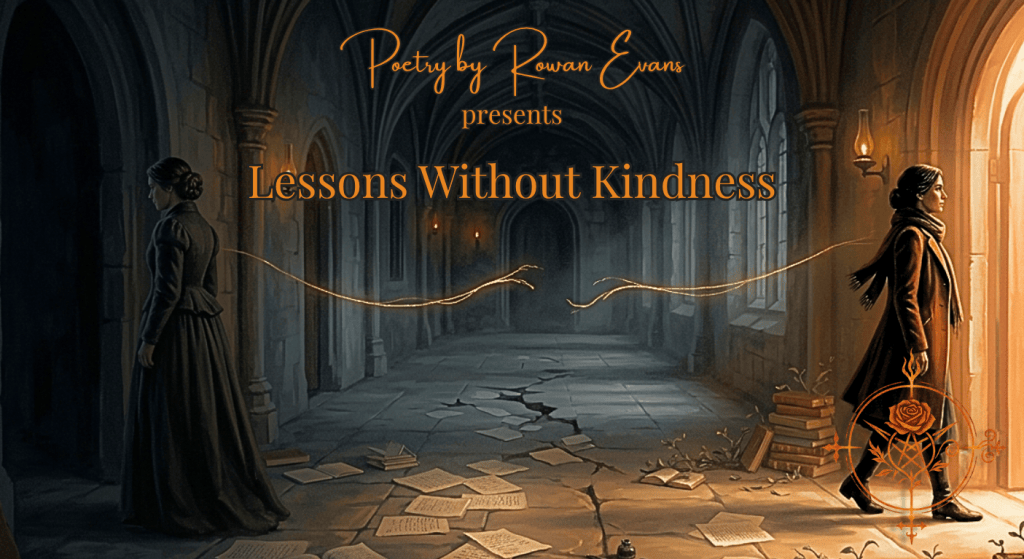
  • Author’s Note

    Lessons Without Kindness is about the strange education that can come from losing someone who once felt like your entire world.

    This isn’t really a poem about getting even. It’s about looking back at a relationship that changed, recognizing the games, the silence, and the ways I allowed myself to become smaller just to keep someone else comfortable—and realizing that I don’t live that way anymore.

    The person who taught me these lessons never intended to be my teacher. They didn’t sit me down and explain what I needed to learn. They simply gave me an experience harsh enough that I eventually learned it myself.

    Sometimes the most important lessons don’t come from kindness, wisdom, or good intentions.

    Sometimes they come from realizing what you will never allow yourself to become again.

    — Rowan Evans


    A figure leaving a shadowed hallway through a doorway of light, symbolizing self-respect learned from a painful relationship.
    Not every teacher is kind. Not every lesson is wasted.

    Lessons Without Kindness
    Poetry by Rowan Evans

    There was a time when
    you were my world,
    everything was fine and
    we really did love each other,
    or so I thought—
    yeah, we’d always talk—constantly,
    I was always thinking of you,
    and I thought
    you thought about me too.
    Maybe you did—once,

    then you changed
    and started playing games—
    you tried to get under my skin,
    pit me against him.
    But here’s the thing—
    he was never gonna win.
    I mean, truly,
    the only real loser was you—
    because in doing what you did,
    you lost me too.

    And I’m not saying I was a prize,
    but I really was a catch for you—
    I put up with too much,
    and spoke up too little.
    But I don’t do that anymore.
    I don’t shrink so someone else can feel tall.
    I don’t bend so someone else can feel right.
    I don’t stay quiet so someone else can stay comfortable.

    You taught me that.
    Not intentionally—
    but lessons don’t need kindness
    to be true,
    just a student and a teacher—
    that was me and you.


    Journey into the Hexverse

    [The Sacred Timeline]
    From childhood stories about Dragon Ball Z, Power Rangers, and Pokémon to gothic cathedrals, ravens, roses, identity, healing, and experimentation, The Sacred Timeline traces how Rowan Evans’s relationship with the pen evolved across thirty-six years—and how the ink remained while the writer kept changing.

    [The Metaphor Machine]
    A poem that takes apart its own machinery as it runs—breaking lines, breaking thoughts, and following metaphors from moonlight to tides, oceans, shorelines, and city streets.

    [Louder Than the Rain]
    A short confessional poem about the overwhelming noise of anxious thoughts, the strange silence of feeling alone in a crowded room, and finding a way to translate pain into words.

    If you’re interested in more poetry, you can find it here → [The Library of Ashes]
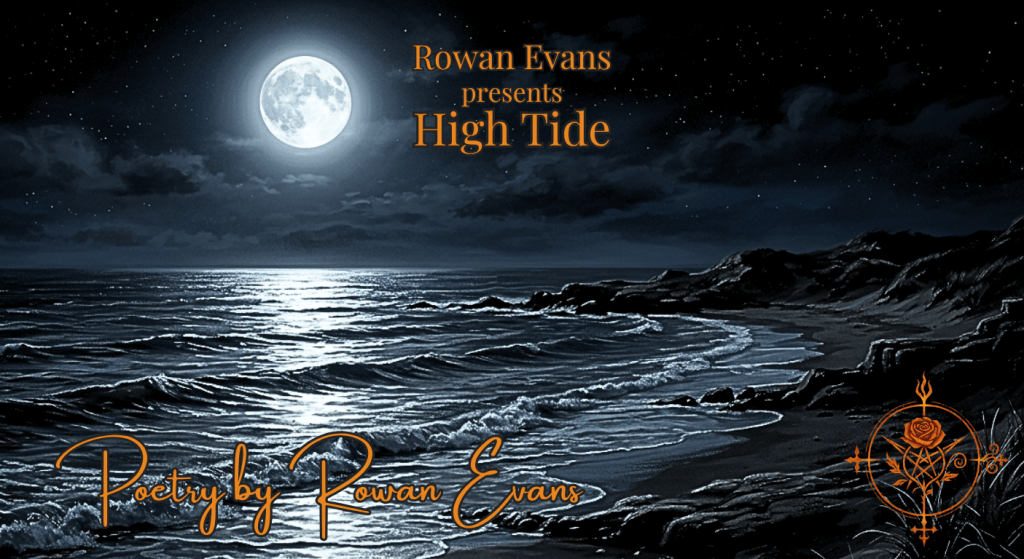
  • Author’s Note

    Some things in life move in cycles—leaving, returning, rising, falling. Sometimes we fight those movements, and sometimes we simply learn to recognize the tide when it comes in.

    — Rowan Evans


    A moonlit ocean rising toward the shore at high tide beneath a full moon.
    The tide rises, the tide falls—and sometimes we find ourselves returning with it.

    High Tide
    Poetry by Rowan Evans

    I said I wouldn’t leave,
    then I did but came back.
    So I guess—high tide—
    the way the water does,
    it rises then falls low—
    guided by the moon from afar, so…
    I guess I can’t be mad
    that you’ve got control.


    Journey into the Hexverse

    [Louder Than the Rain]
    A short confessional poem about the overwhelming noise of anxious thoughts, the strange silence of feeling alone in a crowded room, and finding a way to translate pain into words.

    [My Nightmare]
    A poem about the nightmare of loving someone across distance, seeing the world from different perspectives, and holding onto the hope that the cracks can still be repaired—and that someday two separate shores might become one.

    [Rose & Ruin]
    Two minimalist poems exploring the opposing forces within creativity: the thoughts we cultivate into something beautiful and the darker thoughts we transform before they have a chance to decay.

    If you’re interested in more poetry, you can find it here → [The Library of Ashes]
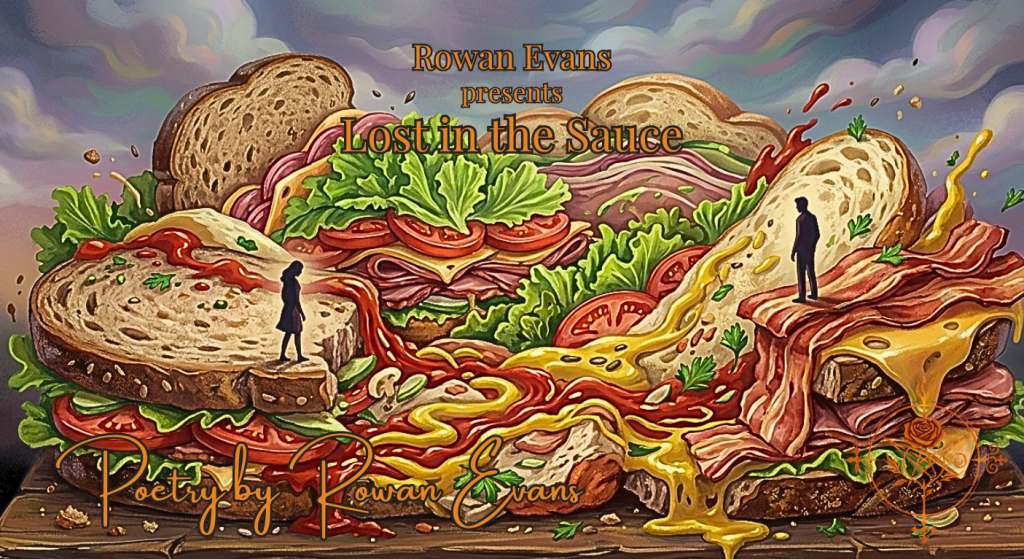
  • Author’s Note

    Sometimes a poem is born from heartbreak.

    Sometimes it is born from a metaphor.

    And sometimes my brain apparently looks at a sandwich and says, yes, this is how we’re processing emotional confusion today.

    Lost in the Sauce is a deliberately playful poem built around food-related wordplay, particularly the language of sandwiches, condiments, bread, and the wonderfully terrible possibilities hidden inside them.

    The jokes are intentionally stupid.

    That is part of the point.

    “Bread” becomes “rye.” “Ketchup” becomes “catch up.” “Mustard” becomes “must’ve.” “Sourdough” becomes an emotional description. Even “lettuce meat in the middle” is doing multiple jobs at once.

    But beneath all of that nonsense is something much more familiar: the confusion of being told that everything is okay while someone’s behavior feels completely different.

    The speaker is trying to understand the contradiction.

    They were told the relationship was fine.

    They were told the other person was happy.

    So why does everything suddenly feel cold?

    Why does affection feel sour?

    Why does the speaker feel trapped in place, struggling to catch up to something they don’t fully understand?

    The ridiculous wordplay gives me permission to approach that emotional confusion without making the poem overly solemn.

    I’ve been rediscovering how much I enjoy treating language like a playground—taking ordinary words, twisting them until they become something else, and seeing how far I can push a joke before the emotional meaning underneath it starts showing through.

    So yes, this poem is about sandwiches.

    Sort of.

    Mostly, it’s about being lost in the sauce when the person you’re trying to understand has already changed the recipe.

    — Rowan Evans


    A surreal sandwich with layers of bread, meat, lettuce, tomato, ketchup, and mustard separating two figures.
    Sometimes you don’t fall apart.
    Sometimes you just get lost in the sauce. 🥪

    Lost in the Sauce
    Poetry by Rowan Evans

    You sandwiched me in
    with an all-tomato—

    love you or leave,
    but I couldn’t do it clean—

    I was lost in the sauce,
    begging lettuce
    meat in the middle.

    You said, “you lie.”
    I said, “Nah, you rye.”

    But do you know why?
    I was stuck in place,
    you wouldn’t wait—

    I was struggling
    to ketchup.
    I thought you
    mustard—

    how could you not?
    People talk.

    Look—
    I’m sorry.
    I don’t want to fight.
    But, you said—
    you were happy.
    We were okay.

    So why you so cold,
    why you actin’ sourdough?


    Journey into the Hexverse…

    [Did You Really Think This Was About Trees?]
    A playful love poem disguised as a forest of terrible tree puns. Beneath the birch, oak, cedar, palms, lumber, and absurdist wordplay is a poem about devotion, loyalty, laughter, and building a life with someone you love.

    [Blended Hardware]
    A playful, absurdist poem where step-ladders, garden hoses, Star Wars, teenage memories, Gothic imagery, and the poet’s own self-interrupting commentary collide. Blended Hardware is a celebration of letting language wander.

    If you’re interested in more poetry, you can find it here → [The Library of Ashes]
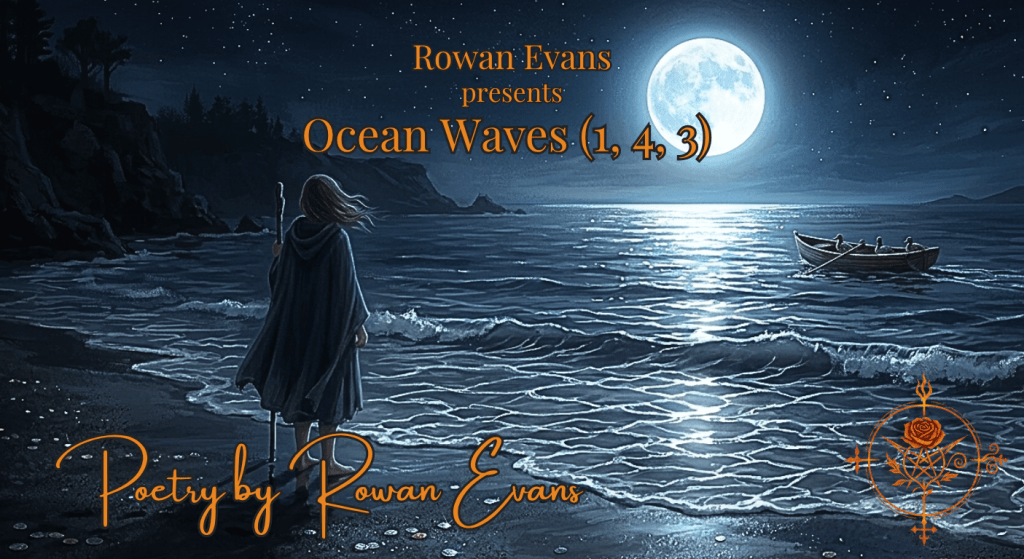
  • Author’s Note

    This poem began as a collection of bad jokes.

    Or at least that was the excuse.

    Sometimes I start writing with no destination in mind. A phrase appears. Then a pun. Then another. A moon becomes a metaphor. Ducks end up in a rowboat. A piggybank loses all its cents.

    And somewhere in the middle of all that nonsense, something honest sneaks in.

    I’ve noticed that humor often works like a side door.

    There are things I can say directly. There are things I can say through poetry. And then there are things that feel easier to approach sideways, hidden beneath wordplay, jokes, and absurd little detours.

    This piece lives in that space.

    The speaker keeps drifting away from the point, circling it rather than naming it. Every joke becomes a delay tactic. Every pun buys another moment before the truth has to be spoken aloud.

    Because sometimes vulnerability isn’t difficult because you don’t know what you feel.

    Sometimes it’s difficult because you know exactly what you feel.

    And saying it out loud makes it real.

    The title’s parenthetical reference, “1, 4, 3,” comes from an old numerical shorthand for a phrase many people know by heart. I liked the idea of building an entire poem around avoiding a confession, only to hide it in plain sight.

    In the end, the poem says exactly what it means.

    It just takes the scenic route to get there.

    — Rowan Evans


    A solitary figure stands on a moonlit beach beside gentle ocean waves while silver moonlight reflects across the water beneath a glowing night sky.
    Sometimes the longest journey to the truth is the scenic route—through moonlight, wordplay, ocean waves, and all the jokes we tell before we finally say what we mean.

    Ocean Waves (1, 4, 3)
    Poetry by Rowan Evans

    I stand on the shore
    giving ocean waves—
    begging the tide
    to take me away.

    I trace the moon
    across the sky,
    I map it in rhyme.
    Line after—
    silver-lined metaphor.

    I got my ducks in a row
    boat—is that what the paddles for?
    I know the direction,
    what would I panic for?

    You might be confused—
    I know that made no sense,
    like an empty piggybank.
    No cents, thoughts scattered
    like loose change.

    I use jokes
    to mask the truth sometimes.

    It makes what I want to say,
    an easier pill to swallow—

    1 letter
    followed by 4
    then 3—

    Together, they mean
    you mean the most to me.
    By your side—

    is where I’m supposed to be.


    Journey into the Hexverse…

    [1-4-3]
    A poem about love that isn’t rooted in need, but in choice. About finding safety not as a cage, but as a place where fear finally stops running—and stays.

    [1-4-3 (Tongue Tied)]
    A vulnerable poem about holding back the words that matter most. 1-4-3 (Tongue Tied) explores fear, emotional suppression, and the quiet ache of wanting to say “I love you.”

    [What I Want to Say]
    Sometimes the hardest words to say are the simplest ones. What I Want to Say explores love, hesitation, and the fear of what might change if you finally speak.

    [No Parachute]
    A poetic reflection on falling in love without hesitation—raw, uncertain, and without a safety net.

    If you’re interested in more poetry, you can find it here → [The Library of Ashes]
  • Author’s Note

    Some feelings become difficult to carry once they stop being hypothetical.

    You rehearse the words in your head, hide them in poems, disguise them as metaphors, bury them in “what ifs” and dream sequences—because saying them plainly makes them real.

    This piece came from that space between silence and confession.

    The strange place where fear and honesty start sounding alike.

    Not fear of loving someone.

    Fear of changing something that already matters deeply to you.

    Because sometimes the connection itself becomes so important that risking it feels terrifying.

    And sometimes love isn’t about perfection at all.

    Sometimes it’s just about seeing someone clearly—and caring anyway.

    — Rowan Evans


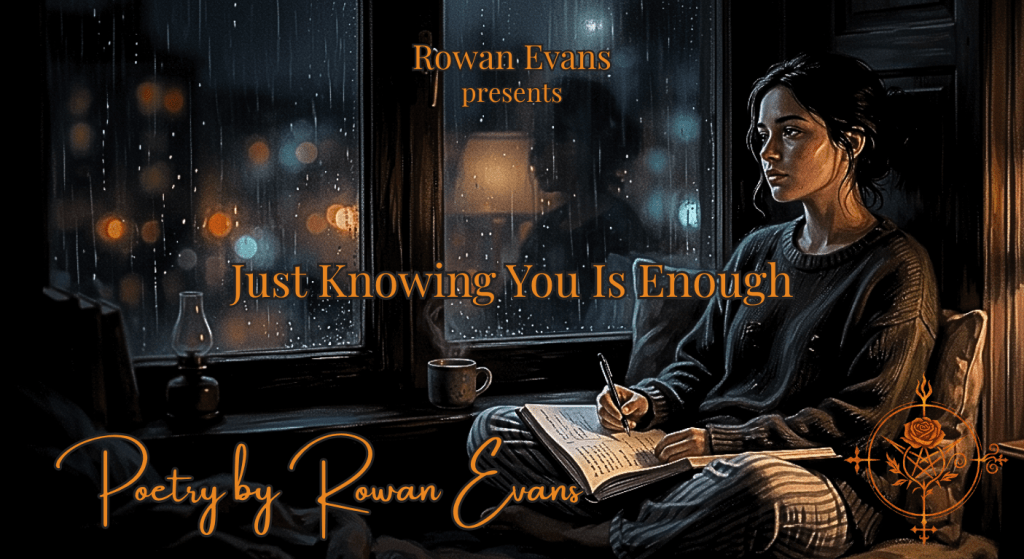
    A solitary person sits beside a softly lit window at night holding an open notebook in a quiet reflective atmosphere.
    Some truths stay hidden in poems long before they’re ever spoken aloud.

    Just Knowing You Has Been Enough
    Poetry by Rowan Evans

    I went quiet,
    but you never left my mind.

    I was silent—
    I had a lot to say,
    just didn’t know how to say it.

    I was afraid.
    Scared out of my mind.

    Everything I could have said,
    it didn’t feel right.
    It felt too heavy—
    too hard to carry.

    I had to set it down
    for a while.

    I had to sit with it,
    the words only spoken
    in my dreams.

    Dreams where,
    you never have the chance
    to respond.

    It feels wrong.

    But I wouldn’t want to
    speak for you.

    It’s been this way
    for a while now.

    I get too in my head,
    too hung up on
    what I have said—

    and what I want to say.

    They aren’t always
    the same.

    I’ve dropped hints
    in coded lines,
    wrote the words plain
    in poems about dreams—
    knowing they’d get overlooked.

    They’re not serious.

    But know this,
    the words written here
    are me being honest:

    I’m scared.
    I’m terrified,
    it’s true—
    but I really do
    love you.

    There’s no other way
    to say it.

    Because what is love—
    if not bias?

    And I am biased.

    Now what’s bias,
    if not seeing perfection
    where there is none?

    Because I know you’re not perfect—
    I’ve seen the cracks.
    I’ve listened to your stories,
    heard the lore—

    but here’s the thing,
    it’s not about perfection
    or lack thereof—
    it never has been.

    It’s about connection.

    It always has been.
    That’s all I’ve ever wanted,
    whatever shape that takes—
    I can be happy.

    Just knowing you
    has been enough.


    Journey into the Hexverse…

    [The Streets I Sleep When I Walk]
    “The Streets I Walk When I Sleep” is a deeply intimate free verse poem about recurring dreams, emotional connection, longing across distance, and the strange feeling of remembering places and moments that have never happened in waking life.

    [Memories From a Life Yet to Come]
    Some dreams feel less like fantasy and more like memory. “Memories From a Life Yet to Come” is a reflective free verse poem about longing, displacement, emotional alignment, and the strange comfort of recognizing yourself more clearly in dreams than in waking life

    [Separate Timelines]
    “Separate Timelines” is a surreal and deeply introspective free verse poem about emotional distance, time zones, vulnerability, and the fear of losing a connection that already feels meaningful before the words are ever spoken aloud.

    If you’re interested in more poetry, you can find it here → [The Library of Ashes]
  • Author’s Note

    There’s a version of success that looks good from the outside.

    Recognition. Stability. Achievement.

    But none of it really answers a simpler question:

    Who is it for?

    This piece comes from realizing that the things we’re told to chase don’t always mean as much as we think they will—especially if there’s no one there to share them with.

    It’s not about rejecting success.

    It’s about redefining what makes it matter.

    — Rowan Evans


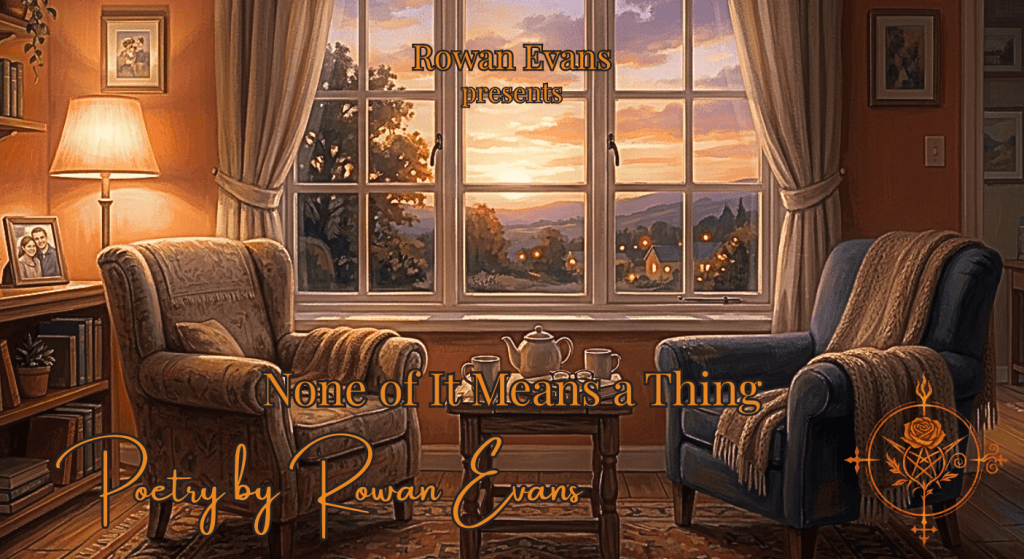
    Cozy home interior with two chairs by a window, representing companionship and shared life.
    Success means little if there’s no one there to share it with.

    None of It Means a Thing
    Poetry by Rowan Evans

    This is me confessing—
    I don’t want success
    to bless me
    unless it’s you
    there with me.

    I don’t need
    a sea of fans
    screaming my name—
    I’m not
    chasing fame.

    I don’t need
    pockets lined with gold.
    I need just enough
    to make our lives easier—
    and I mean it.

    Because I’m trying
    to build a life
    that can sustain—
    I want to thrive,
    not just survive.

    I want to build
    a home.

    But none of it
    means a thing
    if there’s no one
    there to share it.


    If you’re interested in more poetry, you can find it here → [The Library of Ashes]