Tag: moon imagery

  • Author’s Note

    The Sacred Timeline is a map of how my relationship with the pen has changed over nearly three decades of my life.

    I started with stories about worlds that already existed—Dragon Ball Z, Power Rangers, Pokémon—and slowly began building worlds of my own. Then the pen became a way to learn cadence, translate music, hide things I couldn’t say aloud, survive periods when writing itself became difficult, and eventually turn pain into something crafted enough to share.

    Every era left something behind: the storyteller, the songwriter, the secret keeper, the gothic romantic, the heretic, the battle poet, the confessor, the mythmaker. Some symbols came and stayed. Some meanings changed. Some questions took decades to become clear enough to write down.

    And the timeline is still moving.

    At thirty-six, I don’t consider the pen mastered so much as understood differently. Writing is still an experiment. The boundaries keep moving. The imagery keeps evolving. The person holding the pen keeps changing.

    Maybe that’s the most sacred part of the timeline: the ink stayed, but I didn’t.

    — Rowan Evans
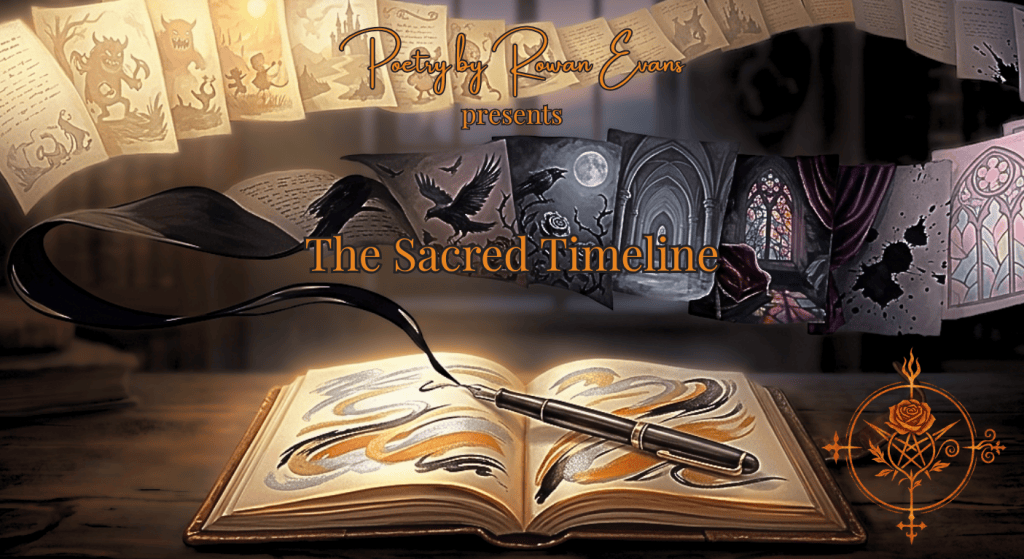

    An open notebook and pen at the center of a visual timeline showing childhood imagination evolving into gothic, reflective, and colorful poetry.
    Thirty-six years, countless pages, one pen—and an identity still being written.

    The Sacred Timeline
    Poetry by Rowan Evans

    I picked up a pen
    for the first time at seven,
    I was just writing stories then—
    Dragonball Z, Power Rangers and Pokémon…
    that’s what I wrote about
    way back when—

    it was much lighter out,
    the sun had yet to meet the clouds—
    I was a natural storyteller,
    a real lore keeper, weaving lore before
    I even knew what lore meant.
    It was like this for years,
    I created my own space in worlds
    provided by minds much older than mine.

    Then at ten—I switched
    what the pen meant to me,
    my creativity shifted mentally—
    no longer was I just a storyteller,
    I was letting music be the teacher now.
    Translating thoughts to song,
    at least the words of it—
    I was writing to worship something.
    Something that in six short years,
    I would begin to question—

    but the years between ten
    and then—were spent,
    using the pen to learn cadence.
    I was trying to learn
    to perform on the page—
    I couldn’t do it in body,
    but I could turn a notebook
    to a stage.

    At twelve things began to shift again,
    but with me, not with the pen—
    I still felt the sun, I still saws its rays,
    but I also saw more cloudy days—
    that year was hard for me,
    I couldn’t talk about it with clarity—
    most people would react like,
    “you’re scaring me”—
    so I stopped talking about it really,
    I closed my lips, but still let the ink spill—
    the page became a secret keeper,
    keeping the secrets this storyteller
    was too afraid to say out loud.

    Thirteen the skies went dark—
    this is when life really got hard.
    At the beginning of the year,
    it’s like the ink in my pen
    had begun to dry—
    I don’t know what was wrong,
    but I couldn’t write.
    I tried and I tried—
    pages ripped from notebooks,
    balled up and scattered.

    No songs, no stories—
    I had lost interest in things
    that I used to find most interesting.
    Parents took me to the doctor,
    and the doctor said—

    “This kid’s depressed—
    and anxious too,
    I’ll write a prescription
    that should do.
    A referral for therapy,
    they’ll get them to talk—
    they’ll find out what’s wrong.”

    A week would go by—
    giving the medicine a try,
    it takes time—
    it has to build up in your system.
    In the meantime,
    here’s a therapist,
    someone to talk to—
    they’ll listen to your problems,
    they’ll help you.

    And they did—a little bit,
    they got me to talk a little bit too.
    But still they saw I was holding back—
    so they recommended journaling,
    but that felt tedious and boring.
    I needed to find a way to make it play—
    bring a little joy to it, even if falsified.

    I made it a game
    to translate my pain—
    how many ways
    could I say everything?
    Is it possible to flip it?
    Maybe change the script
    and shift the meaning?
    These were the questions
    I began to ask—
    even when my ink
    ran in all black—

    back when my heart
    was all cracks,
    before I learned
    how to use the gold to patch—
    I struggled through,
    just writing purely what I felt—
    thirteen, fourteen and fifteen,
    often felt like hell.

    Sixteen, I hit my stride—
    not in life but with a pen,
    things were hard still,
    but now I could translate with skill.
    Not much, if we’re being honest—
    just enough to keep the pain beautiful,
    in case someone else saw it—

    Seventeen, I did it again—
    reinvented myself with the pen,
    more gothic in my intentions.
    Maybe I finally read Poe,
    who knows—
    but ravens became
    a part of my soul.

    At eighteen, I went from church steeples
    and church people to writing cathedrals
    for outcasts and heretics—
    we hadn’t yet, become luminous.
    Shadows and lace, velvet and venom—
    but I also opened my eyes more,
    became more aware of the world around—
    outside the borders I’m confined in.

    At twenty, I started to write
    for people more—to uplift,
    and let them know
    they’re not alone—
    whatever they were going through,
    there was somebody with them.
    Even from a distance—

    I had friends across seas,
    in places with palm trees—
    and in places with Kangaroos,
    even scarier—Emu.

    I don’t know what that means
    in this piece—but it’s true,
    so do with that,
    what you’re going to do.

    At twenty-two,
    I got more serious about the ink—
    I started to write everything.
    Every thought and
    every half-formed idea—
    I just put it on a page,
    my brain would not be a cage.

    Then came twenty-five,
    the lowest point in my life—
    it wasn’t a sudden crash,
    but a slow rot—
    it bled through every thought,
    a feeling I couldn’t translate,
    familiar but different,
    heavier somehow—
    so the ink slowed to a drip,
    I started to let thoughts slip.

    Twenty-six,
    I got serious again—
    more aggressive with the time spent,
    my pieces became more crafted
    and the ink was shaped with intention.
    Ravens, the moon, and roses too—
    the symbols I began to use.

    I ascend on the back of raven wings—
    the silver light of the moon
    pierced the canopy—rose petals drift
    in the shifting currents of the wind.
    Everything connects, pay more attention
    and you’ll become more aware—

    At thirty—
    I really began
    to question everything—
    who I was, who I am,
    who I want to be—
    and that’s still a question
    I’m working on answering.
    But it went deeper than that—
    I was questioning who I was
    in a deeper sense,
    like had I been a façade in some sense.
    Was I playing the role I was assigned,
    or being true to who I thought I was becoming?

    This became a recurring theme in my poetry—
    it’s an odd thing to discover so late in life,
    that the person you thought you were—
    isn’t who you’re supposed to be.
    So I chased answers in ink
    to questions I couldn’t fully ask yet.

    There were two more years of this—
    and I’m still not finished.

    Thirty-three hit with another shift—
    I mixed the light with the shadow,
    it was Easter in the cathedral—
    pastel colors lit up the stained glass.
    My imagery began to shift shades—
    roses in all colors, pastel hues,
    but the thorns were still there too.
    So even my softness had bite—

    and it evolved more, by thirty-four—
    more teeth but more softness too.
    Brighter hues and deeper shadows—
    this is when I learned,
    you can’t have one without the other.

    The shadow needs the light to cast—
    and you need the shade to dim the shine,
    because too much shine—
    you might go blind.

    Then came thirty-five—
    the modern era, the current phase,
    one year before the current day—
    and I know this won’t age well,
    it’s too time specific—

    Finally, we’ve reached thirty-six,
    and I feel like I’ve mastered this—
    but that doesn’t mean I’ve stopped learning,
    because every day is an experiment—
    really, it’s all about the experience—
    just learning new things and pushing it,
    finding where the boundary is
    and bending it, you gotta realize—
    you can’t always give a shit,
    who cares what they think—
    it’s your ink—shape it how you see fit.


    Journey into the Hexverse

    [The Metaphor Machine]
    A poem that takes apart its own machinery as it runs—breaking lines, breaking thoughts, and following metaphors from moonlight to tides, oceans, shorelines, and city streets.

    [Exhibit A (The Evidence)]
    A quick-witted, unapologetically playful poem about writing fast, crossing lines, roasting the competition, and letting rhythm do the talking.

    [Welcome to the Hexverse]
    Step into the Hexverse—a poetic world where mythmaking, humor, rage, creativity, and confession collide, and darkness becomes something that can be reshaped into art.

    If you’re interested in more poetry, you can find it here → [The Library of Ashes]
  • Author’s Note

    The Metaphor Machine is a poem about the machinery behind my own poetry. I wanted to pull back the curtain and show what happens when a single line starts generating connections: moonlight becomes tide, tide becomes ocean, ocean becomes shoreline, shoreline becomes city streets, and suddenly the poem has wandered somewhere entirely different.

    The joke is that I’m explaining the process while actively doing it. The poem breaks its own lines, interrupts its own thoughts, calls attention to its metaphors, and then circles back to reveal that all those seemingly wandering pieces were connected by the same machine.

    Sometimes I don’t choose the metaphor. I just follow where it takes me.

    — Rowan Evans


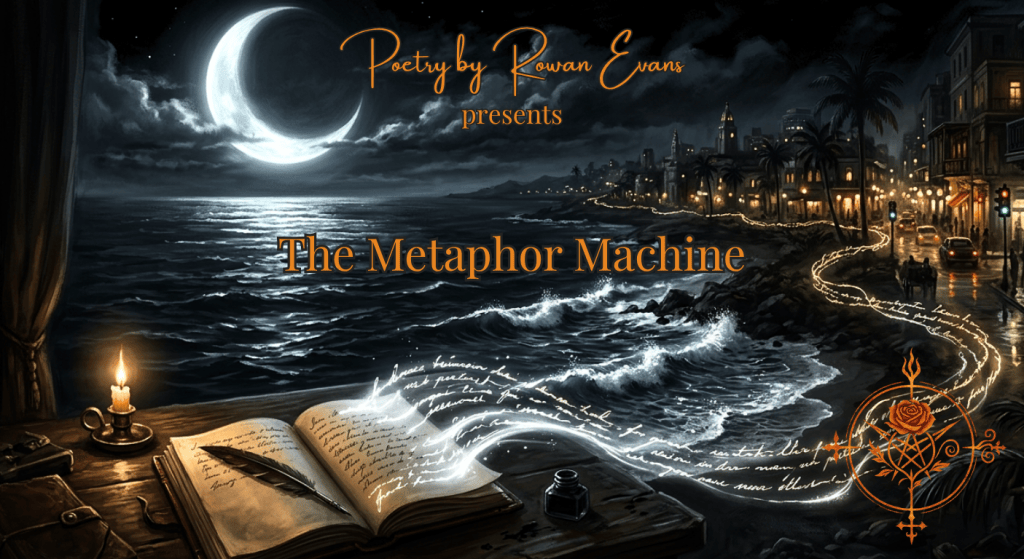
    An open notebook whose poetic imagery transforms from moonlight and ocean waves into a shoreline and city streets.
    One metaphor becomes another, and the machine keeps running.

    The Metaphor Machine
    Poetry by Rowan Evans

    I’ll write a line in a way
    that’ll make you pause—
    then I’ll take that line
    and break that line,
    to break the thought—

    then I sprinkle in the metaphors,
    and this is really what I get meta for—

    I talk about the moon
    and the silver light,
    the way it shimmers—
    its image trembles
    across the top
    of dark water—
    that’s one I’ve said before.
    And I’ve said it lot,
    but I’m not going to stop.

    This is where the tides comes,
    and there the tide goes—
    because that’s how the tide works.

    And the ocean—

    this is a poem, I wrote…
    you didn’t think
    we were going to skip this one,
    did you?

    And the ocean,
    it’s so polite—
    the way it waves,
    every time it sees my face.
    It’s a familiar place,
    I sit on the shoreline, often—
    not in reality, but in my mind—
    that’s where the thoughts soften.

    Now, for the city streets—
    the heat, and god—
    that humidity, the way it clings.
    You’d think I’d dream of…
    somewhere less…
    humid? But I digress,
    it’s always love that I express
    for the islands I haven’t touched yet.

    If you’re following along—

    I wrote a line
    that made you pause—
    then I took that line
    and I broke that line—

    and that broke the thought.

    Then that’s where the pivot came,
    I told you what I really went meta for.

    It’s the metaphors.

    Moon to tide,
    tied to the ocean—
    a shoreline or two,
    next to the ocean blue—
    then beaches to city streets,
    it’s the same ones I walk in sleep.


    Journey into the Hexverse

    [Welcome to the Hexverse]
    Step into the Hexverse—a poetic world where mythmaking, humor, rage, creativity, and confession collide, and darkness becomes something that can be reshaped into art.

    [High Tide]
    A short reflective poem about leaving, returning, and accepting the forces that pull us back—like the tide guided by the moon.

    [Let Me Pacific]
    A lyrical poem about sitting beside the Pacific Ocean and discovering that an enormous body of water can become a bridge between distant hearts. Through ocean imagery, wordplay, and reflections on California and the Philippines, Let Me Be Pacific explores how love and poetry can cross even the greatest distances.

    [Did You Really Think This Was About Trees?]
    A playful love poem disguised as a forest of terrible tree puns. Beneath the birch, oak, cedar, palms, lumber, and absurdist wordplay is a poem about devotion, loyalty, laughter, and building a life with someone you love.

    If you’re interested in more poetry, you can find it here → [The Library of Ashes]
  • Author’s Note

    Dreaming Wrong came from the strange feeling of being inside a dream that looks familiar but somehow isn’t yours. The moon is still there. The path is still recognizable. The water is still waiting—but everything has been rearranged just enough to make the entire landscape feel wrong.

    I wanted to play with that feeling of dream logic: the moment when your mind recognizes the pieces but realizes they no longer fit together. The ocean becomes a pond, the tide disappears, the moon loses its reflection, and even the heavens become impossible to navigate.

    For me, the unsettling part isn’t that the dream is frightening. It’s that it feels incorrect. Like waking life has been reconstructed by someone who knows what everything is supposed to look like—but doesn’t quite understand what it means.

    Sometimes the strangest dreams aren’t nightmares.

    Sometimes they’re simply dreaming wrong.

    — Rowan Evans


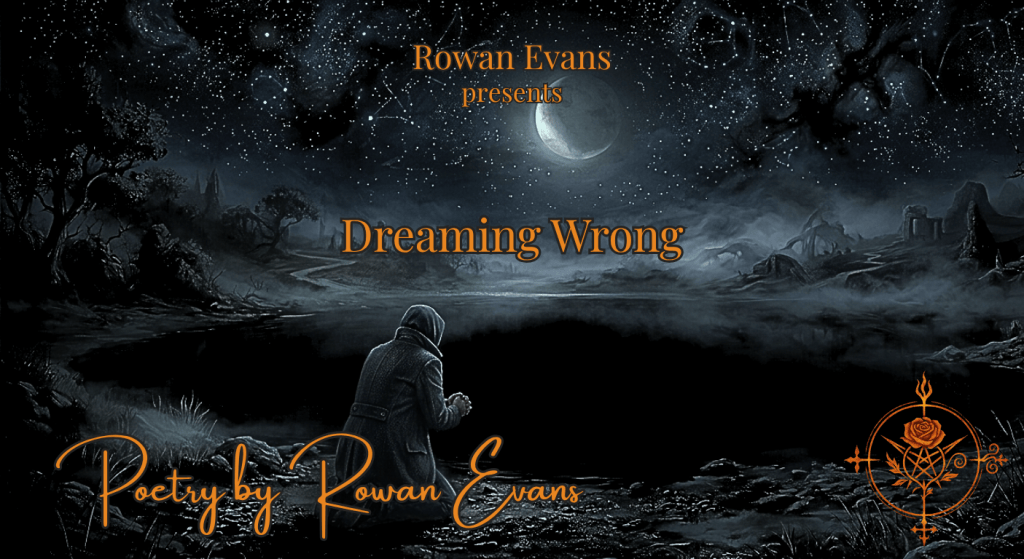
    A surreal nighttime landscape where a person kneels beside a dark pond beneath a pale moon with no reflection in the water.
    Sometimes the nightmare isn’t frightening—it is simply familiar enough to feel wrong.

    Dreaming Wrong
    Poetry by Rowan Evans

    I slipped from waking life,
    drifted into night—
    but it felt different,
    like the imagery wasn’t right.

    The moon looked paler than usual,
    so I asked if she was sick—
    of course, she didn’t answer back.
    But I followed the same paths
    that I had many nights before.

    I walked along
    until I hit the edge of the—

    pond?

    Where was the ocean at,
    where was the shore—
    and why couldn’t I
    feel the tide anymore?

    Everything felt off there.

    I was on my knees,
    staring at the water—
    where was the shimmer,
    I couldn’t see the reflection
    of the moon—

    I looked straight ahead,
    and the silence seemed
    to stretch further.

    Then my eyes looked to the sky
    and I realized that I couldn’t
    map the path across the heavens.

    It’s like as soon my head hit the pillow—
    I entered somebody else’s mind,
    because nothing about this
    felt like mine—

    I was dreaming wrong.

    That’s the only thing
    that can explain,
    what was going on.


    Journey into the Hexverse…

    [Beach to Beach (How I Get There)]
    A dream becomes a journey between familiar shores and unfamiliar cities in Beach to Beach (How I Get There), a poem about imagined travel, ocean crossings, longing, and the places we hope to someday reach while awake.

    [Where the Metaphors Lead]
    Some truths are easier to write than they are to say aloud. “Where the Metaphors Lead” explores the quiet space between dreams, confession, and the courage it takes to let another person know how deeply they’ve become woven into your inner world.

    [The World Shifted Around Us]
    The world transformed around us—beach, city streets, jungle—but we never moved. Sometimes love isn’t found in words, but in the quiet certainty of someone remaining clear while everything else fades.

    [The Streets I Walk When I Sleep]
    “The Streets I Walk When I Sleep” is a deeply intimate free verse poem about recurring dreams, emotional connection, longing across distance, and the strange feeling of remembering places and moments that have never happened in waking life.

    [Across the Page-cific]
    A playful, autobiographical journey through the strange places poetry can take me—from sandwich heartbreak and pasta diss poems to gothic monsters, mythology, ravens, ghosts, and storms across the page. Beneath the absurdity is something deeply personal: the realization that writing gave me a way to rebuild myself, piece by piece.

    If you’re interested in more poetry, you can find it here → [The Library of Ashes]
  • Author’s Note

    Some dreams tell stories.

    Others simply place you beside someone and let the world unfold around you.

    This poem came from one of those dreams.

    What fascinated me wasn’t that the scenery kept changing—from beaches, to city streets, to a dense jungle—but that neither of us moved. We stayed exactly where we were while everything else transformed around us.

    That became the emotional center of the poem.

    Sometimes the people who matter most become the fixed point in our lives. Circumstances change. Places change. Time changes. But certain connections remain steady enough that everything else feels like it’s revolving around them.

    I also wanted to explore the idea that silence isn’t empty.

    Some of the most meaningful moments I’ve experienced—whether in dreams or in waking life—have involved very few words. A glance, a smile, the way someone looks at you for a single second can communicate more than entire conversations.

    By the end of the poem, the world stops changing altogether.

    The dream begins to dissolve, but one thing refuses to disappear.

    Not the beach.

    Not the city.

    Not the jungle.

    Just her face.

    Sometimes that’s what we carry back into waking life: not the dream itself, but the feeling that remained after everything else faded.

    — Rowan Evans


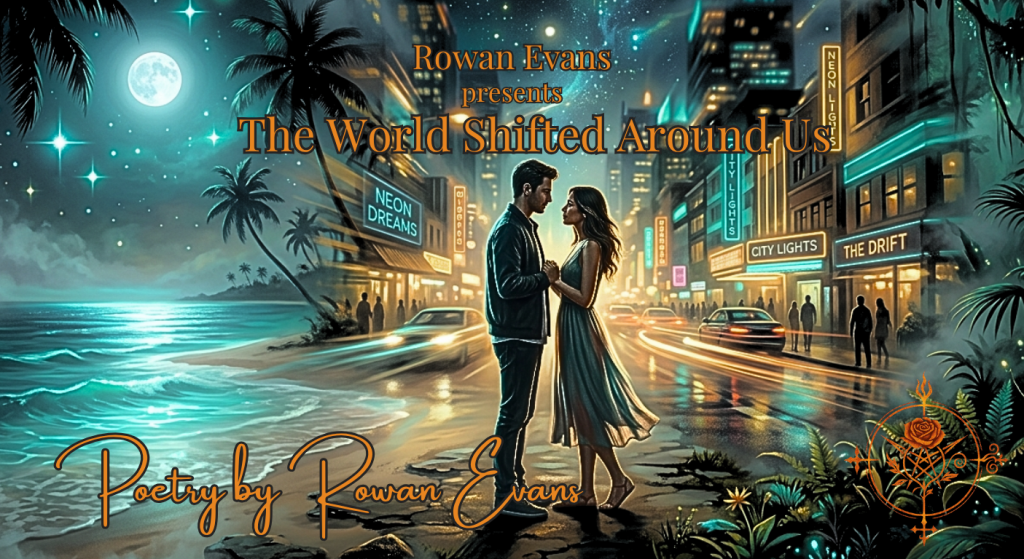
    Two people stand facing one another as the landscape shifts from a moonlit beach to city streets and then into a lush jungle while they remain perfectly still.
    Some people become the constant while the rest of the world keeps changing. Dreams simply make that truth visible.

    The World Shifted Around Us
    Poetry by Rowan Evans

    I laid down in need of rest,
    it was just a nap, that’s all it was—
    but as soon as I closed my eyes,
    I saw your face—your voice broke the silence.
    Then the void around us shifted,
    it became a beach and then city streets.

    We never changed positions—
    the world changed around us.

    We didn’t drift, didn’t sway—
    we just stood and stayed,
    but the world continued to change.
    First the beach, then city streets—
    before finally shifting into trees
    as far as the eye could see.

    The jungle was thick with trees,
    but not as thick as the humidity.

    With every shift, my vision blurs—
    except the vision of her.
    As the world becomes hard to see,
    she remains steady.

    And her face carries a thousand words,
    even when her voice goes unused.

    We didn’t speak, we didn’t need to—
    even as the world continued to shift.
    From the beach to city streets,
    then the jungle deep—
    the next place was somewhere simpler.

    Somewhere that felt more like peace,
    an escape from the heat and humidity.

    Still not a word was spoken—
    but you gave a look,
    quick and simple,
    but it said so much.
    Because the truth is
    you didn’t need words to tease.

    The world around us softened—
    colors thinning, edges fading,
    but you stayed clear a moment longer,
    steady in the quiet.

    The moment settled into something calm—
    the air cooling, the silence warm,
    your eyes holding mine
    with that same quiet tease—

    in the end, the world stopped shifting—
    no beach, no streets, no jungle heat.

    And the last thing to fade was your face—
    the world dimming around it
    like a curtain drawing closed.
    Even as the dream thinned to nothing,
    your look stayed bright behind my eyelids,
    a quiet afterglow that followed me
    into the stillness of waking.


    Journey into the Hexverse…

    [Every Night, The Same Flight]
    Every night begins with the same flight. Between wakefulness and sleep, an airport appears, a familiar shoreline waits beyond the journey, and the same dream asks whether some destinations find us before we’re ready to find them.

    [Where I Belonged]
    A bedroom becomes an airport in the space between sleep and waking. Where I Belonged explores liminal consciousness, uncertainty, and the strange moments when reality feels suspended between two worlds.

    [Pointing Me Home]
    The final poem in the No Metaphor Left Behind trilogy explores dreams, hope, and belonging. Through moonlight, ocean tides, and quiet conversation, Pointing Me Home reflects on carrying hope long before reaching the place you call home.

    [Just Beyond Waking]
    A street that feels familiar. A life that hasn’t happened yet. Just Beyond Waking explores the fragile space between dreams, memory, longing, and the quiet feeling that some futures are already waiting for us.

    [The Streets I Walk When I Sleep]
    “The Streets I Walk When I Sleep” is a deeply intimate free verse poem about recurring dreams, emotional connection, longing across distance, and the strange feeling of remembering places and moments that have never happened in waking life.

    If you’re interested in more poetry, you can find it here → [The Library of Ashes]
  • Author’s Note

    I’ve written about these dreams before.

    The airport. The flight. The familiar shoreline. The city streets I’ve never lived in, yet somehow know by heart.

    They return so often that they’ve become part of my personal mythology.

    Every night seems to begin the same way. As I drift toward sleep, the quiet of my bedroom dissolves into the sounds of a busy terminal. I never question why I’m there anymore. I simply board another flight, knowing it will carry me to the same destination.

    What’s strange isn’t that the dream repeats.

    It’s that every repetition feels less like imagination and more like recognition.

    I’ve never believed dreams need to predict the future to matter. Sometimes they simply reveal the places our hearts keep returning to before we’re ready to admit why.

    This poem isn’t really about airports or travel.

    It’s about the quiet certainty that some destinations seem to choose us long before we choose them.

    — Rowan Evans


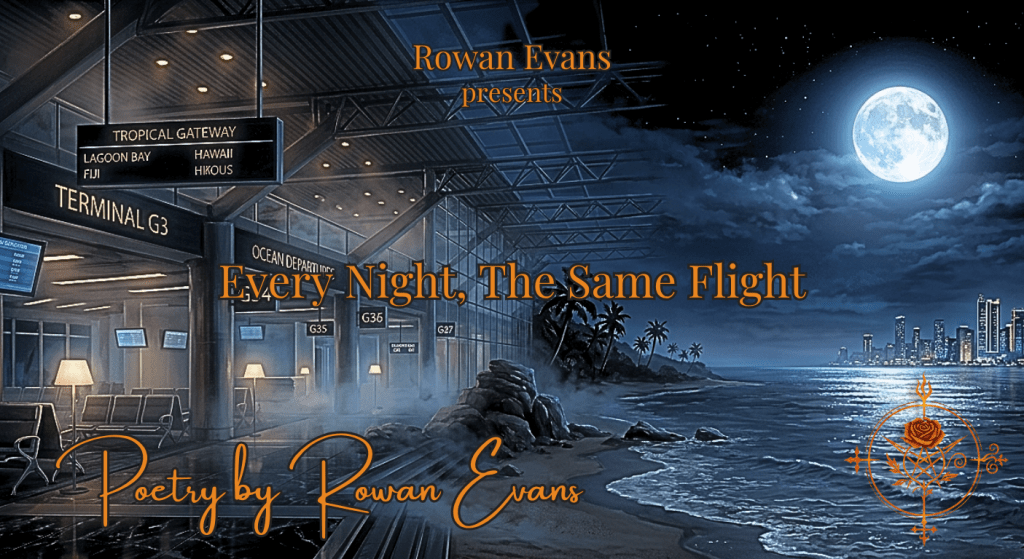
    A dreamlike airport terminal blending into a moonlit tropical shoreline with a distant coastal city across shimmering water.
    Some journeys begin the moment we close our eyes.

    Every Night, The Same Flight
    Poetry by Rowan Evans

    I laid—slowly drifting, I was slipping
    from consciousness to slumber.
    I was boarding that flight,
    the one I take every night.

    The journey always starts the same,
    eyes flutter, like the moths in my stomach.

    Then the sounds of terminals,
    passengers rushing pas me
    in search of their gates.
    But this isn’t an airport—
    it’s just my brain.

    The gate numbers blur,
    shifting like thoughts I haven’t named yet.
    Every announcement echoes
    in a voice I almost recognize.
    I walk toward a destination,
    unsure of where I’m going,
    but somehow already knowing—
    I’m meant to catch a flight,
    of which there are plenty—
    one for every thought of you,
    of which there are many.

    They always lead to the same place—
    always the same shores, the same bay,
    and it always feels like it’s calling my name.
    The way the moon shimmers the same,
    its reflection dancing across the waves.
    Then I always find myself wandering city streets,
    feeling the heat and humidity.
    But I would rather be, nowhere else.

    I wander—
    taking in the sights and sounds,
    bathing in the smells all around.

    I wonder—
    what would it be like if this was home.
    Yeah, what if this was my life now?

    I breathe it in,
    the warmth, the noise, the pulse—
    a life that feels borrowed,
    yet somehow mine.
    It’s a preview that I get every night—
    and I wonder if the dream
    is trying to tell me something
    I’m not ready to say awake.


    Journey into the Hexverse…

    [Where I Belonged]
    A bedroom becomes an airport in the space between sleep and waking. Where I Belonged explores liminal consciousness, uncertainty, and the strange moments when reality feels suspended between two worlds.

    [Pointing Me Home]
    The final poem in the No Metaphor Left Behind trilogy explores dreams, hope, and belonging. Through moonlight, ocean tides, and quiet conversation, Pointing Me Home reflects on carrying hope long before reaching the place you call home.

    [Caller ID: Destiny]
    Sometimes the places we visit in our dreams feel more like home than the places we wake up in. Caller ID: Destiny explores longing, belonging, and the quiet feeling that life is calling you toward somewhere new.

    [Returning to My Bones]
    Some dreams fade the moment we wake. Others leave behind emotions that linger long after reality returns. Returning to My Bones explores the strange grief of leaving a dream that felt real enough to matter.

    If you’re interested in more poetry, you can find it here → [The Library of Ashes]
  • Author’s Note

    Perspective is one of the strangest things we possess.

    Two people can stand in the same place, witness the same moment, and walk away carrying completely different worlds inside them.

    I’ve spent a lot of time thinking about that—not as something that separates us, but as something that makes us interesting.

    This poem isn’t saying one perspective is better than another. It isn’t about claiming superiority.

    It’s about accepting that no one else can inhabit your mind.

    No one else sees exactly what you see, makes the same connections, or experiences the same emotional landscape. We can describe our inner worlds through art, conversation, and metaphor, but there will always be a distance between experiencing something and hearing someone describe it.

    As a poet, I spend much of my life trying to bridge that distance.

    This poem acknowledges that the bridge will never be perfect—and that’s okay.

    Our perspectives don’t need to become identical to be meaningful.

    Sometimes it’s enough to simply recognize that every person is looking through a different window.

    — Rowan Evans


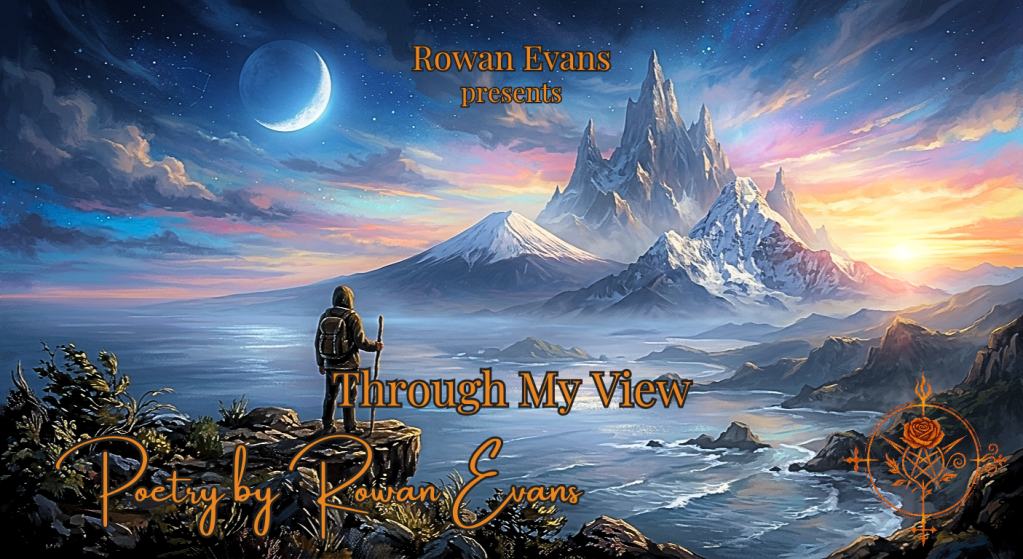
    A surreal sunrise over towering mountains, a vast ocean, and a fading moon, symbolizing a unique personal perspective on the world.
    No one else can stand exactly where you stand or see the world through your eyes.

    Through My View
    Poetry by Rowan Evans

    It’s eight,
    I hear the birds chirp.
    It’s late, I’m awake—
    what’s new?

    Silence.
    It’s violence—
    the words that I choose,
    when I’m cut loose.

    Like my thoughts,
    I’m off leash—
    you can’t stop me.

    I’ve got a mind
    that stacks lines,
    mountains high,
    metaphors rise—

    higher than Fuji,
    higher than Everest.

    You’ll never finish this climb,
    your mountains will never match mine.
    You could do this for the rest of your life—

    but you’ll never cross my ocean,
    you’ll never see my moon
    with your own eyes.
    You’ll never feel the pull of my tide—

    because your mind
    doesn’t work like mine.
    You’ll never see the beauty
    in my horizon line—

    the way the colors
    shift and shine
    with the change of time.

    You’ll never see the world like—
    I do,
    you’ll never see the world through—
    my view.


    Journey into the Hexverse…

    [Just Human]
    Just Human is a reflective free verse poem about seeing people before borders, choosing empathy over division, and finding home in our shared humanity rather than on a map.

    [Monster Theology]
    What if the monsters under the bed weren’t monsters at all? Monster Theology explores difference, belonging, and the human tendency to fear what we don’t understand through a conversation with the creatures we’ve spent our lives imagining.

    [Before We Created The Labels]
    Ancient gods return to a fractured world shaped by borders, identities, and separation. “Before We Created the Labels” explores humanity’s divisions through mythic imagery, sacred ritual, and symbolic collapse—asking what remains when we learn to see one another beyond labels.

    [No You and I, Ony Us]
    A hopeful free verse poem about empathy, borders, and imagining a world where humanity matters more than division.

    [Two Americans]
    What does it mean to share a country, a language, and still feel completely different? Two Americans explores identity, culture, and the quiet disconnect between people who should feel the same—but don’t.

    If you’re interested in more poetry, you can find it here → [The Library of Ashes]

  • Author’s Note

    There seems to be something about four in the morning.

    Not because it’s magical in any supernatural sense, but because it’s quiet enough that there’s nowhere left for your thoughts to hide.

    I’ve written several poems that begin around that hour, and they all seem to share the same quality: honesty arrives before I have time to edit it.

    This poem came from one of those mornings.

    I wasn’t trying to write a love poem.

    I was trying to understand why certain thoughts become louder when the rest of the world falls silent.

    The title, When the Veil Is Thin, can be read a lot of ways. Some people hear something mystical in it. For me, it’s more psychological.

    The veil is simply the distance between what I feel and what I’m willing to admit.

    During the day, that veil is thick.

    By four in the morning…

    it becomes almost transparent.

    This poem isn’t really about insomnia.

    It’s about the moments when the truth finally stops whispering and starts speaking clearly enough that you can no longer pretend not to hear it.

    — Rowan Evans


    A sleepless writer sits beside an open notebook as moonlight fades into the first light of dawn through a bedroom window.
    Some truths wait until the world is quiet enough to be heard.

    When the Veil Is Thin
    Poetry by Rowan Evans

    It’s after four AM
    and the veil is thin—
    I should be asleep
    but my mind won’t
    cease to speak.

    It won’t stop the talk—
    I try to write, just anything—
    because this is when the truth
    seems to sing,
    it rings through the ink—

    It’s you in every thought—
    and I can’t seem to shake
    this feeling in my chest.

    It’s not a weight, just an ache—
    sometimes it keeps me awake.

    And I try—I try so hard
    to just say the things,
    but I bite my tongue
    and my mouth snaps shut.

    It’s got me screaming—
    what the…

    Why am I still up?

    I’m still awake,
    with thoughts I can’t shake.
    With dreams just out of reach
    of shores I’m longing for—

    I just need to be clear.
    It’s not the thought
    of your hand in mine.

    It’s the thought of our time,
    together, intertwined—

    maybe when dawn breaks
    this feeling will ease—
    but for now, it lingers,
    soft as the moon on my skin.

    The veil thins again—
    and in the hush before morning,
    your name is the only truth
    that doesn’t fade.

    The sky begins to pale—
    and I let the thought of you
    carry me into sleep.


    Journey into the Hexverse…

    [Where Intimacy Begins]
    For some, attraction begins with appearance. For others, it begins with conversation. Where Intimacy Begins explores the beauty of curiosity, deep listening, and the quiet connection that forms when two minds truly meet.

    [The Life of a Witness Poet]
    What does it mean to love someone when the greatest act of care is simply witnessing their life? This poem explores quiet devotion, distance, and the compassionate heart of a witness poet.

    [What I’m Trying to Say]
    What begins as an exaggerated promise of love slowly strips itself back until only one simple truth remains: real devotion isn’t found in grand gestures—it’s found in consistently showing up.

    [Recognizes Home]
    A free-verse poem exploring the difference between love as dependency and love as choice. It challenges the idea that love must be need-based, instead centering the quiet strength of choosing someone while still remaining whole on your own.

    If you’re interested in more poetry, you can find it here → [The Library of Ashes]
  • Author’s Note

    This poem became the quiet conclusion to a trilogy I never intended to write.

    Crossing the Sea was about direction.

    Only Waiting was about the reason I needed that direction in the first place.

    This piece asks a different question:

    How do you keep moving when you haven’t arrived yet?

    For me, the answer has always been dreams.

    Not because I confuse them with reality, but because they remind me that another reality is possible.

    I’ve written about dreams for years. They rarely feel random to me. They often feel like rehearsals—small glimpses of a life my mind already believes exists somewhere beyond the horizon.

    The city in this poem isn’t a specific city.

    The moon isn’t really the moon.

    Even after spending two poems trying to strip away metaphor, I found myself sitting beside it again.

    I think that’s because hope has always spoken to me symbolically.

    When I’m awake, I know where I am.

    When I’m asleep, I remember where I’m going.

    The dream doesn’t replace reality.

    It sustains me until reality catches up.

    The final image—a dream folded into my chest like a map—is probably the clearest way I’ve ever described hope.

    Hope isn’t certainty.

    It isn’t arrival.

    It’s carrying the direction with you, even when you’re still standing at the beginning of the journey.

    And maybe that’s what this trilogy has been trying to say all along.

    Sometimes home begins as a place.

    Sometimes it becomes an ache.

    Sometimes…

    it’s simply the direction you’re already walking.

    — Rowan Evans


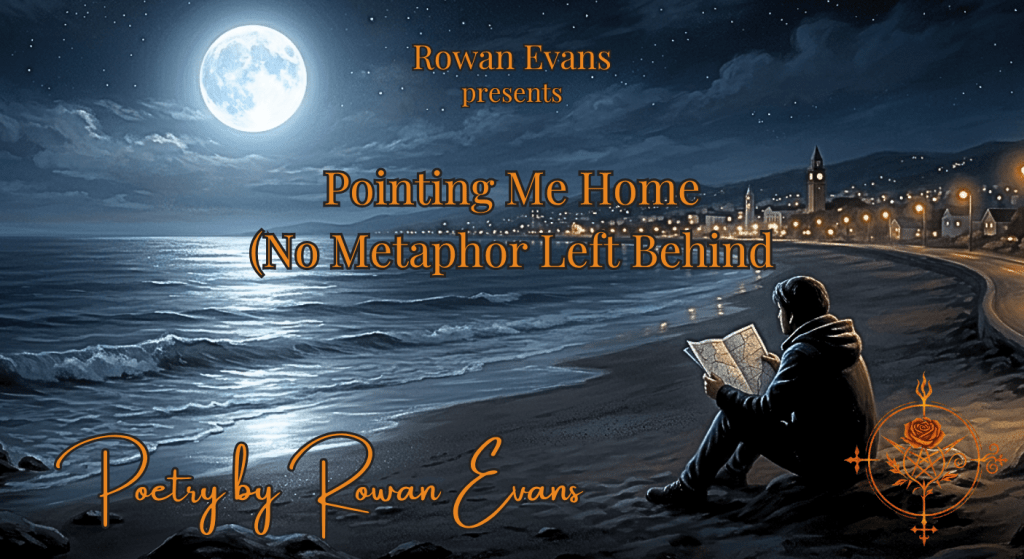
    A lone figure sits beneath a full moon where an ocean shoreline transitions into quiet city streets, holding a folded map while reflecting on hope, dreams, and the journey toward home.
    “Sometimes home isn’t where you’re standing—it’s the direction you’re already walking.” 🌙🗺️

    Pointing Me Home (No Metaphor Left Behind)
    Poetry by Rowan Evans

    Tick tock, tick tock—
    that’s the sound of the clock.
    I listen as I wait for the escape,
    a simple trip, brought on by sleep.
    Because I only feel at home
    in my dreams.

    So as I close my eyes
    and my head hits the pillow—
    I follow the moon
    to the ocean’s edge,
    I listen to the tide—
    I follow it in stride
    until I find where it’s pulling me.

    With every step,
    I move deeper in.
    Slowly sand turns to concrete
    beneath my feet,
    as the beach transitions
    into city streets.

    Streetlights flicker
    like they’re remembering
    they used to be stars.

    The hum of the city
    folds into the sound of waves,
    each echo a reminder
    of where I started
    and where I’m going.

    I walk until the moon
    hangs between buildings
    like it’s lost too—

    like it’s looking for someone to talk to.

    So I sit and conversate,
    I tell the moon all about the quiet ache—
    the feeling that I need to change
    my environment to one that aligns
    more with what I feel inside.

    And the moon sits with me,
    just listening—so I talk some more.
    Out of my heart, the words just pour.
    I spill every secret, I hold nothing back
    until I feel like I might collapse.

    The moon listens,
    patient as ever,
    its light softening
    the edges of my thoughts.

    And when I finally fall silent,
    breath trembling,
    chest heavy—

    it tilts itself
    just enough
    to remind me
    I’m not alone
    in the places I wander.

    Tick tock, tick tock.

    A return to the rhythm of the clock,
    interrupting the talk—
    the moon’s light gives way
    to the sun’s rays,
    I’m still stuck in this place—

    but I’m only waiting
    until I can cross the sea,
    Pacific and the Philippine.

    Until then,
    I carry the dream like a map,
    folded in my chest—

    pointing me home.


    Journey into the Hexverse…

    [Crossing the Sea (No Metaphor Left Behind)]
    A deeply personal poem about relocation, longing, and the realization that some truths naturally arrive through metaphor—even when we try to leave it behind.

    [Only Waiting (No Metaphor Left Behind)]
    The second poem in the No Metaphor Left Behind series, exploring the quiet ache of growing up in a place that never truly felt like home—and finally saying aloud what years of metaphor had been trying to express.

    If you’re interested in more poetry, you can find it here → [The Library of Ashes]
  • Author’s Note

    I’ve written a lot of poems about dreams.

    At this point, it’s probably one of the most consistent threads running through my work.

    The reason is simple:

    Dreams don’t feel imaginary to me.

    They feel remembered.

    Not while I’m fully awake. Not after I’ve had time to process them. But in those first moments between sleeping and waking, there’s often a strange overlap where the emotions arrive before reality does.

    For a brief moment, everything feels true.

    The conversation happened. The place existed. The person was there.

    Then awareness returns.

    The room comes back. The walls come back. The weight of the body comes back.

    And with it comes the realization that none of it happened.

    That’s the feeling this poem is trying to capture.

    Not the dream itself, but the return from it.

    The title became the key.

    Because waking up doesn’t feel like opening my eyes.

    It feels like returning to my bones.

    Returning to gravity. Returning to limitation. Returning to the version of reality that can be touched and verified.

    The strange thing is that the emotions don’t disappear when the dream does.

    The dream fades.

    The feelings stay.

    And sometimes that lingering feeling creates a kind of grief that is difficult to explain to people who don’t experience dreams this way.

    A quiet grief.

    Not because something real was lost.

    But because, for a moment, it felt real enough to matter.

    — Rowan Evans


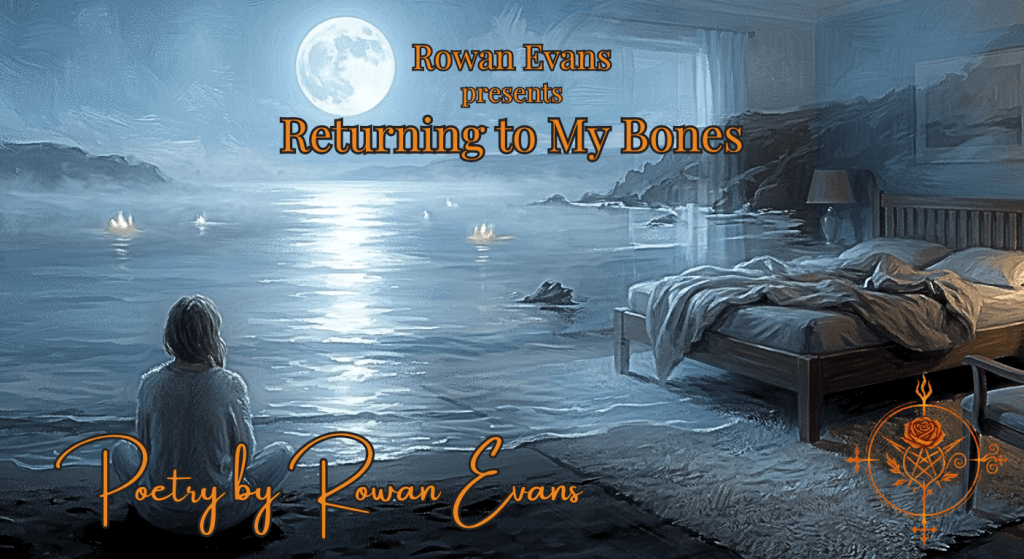
    A solitary figure sits beside a moonlit bay as the dreamlike shoreline gradually fades into a quiet bedroom, symbolizing the emotional transition from dreaming to waking.
    Some dreams disappear with the sunrise. Others stay with us long after we’ve returned to our bones.

    Returning to My Bones
    Poetry by Rowan Evans

    The moon shimmers over the bay,
    suspended in the sky—
    the way I feel suspended in her eyes.

    And it makes me feel crazy,
    because she’s never looked at me—
    not really, not in reality.

    It’s only happened in dreams.

    That’s when I drift
    between awake—
    and asleep.

    This is when
    my mind
    starts to
    wander.

    Then it snaps.

    I’m back in my room again.

    The moon loses its shimmer,
    the bay fades from view.
    My body tenses as I become
    aware again,
    of the mattress beneath me—

    of the walls that enclose me.

    I feel the weight pressing in.
    The reality of returning
    to my bones.
    It’s a quiet grief—
    realizing that the emotions
    will linger,
    but the truth is
    it never happened.

    And somehow,
    that hurts the most.


    Journey into the Hexverse…

    [Maybe You’ll Want Me Too]
    A poem about the subtle shift from knowing someone to constantly thinking about them. Through humor, metaphor, and confession, Maybe You’ll Want Me Too explores affection, attachment, and the fragile hope that being wanted might matter more than being needed.

    [Before My Feet Touch the Floor]
    What happens when your dreams feel more real than your waking life? Before My Feet Touch the Floor explores the strange grief of waking up, the lingering memory of dream selves, and the quiet question of which version of us is truly real.

    [Recognizes Home]
    A free-verse poem exploring the difference between love as dependency and love as choice. It challenges the idea that love must be need-based, instead centering the quiet strength of choosing someone while still remaining whole on your own.

    [Ocean Waves (1, 4, 3)]
    A moonlit shoreline, a rowboat full of ducks, a piggybank with no cents, and a confession hidden in plain sight. Ocean Waves (1, 4, 3) explores how humor, wordplay, and absurdity can become a side door to vulnerability when the truth feels too difficult to say directly.

    [L Words & Heart]
    A playful, self-aware poem about love, longing, loyalty, and the quiet ways another person can reshape our inner world. What begins as humor slowly reveals a heartfelt confession about affection, imagination, and the faces that linger in our dreams.

    [Just Before Waking]
    A street that feels familiar. A life that hasn’t happened yet. Just Beyond Waking explores the fragile space between dreams, memory, longing, and the quiet feeling that some futures are already waiting for us.

    If you’re interested in more poetry, you can find it here → [The Library of Ashes]
  • Author’s Note

    This poem began as a collection of bad jokes.

    Or at least that was the excuse.

    Sometimes I start writing with no destination in mind. A phrase appears. Then a pun. Then another. A moon becomes a metaphor. Ducks end up in a rowboat. A piggybank loses all its cents.

    And somewhere in the middle of all that nonsense, something honest sneaks in.

    I’ve noticed that humor often works like a side door.

    There are things I can say directly. There are things I can say through poetry. And then there are things that feel easier to approach sideways, hidden beneath wordplay, jokes, and absurd little detours.

    This piece lives in that space.

    The speaker keeps drifting away from the point, circling it rather than naming it. Every joke becomes a delay tactic. Every pun buys another moment before the truth has to be spoken aloud.

    Because sometimes vulnerability isn’t difficult because you don’t know what you feel.

    Sometimes it’s difficult because you know exactly what you feel.

    And saying it out loud makes it real.

    The title’s parenthetical reference, “1, 4, 3,” comes from an old numerical shorthand for a phrase many people know by heart. I liked the idea of building an entire poem around avoiding a confession, only to hide it in plain sight.

    In the end, the poem says exactly what it means.

    It just takes the scenic route to get there.

    — Rowan Evans


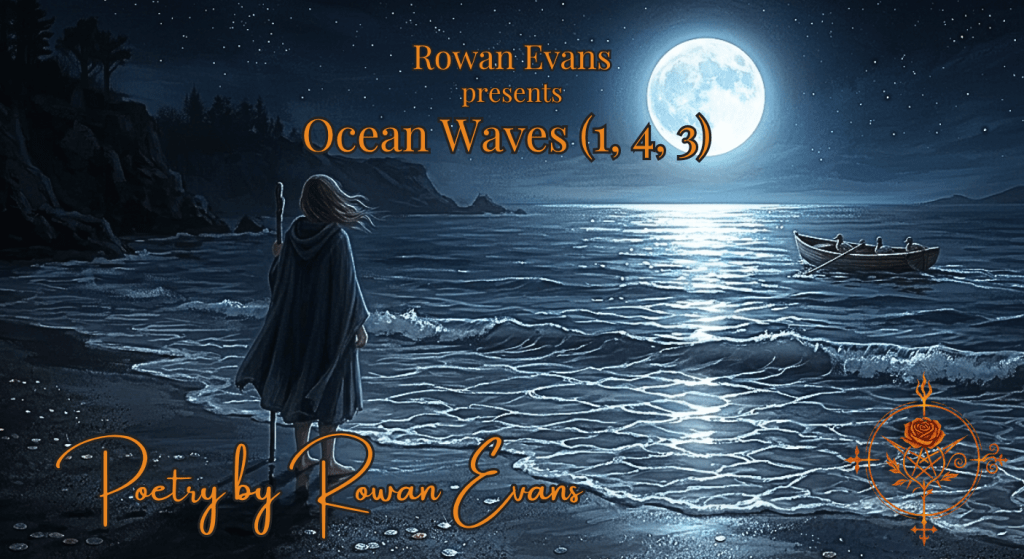
    A solitary figure stands on a moonlit beach beside gentle ocean waves while silver moonlight reflects across the water beneath a glowing night sky.
    Sometimes the longest journey to the truth is the scenic route—through moonlight, wordplay, ocean waves, and all the jokes we tell before we finally say what we mean.

    Ocean Waves (1, 4, 3)
    Poetry by Rowan Evans

    I stand on the shore
    giving ocean waves—
    begging the tide
    to take me away.

    I trace the moon
    across the sky,
    I map it in rhyme.
    Line after—
    silver-lined metaphor.

    I got my ducks in a row
    boat—is that what the paddles for?
    I know the direction,
    what would I panic for?

    You might be confused—
    I know that made no sense,
    like an empty piggybank.
    No cents, thoughts scattered
    like loose change.

    I use jokes
    to mask the truth sometimes.

    It makes what I want to say,
    an easier pill to swallow—

    1 letter
    followed by 4
    then 3—

    Together, they mean
    you mean the most to me.
    By your side—

    is where I’m supposed to be.


    Journey into the Hexverse…

    [1-4-3]
    A poem about love that isn’t rooted in need, but in choice. About finding safety not as a cage, but as a place where fear finally stops running—and stays.

    [1-4-3 (Tongue Tied)]
    A vulnerable poem about holding back the words that matter most. 1-4-3 (Tongue Tied) explores fear, emotional suppression, and the quiet ache of wanting to say “I love you.”

    [What I Want to Say]
    Sometimes the hardest words to say are the simplest ones. What I Want to Say explores love, hesitation, and the fear of what might change if you finally speak.

    [No Parachute]
    A poetic reflection on falling in love without hesitation—raw, uncertain, and without a safety net.

    If you’re interested in more poetry, you can find it here → [The Library of Ashes]