Sometimes “I don’t give a fuck” isn’t really apathy. Sometimes it’s exhaustion, overextension, or finally realizing that not everything deserves a piece of you.
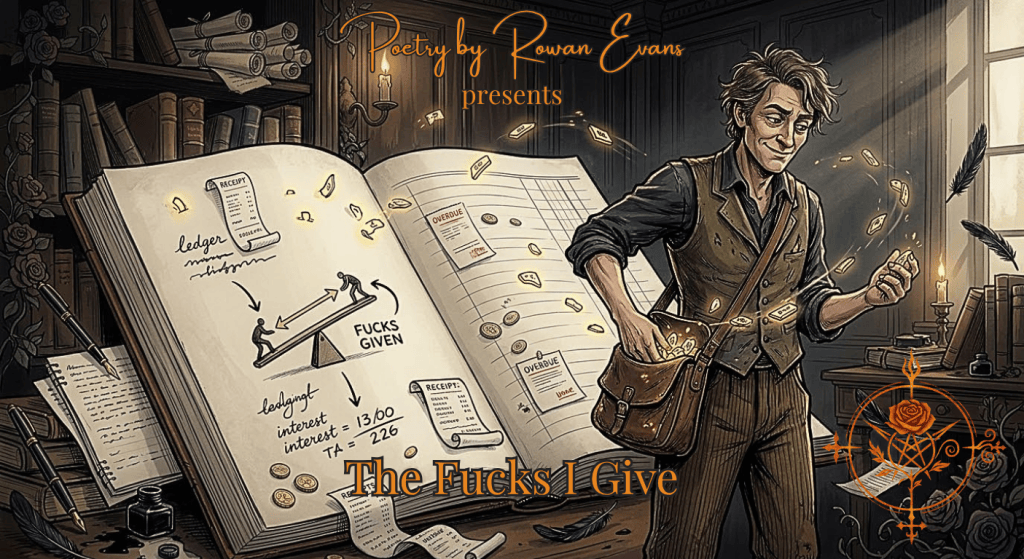
The Fucks I Give takes that idea and turns it into a ridiculous little accounting problem. If I’ve been handing out fucks like they’re an unlimited resource, eventually I’m going to have to audit the books, collect the outstanding balance, and start charging interest.
Underneath the jokes and profanity is something I’m actually pretty serious about: learning to be selective with what gets my attention, my energy, my emotions, and my time.
Because giving a fuck can be an act of love.
So can taking your fucks back.
— Rowan Evans
Apparently, my fucks weren’t free. I’m just finally collecting the outstanding balance.
The Fucks I Give Poetry by Rowan Evans
They said I’m too apathetic,
actin’ like nothing matters,
and it’s pathetic—
they want me to give a fuck,
but shit, I misplaced my bag of fucks—
so I’ve got no fucks to give.
Yeah, I’ll go through
and take all my fucks back—
I’ll walk right up and knock, like—
I’m here to collect my fucks,
and extra fucks too—
it’s a fucking tax,
and there is interest, dude.
You think fucks are endless.
No, I’ve got to be pickier—
because for a minute there,
it was—
fuck everything
and that’s probably
what they’re angry for.
It was fuck this and fuck that—
I was running out of fucks fast.
Some poems don’t need to be abandoned when we outgrow the person who originally wrote them.
Sometimes they need to be revisited.
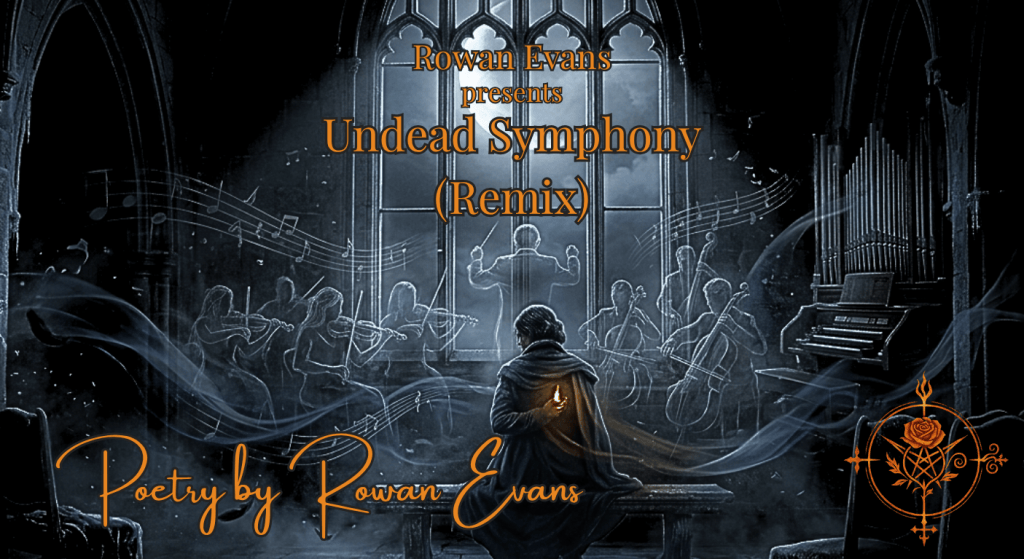
Undead Symphony (Remix) returns to a poem I originally wrote on June 13, 2024. The original was written from a place I understood intimately: feeling perpetually misplaced, overlooked, and emotionally exhausted while still carrying an enormous capacity for empathy underneath the numbness.
The title came from that contradiction.
An undead thing is neither fully alive nor truly dead. A symphony, meanwhile, is full of movement, emotion, tension, and sound. Put those ideas together and you get something that feels very close to the emotional state I was trying to describe: a person who can feel deeply while simultaneously becoming distant from the world around them.
That contradiction is still here in 2026.
What changed is the way I approach it.
The remix gives the poem more room to breathe. I broke apart lines that had previously been compressed together, allowing certain thoughts to linger rather than rushing past them. I also sharpened some of the imagery and cadence, particularly around the relationship between solitude, apathy, and empathy.
The original poem said what I was feeling.
The remix feels more like I understand why I was saying it.
And that distinction matters.
I have spent a lot of time in my writing exploring darkness—not because darkness is all I have, but because I have always been fascinated by the strange things that can survive inside it. Undead Symphony is one of those pieces.
Apathy and empathy shouldn’t fit together.
Yet somehow, they do.
One protects the heart by making the world feel distant.
The other keeps reaching toward it anyway.
That tension is the symphony.
The speaker may feel undead, but the music never actually stops.
— Rowan Evans
Somewhere between apathy and empathy, something inside me keeps making music.
Undead Symphony (Remix) Poetry by Rowan Evans [written on July 23, 2026]
It was always the wrong place,
wrong time—
I was always second best,
never first place—
Never the one to win the race,
I was always the one they laughed at,
never with—
always the one that
when they were gone—
never missed.
So I grew cold and distant
like far-off summer nights,
yearned for on cold winter mornings.
And sometimes—
it still feels hard to breathe,
like a shadow in the light,
fading beneath.
I never was one for faith,
I never believed,
no thoughts and no prayers—
because why should anybody care?
In a crowd I felt alone,
a silent voice,
an empty phone.
It’s apathy—
and I pair it with my empathy.
An odd dance of light and dark,
within me.
It’s beauty in the darkness,
an undead symphony.
But still—I dream of a place,
where I’m more than just a face.
A spark in the night,
a fleeting glimpse
of warmth in the cold,
and strength in the struggle.
I remember moments—
fleeting and rare,
of laughter shared,
of someone who cared.
Brief as they were,
they lit up my sky,
A reminder that even shadows can try.
Yet—
I return to the solitude I know,
where apathy is my only show.
But my empathy,
a hidden grace—
whispers of a longing for a different place.
It’s a contradiction,
a twisted art—
to feel so much,
with a guarded heart.
An undead symphony,
a haunting tune—
a dance of shadows beneath the moon.
Journey into the Hexverse…
[Fallen Angel’s Reckoning (Remix)] Fallen Angel’s Reckoning (Remix) revisits a 2024 poem about heartbreak, broken promises, and falling from an imagined heaven, transforming its original ending into a darker meditation on resilience, self-reclamation, and learning to fly with broken wings.
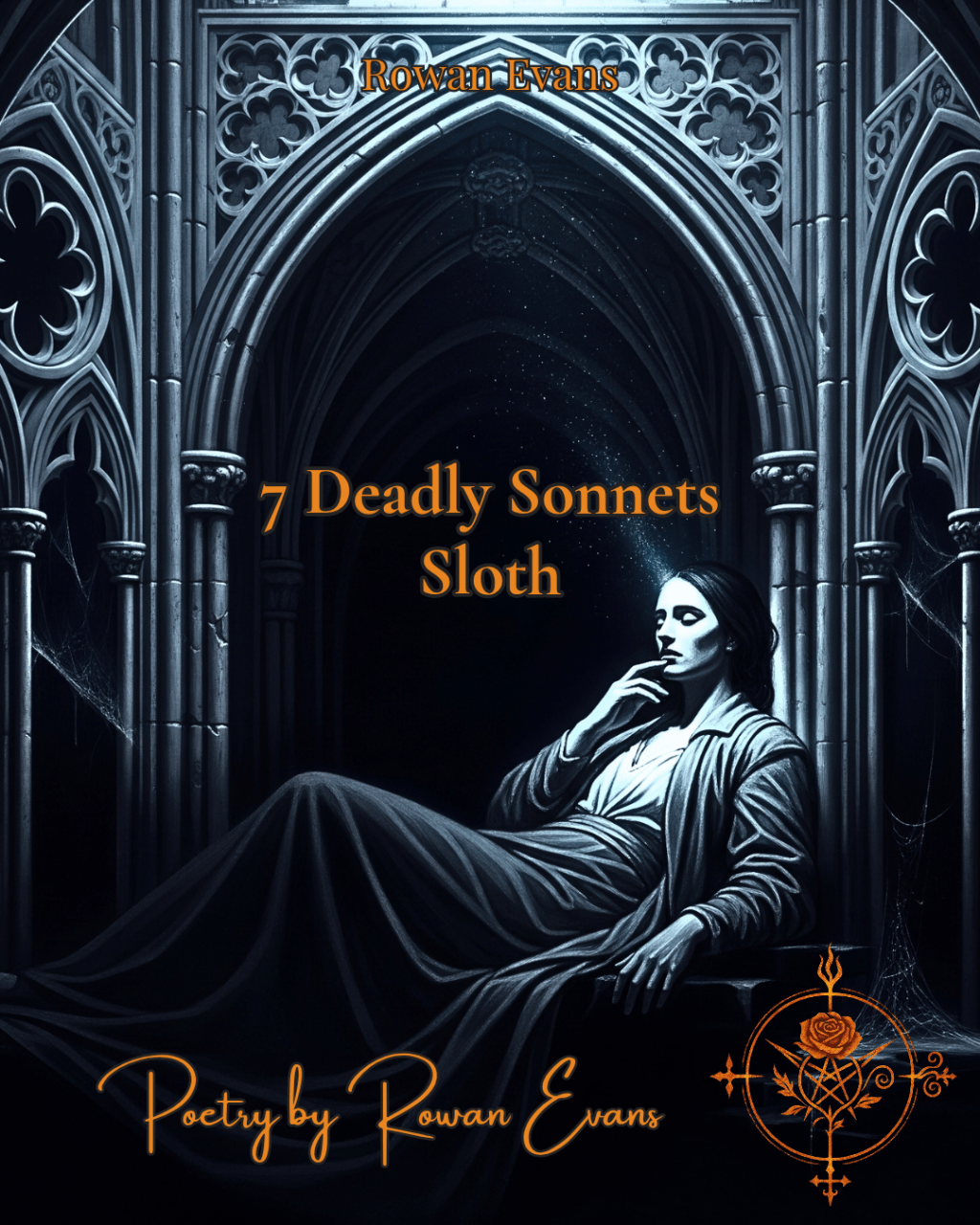
Sloth’s quiet grip halts the spirit. This sonnet portrays the weight of inaction and the hollow stillness that ensnares the soul.
Sloth – the fourth of the 7 Deadly Sonnets by Rowan Evans, exploring paralysis and apathy.
7 Deadly Sonnets Sloth
In shadows wrapped, I watch the world pass by, A ghost in life, unmoved by dawn’s first light, Too heavy is the weight of time gone by, To rouse me from this everlasting night.
The world spins on, but here I lie at rest, Entangled in a web of self-made chains, Each hour a silence draped upon my chest, Where apathy holds court and softly reigns.
The will to rise slips further from my grip, In sloth’s embrace, no fires dare to burn; I feel the cold, its fingers laced and slipped, Through bones too numb to care or yearn.
For sloth, a quiet thief who bids me stay, Consumes my life and wears my youth away.
The 7 Deadly Sonnets
I. Lust My pulse quickens at each whispered breath, desires draping the air like silken chains. ‘Lust,’ the first of the 7 Deadly Sonnets, explores the fevered, consuming hunger that blurs the lines between passion and peril.
II. Gluttony ‘Gluttony’ devours more than food—it consumes the soul. The second of the 7 Deadly Sonnets explores endless craving, the hunger for excess, and the void it leaves behind.
III. Greed ‘Greed’ reveals the hunger that is never sated—the clutching hands, the endless thirst for more, and the hollowness left behind. The third of the 7 Deadly Sonnets.