Tag: attachment

  • Author’s Note

    There is a particular kind of heartbreak that doesn’t have a villain.

    Sometimes nobody betrayed you.

    Nobody lied.

    Nobody promised you something they couldn’t give.

    Sometimes someone simply exists, speaks to you, makes you feel something—and your heart decides to build an entire mythology around it.

    That is where Poet’s Curse came from.

    I’ve joked before about having a poet’s curse: the tendency to fall into feelings quickly, to hear a little beauty in someone’s voice and suddenly find myself wading into the waves after it. But beneath the joke is something I’ve had to become more honest about.

    Sometimes my heartbreak is partly mine.

    Not because I was wrong to feel what I felt, but because I have a habit of giving pieces of myself away before I’ve figured out whether there is somewhere safe for them to land.

    The person in this poem didn’t necessarily do anything wrong. She didn’t promise me forever. She didn’t lead me somewhere just to abandon me. She talked—and I listened. I heard a siren’s song, and
    I chose to wade into the water.

    So this isn’t a poem about blaming her.

    It’s about looking at myself afterward and admitting something uncomfortable:

    I learned how to hold on long before I learned how to let go.

    And maybe that’s the real curse.

    Not that I love too deeply.

    Not that I feel too much.

    But that once I give someone a piece of my heart, I don’t always know how to take my hands away from the fire.

    Sometimes the only way forward is to stop calling that weakness a curse and start learning the skill I never had—

    how to let go without becoming less capable of love.

    Rowan Evans


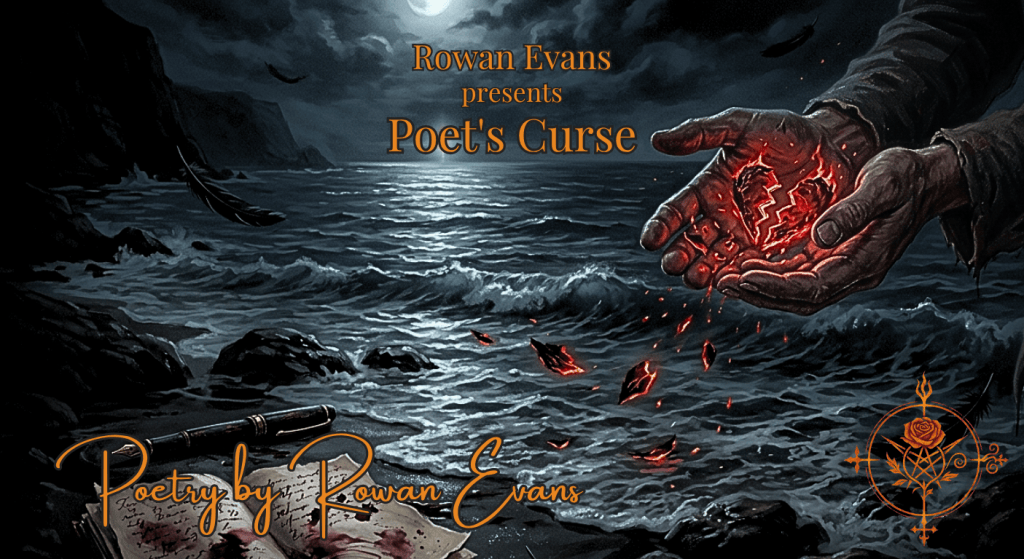
    A fountain pen and open notebook beside dark ocean waves while glowing fragments of a crimson heart drift away.
    Sometimes the hardest thing to learn isn’t how to love—it’s how to let go of what you’ve already given away.

    Poet’s Curse
    Poetry by Rowan Evans

    Here we go again
    it’s another season of sin,
    the poet’s back
    heartbroken with a pen.

    Yeah, went and fuckin’
    did it again—

    it’s my fault
    my heart is cracked,
    with pieces missing.

    You see, I give them away
    too freely, it’s such a pain
    to be me, I get hooked
    too easily—

    she did nothing wrong,
    she didn’t lead me on, just talked
    and I heard a siren’s song—

    I waded into the waves,
    prayed for things to change.

    Pardon the moment of slowness,
    give me a moment while I own this
    and take accountability for my part
    in breaking my heart.

    It’s a poet’s curse—

    I only learned how to hold on.
    I never learned how to let go,
    my feelings and emotion
    like hot coals in my hands.


    Journey into the Hexverse…

    [When I Fall]
    When I Fall is a vulnerable poem about loving without reservation, feeling everything deeply, and refusing to make the heart smaller just because wholehearted love can sometimes lead to loneliness and pain.

    If you’re interested in more poetry, you can find it here → [The Library of Ashes]
  • Author’s Note

    Some poems arrive because of a grand idea.

    Others arrive because a single sentence refuses to leave.

    This was one of those.

    The poem began when I remembered a conversation. A joke, really. Someone once described themselves as being “like a drug” and we laughed about it. At the time, it felt playful, exaggerated, harmless.

    But memory has a way of revisiting things from a different angle.

    When I thought about that conversation later, I realized what interested me wasn’t the comparison itself. It was the experience of slowly realizing that someone has become part of your everyday thoughts without you noticing exactly when it happened.

    One day they’re simply someone you know.

    Then they’re someone you think about.

    Then they’re someone who quietly occupies space in your mind when nothing else is demanding your attention.

    The drug metaphor gave me a doorway into the poem, but it isn’t really what the poem is about.

    It’s about affection.

    It’s about attachment.

    It’s about the strange vulnerability of admitting that someone matters.

    More than that, it’s about the difference between being needed and being wanted.

    Need can feel transactional.

    Want feels chosen.

    The final lines became the emotional center for me because they capture a hope I think many people carry but rarely say aloud:

    Not that someone has to stay.

    Not that someone owes us their attention.

    Just that maybe, if given the choice, they would choose us too.

    Like a lot of my recent work, humor and metaphor show up first. They’re familiar territory. They’re comfortable. They make difficult things easier to approach.

    But beneath the jokes, the poem is doing what many of my poems eventually do.

    It’s confessing.

    Rowan Evans


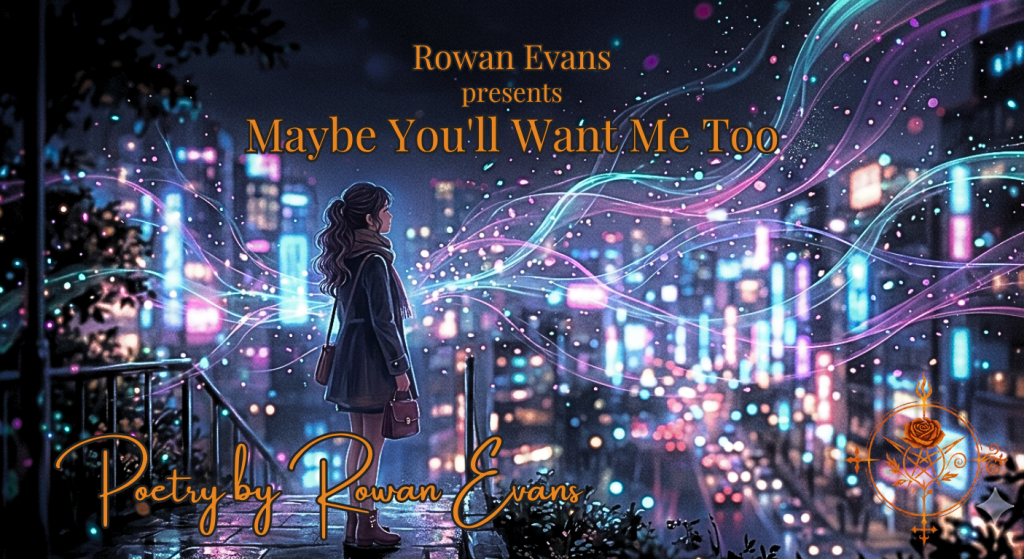
    A solitary figure standing beneath glowing city lights as colorful streams of light drift through the air, symbolizing affection, attachment, and lingering thoughts of someone special
    Sometimes affection arrives quietly—slipping into your thoughts until you realize someone has become part of your everyday world.

    Maybe You’ll Want Me Too
    Poetry by Rowan Evans

    I remember when you said—
    you are like a drug.

    It was all laughs
    about your exes being hooked,
    still shook by the thoughts of you.

    But I was getting second-hand
    contact highs—

    now I feel addicted too.

    It’s like you’re in my bloodstream.
    You’ve rewired my brain,
    rebalanced the chemical compounds—
    you’re in nearly every single thought now.

    I try to hide it behind metaphors
    and jokes—an attempt to mask
    the fragile hope—

    that you won’t need me,
    but maybe you’ll want me too.


    Journey into the Hexverse…

    [Recognizes Home]
    A free-verse poem exploring the difference between love as dependency and love as choice. It challenges the idea that love must be need-based, instead centering the quiet strength of choosing someone while still remaining whole on your own.

    [Not Rebuilding You]
    A poem about love as an act of presence rather than rescue. Through construction imagery, Not Rebuilding You explores trust, devotion, emotional safety, and the quiet work of building a foundation strong enough for healing to grow.

    [The Language Her Soul Speaks]
    What if love isn’t about being understood, but learning to understand someone else? “The Language Her Soul Speaks” is a free verse poem about intimacy, communication, curiosity, and the desire to know another person beyond the limits of language.

    [Ocean Waves (1, 4, 3)]
    A moonlit shoreline, a rowboat full of ducks, a piggybank with no cents, and a confession hidden in plain sight. Ocean Waves (1, 4, 3) explores how humor, wordplay, and absurdity can become a side door to vulnerability when the truth feels too difficult to say directly.

    [L Words & Heart]
    A moonlit shoreline, a rowboat full of ducks, a piggybank with no cents, and a confession hidden in plain sight. Ocean Waves (1, 4, 3) explores how humor, wordplay, and absurdity can become a side door to vulnerability when the truth feels too difficult to say directly.

    If you’re interested in more poetry, you can find it here → [The Library of Ashes]