Tag: moon symbolism

  • Author’s Note

    Some poems begin with an idea. Others begin with a feeling that refuses to leave.

    This one was written in the early hours of the morning, during that familiar stretch of time when the world grows quiet enough for my thoughts to become louder than everything else.

    I’ve always found it easier to write than to speak. Conversations ask for immediate answers. Poetry allows me to sit with a feeling until I understand it well enough to translate it into language.

    Many of the recurring images throughout my recent work—the moon, the tide, distant shores, dreams, and city streets—have become a personal symbolic language. They aren’t separate subjects anymore. They all point toward the same emotional center.

    This poem finally acknowledges that.

    Sometimes the metaphors aren’t hiding anything.

    Sometimes they’re quietly leading us back to the truth we were trying not to say.

    Rowan Evans


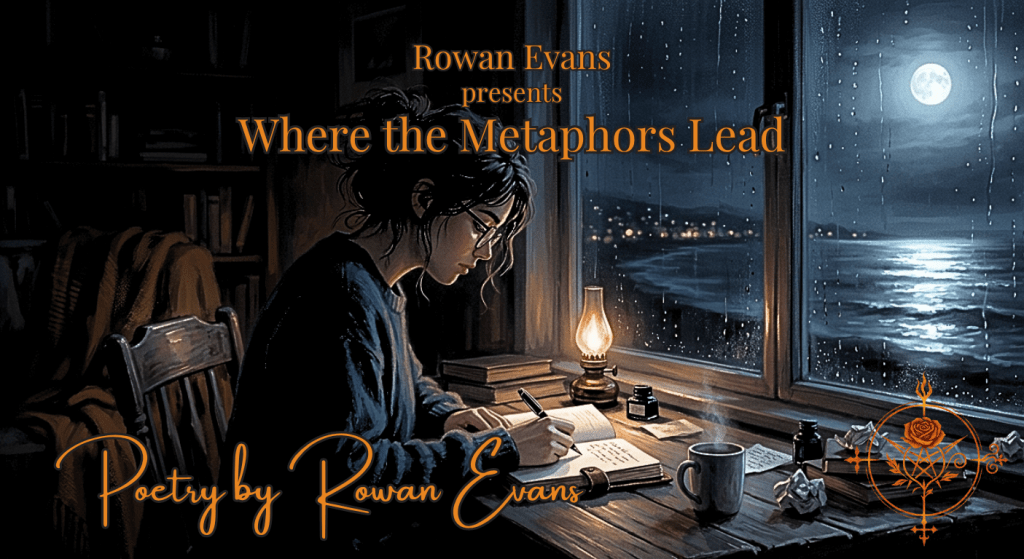
    A lone writer journaling by moonlight at four in the morning while the moon reflects across a calm ocean beyond the window.
    Some feelings only find their voice after midnight, where dreams, memory, and metaphor become impossible to tell apart.

    Where the Metaphors Lead
    Poetry by Rowan Evans

    It’s funny how I find myself here again,
    four AM—it’s just me, the music and my pen.
    I’ve got so many thoughts with so much to say,
    my lips move but no sound comes—
    like I lost one voice, when I found the other.

    And it’s not that I can’t speak—

    it’s just that words don’t come easily,
    when they try to come verbally.

    But on the page,
    everything lines up—

    the thoughts, the feelings,
    the things I never say out loud.
    Ink doesn’t trip over itself
    the way my voice does.

    So here are a few
    truths for you—

    there is a woman
    she is on my mind constantly,
    yeah, she is simultaneously
    the easiest and hardest to talk to.

    She makes me feel like I can be me—
    completely.

    And honestly,
    I’ve never really had that
    with anybody else—

    every beautiful line I write
    about the moon in the sky,
    the ocean and tide—

    yeah, most of the time
    it leads back to her
    in my mind.

    And every dream, I translate in ink—
    the shores I walk in sleep,
    secrets I try not to keep,
    even when it’s hard to speak—

    I lay them on the page and pray
    that they’ll reach their destination one day.

    So I sit here,
    four AM again,
    writing the things
    I can’t say out loud—

    hoping one day
    I’ll find the courage
    to speak them aloud.


    Journey into the Hexverse…

    [The World Shifted Around Us]
    The world transformed around us—beach, city streets, jungle—but we never moved. Sometimes love isn’t found in words, but in the quiet certainty of someone remaining clear while everything else fades.

    [Every Night, The Same Flight]
    Every night begins with the same flight. Between wakefulness and sleep, an airport appears, a familiar shoreline waits beyond the journey, and the same dream asks whether some destinations find us before we’re ready to find them.

    [Where I Belonged]
    A bedroom becomes an airport in the space between sleep and waking. Where I Belonged explores liminal consciousness, uncertainty, and the strange moments when reality feels suspended between two worlds

    [Opposites Coasts of the Same Silence]
    What separates two people isn’t always an ocean. Sometimes it’s the silence between everything left unsaid. Opposite Coasts of the Same Silence explores longing, distance, dreams, and the quiet hope that even across impossible divides, someone might still hear your voice.

    [Ocean Waves (1, 4, 3)]
    A moonlit shoreline, a rowboat full of ducks, a piggybank with no cents, and a confession hidden in plain sight. Ocean Waves (1, 4, 3) explores how humor, wordplay, and absurdity can become a side door to vulnerability when the truth feels too difficult to say directly.

    [Call of the Tide]
    A poem about identity, displacement, and the quiet pull toward something beyond the shoreline you were born on. Sometimes the tide calls louder than the anthem.

    If you’re interested in more poetry, you can find it here → [The Library of Ashes]
  • Author’s Note

    Some poems don’t begin with an idea.

    They begin with resistance.

    This one came from that familiar place I’ve written about before: four in the morning, when the world is quiet enough that my thoughts become impossible to ignore.

    I started writing about fear, but somewhere along the way I realized I wasn’t afraid of the page.

    The page has never been the problem.

    Ink has always been brave.

    It says the things I hesitate to speak.

    The real fear has always been what happens after the words exist.

    What happens when a confession leaves the safety of metaphor.

    When it stops being “the moon,” “the tide,” or “the shore,” and simply becomes the truth.

    If you’ve read much of my recent work, you’ll probably recognize many of the images here. The moon. The bay. The ocean. The distant shoreline. Dreams that feel more like memories than imagination.

    They’re all still here.

    Only this time, the poem admits something they’ve been pointing toward all along.

    Sometimes metaphors aren’t hiding the truth.

    They’re slowly teaching us how to say it.

    Rowan Evans


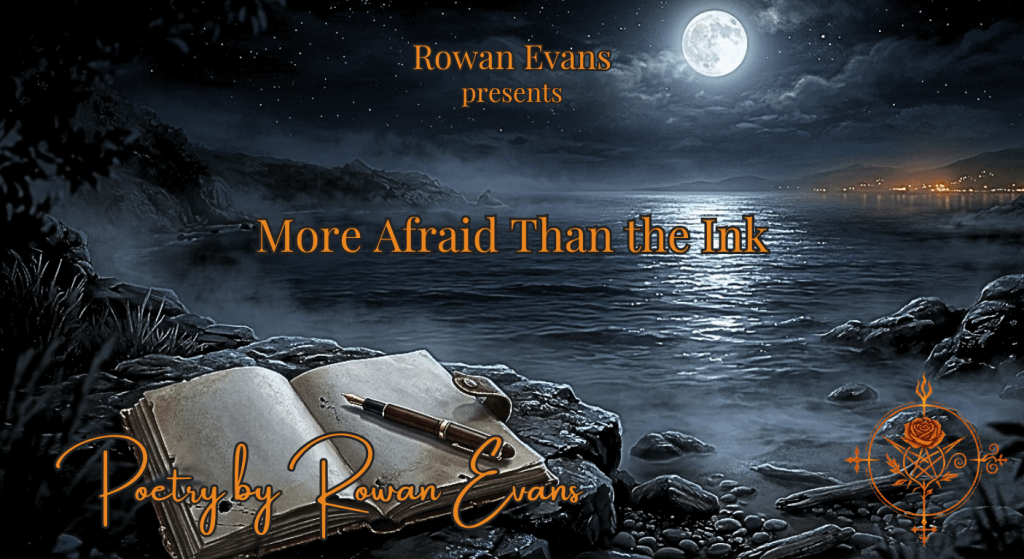
    An open journal and fountain pen beside a moonlit bay with shimmering reflections across calm water.
    Sometimes the ink is willing to tell the truth long before the poet is.

    More Afraid Than the Ink
    Poetry by Rowan Evans

    Four AM again—
    I breathe in and try to center myself,
    but it doesn’t seem to help.
    My mind wanders—
    moving from idea to truth
    and back again,
    carrying a collection of images
    and broken metaphors.

    The ink runs from my pen—
    like it’s scared of it.
    Because sometimes,
    my thoughts are dark
    and there’s no light in it.
    It trembles—
    lines becoming jagged
    as the truth hits
    a little too close to home.

    And the metaphors
    are broken for sure—
    it’s like I see the moon,
    but it doesn’t shimmer anymore.
    I don’t see the bay,
    I don’t feel the tide.

    There’s no ache,
    no longing for connection—
    across a divide
    an ocean wide.

    Okay, I lied.

    At night, when I close my eyes
    and my head hits the pillow—
    I feel the tide,
    it tugs at the heartstrings inside.
    I hear the waves, feel the ocean spray—
    and I see the familiar shimmer,
    the way the moon’s light trembles
    across dark water.

    The tide is why I dream of your shores—
    it’s why I walk your streets in sleep.
    And the moon provides the spotlight
    for every confession
    I speak with eyes closed…

    for every confession
    that I cannot say aloud,
    not outside of my dreams—not now,
    because I’m more afraid
    than the ink is.


    Journey into the Hexverse…

    [When the Veil Is Thin]
    Some truths wait until after four in the morning to make themselves known. When the Veil Is Thin explores insomnia, longing, quiet vulnerability, and the thoughts that become impossible to ignore before dawn.

    [Ocean Waves (1, 4, 3)]
    A moonlit shoreline, a rowboat full of ducks, a piggybank with no cents, and a confession hidden in plain sight. Ocean Waves (1, 4, 3) explores how humor, wordplay, and absurdity can become a side door to vulnerability when the truth feels too difficult to say directly.

    [The Language Her Soul Speaks]
    What if love isn’t about being understood, but learning to understand someone else? “The Language Her Soul Speaks” is a free verse poem about intimacy, communication, curiosity, and the desire to know another person beyond the limits of language.

    If you’re interested in more poetry, you can find it here → [The Library of Ashes]
  • Author’s Note

    Some distances aren’t measured in miles.

    They’re measured in conversations you haven’t had yet.

    In words that stayed behind your teeth.

    In the quiet space between two people who are looking toward one another but still can’t quite bridge the water between them.

    I’ve always been drawn to oceans because they represent contradiction. Water connects continents, yet it also separates them. It carries messages, memories, ships, storms—and still leaves shorelines untouched by one another.

    That became the emotional center of this poem.

    The “opposite coasts” aren’t necessarily literal places. They’re two inner worlds existing at the same time, close enough to imagine, far enough that neither person can simply step across.

    The moon became the only thing capable of visiting both shores.

    It witnesses both sides equally.

    It touches both tides.

    Yet even it cannot erase the distance.

    This poem isn’t about giving up.

    It’s about acknowledging that some silences become landscapes of their own—and learning to live honestly inside them until, perhaps, one day, the tide changes.

    Rowan Evans


    Two figures stand on opposite moonlit shores separated by a wide ocean as the full moon reflects across the water between them.
    Some distances aren’t measured in miles—they’re measured in everything left unsaid.

    Opposite Coasts of the Same Silence
    Poetry by Rowan Evans

    I sit—moon kissed,
    watching the tide
    inside my mind—
    as dreams move in,
    and thoughts roll out.

    It’s an ocean wide,
    this divide between us.
    I can see your shore in my mind,
    but I can’t seem to reach it—
    we stand on opposite coasts
    of the same silence.

    It’s a silence
    full of things I never said.
    A silence
    shaped like your name.

    The moon hangs between us
    like a quiet messenger—
    I whisper secrets for her to carry
    from my shore to yours.
    It pulls at your tide and mine,
    but never enough to close the distance.

    Sometimes I swear
    I hear your voice in the undertow.
    The distance hums
    with everything unfinished.

    Every wave reaches
    for something it can’t hold.
    The water keeps returning,
    but you don’t.
    There are whole storms between us
    I never learned to name.
    Currents I can feel but not follow.


    Journey into the Hexverse…

    [Where Intamacy Begins]
    For some, attraction begins with appearance. For others, it begins with conversation. Where Intimacy Begins explores the beauty of curiosity, deep listening, and the quiet connection that forms when two minds truly meet.

    [I’d Rather Try]
    Anyone can promise they’d die for someone. But love isn’t built on one dramatic moment—it’s built on showing up, trying again tomorrow, and proving your words through consistent action.

    [Pointing Me Home]
    The final poem in the No Metaphor Left Behind trilogy explores dreams, hope, and belonging. Through moonlight, ocean tides, and quiet conversation, Pointing Me Home reflects on carrying hope long before reaching the place you call home.

    [Ocean Waves (1, 4, 3)]
    A moonlit shoreline, a rowboat full of ducks, a piggybank with no cents, and a confession hidden in plain sight. Ocean Waves (1, 4, 3) explores how humor, wordplay, and absurdity can become a side door to vulnerability when the truth feels too difficult to say directly.

    [I’ll Be There to See Your Sunrise]
    Love has never come easily to me. This poem explores the fear, vulnerability, and quiet courage required to stay emotionally present when connection begins to matter deeply. “I’ll Be There to See Your Sunrise” is about choosing love despite the risk of heartbreak—and promising to remain long enough to witness someone fully.

    If you’re interested in more poetry, you can find it here → [The Library of Ashes]

  • Author’s Note

    Some poems arrive as declarations.

    This one arrived as an observation.

    I’ve often described myself as a witness poet—someone who pays attention, who notices the emotional weather around the people I care about, and then translates those observations into poetry.

    Sometimes that role feels like a gift.

    Sometimes it feels helpless.

    Because witnessing doesn’t always come with the ability to change what you see.

    You can recognize someone’s strength, admire their resilience, ache alongside their struggles, and still be separated by circumstances larger than either of you.

    This poem isn’t about unrequited love.

    It isn’t about sacrifice.

    It’s about accepting that love isn’t always measured by proximity.

    Sometimes love looks like paying attention.

    Sometimes it looks like quietly hoping someone feels a little less alone because, somewhere in the world, another heart witnessed their struggle with compassion instead of judgment.

    That’s the strange privilege—and responsibility—of being a witness poet.

    Not every distance is meant to be closed.

    Some are simply meant to be seen.

    Rowan Evans


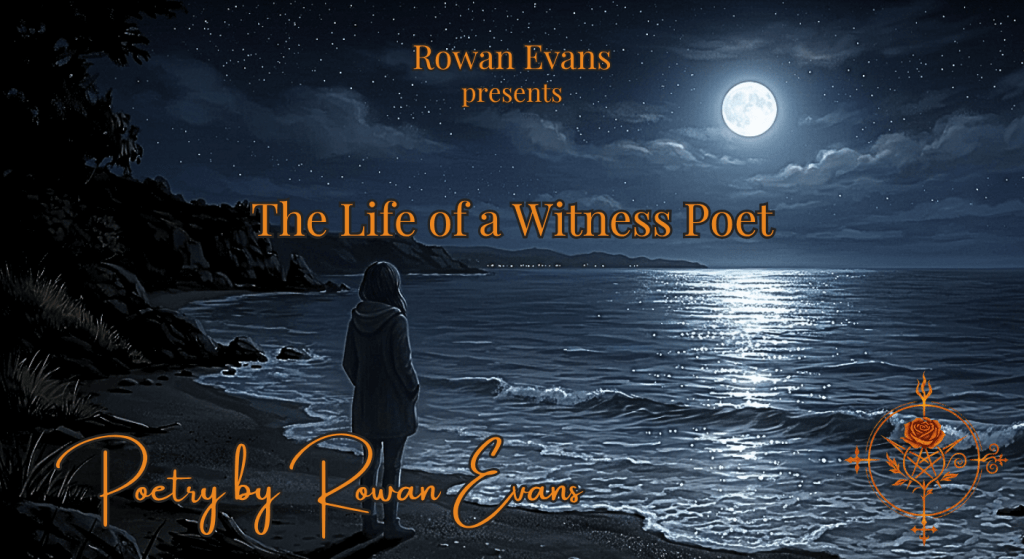
    A lone figure watching moonlight shimmer across a calm ocean toward a distant shore, symbolizing quiet love, witnessing, and emotional distance.
    “Some distances cannot be crossed—but they can still be held with compassion.”

    The Life of a Witness Poet
    Poetry by Rowan Evans

    The life of a witness poet—

    it’s harder than you think,
    when your heart bleeds in ink.
    And it only gets harder
    when you’ve fallen
    for the one you witness.

    You see the weight she carries,
    you watch from a distance—
    your hands tied by the tide,
    and the gap—an ocean wide.
    You want to be a light in her life—

    like the moon in the sky.

    You learn to glow quietly,
    hoping she’ll look up someday—

    not for you,
    but for the comfort
    you’ve been trying to give
    from a distance.

    So you learn to love in silence,
    in the spaces between her storms—

    holding what you can,
    honoring what you can’t,
    knowing some distances
    aren’t meant to be crossed,
    only witnessed.


    Journey into the Hexverse…

    [What I’m Trying to Say]
    What begins as an exaggerated promise of love slowly strips itself back until only one simple truth remains: real devotion isn’t found in grand gestures—it’s found in consistently showing up.

    [I’d Rather Try]
    Anyone can promise they’d die for someone. But love isn’t built on one dramatic moment—it’s built on showing up, trying again tomorrow, and proving your words through consistent action.

    [Pointing Me Home]
    The final poem in the No Metaphor Left Behind trilogy explores dreams, hope, and belonging. Through moonlight, ocean tides, and quiet conversation, Pointing Me Home reflects on carrying hope long before reaching the place you call home.

    [Only Waiting]
    The second poem in the No Metaphor Left Behind series, exploring the quiet ache of growing up in a place that never truly felt like home—and finally saying aloud what years of metaphor had been trying to express.

    [Crossing the Sea]
    A deeply personal poem about relocation, longing, and the realization that some truths naturally arrive through metaphor—even when we try to leave it behind.

    [I’ll Be There to See Your Sunrise]
    Love has never come easily to me. This poem explores the fear, vulnerability, and quiet courage required to stay emotionally present when connection begins to matter deeply. “I’ll Be There to See Your Sunrise” is about choosing love despite the risk of heartbreak—and promising to remain long enough to witness someone fully.

    If you’re interested in more poetry, you can find it here → [The Library of Ashes]