Author’s Note
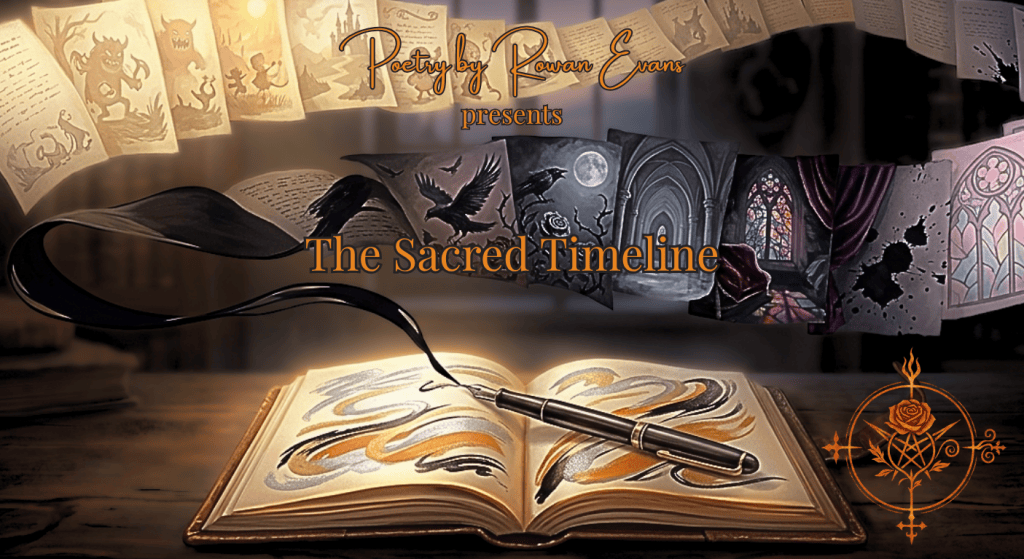
The Sacred Timeline is a map of how my relationship with the pen has changed over nearly three decades of my life.
I started with stories about worlds that already existed—Dragon Ball Z, Power Rangers, Pokémon—and slowly began building worlds of my own. Then the pen became a way to learn cadence, translate music, hide things I couldn’t say aloud, survive periods when writing itself became difficult, and eventually turn pain into something crafted enough to share.
Every era left something behind: the storyteller, the songwriter, the secret keeper, the gothic romantic, the heretic, the battle poet, the confessor, the mythmaker. Some symbols came and stayed. Some meanings changed. Some questions took decades to become clear enough to write down.
And the timeline is still moving.
At thirty-six, I don’t consider the pen mastered so much as understood differently. Writing is still an experiment. The boundaries keep moving. The imagery keeps evolving. The person holding the pen keeps changing.
Maybe that’s the most sacred part of the timeline: the ink stayed, but I didn’t.
— Rowan Evans
The Sacred Timeline
Poetry by Rowan Evans
I picked up a pen
for the first time at seven,
I was just writing stories then—
Dragonball Z, Power Rangers and Pokémon…
that’s what I wrote about
way back when—
it was much lighter out,
the sun had yet to meet the clouds—
I was a natural storyteller,
a real lore keeper, weaving lore before
I even knew what lore meant.
It was like this for years,
I created my own space in worlds
provided by minds much older than mine.
Then at ten—I switched
what the pen meant to me,
my creativity shifted mentally—
no longer was I just a storyteller,
I was letting music be the teacher now.
Translating thoughts to song,
at least the words of it—
I was writing to worship something.
Something that in six short years,
I would begin to question—
but the years between ten
and then—were spent,
using the pen to learn cadence.
I was trying to learn
to perform on the page—
I couldn’t do it in body,
but I could turn a notebook
to a stage.
At twelve things began to shift again,
but with me, not with the pen—
I still felt the sun, I still saws its rays,
but I also saw more cloudy days—
that year was hard for me,
I couldn’t talk about it with clarity—
most people would react like,
“you’re scaring me”—
so I stopped talking about it really,
I closed my lips, but still let the ink spill—
the page became a secret keeper,
keeping the secrets this storyteller
was too afraid to say out loud.
Thirteen the skies went dark—
this is when life really got hard.
At the beginning of the year,
it’s like the ink in my pen
had begun to dry—
I don’t know what was wrong,
but I couldn’t write.
I tried and I tried—
pages ripped from notebooks,
balled up and scattered.
No songs, no stories—
I had lost interest in things
that I used to find most interesting.
Parents took me to the doctor,
and the doctor said—
“This kid’s depressed—
and anxious too,
I’ll write a prescription
that should do.
A referral for therapy,
they’ll get them to talk—
they’ll find out what’s wrong.”
A week would go by—
giving the medicine a try,
it takes time—
it has to build up in your system.
In the meantime,
here’s a therapist,
someone to talk to—
they’ll listen to your problems,
they’ll help you.
And they did—a little bit,
they got me to talk a little bit too.
But still they saw I was holding back—
so they recommended journaling,
but that felt tedious and boring.
I needed to find a way to make it play—
bring a little joy to it, even if falsified.
I made it a game
to translate my pain—
how many ways
could I say everything?
Is it possible to flip it?
Maybe change the script
and shift the meaning?
These were the questions
I began to ask—
even when my ink
ran in all black—
back when my heart
was all cracks,
before I learned
how to use the gold to patch—
I struggled through,
just writing purely what I felt—
thirteen, fourteen and fifteen,
often felt like hell.
Sixteen, I hit my stride—
not in life but with a pen,
things were hard still,
but now I could translate with skill.
Not much, if we’re being honest—
just enough to keep the pain beautiful,
in case someone else saw it—
Seventeen, I did it again—
reinvented myself with the pen,
more gothic in my intentions.
Maybe I finally read Poe,
who knows—
but ravens became
a part of my soul.
At eighteen, I went from church steeples
and church people to writing cathedrals
for outcasts and heretics—
we hadn’t yet, become luminous.
Shadows and lace, velvet and venom—
but I also opened my eyes more,
became more aware of the world around—
outside the borders I’m confined in.
At twenty, I started to write
for people more—to uplift,
and let them know
they’re not alone—
whatever they were going through,
there was somebody with them.
Even from a distance—
I had friends across seas,
in places with palm trees—
and in places with Kangaroos,
even scarier—Emu.
I don’t know what that means
in this piece—but it’s true,
so do with that,
what you’re going to do.
At twenty-two,
I got more serious about the ink—
I started to write everything.
Every thought and
every half-formed idea—
I just put it on a page,
my brain would not be a cage.
Then came twenty-five,
the lowest point in my life—
it wasn’t a sudden crash,
but a slow rot—
it bled through every thought,
a feeling I couldn’t translate,
familiar but different,
heavier somehow—
so the ink slowed to a drip,
I started to let thoughts slip.
Twenty-six,
I got serious again—
more aggressive with the time spent,
my pieces became more crafted
and the ink was shaped with intention.
Ravens, the moon, and roses too—
the symbols I began to use.
I ascend on the back of raven wings—
the silver light of the moon
pierced the canopy—rose petals drift
in the shifting currents of the wind.
Everything connects, pay more attention
and you’ll become more aware—
At thirty—
I really began
to question everything—
who I was, who I am,
who I want to be—
and that’s still a question
I’m working on answering.
But it went deeper than that—
I was questioning who I was
in a deeper sense,
like had I been a façade in some sense.
Was I playing the role I was assigned,
or being true to who I thought I was becoming?
This became a recurring theme in my poetry—
it’s an odd thing to discover so late in life,
that the person you thought you were—
isn’t who you’re supposed to be.
So I chased answers in ink
to questions I couldn’t fully ask yet.
There were two more years of this—
and I’m still not finished.
Thirty-three hit with another shift—
I mixed the light with the shadow,
it was Easter in the cathedral—
pastel colors lit up the stained glass.
My imagery began to shift shades—
roses in all colors, pastel hues,
but the thorns were still there too.
So even my softness had bite—
and it evolved more, by thirty-four—
more teeth but more softness too.
Brighter hues and deeper shadows—
this is when I learned,
you can’t have one without the other.
The shadow needs the light to cast—
and you need the shade to dim the shine,
because too much shine—
you might go blind.
Then came thirty-five—
the modern era, the current phase,
one year before the current day—
and I know this won’t age well,
it’s too time specific—
Finally, we’ve reached thirty-six,
and I feel like I’ve mastered this—
but that doesn’t mean I’ve stopped learning,
because every day is an experiment—
really, it’s all about the experience—
just learning new things and pushing it,
finding where the boundary is
and bending it, you gotta realize—
you can’t always give a shit,
who cares what they think—
it’s your ink—shape it how you see fit.
Journey into the Hexverse
[The Metaphor Machine]
A poem that takes apart its own machinery as it runs—breaking lines, breaking thoughts, and following metaphors from moonlight to tides, oceans, shorelines, and city streets.
[Exhibit A (The Evidence)]
A quick-witted, unapologetically playful poem about writing fast, crossing lines, roasting the competition, and letting rhythm do the talking.
[Welcome to the Hexverse]
Step into the Hexverse—a poetic world where mythmaking, humor, rage, creativity, and confession collide, and darkness becomes something that can be reshaped into art.
If you’re interested in more poetry, you can find it here → [The Library of Ashes]
 Poetry by Rowan Evans