Tag: Writing About Love

  • Author’s Note

    Writing Has Never Been the Problem
    There are things I can say beautifully on a page that I struggle to say out loud.

    That’s one of the central contradictions of being a poet: I can take something complicated, painful, frightening, or deeply personal and turn it into lines of poetry—but when the page disappears and I’m standing in front of the person who matters, suddenly the words don’t come so easily.

    Writing Has Never Been the Problem (Promises on the Page) is about that gap.

    Because writing a promise is easy compared to keeping one.

    On the page, I can find the perfect words. I can explain myself. I can make the feeling beautiful. I can build an entire world around what I mean.

    But eventually, the poem has to leave the page.

    Eventually, words have to become choices.

    And that’s where the real question begins:

    Can I live what I write?

    This poem isn’t me claiming that I’ve figured that out. It’s me admitting that the page is the place where my confidence is strongest—and that becoming the person behind those words is the harder work.

    The writing has never been the problem.

    Living it is.

    — Rowan Evans
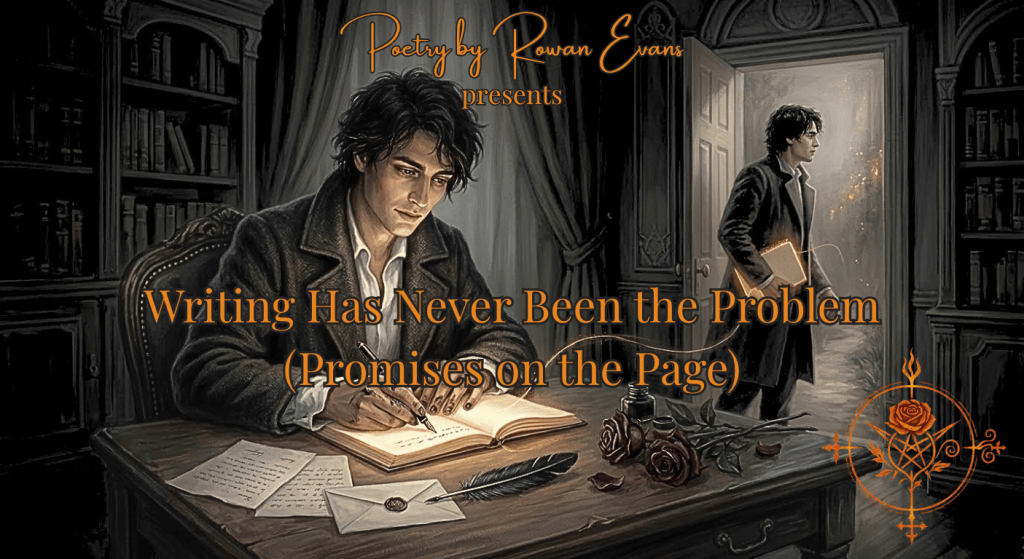

    A poet writes promises in a glowing notebook while hesitating at an open doorway leading from the safety of the page into the real world.
    The page can hold every promise. The real question is whether I can carry them beyond it.

    Writing Has Never Been the Problem (Promises on the Page)
    Poetry by Rowan Evans

    I’ve been trying to be more honest lately,
    not that I’ve been lying directly—
    just by omission, admittedly.
    I was keeping things to myself,
    things I could have said on the page—
    I know I can’t say them to her face,
    or even over the phone—
    the only place safe is the page,
    the place my words call home—
    it’s where my voice is the loudest,
    where I stand the proudest—
    where my confidence is loud,
    but doesn’t shout—

    I know I’m good at what I do,
    but I know I could do better too—
    I could be better for her,
    I already write the prettiest words—
    even the ones absurd,
    every single verse—
    not a single word rehearsed,
    even the ones written—
    writing has never been the problem.

    It’s always been speaking—
    always been living,
    that’s the thing I struggle with—
    I can make all the promises on the page,
    phrased in a hundred different ways—
    but can I follow through?
    Can I do what I’m supposed to do
    when it matters most to her?
    Or would I become another problem too?
    Another example of what not to settle for,
    I’m saying this plain, no need for metaphors.


    Journey into the Hexverse

    If you’re interested in more poetry, you can find it here → [The Library of Ashes]
  • Author’s Note

    Sending What I Can’t Say
    There are things I can write much more easily than I can say.

    That’s probably one of the strangest contradictions of being a poet: I can put some of my deepest thoughts onto a page and hand them to strangers, yet saying those same words directly to one person can feel almost impossible.

    Message in a Bottle lives inside that contradiction.

    The poem is about affection, vulnerability, fear, and the strange freedom that comes from finally letting thoughts escape after keeping them locked away for too long. The words may come easily onto the page, but that doesn’t necessarily mean they’re easy to carry once they’re written.

    And sometimes I wonder what happens to all those words after I release them.

    Do they reach the person they’re meant for?

    Do they wash ashore somewhere?

    Or do they simply drift through the world, another confession swallowed by the waves?

    Maybe that’s part of why I keep writing.

    Even when I can’t say something aloud, I can still send it.

    So I put the message in the bottle, seal it with ink, and let the tide decide where it goes.

    — Rowan Evans


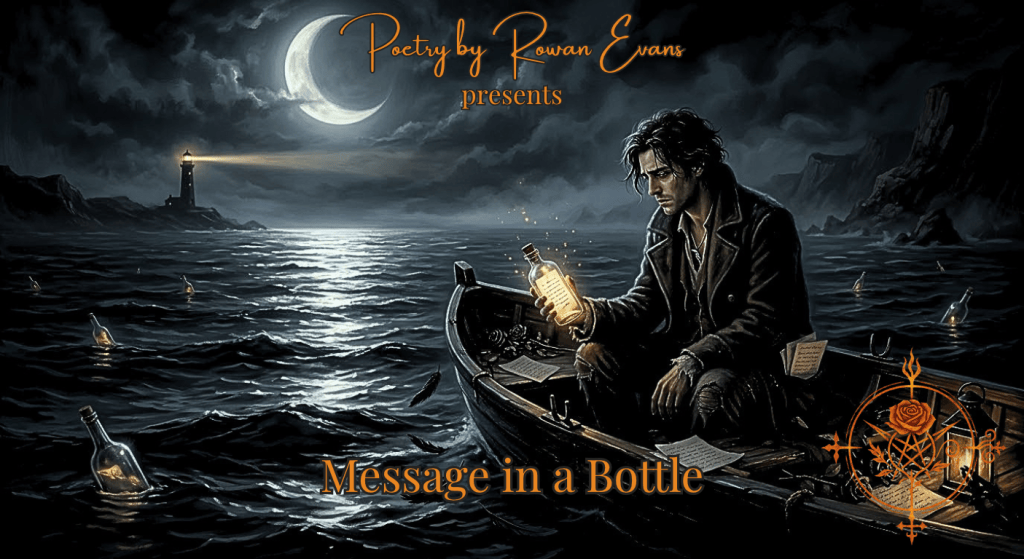
    A poet in a small rowboat holds a glowing message in a bottle while a distant lighthouse shines across a moonlit ocean.
    Some things are easier to write than to say. So I put the words in a bottle and let the ocean carry them.

    Message in a Bottle
    Poetry by Rowan Evans

    I want to talk about what I feel,
    but sometimes I get scared
    and that just seems silly—
    because I spend the majority of my time
    writing lines about what I feel,
    coded in rhymes and metaphors, for real.
    I fall in love like once a second—
    but it’s hardly what you think,
    it’s just the way my mind shows affection—
    it’s like every time I blink,
    I see her face and fall again.

    I’ve taken risks, I’ve let things slip from my lips—
    things that before I would have kept locked inside,
    packed in a box in the back of my mind.
    Even when I try and stop it—
    just can’t stop it, at all,
    body is fine—heart in a free fall.
    No parachute, ground approaches fast—
    and I can’t help but laugh.
    I’ve been weak, powerless since I met her—
    but still, I’ve never been stronger either.

    In years past, I’ve kept my secrets
    with lips locked—padlocks and lost keys.
    But with her, these words come easily—
    too easy, it was for me to say these things.
    It’s like I regurgitate every thought I had—
    but every thought I had spoiled,
    rotten and gone bad—

    I held them in too long.

    They’ve become twisted,
    corrupted and all wrong—
    or that’s how it feels
    when the lantern burns out—
    when I’m too far from the shore
    to see the lighthouse now.

    So I sit in a rowboat,
    rocking in the waves—
    praying for a chance to say
    everything I want to say.
    It’s stuck at the tip of my tongue—
    and the thought she’ll never hear
    takes the air from my lungs—

    but still, can’t seem to produce a sound—
    so I’ll continue to write it down,
    in hopes that one day she’ll get a chance to see—
    and that every poem isn’t just another
    message in a bottle, lost at sea—


    Journey into the Hexverse

    If you’re interested in more poetry, you can find it here → [The Library of Ashes]

  • Author’s Note

    This piece was supposed to be a diss poem.

    Seriously.

    I started writing with the intention of poking fun at the endless parade of “Roses are red, violets are blue” poems that seem to recycle the same handful of ideas over and over again. The opening lines still carry some of that energy. They’re impatient. Slightly sarcastic. A little annoyed with how often people settle for the familiar when language can do so much more.

    But somewhere along the way, the poem changed directions.

    Instead of criticizing the cliché, I started asking why it feels like one.

    And I think the answer is simple:

    It’s not that the format is the problem.

    It’s that too often we borrow someone else’s words when our own would mean more.

    Love isn’t memorable because it’s perfectly phrased. It becomes memorable because it’s specific. Personal. Honest.

    Nobody falls in love with a template.

    They fall in love with the details.

    The shimmer of moonlight on water. The way someone’s voice changes when they’re excited. The strange contradictions of affection—how a person can make you feel stronger and weaker at the same time.

    Those things belong to you.

    The final lines became the heart of the piece for me because they move beyond parody and into something sincere.

    Don’t give someone borrowed language.

    Don’t hand them a greeting card version of your feelings.

    Give them your words.

    Give them the truth of you.

    — Rowan Evans


    Moonlight reflecting across dark water beside an open notebook and pen, symbolizing love, poetry, and authentic self-expression.
    “Don’t give someone borrowed language. Give them your words instead.” — A poem about authenticity, romance, and the details that make love unforgettable.

    Give Her Your Words Instead
    Poetry by Rowan Evans

    Roses are red,
    violets are blue—
    and so am I, too.
    Because your originality
    is growing old—
    your thoughts,
    are all cliché.

    I feel like I’ve
    read this all before.
    Roses are red—
    it’s been said and done,
    over and over.
    Too many times to count.

    It’s a quick start,
    not a spark—
    has no heart.

    You could do more.

    You could talk about
    the shimmer of the moon,
    over dark water—

    the way its reflection
    trembles—
    like my knees
    when she walks in.

    How the heart flutters
    like butterfly wings,
    whenever she speaks.

    She gives me strength.
    She is the spinach
    to my Popeye muscles.

    And yet—
    she makes me weak.
    She’s the kryptonite
    to my Kent.

    All I’m saying is—
    don’t give
    her roses of red,
    give her your words instead.

    No violets of blue,
    just the truth of you.


    Journey into the Hexverse…

    [Violets Are Violet (Roses Are Complicated)]
    A simple observation leads to an absurd conclusion: violets aren’t blue, roses aren’t always red, and the classic love poem may be far less accurate than advertised. A humorous free-verse poem about overthinking, flower symbolism, and the unintended consequences of analyzing clichés too closely.

    If you’re interested in more poetry, you can find it here → [The Library of Ashes]