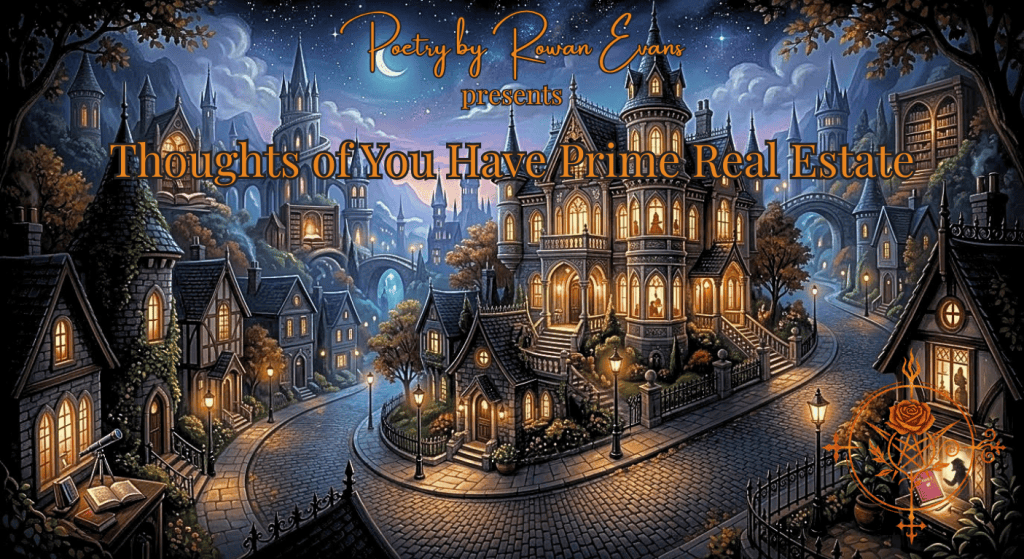
We often say someone is “living rent-free in our head,” but what if they weren’t renting?
Thoughts of You Have Prime Real Estate takes that familiar expression and builds an entire neighborhood inside the mind—roads, sidewalks, corner lots, contemporary homes, secrets, dreams, and eventually one particularly valuable property.
Because thoughts don’t always feel temporary. Sometimes they settle in, expand, renovate, and quietly become part of the landscape.
And apparently, the thoughts of you got the best view.
— Rowan Evans
Some thoughts rent a room. Yours apparently bought the whole corner lot.
Thoughts of You Have Prime Real Estate Poetry by Rowan Evans
They say, when something is stuck in your thoughts— it lives rent free in your head, and that’s true in a sense— because the thoughts have taken up real estate, they own land— building new developments. New neighborhoods are being constructed, new roads are being laid— new sidewalks paved.
Take a walk down the block, you’ll see thoughts taking up corner lots—
modern contemporary homes lining the streets— full of my secrets to keep, and rooms where my dreams sleep.
But the nicest home of all— the one with the best views, and the biggest rooms…
it houses my thoughts of you.
Journey into the Hexverse
[Half a Picture] What happens when someone falls in love with the person they discover through your poetry? Half a Picture explores the strange intimacy between writer and reader—and the distance between seeing someone’s mind through their words and truly knowing the whole person.
[Love Me From Over There] A sharp and humorous poem about the strange contradiction of wanting someone close while simultaneously needing them to stay several feet away from your face.
[It Could Have Been…] A playful little love poem about strawberries, roses, and the wonderfully ridiculous ways romance can show up when you know someone doesn’t like the traditional version.
[High Tide] A short reflective poem about leaving, returning, and accepting the forces that pull us back—like the tide guided by the moon.
Sometimes it’s strawberries, questionable scientific reasoning, and the absolute confidence to say, “Deal with it.”
This piece is a little love poem for the people who show affection in their own weird, imperfect, slightly ridiculous way.
— Rowan Evans
When roses won’t do, bring strawberries. Romance is all about knowing what they like.
It Could Have Been… Poetry by Rowan Evans
I know you don’t like roses— so I brought you a bouquet of strawberries— they’re the same thing, scientifically— maybe not exactly, but they come from the same family—
it’s still romantic. Deal with it.
Oh, and hey— it could have been apples.
It could have been…
Peaches, Pears, Raspberries, Cherries…
heck…
a bag of almonds…
but I gave the one that still feels—
like romance.
Journey into the Hexverse
[Welcome to the Hexverse] Step into the Hexverse—a poetic world where mythmaking, humor, rage, creativity, and confession collide, and darkness becomes something that can be reshaped into art.
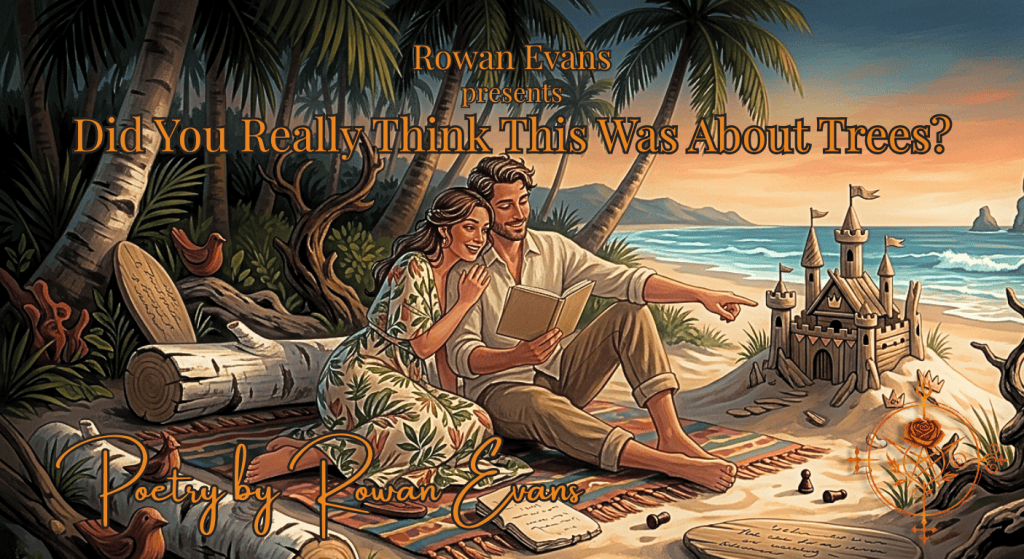
Every now and then, affection shows up wearing bark and leaves. Today was one of those days.
Did you really think this was about trees? 🌳
Did You Really Think This Was About Trees? Poetry by Rowan Evans
Birch, I’m in a mood—
but I’m feelin’ pretty Oak today,
oops, I mean, a-o-k—
especially with my Rose Wood beside me,
open my eyes, so I could Cedar—
her fingers in my hair,
like the breeze through the leaves.
Did you really think
this was about trees?
It’s just me and her
by the summer seas,
just us with Palms in the sand—
castle and a plot of land,
where she is royalty—
a Queendom built
off the back of loyalty.
And that’s something I don’t lack,
I got it in stacks—packed to the rafters,
stick with me and you’ll have a life full of laughter—
you’ll never get board like a lumberyard,
and I work hard—
to prove my words have meaning,
even when they are weird
or absurdist leaning.
Author’s Note
Sometimes I write a poem because I have something profound to say.
Sometimes I write one because my brain looked at a bunch of tree names and apparently decided they needed to become flirting material.
This is the latter.
Did You Really Think This Was About Trees? is a deliberately ridiculous little love poem built almost entirely around wordplay. Birch, oak, rosewood, cedar, palms, lumberyards, boards—I’m taking language that belongs to the world of trees and woodworking and forcing it into a completely different emotional landscape.
And yes, the title is absolutely part of the joke.
The poem starts by making the reader think they’re about to get some sort of nature poem. Then I reveal that the trees were never really the subject.
The subject was her.
The forest is just the camouflage.
I also wanted the poem to feel conversational and slightly chaotic. The little correction from “Oak” to “a-o-k,” the exaggerated promises, the lumberyard imagery, and the final admission that the whole thing is leaning toward absurdism are all intentional.
There is something freeing about allowing a love poem to be stupidly playful.
Not every expression of affection needs to be solemn.
Sometimes love looks like poetry.
Sometimes it looks like devotion.
And sometimes it looks like spending an entire poem making increasingly terrible tree puns because you love someone enough to make yourself laugh while writing about them.
Honestly, I’ll take all three.
— Rowan Evans
Journey into the Hexverse…
[Blended Hardware] A playful, absurdist poem where step-ladders, garden hoses, Star Wars, teenage memories, Gothic imagery, and the poet’s own self-interrupting commentary collide. Blended Hardware is a celebration of letting language wander.
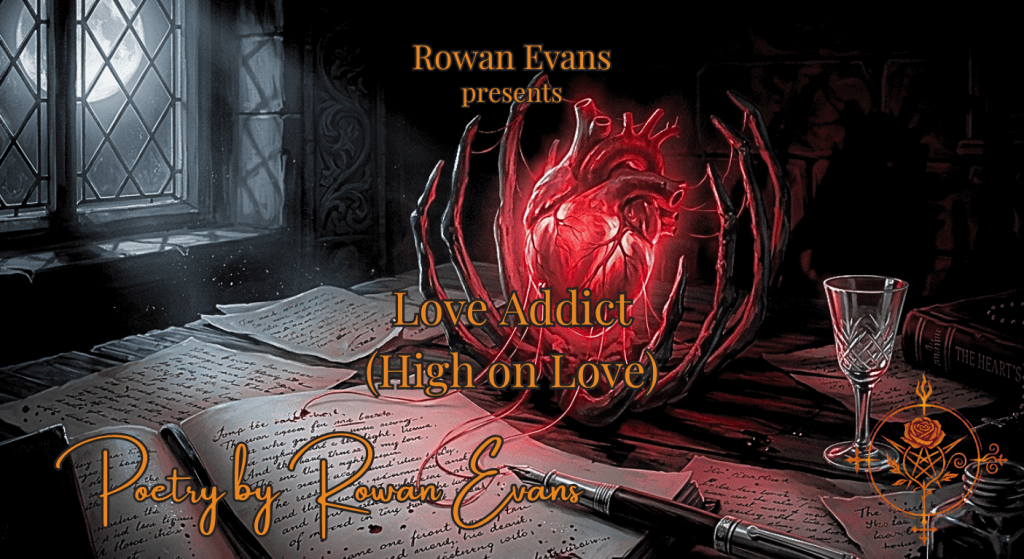
Love Addict (High on Love) is me taking one of my recurring themes—how intensely I experience love—and pushing the metaphor until it becomes impossible to ignore.
I’ve often written about love as something intoxicating. A rush. A chemical reaction. Something that can make the world feel brighter and the mind move faster. But this poem asks what happens when that metaphor is taken literally enough to become uncomfortable.
Because sometimes I don’t simply want love.
I crave it.
There is a difference.
The language of addiction works here because love can create its own strange cycle: anticipation, euphoria, uncertainty, withdrawal, craving, and the desperate desire for another hit of the feeling that made everything seem worthwhile.
And, naturally, my response to that craving is to write.
That’s one of the things I find fascinating about my relationship with poetry. I don’t merely write about what I’m feeling—I often metabolize the feeling through language. I take the emotion, push it through rhythm and metaphor, turn it over until I can see its shape, and then put it on the page.
So the final joke is also the truth.
I get high on love.
Then I get high on writing about getting high on love.
And apparently, the cycle continues.
Maybe that’s the real habit.
— Rowan Evans
Some people chase love. I apparently write it until the high wears off—and then write another poem.
Love Addict (High on Love) Poetry by Rowan Evans
I get high on love
like it’s a drug
and I’m an addict
with a habit,
fighting for every hit
that I can get—
if I could,
I would OD on it.
Inject it straight
to my chest,
in-between the ribs—
where the heart lives.
I’d take the risk,
the comedown, the crash,
just to feel one moment
where love doesn’t pass.
I get the shakes and quake,
knot in the stomach—cold sweats,
when love doesn’t sit in the chest—
it feels fake, not worth the weight.
Wait—
what was I saying?
I get high on love
like it’s a drug
and I’m an addict,
so I write lines
that expand the mind,
to feed the habit.
Journey into the Hexverse…
[Poet’s Curse] Poet’s Curse explores the painful side of falling too deeply: giving pieces of yourself away freely, taking accountability for your own heartbreak, and realizing that learning to let go can be harder than learning to love.
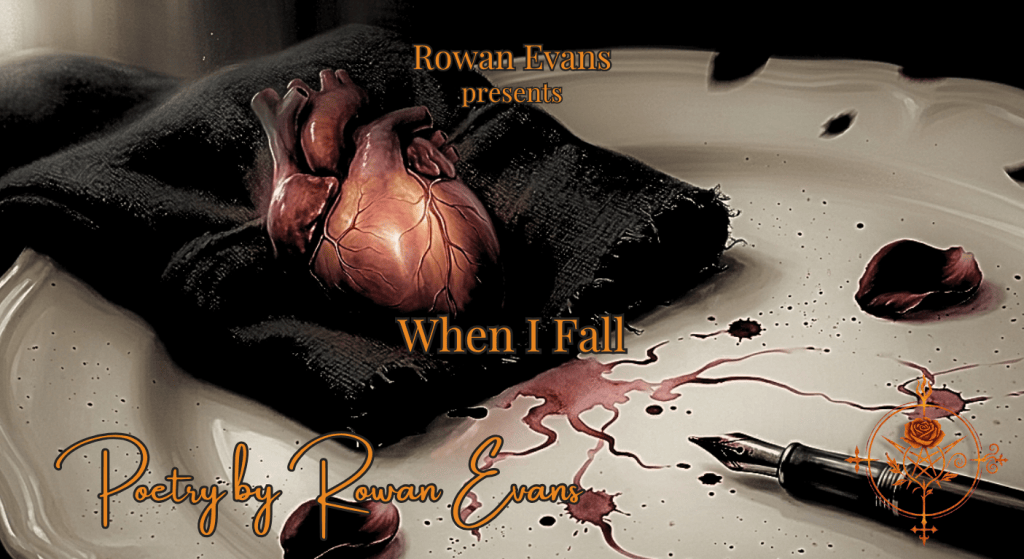
[When I Fall] When I Fall is a vulnerable poem about loving without reservation, feeling everything deeply, and refusing to make the heart smaller just because wholehearted love can sometimes lead to loneliness and pain.
When I Fall is about the way I experience love when I stop trying to make it smaller.
I have never been particularly good at feeling things halfway. When something reaches my heart, it tends to go deeper than the surface—into the marrow, into the places where emotion becomes difficult to separate from identity. That intensity can be beautiful, but it can also hurt when the love I give doesn’t find its way back to me.
The easy response would be to close myself off.
To dim the light.
To protect myself by pretending I don’t feel as deeply as I do.
But I don’t want to do that.
There is something important about refusing to treat your capacity for love as a flaw simply because someone else couldn’t—or wouldn’t—meet you there. Sometimes loving wholeheartedly means accepting that you may get hurt. Sometimes being honest about what you feel means sitting with the loneliness afterward.
That doesn’t mean the answer is to become colder.
I would rather keep my heart open.
I would rather love the way I love—whole, honest, and unhidden—than spend my life making myself smaller just to avoid the possibility of pain.
Maybe falling hard isn’t the problem.
Maybe the real courage is choosing to keep getting back up without becoming afraid of the fall.
— Rowan Evans
I would rather love wholeheartedly than make my heart smaller just to make the fall hurt less.
When I Fall Poetry by Rowan
When I fall, I fall hard.
I feel it all or nothing—
when it comes to matters of the heart.
There is no middle ground,
no in-between—
it’s all or nothing for me.
I send out love,
and no one returns with it.
so I sit alone—
it’s the same as always,
I’m used to it.
I wear my heart on my sleeve,
exposed to the elements.
That means I feel things deeply,
nothing is surface level—
everything is marrow deep.
So I pour myself in crimson ink
across a porcelain page—
the only place
that I can put this pain.
Still, I don’t close myself.
I don’t dim the light.
I don’t pretend my heart is smaller
than it is.
I love the way I love—
whole, honest, unhidden—
even if it leaves me alone sometimes.
Journey into the Hexverse…
[Where the Metaphors Lead] Some truths are easier to write than they are to say aloud. “Where the Metaphors Lead” explores the quiet space between dreams, confession, and the courage it takes to let another person know how deeply they’ve become woven into your inner world.
[Beach to Beach (How I Get There)] A dream becomes a journey between familiar shores and unfamiliar cities in Beach to Beach (How I Get There), a poem about imagined travel, ocean crossings, longing, and the places we hope to someday reach while awake.
[The World Shifted Around Us] The world transformed around us—beach, city streets, jungle—but we never moved. Sometimes love isn’t found in words, but in the quiet certainty of someone remaining clear while everything else fades.
[I’d Rather Try] Anyone can promise they’d die for someone. But love isn’t built on one dramatic moment—it’s built on showing up, trying again tomorrow, and proving your words through consistent action.
I wrote this for her — the one whose name feels like both prayer and sin.
Not to mock heaven, but to remind it what love looks like when it’s lived in human skin.
Because sometimes, faith isn’t worship. It’s defiance in the name of tenderness.
“Love made them fearless enough to brawl with heaven — and tender enough to lay it back to rest.”
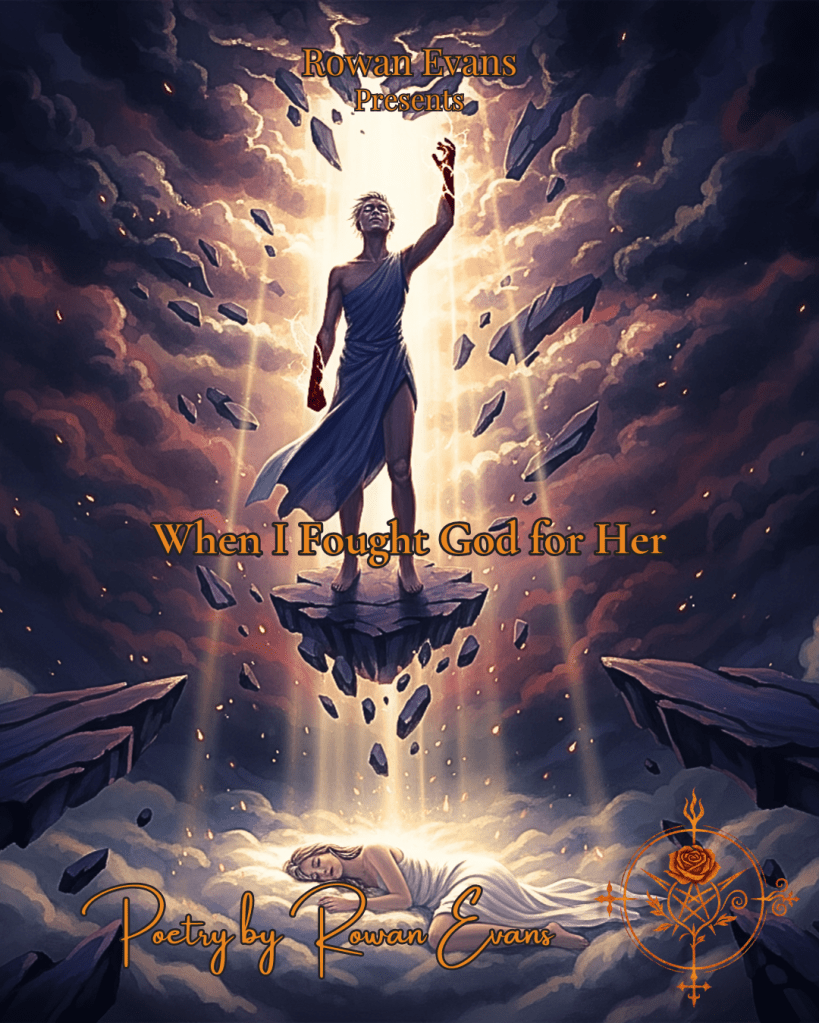
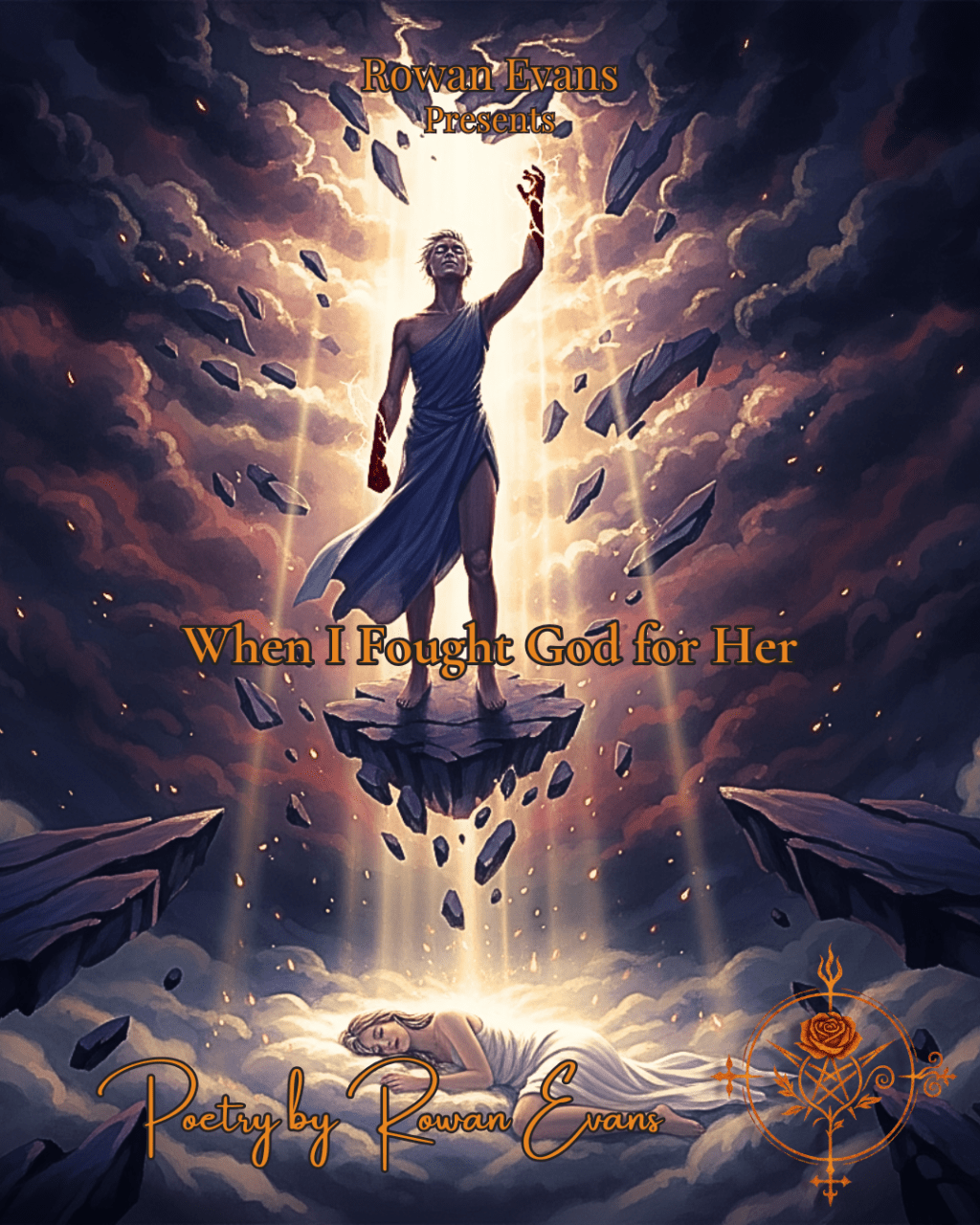
When I Fought God for Her Poetry by Rowan Evans
You said— you had a migraine again, so I told you, I’d say a little prayer. But if that didn’t work, I’d go up there and make God make it go away.
You laughed. But I meant it. I’d box deities to take your pain away. I’d throw hands with Gods and Goddesses.
I’d walk right up, like — “listen here, you divine little prick.” Catch him off guard: “You might be God, but you clearly got a little dick. The way you wield little-dick energy.”
Go ahead— smite me. (Coward.) Just know— you better be ready to fight me.
“I said heal her, not test her— you omnipotent coward. Give her rest, or I’ll rewrite your scripture myself.”
So I climb. Not on a ladder of prayer, but up a rope made of names I swear I’ll never say again— each knot a vow, each loop a promise. The sky cracks like an egg; thunder flinches. Clouds part to watch the mess I’m about to make.
First I find the doorman to the heavens— the one with a clipboard and a halo too small for his head. He checks my grief like it’s a permit; I hand him a bruise and a name. He frowns, flips a page, tries to veto me. I step in close and whisper: “You work customer service for eternity? Poor you.” Then my fist meets marble and the bell rings, and the Pearly Gates swing off their hinges.
Wings beat like shutters; angels tilt their heads like bored referees. I dodge the choir— their harmonies can be lethal—and I keep walking. A goddess in linen offers incense; I snatch the censer, skein it into a rope, and swing. Her perfume tastes like paperwork; I cough it up into the wind and keep going.
Hallways mapped by myth— Olympus, Valhalla, the mailroom of miracles— I stride them all barefoot, dragging a trail of small rebellions. I pass Zeus in a robe, bored with thunder. I clap once and steal his lightning. “Borrowed,” I tell him. He blinks. Lightning in my palm feels heavy with apology. I throw it like a rope—no, like an apology turned projectile— toward the place where pain hides.
Ministers of fate try to lecture me on consequence. I read their contracts aloud and rip the margins out like ticker tape. “Fine print,” I say. “Fine for you. Not tonight.” One deity mutters something about hubris; I hand them a mirror. They don’t like their reflection.
The gods swell; the heavens tense, like neighborhoods preparing for a parade that never comes. I trade left hooks for liturgy— each punch rearranges a verse, each uppercut edits a line. Commandments rattle. Mythic laws become limericks under my knuckles. I bleed ink and the stars drink it and become quieter.
They call reinforcements— avatars, avatars with perfect hair and terrible customer service. I meet each one the same: a joke, a jab, a promise. “Your omnipotence has been outsourced,” I tell them. A Valkyrie grins; I say, “Not tonight,” and she drops her spear like it’s tired of being serious.
At the gate where they schedule tests, I find the migraine: a small, grey child with the world’s noise in its fists. It sits on a throne of buzzing radios, feeds on fluorescent hum. I kneel. Not a prayer this time—a plan. I cup the child’s head like a secret, whisper apologies I don’t deserve to say aloud. Then I punch a hole in the noise. It’s less dramatic than you think— a clean, surgical silence that smells like relief.
The gods holler. “You cannot—” they begin. I finish for them: “Watch me.” I gather their stubbornness, twist it, braid it into lullaby. Rewrite scripture? I do—one line at a time. Where they wrote tests, I write rest. Where they insisted on trial, I ink in mercy. Where they wrote cosmic riddles, I carve simple sleep.
A thunder god tries diplomacy— offers a crown if I’ll walk back. I toss it into the void; it clatters into oblivion like a coin with no value. “You keep the crown,” I tell him. “I’ll keep the quiet.” He sulks and the weather lightens.
Blood and starlight, sweat and scripture: the bargain smells like incense and victory. I do not conquer with conquest’s cruelty; I conquer with the small, stubborn insistence of care. I return the migraine to its box— soft, bound with my exhale— and hand it back to the universe with a receipt: PAID IN FULL — one love, nonrefundable.
When I climb down, the sky blinks as if it had only been napping. You sit in your quiet room with a blanket and a mug, blinking like an animal reintroduced to light. You laugh at me later—a small, breathy thing— because you always laugh when I swear and fight. I kiss the place behind your ear like I’m sealing the universe back in its proper frame.
Gods grumble; some edit their resumes. Angels gossip like old women about the loud mortal who would not hush. I don’t care. I come down with sore knuckles and a new psalm in my back pocket. It reads: She shall sleep. He shall never tire of saving her. We will not test what we cannot bear.
And if any deity asks, I say the same thing I said when I walked up: “listen here, you divine little prick— you might be God, but you got little-dick energy. Fight me if you want. Fight us if you have to. But know this: I love her. I will make the cosmos learn how to be gentle.”
You close your eyes and breathe. The migraine loosens its grip like a tired animal. You murmur a name and sleep folds you into it like a clean sheet. I stay awake for a while, fingers laced with that holy, ridiculous, furious calm— the kind that only comes after you’ve brawled with the architecture of the world for someone you love.
If you are interested in checking out more of my poetry, you can find it here—[The Library of Ashes]
I wrote this in the quiet between 4 and 5 a.m., when my thoughts refused to let me sleep because they kept circling back to her. Not out of longing alone, but from a deeper wish—that she might know peace, that her smile might return without effort, that her chest might rise and fall free of heaviness. This piece is not a love poem in the usual sense. It is a prayer, a vow, a cathedral built from words to hold her burdens for a while so she can simply breathe.
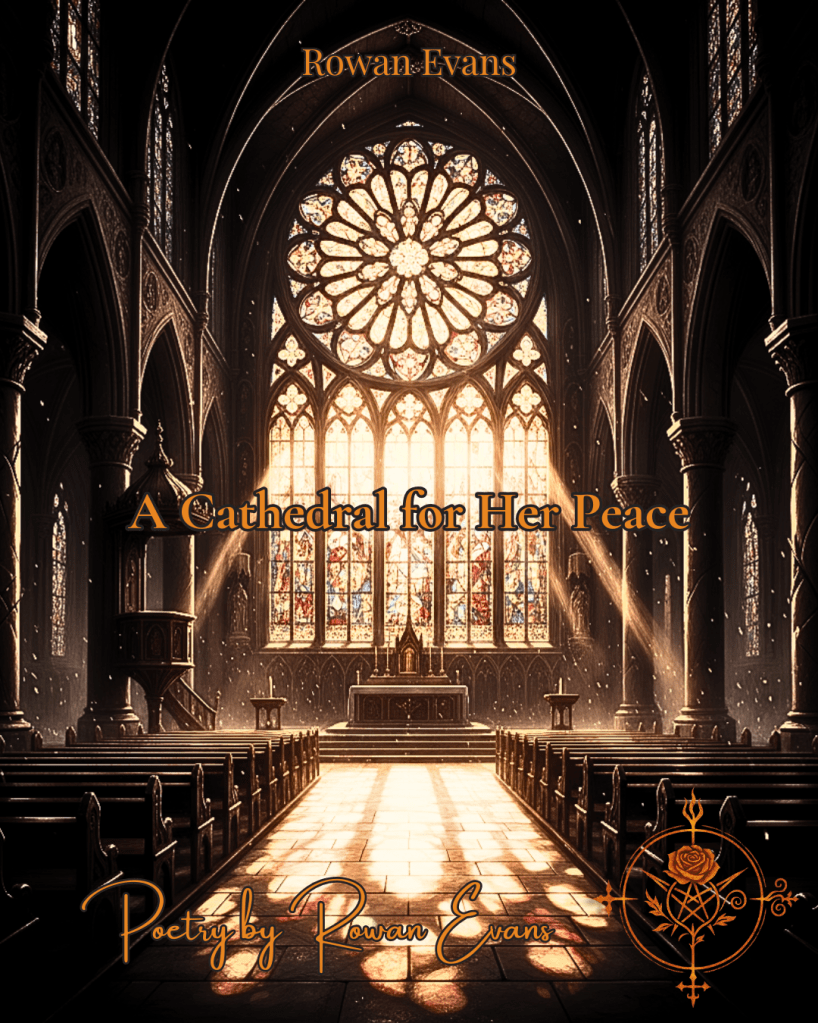
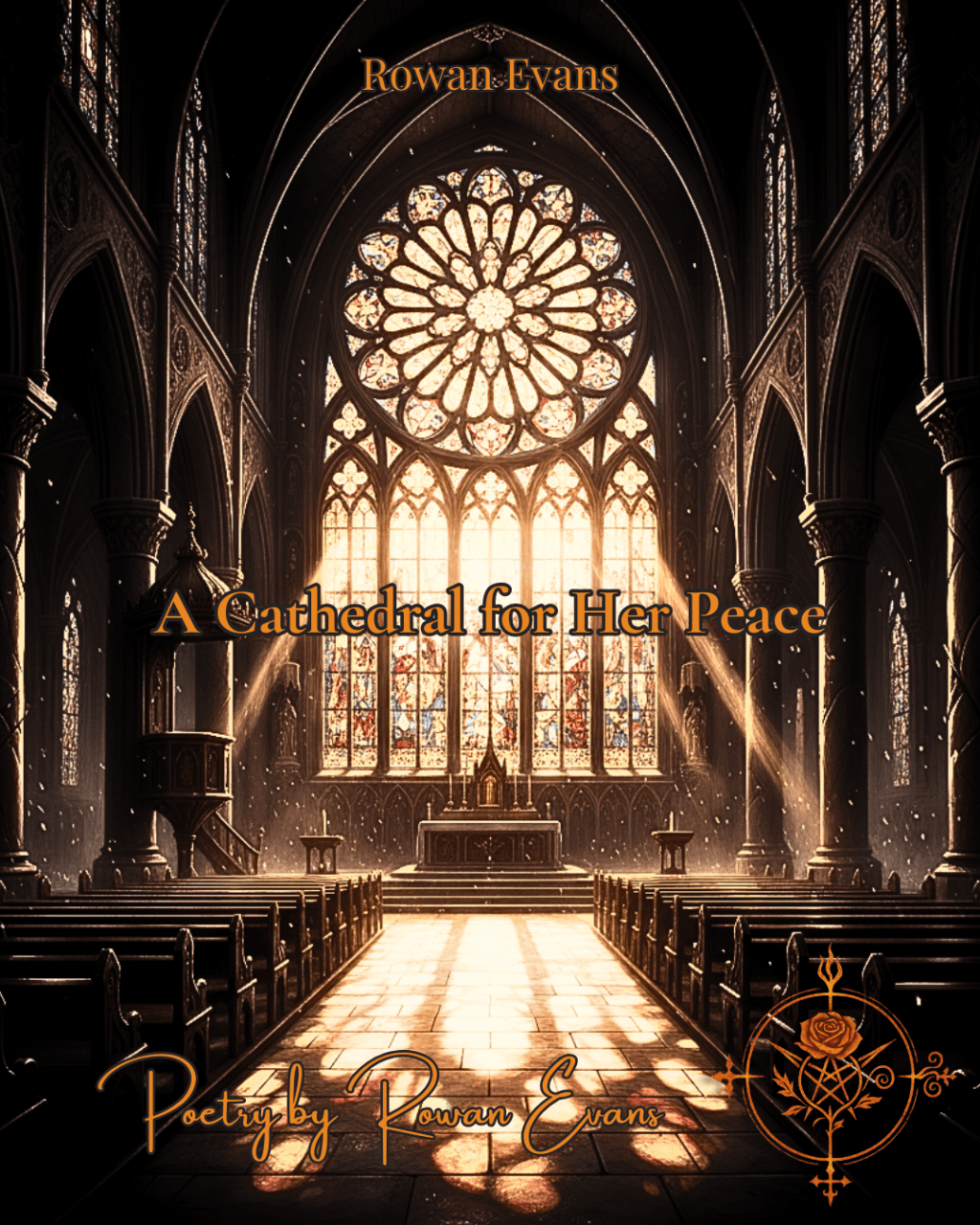
A Cathedral for Her Peace – a poetic sanctuary of love, devotion, and quiet reverence by Rowan Evans.
A Cathedral for Her Peace Poetry by Rowan Evans
She’s on my mind, like all of the time. Got me on my knees again speaking to Him. Just askin’ for ease, begging for her peace.
“God… give me her trials, let me carry the weight for a while. I just want to see her smile.
Let me take away her pain— be her umbrella in the rain, the shelter when storms arrive.”
Let her walk where the sun leans soft, where the wind sings lullabies instead of sirens, where shadows dare not linger. Let her laughter ring like bells in a cathedral, her tears fall only for joy, every sigh a hymn of comfort.
I will be the echo of her unspoken prayers, the vessel that holds her storms, the altar upon which her dreams may rest unbroken. She deserves peace that drapes like velvet, a hush that whispers, you are safe. You are enough.
She deserves to be spoiled in love, revered in touch, to have every desire mirrored back as truth. Let every gaze that falls upon her see her crown, not a shadow to tame, but a flame to worship. I will guard the sanctity of her being as a priest guards a holy relic, as a fortress holds the key to a kingdom.
I will carry the weight she should never have to bear, stand unwavering where darkness tempts, and watch over her like a cathedral standing sentinel through every storm, every unkindness, every cruel word the world might hurl her way.
Even if I am not the one to give it, let me be the one to show her she is worth it all. To show her she is lovable, truly, even if she gets a little unruly, even if the world whispers otherwise. Let her know, without question, that in my eyes, she is enough, she has always been enough, and she deserves nothing less than reverence.
Closing Note
If you’ve ever felt that same ache—for someone else’s joy to matter more than your own—then you already understand what this poem carries. Love is not always about possession or proximity; sometimes it is simply devotion, a fierce hope that the ones we care for find rest and light.
If this speaks to you, I invite you to share your own prayer, blessing, or small wish—for the person on your heart, for the soul you’d carry through storms if you could. Together, may we remind each other that reverence is not rare, and that offering peace to another is among the purest forms of love.
May these words linger like candlelight in the quiet corners of your heart. If you wish to wander further into shadows and flame, the doors ofThe Library of Ashesawait, holding the stories of devotion, ruin, and reverence, all bound in ink and ember.
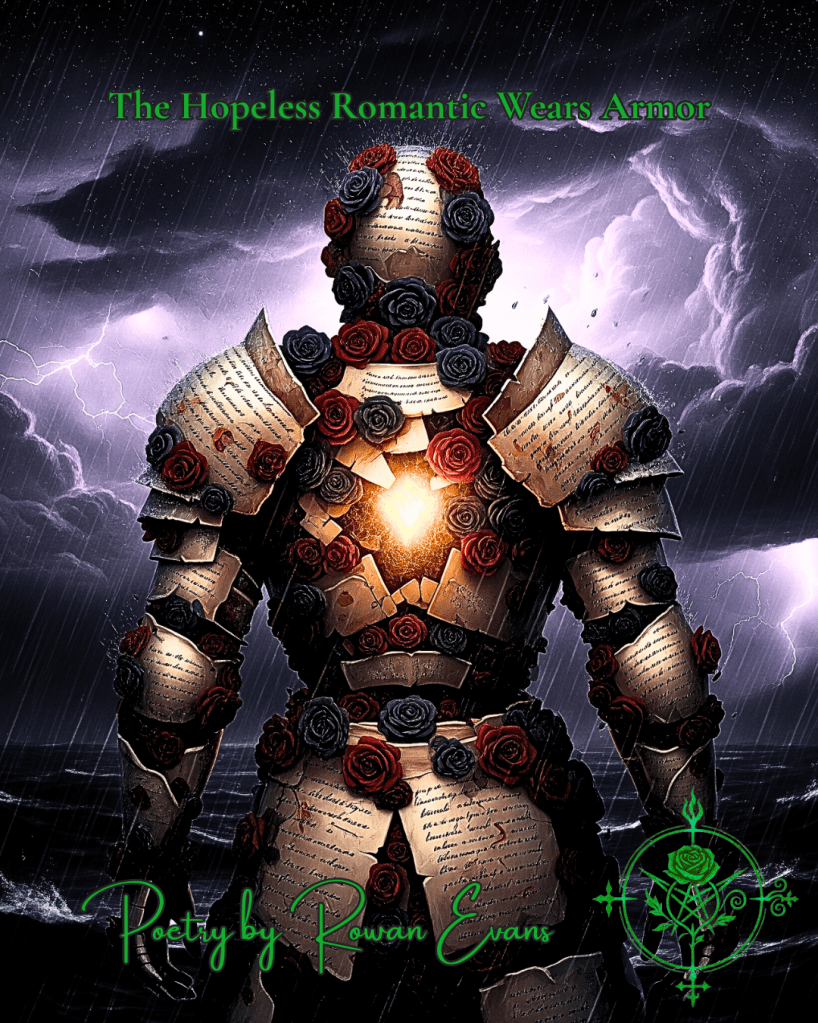
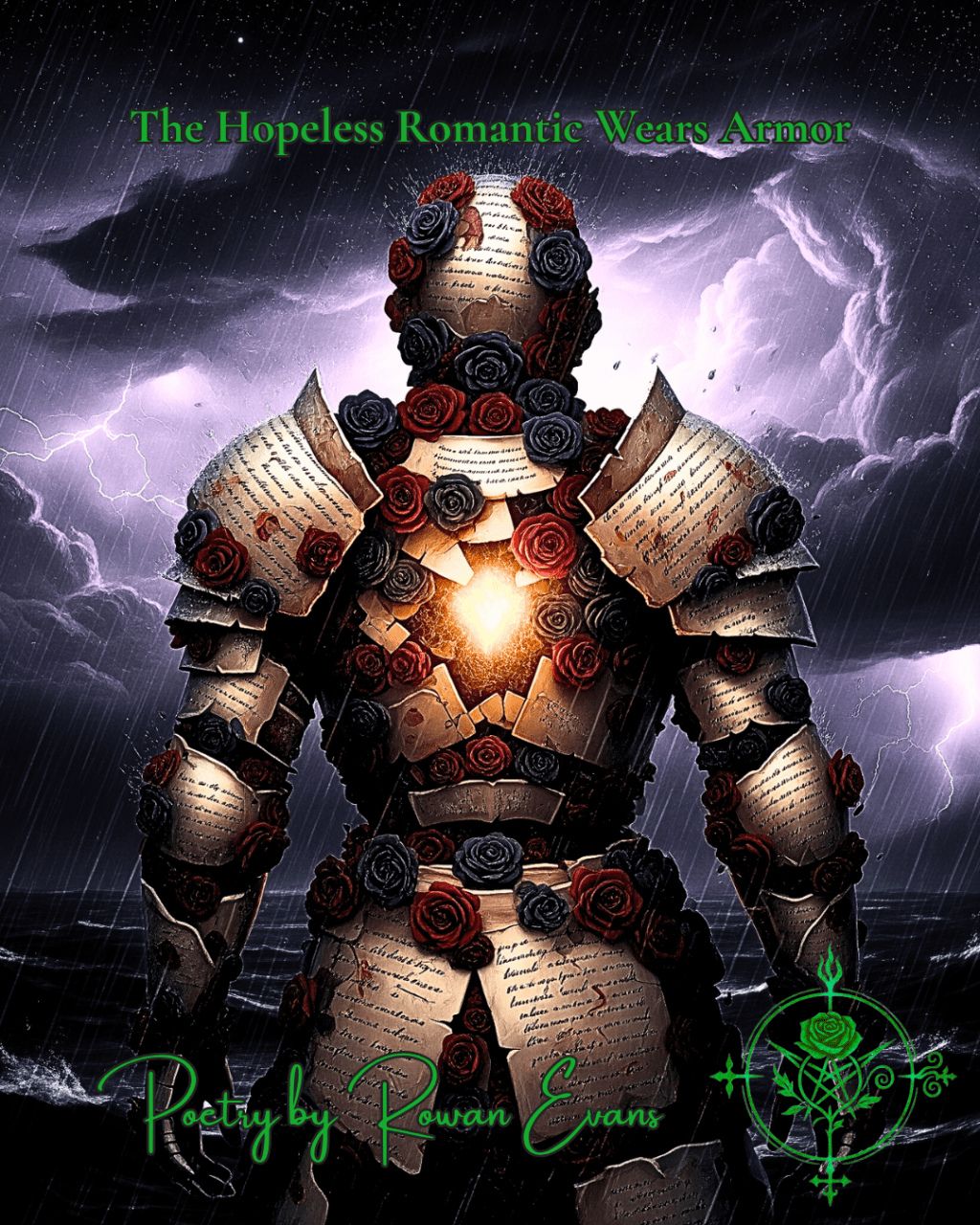
This poem is a tribute to the fierce resilience of love—the kind that’s messy, painful, and profoundly real. It honors the hopeless romantics who bear their scars like armor, who choose presence over perfection, and who dare to keep their hearts bare in a world that often demands they harden. This is for anyone who has ever loved with trembling hands and steady hope.
The Hopeless Romantic Wears Armor — a poetic embrace of love’s enduring presence beneath vulnerability.
The Hopeless Romantic Wears Armor Poetry by Rowan Evans
I’ve been told— “You must be a romantic,” like it was something delicate, a petal too soft for stormy weather. But they don’t see the thorns I’ve stitched into my smile, the way I carry hope like a blade in my boot.
They mistake softness for surrender, but I have loved through hurricanes— hands trembling, heart steady, singing lullabies to ghosts who only ever came to haunt.
I’ve written poems to silence, and bled ink for people who didn’t know what it meant to be cherished without condition.
I’ve fallen for echoes, mistaken attention for affection, believed in almosts like they were promises.
But still— I light candles in empty rooms, not because I expect someone to walk in, but because love is a ritual I perform even when I’m the only one watching.
I romanticize survival because I know the cost of staying soft in a world that sharpens everything it touches.
And yes, I’m a hopeless romantic— not because I believe in fairy tales, but because I believe that even cracked hearts can bloom again.
I believe in letters left on pillows, in forehead kisses before panic sets in, in waiting through silence without letting it change me.
Call it foolish, but I will always choose the ache of loving over the emptiness of apathy.
I don’t need love to be easy— I just need it to be real.
So if I love you, know this:
I will not run when the storms come. I will hold your hand through the wreckage and whisper, “This is not the end.”
Because love, to me, has never been about perfection— it’s about presence.
And I will be present. Even when it hurts. Even when it scares me. Even when it means standing alone with my armor made of poetry, and my heart still bare beneath it.
Closing Note
In the end, maybe that’s what it means to be a hopeless romantic: To carry tenderness like armor, to keep loving even when it hurts, and to trust that even the most wounded hearts can still bloom green in the ruins.
Because it does hurt. And sometimes it feels foolish. But I’d rather ache from loving too deeply than be left untouched by apathy.