Tag: Pacific Ocean

  • Author’s Note

    There are some places that become more than places.

    An ocean can be a physical distance, a horizon, a body of water stretching farther than the eye can follow. But sometimes it becomes something else entirely—a canvas, a metaphor, a meeting place between two people who happen to be standing on opposite sides of the world.

    Let Me Be Pacific began with a simple invitation: let me show you the ocean the way I see it.

    From there, the words wandered where they wanted to go.

    Purple skies. Silver moons. Dark water. Rhymes. Trees. Wordplay.

    And eventually, the Pacific became more than scenery.

    It became the space between here and there—and the reminder that something can cross an enormous distance without ever needing to disappear.

    So, for a moment, come sit beside me on the shoreline.

    Let me paint you a picture.

    Rowan Evans


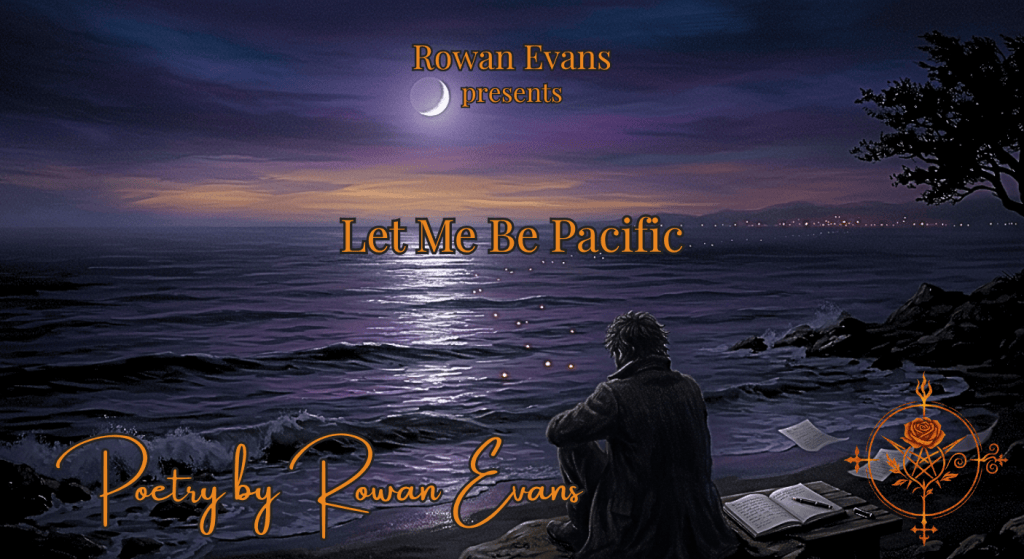
    A solitary poet sits beside the Pacific at twilight beneath a silver moon, watching its reflection shimmer across the waves.
    The Pacific may separate two shores, but poetry has never been particularly good at respecting distance.

    Let Me Be Pacific
    Poetry by Rowan Evans

    Here let me take my words
    and paint a picture for you—
    the sky in shades of purple and blue,
    lit by the silver moon—
    it lingers over the bay,
    that’s where it stays—
    watching over the tide,
    and I sit on the shoreline—
    watching the ocean’s waves.

    Which ocean? Okay,
    here let me try and spell it out,
    let me be Pacific—
    it’s off the California coast,
    it touches the Philippine Sea,
    sits between Japan and Me.

    Now back to the imagery—
    there was me, next to a happy little tree,
    and the moon was shimmering,
    trembling across dark water—
    back on the shoreline,
    having written more lines,
    not less, but more rhymes.

    So let me stay Pacific—
    specific in the way I see the sea,
    how every wave feels like a message
    sent across the world to me.
    I sit, I rhyme, I watch the tide—
    the ocean’s big, but so’s my mind.

    And if you ask me why I write
    beside this ocean every night—
    it’s because the tide keeps teaching me
    how distance isn’t always far,
    how even the Pacific can carry a heart
    from California to wherever you are.


    Journey into the Hexverse…

    [My Nightmare]
    A poem about the nightmare of loving someone across distance, seeing the world from different perspectives, and holding onto the hope that the cracks can still be repaired—and that someday two separate shores might become one.

    [Rose & Ruin]
    Two minimalist poems exploring the opposing forces within creativity: the thoughts we cultivate into something beautiful and the darker thoughts we transform before they have a chance to decay.

    [Across the Page-cific]
    A playful, autobiographical journey through the strange places poetry can take me—from sandwich heartbreak and pasta diss poems to gothic monsters, mythology, ravens, ghosts, and storms across the page. Beneath the absurdity is something deeply personal: the realization that writing gave me a way to rebuild myself, piece by piece.

    If you’re interested in more poetry, you can find it here → [The Library of Ashes]
  • Author’s Note

    This poem became the quiet conclusion to a trilogy I never intended to write.

    Crossing the Sea was about direction.

    Only Waiting was about the reason I needed that direction in the first place.

    This piece asks a different question:

    How do you keep moving when you haven’t arrived yet?

    For me, the answer has always been dreams.

    Not because I confuse them with reality, but because they remind me that another reality is possible.

    I’ve written about dreams for years. They rarely feel random to me. They often feel like rehearsals—small glimpses of a life my mind already believes exists somewhere beyond the horizon.

    The city in this poem isn’t a specific city.

    The moon isn’t really the moon.

    Even after spending two poems trying to strip away metaphor, I found myself sitting beside it again.

    I think that’s because hope has always spoken to me symbolically.

    When I’m awake, I know where I am.

    When I’m asleep, I remember where I’m going.

    The dream doesn’t replace reality.

    It sustains me until reality catches up.

    The final image—a dream folded into my chest like a map—is probably the clearest way I’ve ever described hope.

    Hope isn’t certainty.

    It isn’t arrival.

    It’s carrying the direction with you, even when you’re still standing at the beginning of the journey.

    And maybe that’s what this trilogy has been trying to say all along.

    Sometimes home begins as a place.

    Sometimes it becomes an ache.

    Sometimes…

    it’s simply the direction you’re already walking.

    Rowan Evans


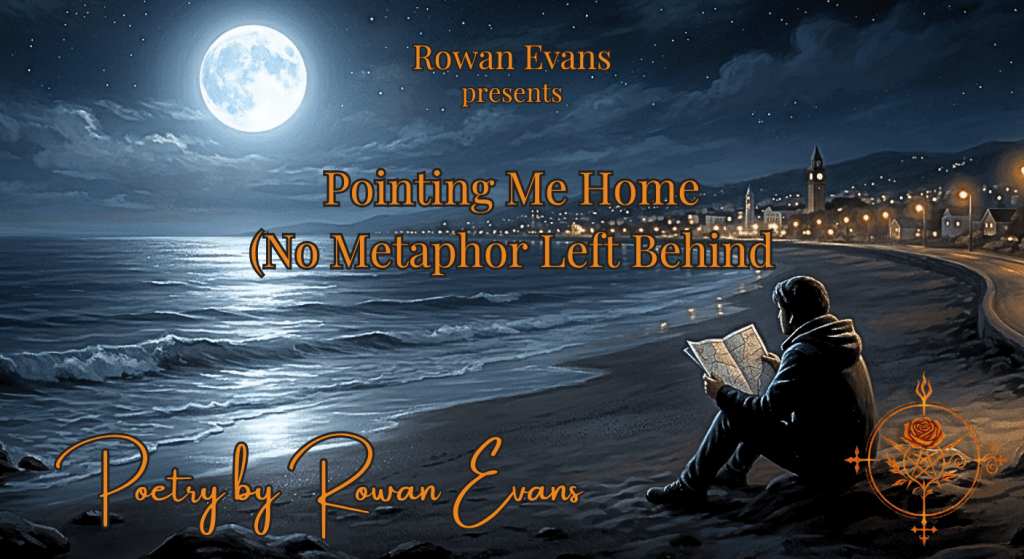
    A lone figure sits beneath a full moon where an ocean shoreline transitions into quiet city streets, holding a folded map while reflecting on hope, dreams, and the journey toward home.
    “Sometimes home isn’t where you’re standing—it’s the direction you’re already walking.” 🌙🗺️

    Pointing Me Home (No Metaphor Left Behind)
    Poetry by Rowan Evans

    Tick tock, tick tock—
    that’s the sound of the clock.
    I listen as I wait for the escape,
    a simple trip, brought on by sleep.
    Because I only feel at home
    in my dreams.

    So as I close my eyes
    and my head hits the pillow—
    I follow the moon
    to the ocean’s edge,
    I listen to the tide—
    I follow it in stride
    until I find where it’s pulling me.

    With every step,
    I move deeper in.
    Slowly sand turns to concrete
    beneath my feet,
    as the beach transitions
    into city streets.

    Streetlights flicker
    like they’re remembering
    they used to be stars.

    The hum of the city
    folds into the sound of waves,
    each echo a reminder
    of where I started
    and where I’m going.

    I walk until the moon
    hangs between buildings
    like it’s lost too—

    like it’s looking for someone to talk to.

    So I sit and conversate,
    I tell the moon all about the quiet ache—
    the feeling that I need to change
    my environment to one that aligns
    more with what I feel inside.

    And the moon sits with me,
    just listening—so I talk some more.
    Out of my heart, the words just pour.
    I spill every secret, I hold nothing back
    until I feel like I might collapse.

    The moon listens,
    patient as ever,
    its light softening
    the edges of my thoughts.

    And when I finally fall silent,
    breath trembling,
    chest heavy—

    it tilts itself
    just enough
    to remind me
    I’m not alone
    in the places I wander.

    Tick tock, tick tock.

    A return to the rhythm of the clock,
    interrupting the talk—
    the moon’s light gives way
    to the sun’s rays,
    I’m still stuck in this place—

    but I’m only waiting
    until I can cross the sea,
    Pacific and the Philippine.

    Until then,
    I carry the dream like a map,
    folded in my chest—

    pointing me home.


    Journey into the Hexverse…

    [Crossing the Sea (No Metaphor Left Behind)]
    A deeply personal poem about relocation, longing, and the realization that some truths naturally arrive through metaphor—even when we try to leave it behind.

    [Only Waiting (No Metaphor Left Behind)]
    The second poem in the No Metaphor Left Behind series, exploring the quiet ache of growing up in a place that never truly felt like home—and finally saying aloud what years of metaphor had been trying to express.

    If you’re interested in more poetry, you can find it here → [The Library of Ashes]
  • Author’s Note

    This poem began as an experiment in restraint.

    I wanted to see what would happen if I stopped relying on metaphor—the oceans, tides, moons, and distant imagery that so often shape the way I write—and instead said things as directly as I could.

    What I discovered is that I don’t really think in a “non-metaphorical” way.

    Even when I try to remove symbolism, my mind still reaches for it. The language of distance, direction, and crossing appears naturally because that is how I process emotional states: spatially, geographically, in motion.

    So the poem became something else.

    Not an escape from metaphor, but an awareness of it.

    A recognition that even when I say “I won’t use the ocean this time,” I still understand my life through movement across it.

    This piece lives in that tension between clarity and instinct—between what I am trying to say plainly, and the language my mind naturally returns to.

    And in the end, it admits something simple:

    Sometimes the clearest way to say the truth… is still through the shape of the thing you tried to leave behind.

    Rowan Evans


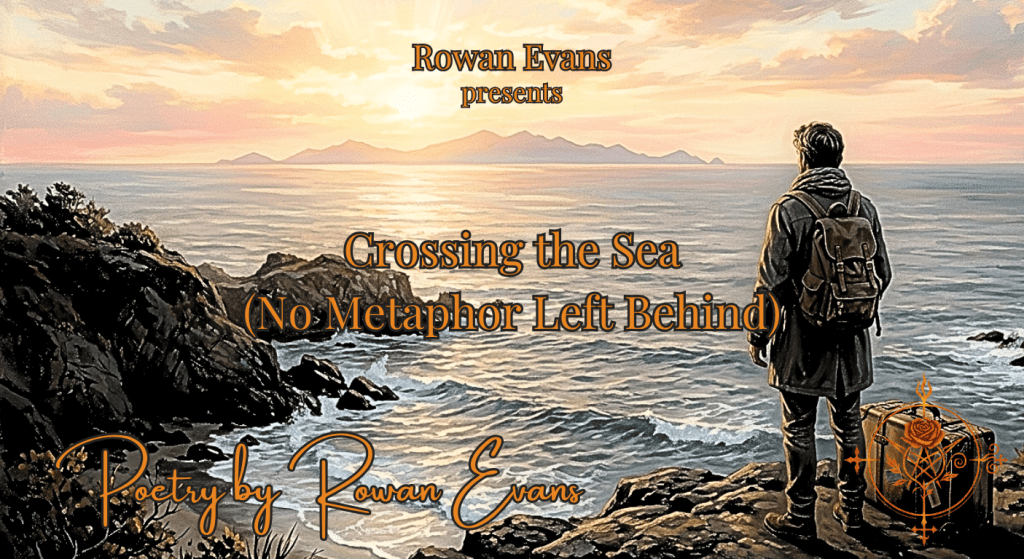
    A lone traveler stands on a Pacific shoreline looking toward distant islands across the ocean at sunrise.
    Some distances are measured in miles. Others are measured in becoming.

    Crossing the Sea (No Metaphor Left Behind)
    Poetry by Rowan Evans

    I am going to try
    something that terrifies me—
    that most of the time,
    would leave me paralyzed.

    I am going to try
    and say everything
    I hold inside—
    no metaphors
    to hide behind
    this time.

    I’m not where
    I want to be
    and part of me,
    thinks I’ll never be.

    I know that’s just
    fear and doubt—

    just because part of me
    thinks it, doesn’t make it true.

    Relocating
    is just taking
    longer than I wanted it to.

    But I know the direction.
    The destination is clear—
    I just got to get there.

    I got to leave here.

    This isn’t a new feeling—
    I’ve said this all before,
    buried in metaphors.

    Hidden behind symbolism.

    This is where
    I’d put the ocean
    and the tide,
    a way to describe
    the distance.

    Between where I am
    and where I want to be—
    and to get there,
    I have to cross the sea.

    Not a metaphor,
    I mean that literally—
    Pacific and the Philippine.


    Journey into the Hexverse…

    [Translating What I Feel]
    A poem about the invisible process of turning emotion into imagery, imagery into language, and language into poetry. An intimate reflection on creativity, loneliness, and twenty-three years of learning to translate what the heart feels.

    [Recognizes Home]
    A free-verse poem exploring the difference between love as dependency and love as choice. It challenges the idea that love must be need-based, instead centering the quiet strength of choosing someone while still remaining whole on your own.

    [Not Rebuilding You]
    A poem about love as an act of presence rather than rescue. Through construction imagery, Not Rebuilding You explores trust, devotion, emotional safety, and the quiet work of building a foundation strong enough for healing to grow.

    [The Language Her Soul Speaks]
    What if love isn’t about being understood, but learning to understand someone else? “The Language Her Soul Speaks” is a free verse poem about intimacy, communication, curiosity, and the desire to know another person beyond the limits of language.

    [Ocean Waves (1, 4, 3)]
    A moonlit shoreline, a rowboat full of ducks, a piggybank with no cents, and a confession hidden in plain sight. Ocean Waves (1, 4, 3) explores how humor, wordplay, and absurdity can become a side door to vulnerability when the truth feels too difficult to say directly.

    [L Words & Heart]
    A playful, self-aware poem about love, longing, loyalty, and the quiet ways another person can reshape our inner world. What begins as humor slowly reveals a heartfelt confession about affection, imagination, and the faces that linger in our dreams.

    [I’ll Be There to See Your Sunrise]
    Love has never come easily to me. This poem explores the fear, vulnerability, and quiet courage required to stay emotionally present when connection begins to matter deeply. “I’ll Be There to See Your Sunrise” is about choosing love despite the risk of heartbreak—and promising to remain long enough to witness someone fully.

    [Altar and Roses]
    A gothic free verse poem about poetic identity, recurring symbolism, devotion, and the quiet humanity beneath dramatic imagery.

    If you’re interested in more poetry, you can find it here → [The Library of Ashes]