Tag: Ocean Waves

  • Author’s Note

    There are some places that become more than places.

    An ocean can be a physical distance, a horizon, a body of water stretching farther than the eye can follow. But sometimes it becomes something else entirely—a canvas, a metaphor, a meeting place between two people who happen to be standing on opposite sides of the world.

    Let Me Be Pacific began with a simple invitation: let me show you the ocean the way I see it.

    From there, the words wandered where they wanted to go.

    Purple skies. Silver moons. Dark water. Rhymes. Trees. Wordplay.

    And eventually, the Pacific became more than scenery.

    It became the space between here and there—and the reminder that something can cross an enormous distance without ever needing to disappear.

    So, for a moment, come sit beside me on the shoreline.

    Let me paint you a picture.

    Rowan Evans


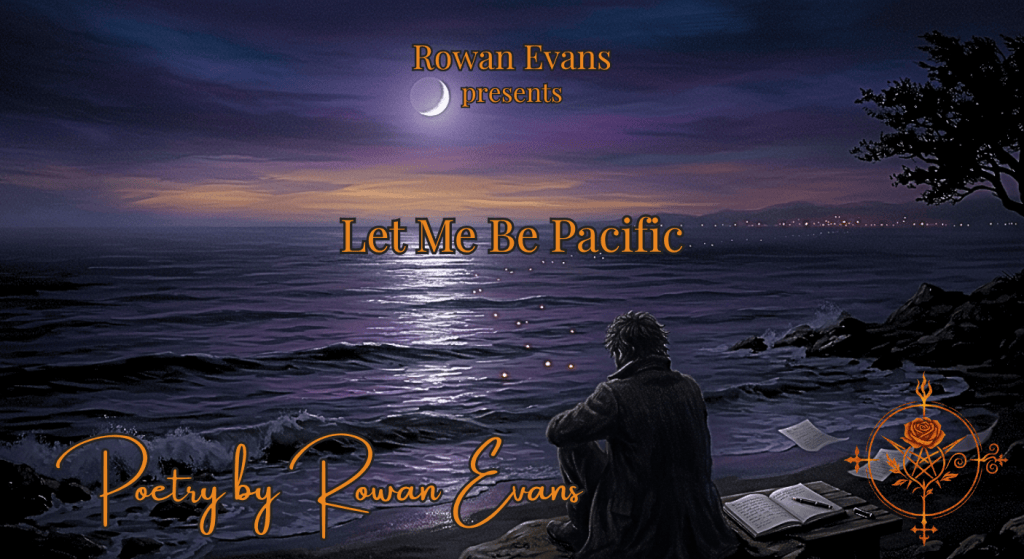
    A solitary poet sits beside the Pacific at twilight beneath a silver moon, watching its reflection shimmer across the waves.
    The Pacific may separate two shores, but poetry has never been particularly good at respecting distance.

    Let Me Be Pacific
    Poetry by Rowan Evans

    Here let me take my words
    and paint a picture for you—
    the sky in shades of purple and blue,
    lit by the silver moon—
    it lingers over the bay,
    that’s where it stays—
    watching over the tide,
    and I sit on the shoreline—
    watching the ocean’s waves.

    Which ocean? Okay,
    here let me try and spell it out,
    let me be Pacific—
    it’s off the California coast,
    it touches the Philippine Sea,
    sits between Japan and Me.

    Now back to the imagery—
    there was me, next to a happy little tree,
    and the moon was shimmering,
    trembling across dark water—
    back on the shoreline,
    having written more lines,
    not less, but more rhymes.

    So let me stay Pacific—
    specific in the way I see the sea,
    how every wave feels like a message
    sent across the world to me.
    I sit, I rhyme, I watch the tide—
    the ocean’s big, but so’s my mind.

    And if you ask me why I write
    beside this ocean every night—
    it’s because the tide keeps teaching me
    how distance isn’t always far,
    how even the Pacific can carry a heart
    from California to wherever you are.


    Journey into the Hexverse…

    [My Nightmare]
    A poem about the nightmare of loving someone across distance, seeing the world from different perspectives, and holding onto the hope that the cracks can still be repaired—and that someday two separate shores might become one.

    [Rose & Ruin]
    Two minimalist poems exploring the opposing forces within creativity: the thoughts we cultivate into something beautiful and the darker thoughts we transform before they have a chance to decay.

    [Across the Page-cific]
    A playful, autobiographical journey through the strange places poetry can take me—from sandwich heartbreak and pasta diss poems to gothic monsters, mythology, ravens, ghosts, and storms across the page. Beneath the absurdity is something deeply personal: the realization that writing gave me a way to rebuild myself, piece by piece.

    If you’re interested in more poetry, you can find it here → [The Library of Ashes]
  • Author’s Note

    This poem began as a collection of bad jokes.

    Or at least that was the excuse.

    Sometimes I start writing with no destination in mind. A phrase appears. Then a pun. Then another. A moon becomes a metaphor. Ducks end up in a rowboat. A piggybank loses all its cents.

    And somewhere in the middle of all that nonsense, something honest sneaks in.

    I’ve noticed that humor often works like a side door.

    There are things I can say directly. There are things I can say through poetry. And then there are things that feel easier to approach sideways, hidden beneath wordplay, jokes, and absurd little detours.

    This piece lives in that space.

    The speaker keeps drifting away from the point, circling it rather than naming it. Every joke becomes a delay tactic. Every pun buys another moment before the truth has to be spoken aloud.

    Because sometimes vulnerability isn’t difficult because you don’t know what you feel.

    Sometimes it’s difficult because you know exactly what you feel.

    And saying it out loud makes it real.

    The title’s parenthetical reference, “1, 4, 3,” comes from an old numerical shorthand for a phrase many people know by heart. I liked the idea of building an entire poem around avoiding a confession, only to hide it in plain sight.

    In the end, the poem says exactly what it means.

    It just takes the scenic route to get there.

    Rowan Evans


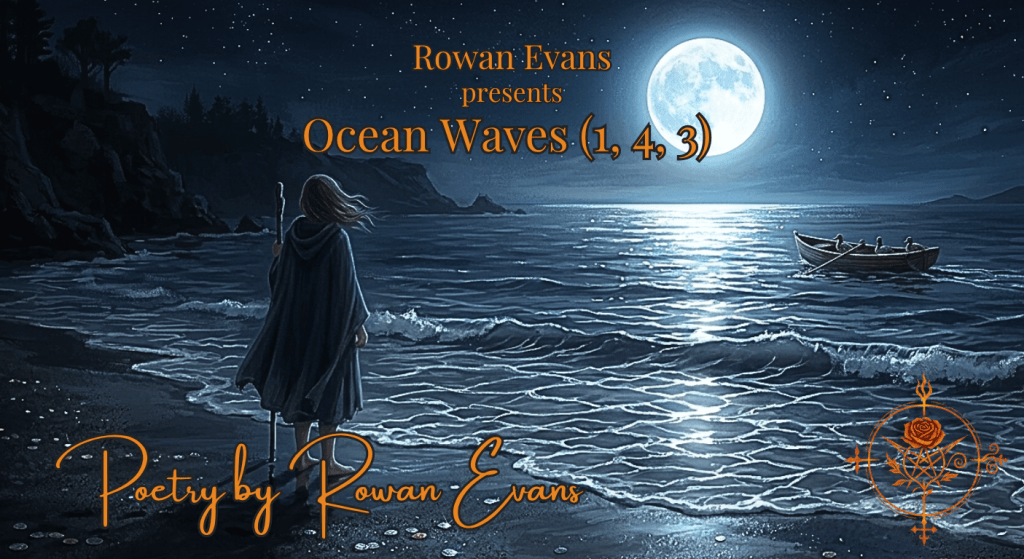
    A solitary figure stands on a moonlit beach beside gentle ocean waves while silver moonlight reflects across the water beneath a glowing night sky.
    Sometimes the longest journey to the truth is the scenic route—through moonlight, wordplay, ocean waves, and all the jokes we tell before we finally say what we mean.

    Ocean Waves (1, 4, 3)
    Poetry by Rowan Evans

    I stand on the shore
    giving ocean waves—
    begging the tide
    to take me away.

    I trace the moon
    across the sky,
    I map it in rhyme.
    Line after—
    silver-lined metaphor.

    I got my ducks in a row
    boat—is that what the paddles for?
    I know the direction,
    what would I panic for?

    You might be confused—
    I know that made no sense,
    like an empty piggybank.
    No cents, thoughts scattered
    like loose change.

    I use jokes
    to mask the truth sometimes.

    It makes what I want to say,
    an easier pill to swallow—

    1 letter
    followed by 4
    then 3—

    Together, they mean
    you mean the most to me.
    By your side—

    is where I’m supposed to be.


    Journey into the Hexverse…

    [1-4-3]
    A poem about love that isn’t rooted in need, but in choice. About finding safety not as a cage, but as a place where fear finally stops running—and stays.

    [1-4-3 (Tongue Tied)]
    A vulnerable poem about holding back the words that matter most. 1-4-3 (Tongue Tied) explores fear, emotional suppression, and the quiet ache of wanting to say “I love you.”

    [What I Want to Say]
    Sometimes the hardest words to say are the simplest ones. What I Want to Say explores love, hesitation, and the fear of what might change if you finally speak.

    [No Parachute]
    A poetic reflection on falling in love without hesitation—raw, uncertain, and without a safety net.

    If you’re interested in more poetry, you can find it here → [The Library of Ashes]