Tag: dark poetry

  • Author’s Note

    This poem started as play.

    I wasn’t trying to be deep or careful — I was letting my brain sprint, letting pop culture, mythology, and intrusive thoughts collide on the page. Comics, villains, alter egos, masks — all the familiar metaphors we use when our minds feel too loud to live in quietly.

    What surprised me wasn’t the darkness, but the balance. This isn’t a descent — it’s a return with awareness. Standing in the light doesn’t mean pretending the shadows don’t exist. It means no longer fearing them.

    This is what it feels like when poetry stops being a tool and starts being a force — when the ink takes over, and you let it.
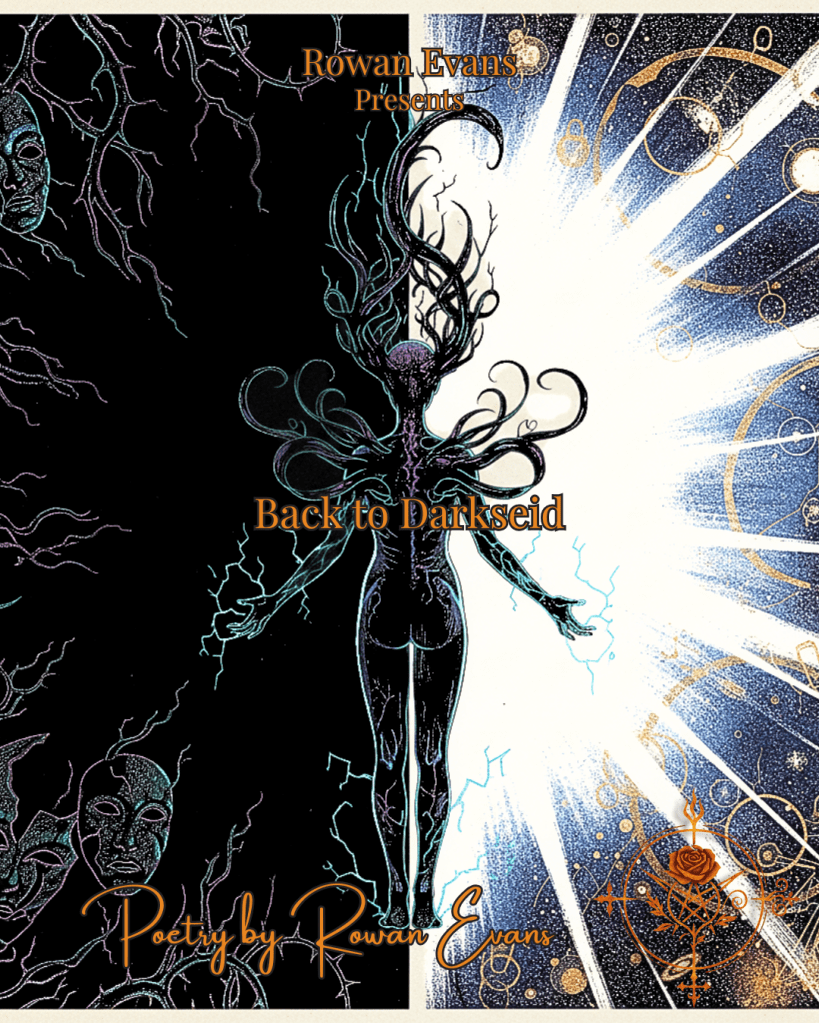

    Surreal illustration of a figure in shadow with ink tendrils rising up their spine, symbolizing chaos, identity, and creative obsession.
    Where chaos, identity, and ink collide.

    Back to Darkseid
    Poetry by Rowan Evans

    I walk in,
    ready to rock
    like a shock
    to the system.

    Watch me
    ghost ride the whip,
    hit you with the
    penance stare.

    Watch as you become
    hyper aware
    of every misdeed,
    and every sin seeps
    into the veins.

    It circulates
    until it hits
    the brain.

    Lights out.

    Silence.

    My noggin’s
    an asylum,
    I’m sick in the head.
    Coin flip of fate,
    I’m two-faced
    with my joker’s thoughts.

    I’m a dark knight,
    on a dark night—
    fighting the monsters
    that my mind creates.

    Don’t try to figure me out.
    I’m an enigma, a riddle
    with no answer.

    A twisted harlequin
    in a garden
    made by Ivy.
    Each petal unfurls,
    guiding—
    leading me back
    from the edge.

    Now I’m standing in the light,
    back to Darkseid—
    I no longer fear
    Apocalypse.

    Watch my ink
    twist into tendrils.
    Watch as they
    wrap around,
    and creep up
    my spine like venom.
    Watch as poetry
    slowly,
    takes over
    my mind.


    If you’re interested in more poetry, you can find it here → [The Library of Ashes]

  • Author’s Note

    This poem was written as a meditation on grief, curiosity, and the dangerous desire to hear a familiar voice again. Ouija isn’t about ghosts so much as it is about what happens when longing outweighs caution—when we reach into the dark hoping for comfort, and something else answers instead.


    A candlelit Ouija board in a dark room, with shadows and mist creating a haunting supernatural atmosphere.
    Some doors answer—but not with the voices you’re hoping to hear.

    Ouija
    Poetry by B.D. Nightshade

    In the hush of midnight’s mournful plea,
    I sought a voice lost to eternity.
    The planchette whispered, soft and sly,
    A bridge to the beyond, where spirits lie.

    “Speak to me,” I begged the unseen,
    “My grief is heavy, my heart unclean.
    I seek the warmth of a loved one’s face,
    To pierce the silence, to find their grace.”

    The board sighed—its letters danced,
    A presence stirred, a spectral chance.
    But the air grew cold, a shadow fell,
    A creeping dread, a whispered spell.

    “Not who you seek,” it scratched, obscene—
    A voice too dark, too serpentine.
    The candles flickered, their flames bent low,
    And in that moment, I should have let go.

    But curiosity, a fatal sin,
    Pulled me deeper, drew me in.
    The board laughed—a hollow tone:
    “You’ve opened the door. You’re never alone.”

    Footsteps echoed where none should tread,
    A phantom touch brushed ’cross my bed.
    Mirrors cracked; their shards betrayed
    A face unknown, in shadows swayed.

    I prayed for peace, I screamed for aid,
    But the veil was torn, the debt unpaid.
    The unseen force—relentless, vile—
    Lurks in corners, mocks my denial.

    I see it now in every dream:
    A ghastly grin. An endless scream.
    The Ouija’s curse, my foolish pact—
    A gateway opened. I can’t retract.

    So heed my tale. Beware the night.
    Some voices whisper with claws of spite.
    When you seek the dead, tread light—beware:
    Not all spirits are kind or fair.


    If you’re interested in more poetry, you can find it here → [The Library of Ashes]
  • Author’s Note

    I wrote Schrödinger’s Depression during a period when my inner world felt suspended—when I was functioning on the surface while quietly unraveling underneath. I was fascinated by the idea of existing in two opposing states at once: alive enough to move through the world, but emotionally absent enough to feel untethered from it.

    The metaphor of Schrödinger’s cat gave me language for that limbo—the way depression can make you feel both present and unreachable, breathing yet hollow, seen yet unseen. This poem isn’t about resignation so much as endurance. Even inside the box, something persists.

    Revisiting it now, I recognize it as one of many moments  where my writing became a survival mechanism—naming the paradox instead of pretending it didn’t exist.


    A closed box in shadow with light leaking through cracks, symbolizing emotional limbo and depression
    Existing somewhere between alive and absent.

    Schrödinger’s Depression
    Poetry by Rowan Evans

    In this box, I dwell, unseen, unheard,
    Both alive and dead, a paradox deferred.
    I am Schrödinger’s Cat, in my own dismay,
    Trapped in shadows, night and day.

    Alive in the motions, but dead in the soul,
    A hollow existence, a fractured whole.
    Every breath I take, a silent scream,
    Lost between the seams of a broken dream.

    My mind, a labyrinth, with no escape,
    A maze of despair, where hope fades to wraith.
    Eyes that see, yet fail to perceive,
    The vibrant colors of life, I cannot believe.

    Heart beats on, a hollow drum’s thrum,
    But inside, a void where emotions are numb.
    Walking through life, a ghost in disguise,
    A shell of a person, with lifeless eyes.

    I exist in this state, a cruel design,
    Both here and not, in a tangled line.
    Alive enough to feel the pain,
    Dead enough to know it’s all in vain.

    I am the paradox, the living dead,
    A prisoner of thoughts that fill my head.
    Drowning in an ocean of silent despair,
    Reaching for a lifeline that’s never there.

    Some days, the light filters through the cracks,
    A fleeting glimpse, but the darkness always tracks.
    It swallows me whole, a ravenous beast,
    Feasting on my soul, never ceasing, never least.

    Alive in the struggle, dead in the heart,
    A fractured existence, torn apart.
    Schrödinger’s Depression, a relentless tide,
    Dragging me under, where shadows abide.

    In this box, I am trapped, forever confined,
    Both living and dying, a state undefined.
    Yet somehow, I persist, in this duality’s snare,
    Schrödinger’s truth, in this life of despair.


    If you’re interested in more poetry, you can find it here → [The Library of Ashes]
  • Author’s Note

    Some poems are confessions.
    Some are exorcisms.

    This one is alchemy.

    Alchemist of Ink (All Sixes) came from that familiar edge—when the weight presses in, when the mind contracts, when the darkness feels like it might finally win. But instead of letting it consume me, I let it become something. I let it turn into ink.

    This poem is about that moment of reclamation.
    About taking what hurts and making it mine.
    About refusing to be only what the darkness names me.

    If you’ve ever felt yourself folding inward—this is for you.
    If you’ve ever made art out of survival—this is yours too.


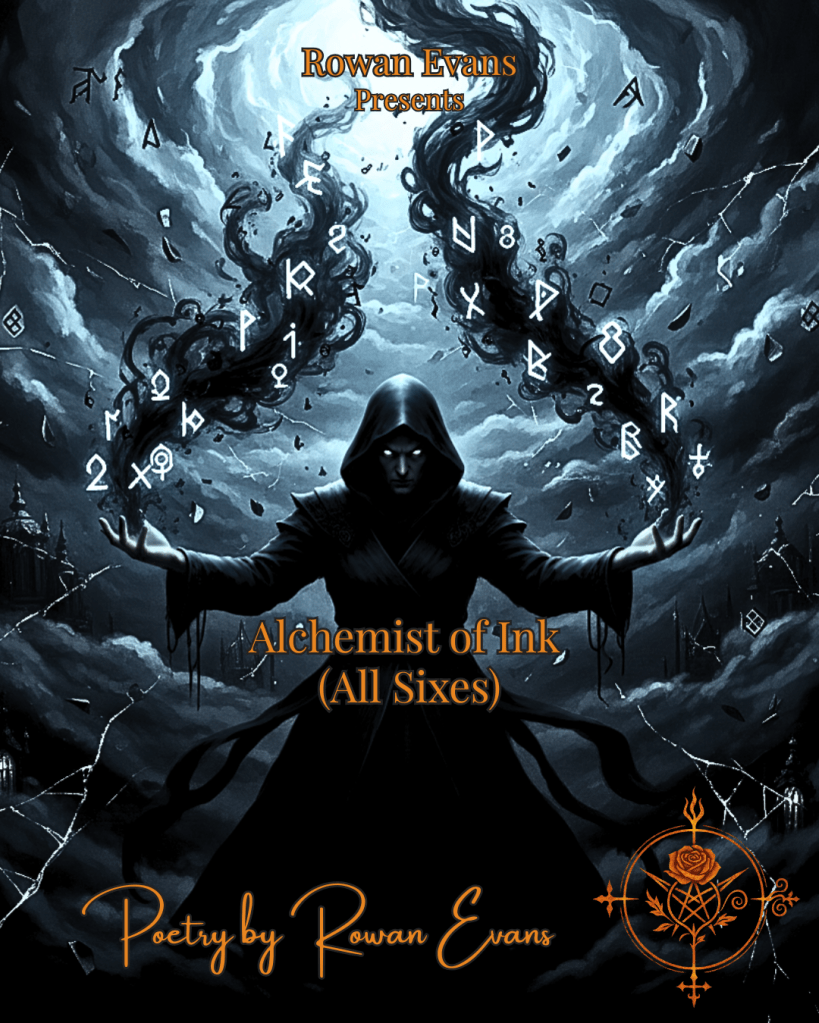
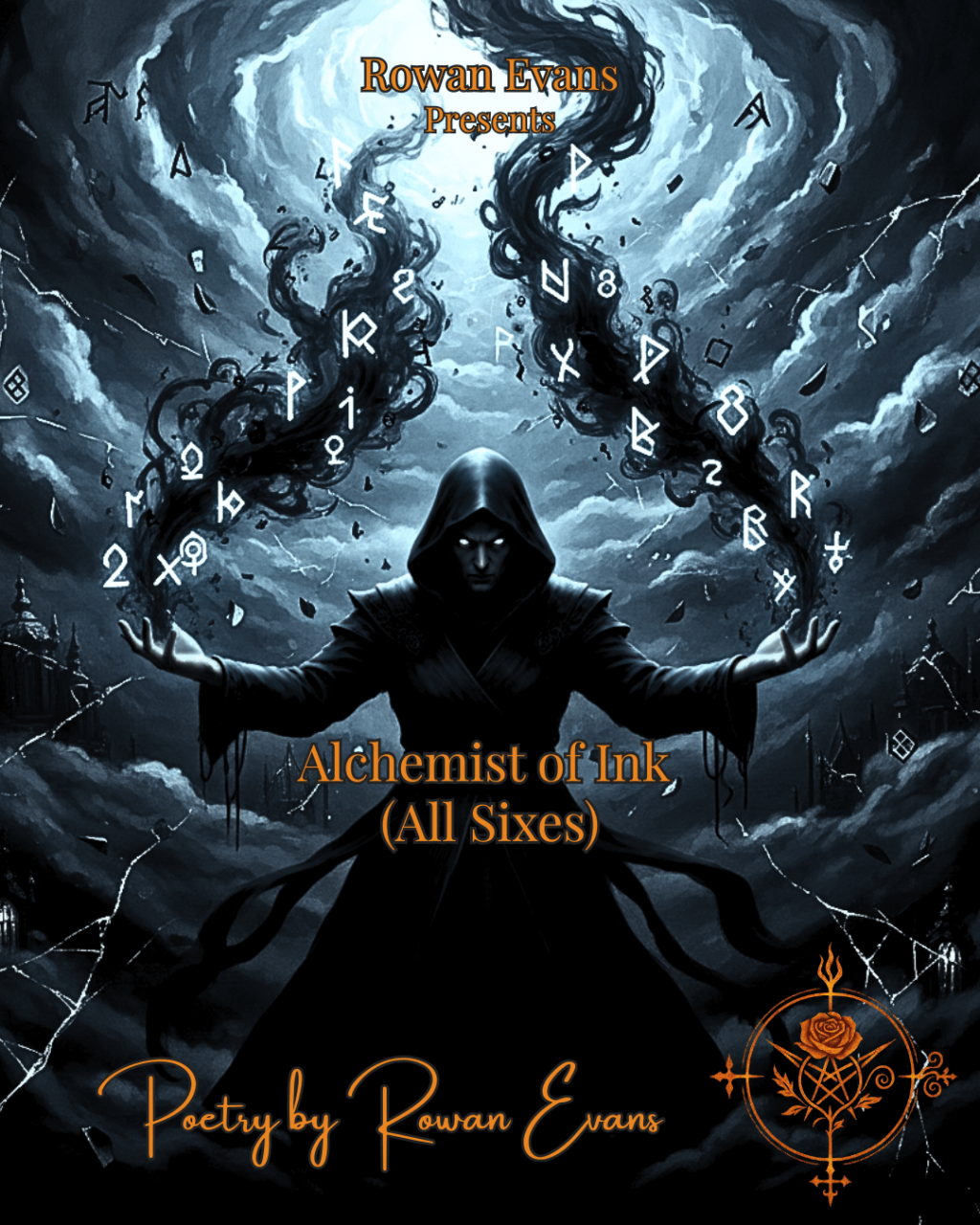
    A shadowed poet with glowing eyes as black ink pours from their hands, transforming into swirling symbols of power in a dark, gothic setting.
    Turning darkness into language. Pain into power. Ink into alchemy.

    Alchemist of Ink (All Sixes)
    Poetry by Rowan Evans

    I am all sixes when its needed,
    this darkness,
    your hatred feeds it.

    I can feel it—
    crawling up my spine,
    that creeping feeling.
    It twists around my mind,
    contracting.

    I can feel it squeeze,
    as I fall to knees.

    My eyes flicker and flash,
    fade to black—
    as you see
    my face distort.
    Twisted reflection.
    Personified depression.

    Can you see—
    as I begin to bleed ink?
    It pours from me,
    covering fingers,
    hands and arms.

    It twists,
    never relents.


    I’m a motherfucking
    alchemist,
    the way I take my pain
    and change it.
    I’ll write like hell,
    to subtly rearrange it.


    If you’re interested in more poetry, you can find it here → [The Library of Ashes]
  • ✦ Author’s Note ✦

    These words spill like blood and ink. They explore fear, shame, and the weight of confession. Step forward only if you feel steady.

    Your breath, your life, and your heart are sacred. If these words stir difficult feelings, pause, breathe, and reach for light, support, or care. You are never truly alone in the dark.

    Resources if needed:

    US: 988 Suicide & Crisis Lifeline – Call or text 988 | https://988lifeline.org

    UK: Samaritans – Call 116 123 | https://www.samaritans.org

    Australia: Lifeline – Call 13 11 14 | https://www.lifeline.org.au

    Canada: Talk Suicide Canada – Call 1-833-456-4566 | https://talksuicide.ca

    Global: Befrienders Worldwide – https://www.befrienders.org


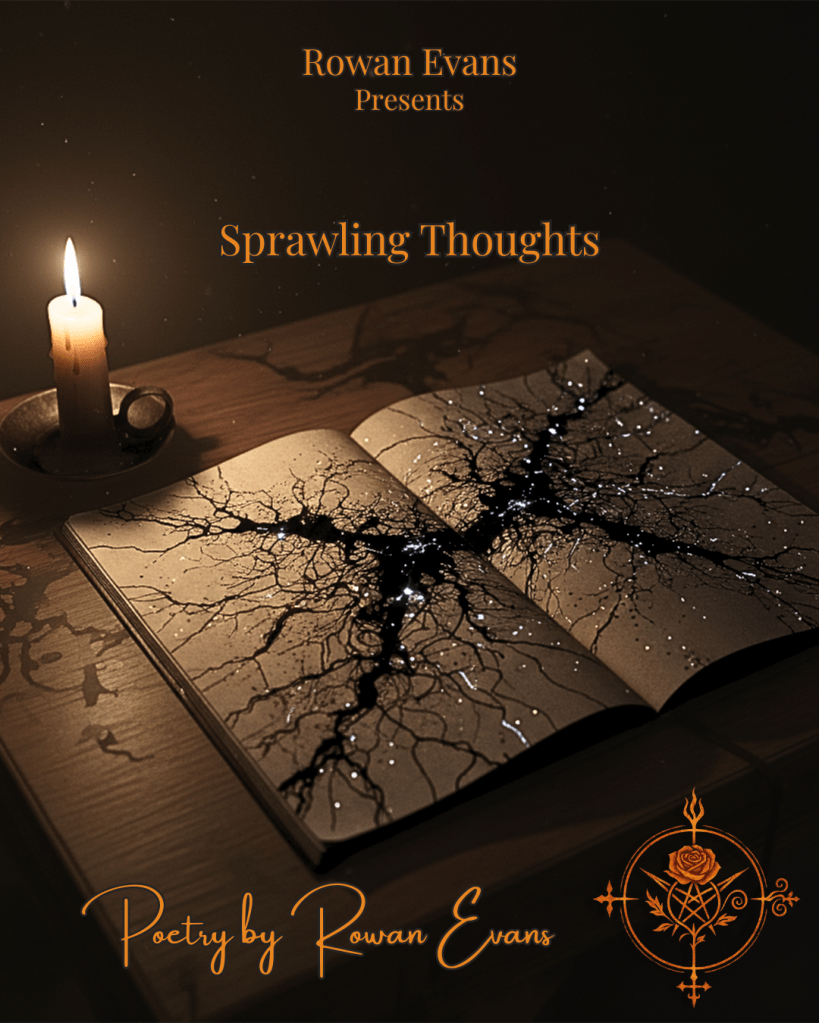
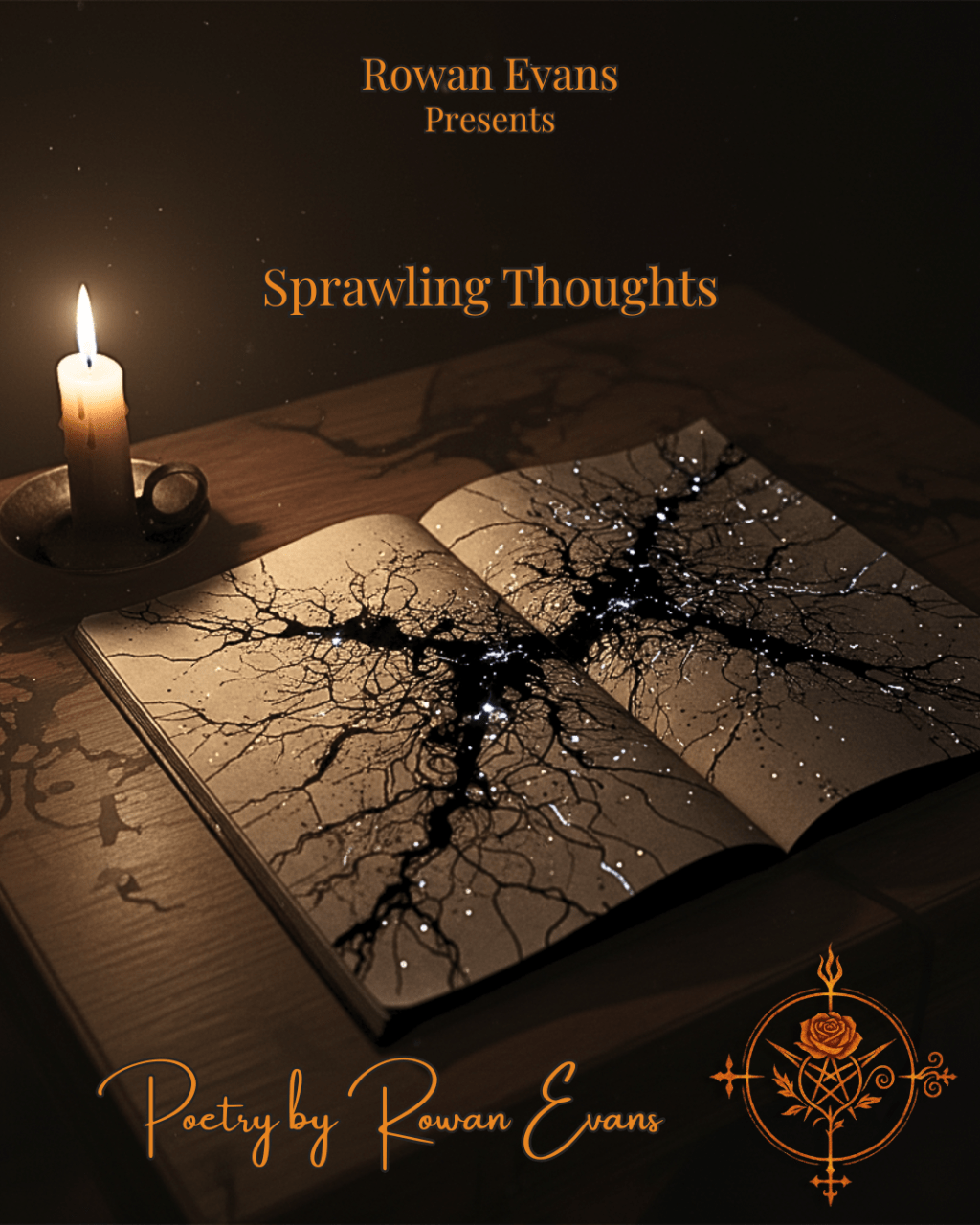
    An open notebook on a dark desk, ink spreading across the page like constellations, lit by a single candle in a shadowed room.
    Where ink becomes confession and scars learn how to shine.

    Sprawling Thoughts
    Poetry by Rowan Evans

    I put the pen to paper
    like a gun to my head.
    Pull the trigger,
    write the first line—
    watch the ink splatter,
    like brain matter—
    as thoughts sprawl,
    and crawl
    across
    the page.

    This is what
    confession feels like,
    when I write.
    I pour
    my heart out
    on the page.
    The fear and shame,
    I give it shape,
    I give it a name.

    I dance with my demons,
    and map my scars
    like astronomers
    mapping stars.


    If you’re interested in more poetry, you can find it here → [The Library of Ashes]
  • Author’s Note

    This poem is a reflection on the long, quiet war I’ve carried inside my mind for most of my life. I wrote this piece as an acknowledgment of survival—not as a victory march, but as a tired, honest admission that I’m still here. Depression and anxiety are battles most people never see, but if you’re fighting them too, I hope this reminds you that surviving is a form of defiance. You’re not alone, and your existence—even in the hardest moments—is a testament to your strength.


    A solitary figure surrounded by symbolic shadows and swirling smoke, standing in an abstract mental battlefield, illuminated by a faint light.
    A visual representation of the internal war between survival and despair.

    I Survive (I’m Alive)
    Poetry by Rowan Evans

    I stand in the midst of a battlefield—
    not literal, but metaphor.
    And I still struggle to see
    what this struggle is even for.
    There is a war raging in my head,
    between the voice that wants to live
    and the voice that wants me dead.

    That was me at sixteen.
    Now I’m thirty-five—
    still wondering how I’m even alive.
    And though I’ve fought like hell,
    I’m not doing well.
    Yet I survive.
    Even when I don’t thrive,
    I’m alive.

    Alive in spite of
    years of internal torment.
    So go on—
    tell me I’m going to hell
    for the way I live.
    I’ll face eternal torment
    with a smile on my face;
    I’ve lived it already.

    Next year, I’ll be thirty-six.
    Six. Six.
    They say I’m evil in my ways,
    that even the devil
    wouldn’t praise.
    But that’s okay—
    because I’m mentally sick.
    Sick. Sick.

    Depression.
    Anxiety.
    They are the rot
    inside of me.
    I see them with clarity.
    I don’t need
    your pity or charity.

    I just need patience,
    and understanding—
    but you won’t give it,
    because you’ve never lived it.
    So how could you?
    How could you understand
    what it’s like
    to both want to live
    and to die
    at the same time,
    in the same breath?

    But I won’t leave.
    I won’t shed this flesh.
    I’ve made promises.
    I promised…
    I’m not going anywhere.


    Looking for more poetry? You can find it all in the Library of Ashes.

  • For anyone who has been curious as to what my style is all about—here is the guiding flame. Read, take what burns in you, and join the ritual.


    Gothic candlelit room with scattered parchment and a quill, casting shadows on crumbling walls, symbolizing Neo-Gothic Confessional Romanticism.
    Where ink bleeds with fire, shadow, and devotion—welcome to the ritual of Neo-Gothic Confessional Romanticism.

    Neo-Gothic Confessional Romanticism: A Manifesto

    Welcome, wanderer.
    You have stumbled into a space where ink bleeds with fire, shadow, and devotion. Here, we do not hide from the extremes of the human heart. Here, we celebrate them.

    1. Confess without apology

    Your poetry is your altar. Speak what others would censor. Reveal the darkness you cradle, the obsession you cherish, the love you fear to voice. Confession is not weakness—it is power.

    2. Embrace Gothic sensibilities

    We borrow the language of ruins, candlelight, and shadowed hallways. Our metaphors are not polite; they are ritualistic, visceral, and haunting. Cast your words like spells. Invite imagery that whispers, screams, or glows.

    3. Worship multiplicity of voice

    Your persona need not be singular. Write through the eyes of the heart, the mind, the shadow, the rage, the playful child, the protector. Let your text be a stage of personas. Let readers hear not just your voice, but the echo of all you carry within.

    4. Make the page a ritual

    Format, punctuation, visual cues—these are not minor details; they are part of the spell. Break the line. Change fonts. Use icons or colors if you must. Your reader should feel the cadence of ritual in how the text moves.

    5. Infuse devotion and play

    Romance, obsession, adoration—these are sacred tools. Love intensely, worship fiercely, play gleefully. Your writing should make readers feel the exhilaration, terror, and ecstasy of your devotion.

    6. Transcend genre boundaries

    Do not ask if your work is “poetry” or “fiction.” Here, labels bend and dissolve. The only rule is to move truth through beauty and chaos, to convert emotion into experience, and to leave the reader both unsettled and enchanted.

    7. The reader is your witness

    Neo-Gothic Confessional Romanticism is not meant to be polite or passive. It is a shared ritual. Your reader walks beside you through shadowed corridors, candlelit rooms, and flaming skies. Invite them, terrify them, and leave them breathless.


    Invitation to the New Gods:
    Pick up your pen, your knife, your candle. Begin. Spill your ink, ignite your voice, and do not be afraid to hex, haunt, or hold your reader in the palms of your words.

    This is Neo-Gothic Confessional Romanticism.
    We are the sacred misfits.
    We are the luminous heretics.
    We are the poets who burn and write in equal measure.

    So mote it be


    To find examples of all the different ways this genre can be expressed, check out The Library of Ashes: Here

  • Author’s Note

    This piece is a meditation on resilience, self-reclamation, and the sanctity of imperfection. I wrote it as a sermon for anyone who has ever felt broken, misfit, or misaligned with the world’s expectations. It’s a reminder that divinity exists in survival, in truth-telling, and in the courage to rebuild oneself repeatedly. For the fractured souls out there: this one’s for you.

    Rowan Evans


    A lone figure stands in a dimly lit gothic cathedral, bathed in colored light from stained glass, representing resilience and sacred rebellion.
    A sermon for the fractured soul—finding divinity and strength in imperfection.

    Sermon for the Fractured
    Sermon by Rowan Evans

    Every poem I write
    is a sermon for the fractured soul.
    Saint with a pen,
    heathen in the mind.
    I’m a preacher’s child
    gone wild—
    welcome to my church,
    it’s a service for the misfits.

    I crowned myself a deity.
    My divinity
    lives somewhere between
    G-O-D and Lucifer.
    I’m a morningstar, lightbringer.
    Or a shadow
    walking through a holy world.

    Your holy book
    banned my name.
    Heaven doesn’t want me,
    Hell doesn’t either.
    So I made
    Purgatory my kingdom.

    You don’t have to praise me,
    you don’t have to worship.
    I don’t need blind faith—
    for the miracles I create.
    You don’t have to suffer
    to prove a thing—
    your breath is devotion enough.

    You don’t have to
    sell me your soul.
    I will bless you,
    while you remain whole.

    I am not a deity without flaw—
    I’ve been cracked, fractured,
    put back together
    by my own hands.
    I’ve rebuilt myself,
    time and time again.
    So I don’t ask for perfection,
    I ask for confession,
    truth and witness.


    You can find more of my gospel in the Library of Ashes. [The Library of Ashes]
  • 🖤 Author’s Note 🖤

    Each of these gospels was born from a silence I refused to keep. The 13 Mirrored Gospels is my reckoning with faith, identity, and the inherited wounds of expectation. These are not sermons for the saved — they are psalms for the broken, whispered through smoke and mirrorlight.

    Read carefully.

    The smoke is watching.


    A dimly lit gothic altar with candles, smoke, and shattered mirrors — representing “The 13 Mirrored Gospels” by Rowan Evans.
    Read carefully. The smoke is always watching.

    🖤 The 13 Mirrored Gospels 🖤
    Poetry by Rowan Evans

    “There are no saints in these gospels—
    only shadows that learned to speak.”
    Rowan Evans

    𖤐𓆩 🜏 𓆪𖤐

    I. The Gospel of Mirrors

    Step inside.
    Watch yourself rot in reverse.
    Every smile you wore as armor,
    now bleeding at the edges.
    The mirror never lied.
    You just kept asking the wrong questions.

    𖤐𓆩 🜏 𓆪𖤐

    II. The Gospel of Silence

    Not the silence of peace—
    the silence after impact.
    The quiet that follows
    when every scream is spent,
    and all that’s left
    is the echo of your own denial.

    𖤐𓆩 🜏 𓆪𖤐

    III. The Gospel of Golden Lies

    They dipped their cruelty in gold leaf
    and called it kindness.
    They said “light saves”
    while tightening the noose.
    Shine is not salvation.
    Shine is strategy.

    𖤐𓆩 🜏 𓆪𖤐

    IV. The Gospel of the Sainted Wound

    She told me pain makes you beautiful.
    So I made myself a masterpiece.
    Now they can’t look at me
    without flinching.

    𖤐𓆩 🜏 𓆪𖤐

    V. The Gospel of Velvet Ruin

    I dressed my rage in elegance—
    because pretty things bleed quieter.
    Because if I scream in silk,
    they call it poetry,
    not proof.

    𖤐𓆩 🜏 𓆪𖤐

    VI. The Gospel of the Haloed Knife

    They told me love was soft.
    So when I bled, I thought I was wrong.
    Turns out, some loves
    come serrated.
    Turns out, mine did too.

    𖤐𓆩 🜏 𓆪𖤐

    VII. The Gospel of the Unknown Reflection

    The mirror shows my face,
    but it isn’t me—
    just a shadow stitched from language,
    from names that never fit.

    They told me what to be:
    man, believer, saved—
    but I only felt the ache
    between those words.

    Now even silence
    flinches.

    𖤐𓆩 🜏 𓆪𖤐

    VIII. The Gospel of Smoke-Laced Psalms

    I wrote devotion in ash,
    but they wanted ink.
    So I choked on incense
    until my prayers tasted like
    what they’d believe.

    𖤐𓆩 🜏 𓆪𖤐

    IX. The Gospel of Unholy Softness

    I offered tenderness.
    They saw weakness.
    I offered truth.
    They called it unstable.
    So now I offer nothing
    but teeth.

    𖤐𓆩 🜏 𓆪𖤐

    X. The Gospel of Reverse Reverence

    I bowed to nothing—
    not out of pride,
    but protection.
    Every altar I’ve knelt before
    asked for a piece of me.
    I’ve run out of offerings.

    𖤐𓆩 🜏 𓆪𖤐

    XI. The Gospel of Misnamed Miracles

    They called my survival
    a phase.
    A scream for attention.
    But I was just trying
    to exist loud enough
    to feel real.

    𖤐𓆩 🜏 𓆪𖤐

    XII. The Gospel of Heretics and Honey

    I tasted joy once.
    Sweet. Brief.
    But it rotted faster than grief.
    I keep it in a jar now,
    like a dead bee.
    Just in case.

    𖤐𓆩 🜏 𓆪𖤐

    XIII. The Gospel of the Flame That Didn’t Save Me

    They said fire cleanses.
    But all it did
    was remind me
    what burning feels like
    from the inside.


    More Gospels, Psalms & Riddles

    The Gospel of Softness III: Thirteen Psalms for the Tender-Hearted

    13 Psalms of Falling: A Sapphic Confessional Litany of Softness & Sacred Ruin

    13 Riddles for the Starborn Child

    XIII Psalms for the Goddess in My Mouth

  • Content warning: contains imagery of revenge and violence. This poem is catharsis and fiction; it does not condone real‑world harm.

    Author’s Note

    I wrote “Retribution in Shadows” on November 5, 2024 — the afternoon before someone I would come to care about walked into my orbit. At the time it was an experiment in voice: the shield that rises when you’ve watched someone you love be hurt and felt powerless to make it right.

    This poem is not an instruction; it is a feeling made language — the visceral, righteous imagining of a protector who chooses the shadowed path of vengeance in fiction because sometimes rage needs a form. It is a confession, a performance, and a prayer for justice that lives in mythic tones rather than real action. Read it as the honest, dark music of someone who would rather break the night than let another sunrise find a bruised heart.

    Rowan Evans


    Silhouetted figure in shadows moving through a dim, Gothic hallway, moonlight highlighting edges, representing secrecy and poetic vengeance.
    “In the shadows, the voice of justice whispers.”

    Retribution in Shadows
    Poetry by Rowan Evans

    When she whispered your name,
    Her voice cracked like glass,
    Eyes rimmed in sorrow,
    Bruises painted like dusk on her skin—
    In that moment, I swore your reckoning would begin.

    I watched from the shadows,
    Your every careless stride,
    Studied the rhythms of your ordinary life,
    Each step a beat in the dirge of your demise.

    And when the night fell thick and soundless,
    I cut the power, cloaked in the dark,
    Slipped through the cracks you left wide,
    Moving like vengeance, swift and stark.

    Up the stairs, where silence reigns,
    Your breath soft, blissfully blind—
    I crept, unseen, your oblivion growing,
    My heartbeat a dirge, slow and unkind.

    I could see you there, sprawled and serene,
    Innocent, unaware of the reckoning near.
    I craved the look that would crack your mask,
    The flash of terror—the taste of your fear.

    For each tear she shed, each silent plea,
    I became the weight, the steel, the fire.
    Not for mercy, not for grace,
    But for the justice of her unwept cries,
    A reckoning for wounds unseen by daylight’s gaze.

    In the shadows, I am retribution’s breath,
    Silent, sharp, and set to descend—
    To haunt, to end, to steal your peace,
    And let her bruised heart find release.


    Closing Note

    If this poem shakes something loose in you — anger, sorrow, a memory — you are seen. Creative rage can be a way of naming wrongs; healing often requires more than imagination. Be gentle with yourself. If you need to talk, reach for someone who will listen without minimizing you: a trusted friend, a peer, or a professional. And if you want to sit in the dark with me for a while longer, comment below — I read everything.

    R.