Tag: mental-health

  • Author’s Note

    This piece is the closest I’ve come to writing the truth of my internal war without softening it. Between Worlds is about self-violence—the way the mind learns your weak spots, remembers the old wounds, and knows exactly where to cut. It’s a poem about relapse, about memory, about survival, and about the strange loneliness that follows healing.

    It speaks to the years where I wasn’t sure I’d make it. The hospital walls. The padded quiet. The fluorescent lights humming through the silence. It speaks to dissociation, to identity, to queerness, and to the mythic distance I’ve always felt between who I am and the world I live in.

    This poem isn’t a cry for help—it’s a record of survival. It isn’t tragedy for tragedy’s sake—it’s truth. It’s the reality that healing isn’t linear, that progress has shadows, and that sometimes the loudest battles are fought in the mind no one else can see.

    If you know this feeling—of standing in your own skin like it never quite fits, of fighting thoughts with thoughts, of loving your existence even when you question your place in it—then I hope you feel seen here.

    Because none of us are alone in the in-between.

    Rowan Evans


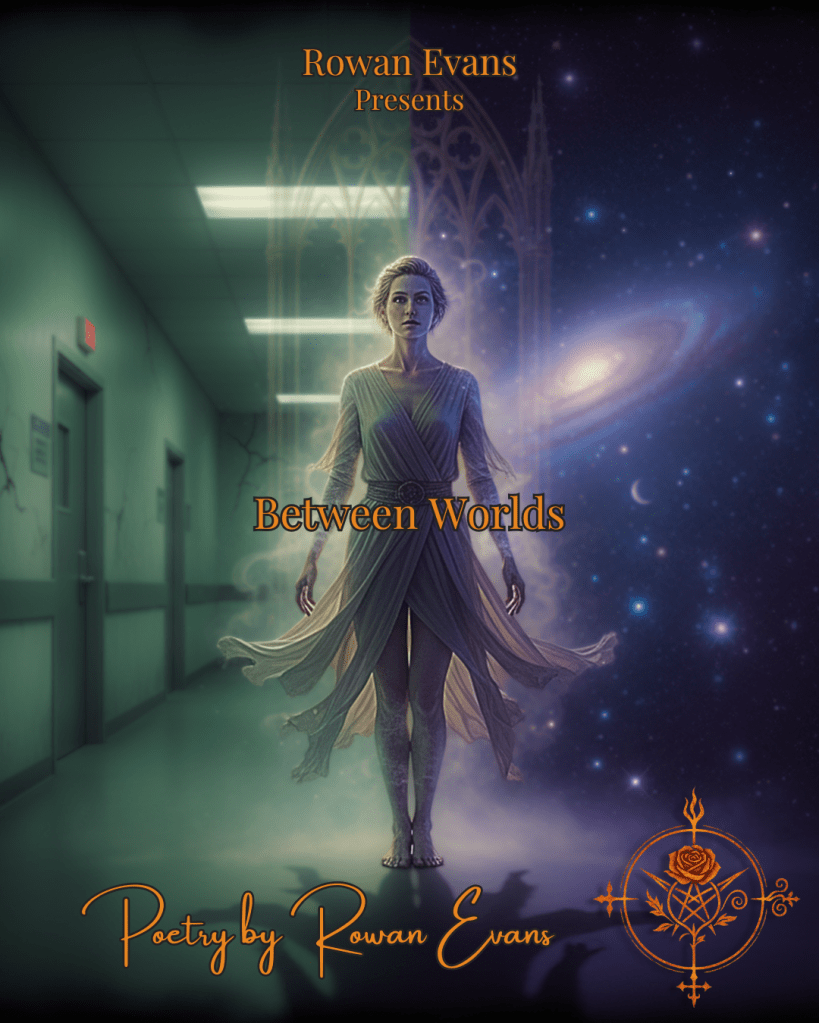
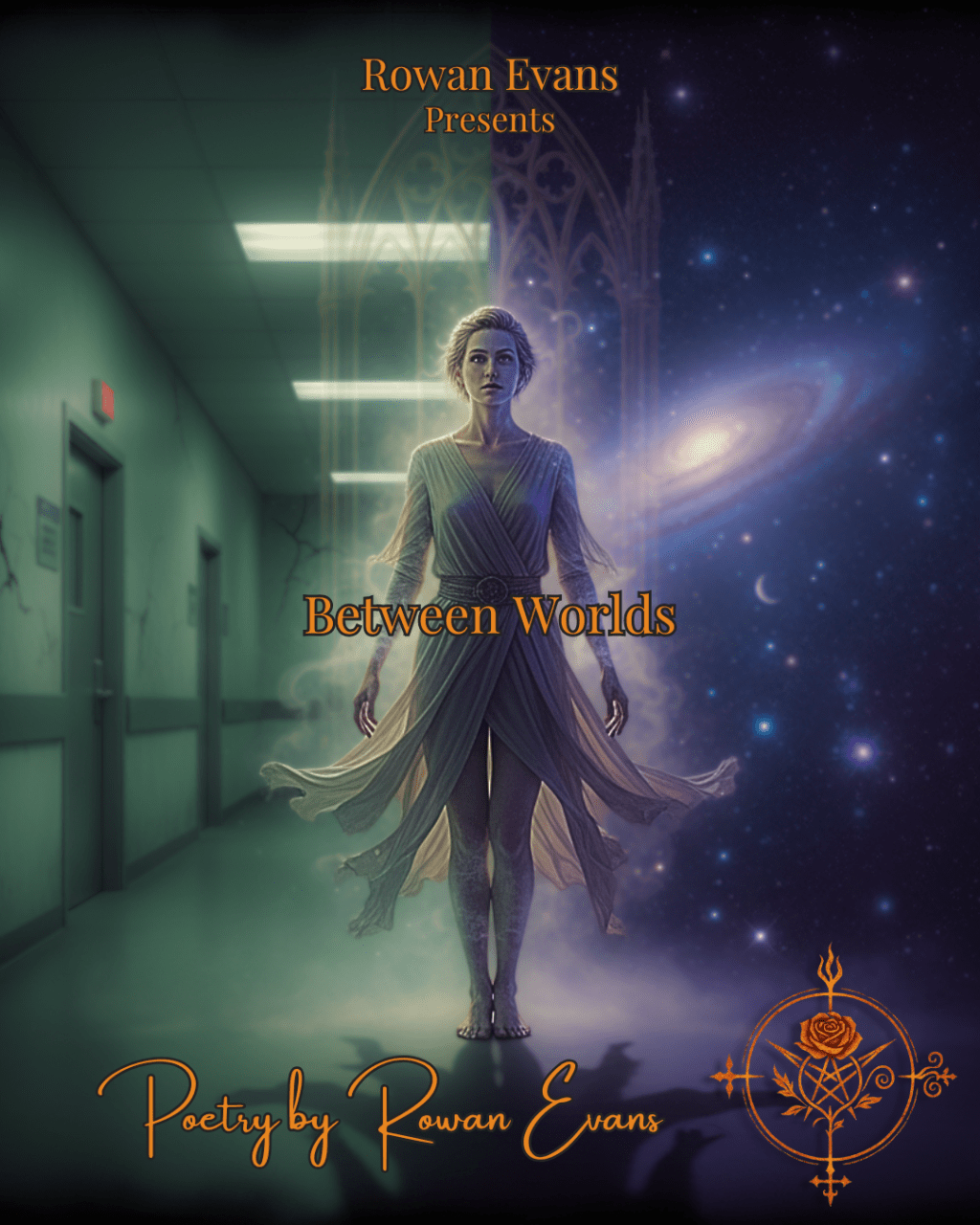
    Nonbinary person standing between a hospital hallway and a star-filled night sky, symbolizing dissociation and identity between worlds.
    Between Worlds — artwork representing Rowan Evans’ poem about surviving mental illness, dissociation, and identity beyond binaries.

    Between Worlds
    Poetry by Rowan Evans

    Why do I
    always try
    to pick a fight
    with me?

    You’d think I’d know,
    by now, just how
    quick I’ll slip
    an insult
    under the ribs.

    I’ll hit
    every single fear,
    twist them
    like a knife—
    until I’m
    on my knees,
    gasping,
    spitting blood.

    I don’t fight fair.
    I target old wounds,
    tear at what’s
    already healed.
    I’ll fuck around
    and send myself
    back ten years—
    back to hospital walls
    and quiet rooms,
    where the only sound
    was the fluorescent hum.

    Where time dissolved…
    where clocks stopped
    ticking.

    But I walked out
    of those halls—
    didn’t I?

    Didn’t I?

    But what if I didn’t?
    What if I’m still locked inside,
    in a padded room
    with the jacket
    strapped tight?
    Thoughts confined,
    so the words
    won’t escape.

    Writing poems
    in my head,
    just to pass
    the time.

    I’ve been alive,
    but dead inside.
    And I’ll be honest:
    I’ve died
    inside my mind
    more than
    a dozen times.

    I just wanted escape.

    Escape from pain,
    from feeling misplaced—
    I just wanted
    to belong.

    But it’s like—
    something is wrong here.
    Why don’t I
    feel like
    I belong here?

    Why does everything feel
    a half inch to the left—
    like I’m living inside
    the echo of myself?

    Like I’m watching my life
    from behind fogged glass,
    palms against the surface,
    screaming—
    but no sound
    passes through.

    Sometimes I swear
    the world forgets I’m here,
    and sometimes
    I do too.

    Maybe it’s because
    every room I walk into,
    I’m half a ghost already—
    too queer, too quiet,
    too soft, too strange.
    Too fucking much
    for everyone
    but me.

    Maybe that’s why
    the fight never ends—
    because I’m still trying
    to prove I deserve
    the space I take up,
    even in my own skin.

    So maybe I don’t belong here
    because I was born
    between worlds—
    not alive, not dead,
    not human, not myth,
    not safe, not ruined.

    Maybe my bones remember
    a home I never had,
    and every heartbeat since
    has been an attempt
    to map
    my way back.


    If you’re looking for more poetry, you can find it here → [The Library of Ashes]

  • Introduction

    When the Mask Slips explores the fragile boundary between performed sanity and inner unraveling. Through vivid imagery, surreal metaphor, and a self-aware voice, Rowan Evans captures the terror and beauty of identity under pressure, where the mask may be all that stands between perception and emptiness.


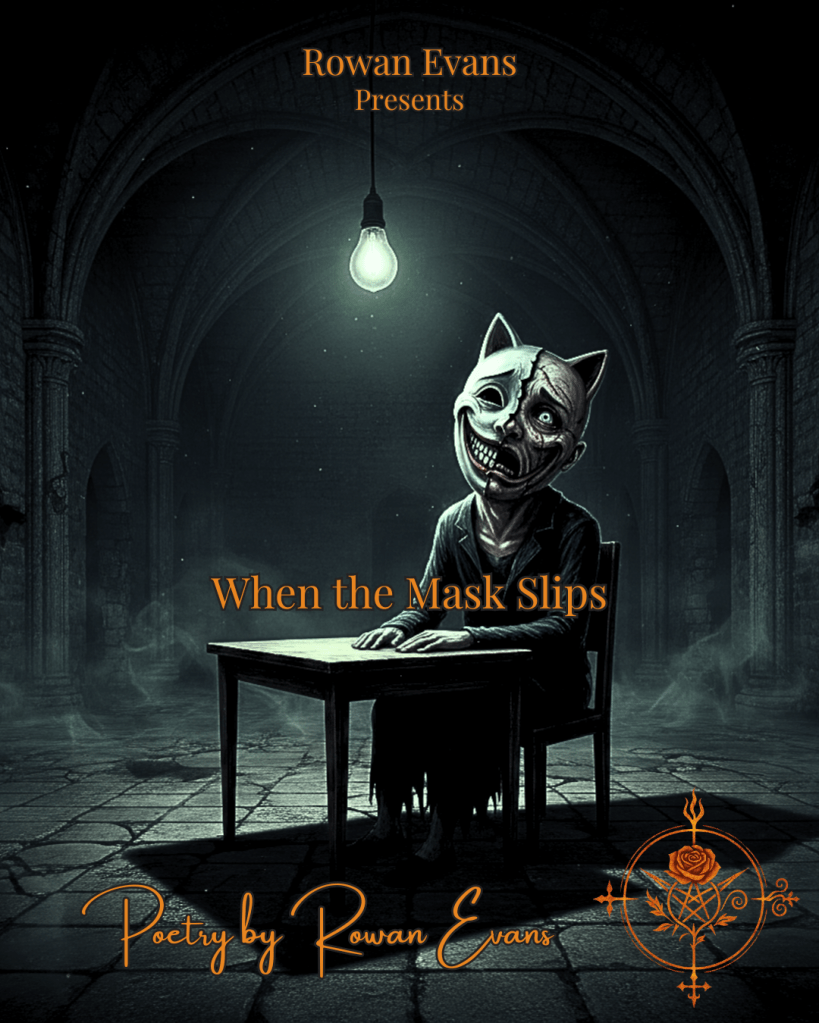
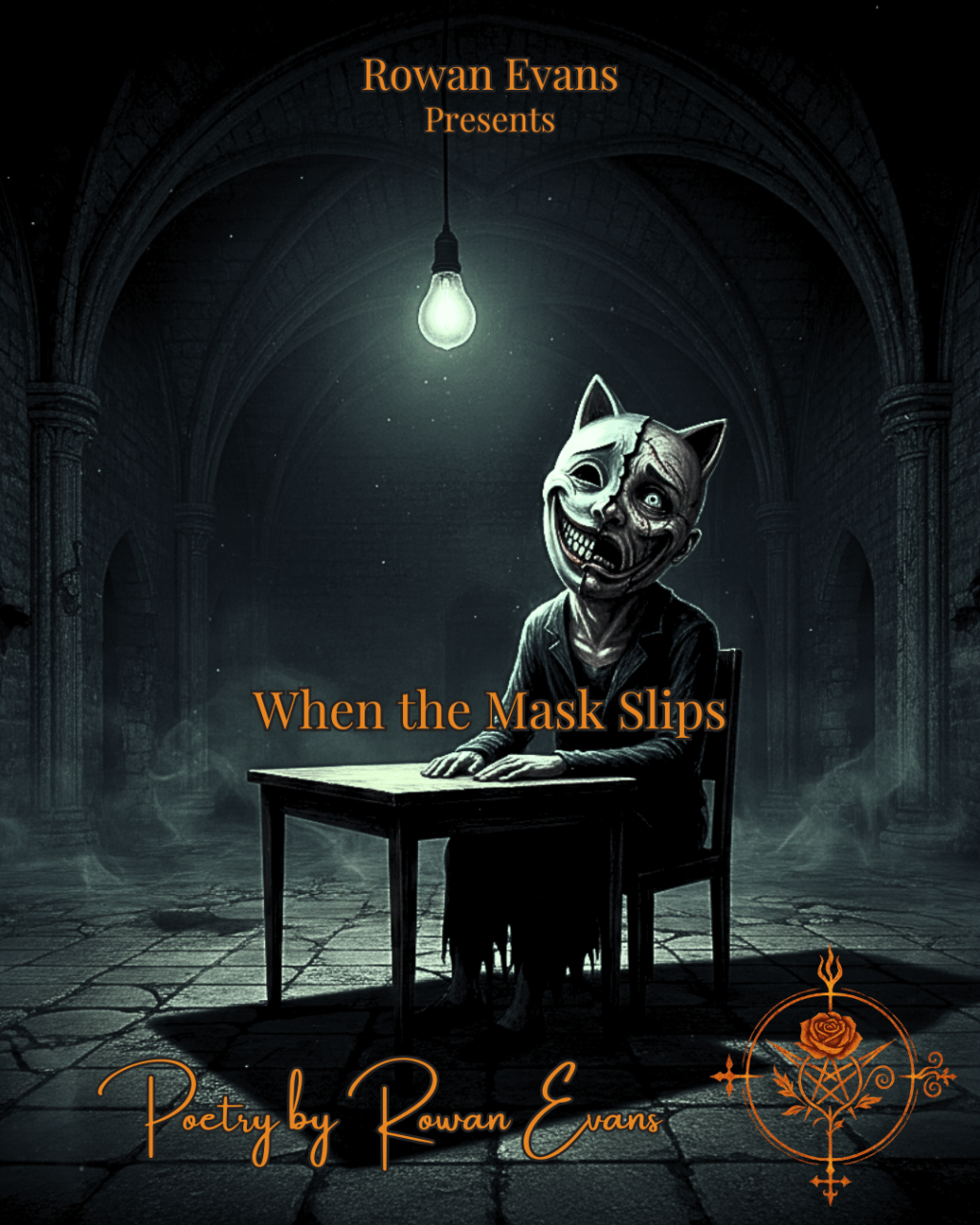
    Neo-Gothic digital illustration of a solitary figure with a Cheshire grin sitting at a flickering-lit table, representing the fragility of identity and performed sanity.
    When the Mask Slips visualized: a lone figure navigating the fragile line between performance and inner self.

    When the Mask Slips
    Poetry by Rowan Evans

    I am going to be honest—

    I think I’ve lost my mind,
    I’ve been drifting in this mental fog.
    Wandering. Lost.
    Not sure what I was trying to find,
    not sure what was the cost.

    But I’ve been—
    orbiting annihilation,
    facing Armageddon
    in phases—
    the moon isn’t the only thing
    that disappears piece by piece.

    I keep losing track of my thoughts
    like loose teeth—
    wiggling them
    just to feel something give.
    I’m just a Mad Hatter,
    with a Cheshire grin—
    screaming “Off with their heads!”
    just to hear the echo—
    make sure the room and I are still real.

    Sometimes—
    I cosplay sanity,
    like I have a grasp on reality.
    Like I know the meaning of stability—
    mentally.
    I dress up, pretend that I’m normal—
    but it feels too boring and formal,
    too exposed.
    Too much light, not enough shade,
    too many eyes on my face.

    And underneath it all,
    I’m terrified there’s nothing there—
    when the world stops being a stage,
    when existence stops being a performance.
    When the mask slips…
    and it’s just me.

    (God, what if that’s worse?)


    Author’s Note

    This poem sits at the edge between humor and unraveling—between the persona we show the world and the version of ourselves we hope no one ever sees. It isn’t about insanity; it’s about the fear that sanity might be nothing more than costume, choreography, and survival instinct.

    It uses absurdity as honesty, because sometimes the surreal is the only language for a fraying mind. The Wonderland imagery isn’t playful fantasy—it’s metaphorical dissociation. The poem is meant to feel unsteady, spiraling, self-aware, and a little unhinged. It asks:

    What if the mask isn’t hiding anything?
    What if the performance is the person?

    This piece reflects the quiet terror of identity erosion—the dread that beneath the jokes, the aesthetics, the manic charm, and the polished poetry… there may be nothing solid to hold onto.


    If you’re looking for more poetry, you can find it here → [The Library of Ashes]

  • Author’s Note

    This piece is a reflection on persistence, inspiration, and the threads that connect my work over the past year. Each italicized title is a window into the poems that shaped this journey—moments of love, desire, trauma, healing, and devotion.

    At its heart, this is about process as much as outcome: the daily practice of writing, the sparks of muse, and the quiet work done in the late hours when the world is still. It’s also a tribute to those who witness these words—across screens, pages, and hearts—you are part of this ongoing journey too.

    Consider this piece a bridge: between poems, between moments, between the past and the work yet to come.


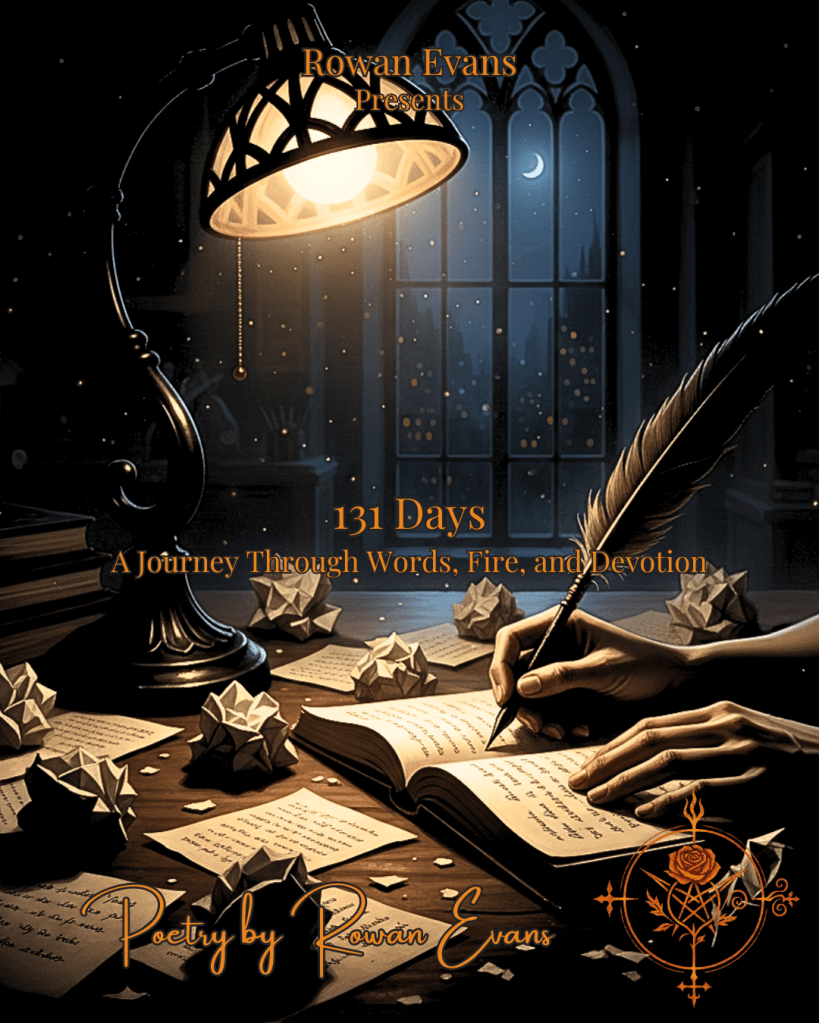
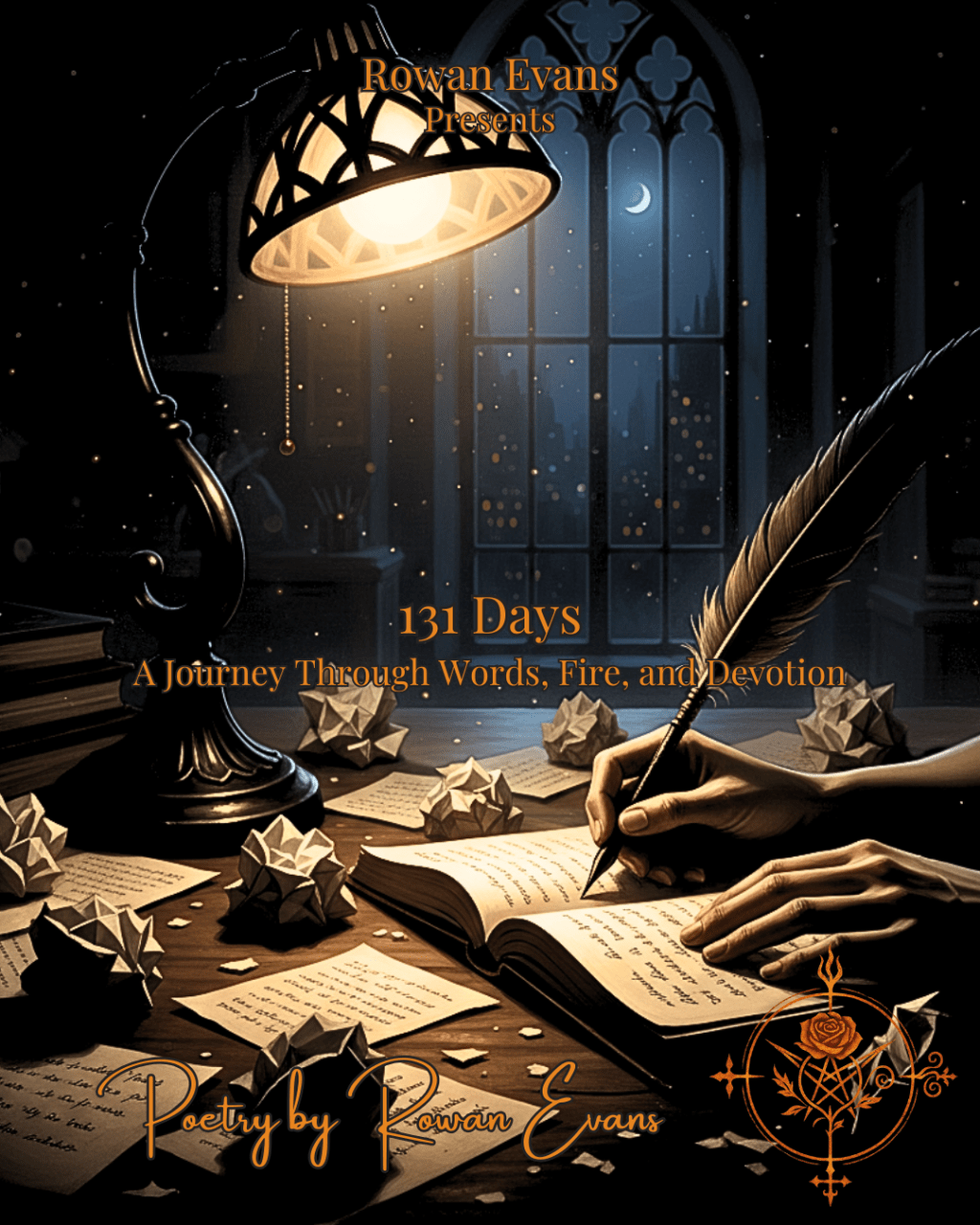
    A writer’s hands holding a pen over scattered pages of poetry, lit by a warm lamp, evoking quiet inspiration and devotion.
    Late nights, ink-stained fingers, and the quiet companionship of words—where every poem begins.

    131 Days
    (A Journey Through Words, Fire, and Devotion)
    Poetry by Rowan Evans

    I’ve been
    so focused—
    over-focused, some say.
    One hundred thirty-one days
    and counting.

    I’ve written with range:
    love, desire, mental health,
    trauma, recovery.
    There’s more, of course,
    but that’s the core.

    I write like
    A Heart Unveiled,
    witnessing the
    Colors of Your Soul.
    My pen
    revealing,
    the Infinity Within.
    As my mind
    drifts free
    in The Hallow Sea.

    My muse,
    my inspiration is—
    A-Woman.
    The vision of beauty,
    an angel on earth—
    a Filipina,
    with fire in her eyes.
    When the world tries
    to put her fire out,
    that is when I
    Cry to the Quiet.
    And why
    I Am
    offering myself
    to her, fully.
    Freely.
    For you see,
    she—
    is Perfectly Imperfect,
    which means…
    she is perfect for me.

    She has shown me,
    that there are
    Timelines Worth Rewriting.
    And your essence,
    I will never forget—
    because
    I Am the Storm That Remembers.

    Late nights, ink-stained fingers,
    the quiet my closest companion.
    For those who witness, across pages and screens,
    you carry a piece of this journey too.
    And still, I write on.


    If you enjoyed this piece and want to check out more of my work, you can click one of the many links scattered throughout the poem itself. They take you to my highest viewed pieces of the year. I am not saying they are my best pieces, just the ones that got the most views. Anyway, you can find more of my work here: [The Library of Ashes]

  • Author’s Note

    This piece came from a place of uncomfortable clarity — the kind that only arrives after you’ve survived enough storms to notice the patterns in the people around you. There’s a strange truth I’ve learned over the years: some people loved me louder when I was breaking than when I was healing. Pain made me poetic, easy to praise, easy to place on a pedestal of tragedy. But healing? Healing is quieter, steadier, less romantic. And somehow, to some people, that made it less worthy of attention.

    I didn’t write this to shame anyone. I wrote it because it’s real — because recovery deserves reverence too, because resilience isn’t any less beautiful than collapse, and because we don’t talk enough about how lonely healing can be.

    This piece is for anyone who’s ever felt more valuable broken than whole. For anyone rebuilding themselves without applause. For anyone learning to exist without having to bleed for validation.

    You are still art.

    Rowan Evans


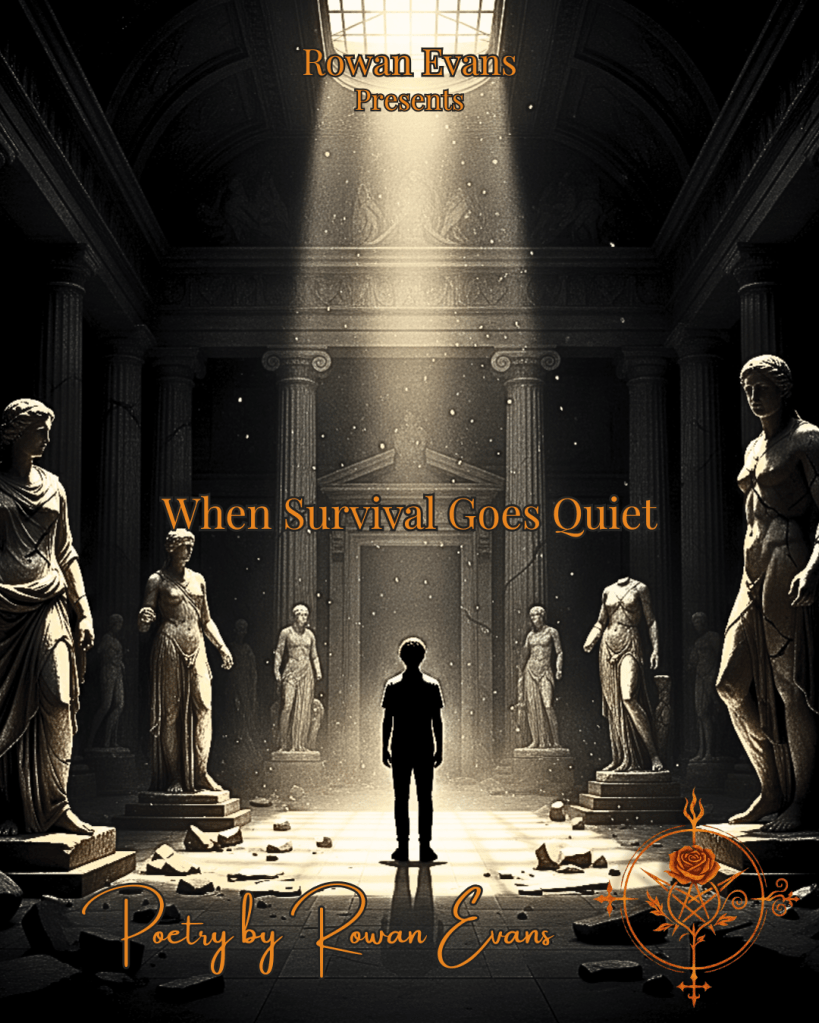
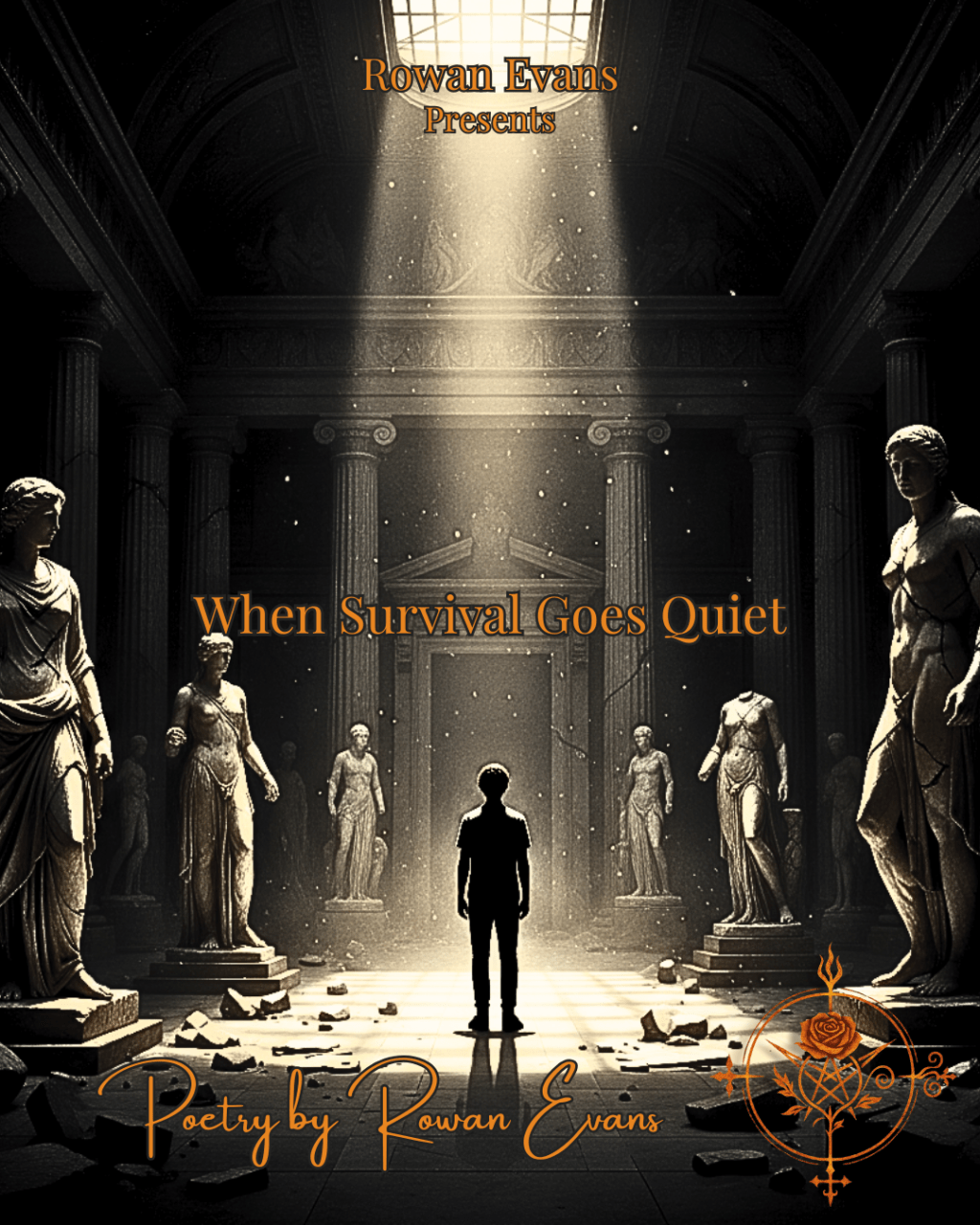
    A solitary figure in a dim, gothic museum surrounded by cracked statues, symbolizing healing after emotional collapse.
    Even survival can feel quiet in a world that only learned to listen to the sound of breaking.

    When Survival Gets Quiet
    Poetry by Rowan Evans

    It’s always been strange to me
    how people praised me louder
    when I was dying inside
    than when I wasn’t.

    And I don’t say this
    to make anyone feel shame—
    it’s just something I’ve noticed
    over time.
    Over a lot of motherfuckin’ time.

    I can think back
    to so many moments
    where I was ready to check out.
    Where the smallest thing
    felt like the final straw.

    And I don’t say that
    to minimize, or erase,
    or make light of the weight
    those moments carried.

    They held me like a museum tragedy—
    a relic of ruin,
    a beautiful collapse.

    But when I finally learned to breathe again,
    their applause softened,
    like my healing made the art
    less valuable.

    Maybe it’s easier to love me
    when I’m bleeding metaphors
    than when I’m quietly rebuilding.

    Maybe survival is too quiet
    for people who only learned
    to listen to the sound
    of breaking.


    Looking for more poetry? You can find it all in the Library of Ashes.

  • Author’s Note

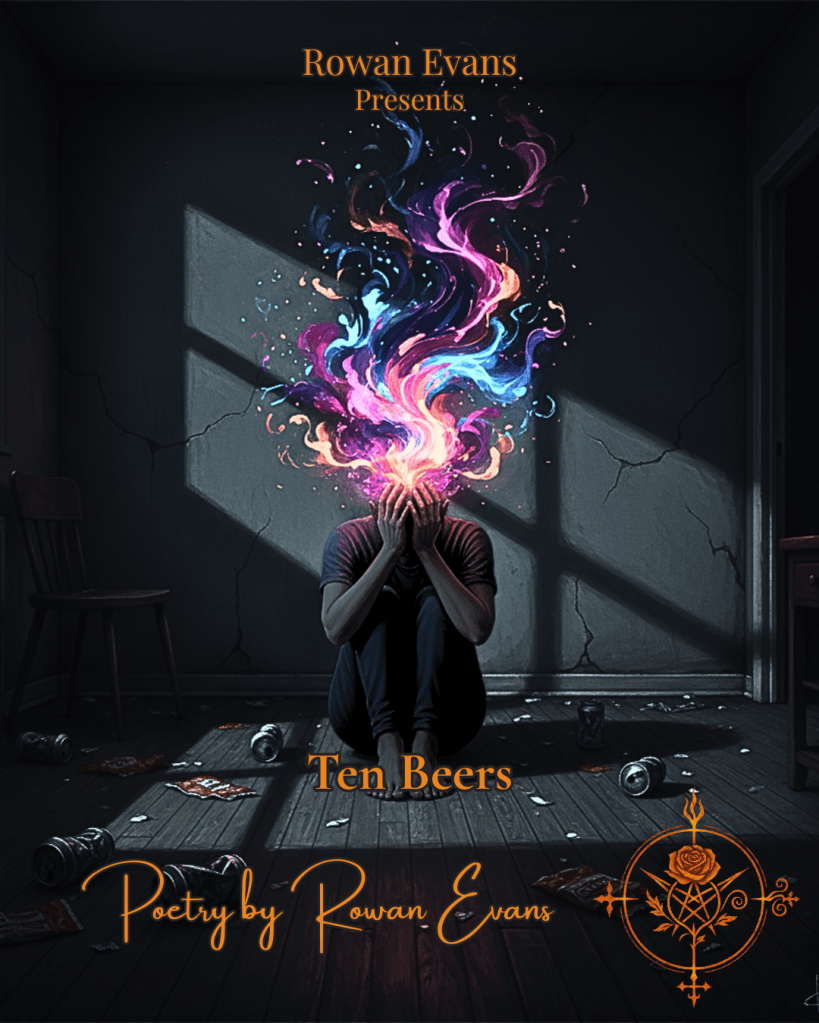
    These paired pieces come from a place of reflection, reckoning, and resilience. Ten Beers is written from the perspective of a younger self, caught in the cycle of self-medication, chaos, and denial. Its repetition mirrors the rituals we create to escape, the desperate attempts to quiet the storm in our own minds.

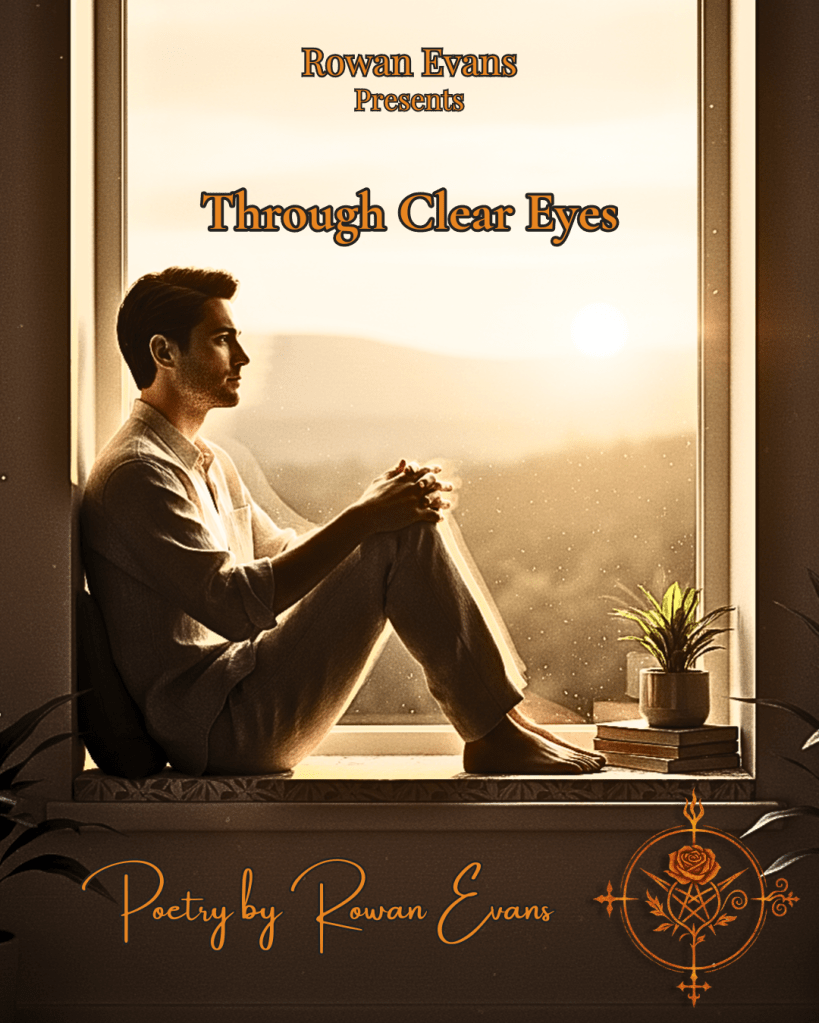
    Through Clear Eyes is the response, the voice of survival and understanding. It looks back with compassion, honesty, and accountability, confronting past pain while acknowledging growth. Together, they explore addiction, self-destruction, and ultimately, forgiveness—both of oneself and of the ways we survive.

    I offer these poems as a testament to the storms we endure, the patterns we outgrow, and the quiet victories of seeing clearly, even after years of being lost in the haze.

    Rowan Evans


    “Person overwhelmed by thoughts, surrounded by empty beer cans and abstract swirls of color.”
    Chasing the blackout, quieting the storm within.

    Ten Beers
    Poetry by Rowan Evans

    I drank ten beers,
    then I drank ten more—
    just trying to escape my mind.
    To numb the pain,
    to quiet the storm inside.
    I drank ten beers,
    then I drank ten more.

    It wasn’t a problem in my eyes,
    I had it all under control.
    I could stop when I wanted—
    I just didn’t want to.
    So I drank and drank,
    then I drank some more.
    I drank ten beers,
    then I drank ten more.

    I chased the blackout,
    just wanted to turn the lights out.
    Quiet the storm raging unseen.
    It’s all in your head. Just don’t be sad.
    If only it were that easy.
    I was drunk every weekend—
    the only way I could be.
    I couldn’t see…
    there were people who needed me.

    I remember waking up,
    cans lined up—
    eighteen, twenty deep.
    I’d stumble to my feet,
    this was weekly, rinse and repeat.
    I drank ten beers,
    then I drank ten more—
    just trying to quiet the storm.

    I poured liquor into whatever cup,
    goal was to get fucked up.
    Chasing the blackout, turning the lights out.
    Cut power. Fade out.
    I thought I was fine,
    thought I was in control—
    but the alcohol had a hold of me.
    I was borderline,
    still telling myself “I’m fine.”
    But I wasn’t.
    I was numbing the pain,
    avoiding everything.
    So I—
    drank ten beers,
    then I drank ten more.

    It was a problem.
    Felt like I was the problem.
    But I was just trying to quiet the storm—
    raging in my head,
    while I whispered,
    “I’m young, just having fun.”


    “Person sitting at a sunlit window, reflecting with clarity and peace.”
    Through introspection, clarity emerges.

    Through Clear Eyes
    Poetry by Rowan Evans

    You weren’t having fun,
    you were hurting—
    you just refused to see.
    You numbed yourself too much,
    blurred your own vision,
    slurred your words.

    You were hurting,
    and thought you could fix it
    by getting fucked up.
    I forgive you, but—
    look what we did to us.
    You drank to numb the pain,
    to quiet the storm inside our brain.

    Then I had to fight like hell
    just to feel normal again.
    It was toxic, the way we coped.
    We lashed out, bitter all the time,
    still swearing we were fine.

    Had to make phone calls
    to find missing clothes—
    and you still couldn’t see.
    The problem was me.


    Closing Note

    These pieces reflect a time when alcohol was a way to quiet the storm in my head, a form of self-medication I thought I could control. Through introspection, reflection, and deliberate inner work, my relationship with alcohol has changed. Today, I can drink without chasing blackouts, without using it to numb myself. I write these poems not to glorify past behavior, but to bear witness to it, to understand it, and to acknowledge how far I’ve come.

    Rowan Evans


    You can find all of my work in my archive [The Library of Ashes].

  • Author’s Note

    This piece reflects on the quiet strength it takes to remain soft in a world that often tries to harden you. It’s a personal reflection on resilience, empathy, and the enduring capacity to love, even in the face of doubt and adversity.

    This post marks my 83rd consecutive day of sharing on the blog,   I have not missed a day since August 8th… During this time, I have tried to push myself to be a little more open. A little more honest. Even when it’s hard, even when I just want to be closed off from the world…


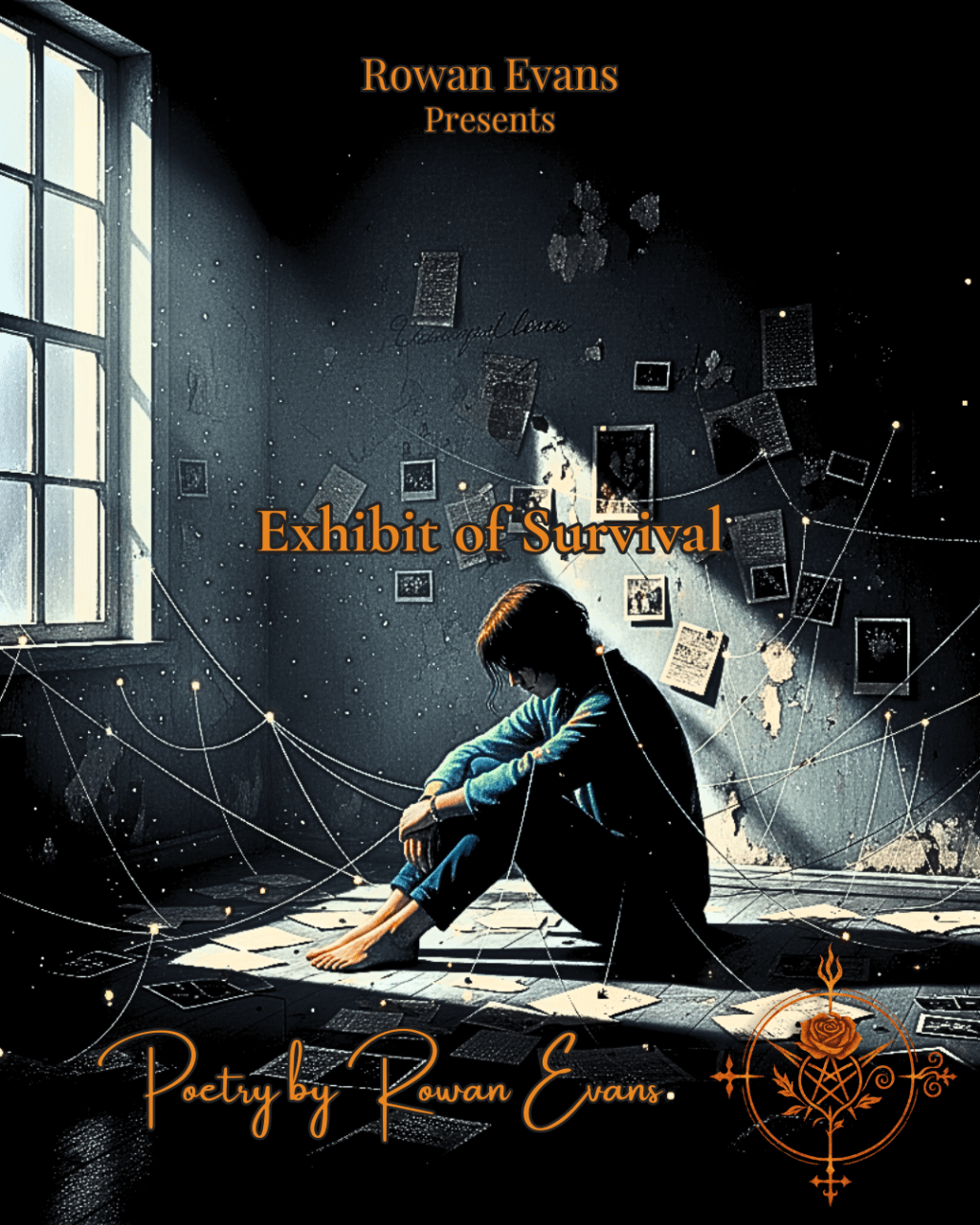
    Figure sitting on the floor surrounded by pinned papers and threads, illuminated by soft light, representing reflection, resilience, and quiet strength.
    Caught in the threads of life — resilience and reflection hold them in place.

    Exhibit of Survival
    Poetry by Rowan Evans


    Pins.
    They hold me in place.
    As the glass
    lowers over my face.
    Framed.
    In a frame. On display.
    Like a dead butterfly.


    I have had people in my life who pretended to be on my side—who pretended to care—when really, they just wanted front-row seats to my struggles. They wanted to watch as I unraveled, whispering doubts to freeze me in place, to preserve the ache. To keep me from moving forward. And yet, I still pushed. I still tried.


    Threads.
    Tied to limbs.
    Marionette.
    Puppet on strings.
    They’ve got control of me.
    Free? Not really.


    Those same people tried to talk me out of anything I wanted to do—anything that could bring me closer to the life I wanted. “Why do you want to leave America?” they’d ask. But it’s not my home; it’s just the place I was born. The place I was raised. I’ve never felt like I belong here. Not once.

    Everything holds me back—my brain looping their doubts, my own depression and anxiety echoing them back to me. It’s a war on all fronts. And still, I stand.


    My thoughts.
    They flutter and fade
    in this liminal space.
    It’s pain—
    just to be alive.
    It’s a wonder.
    A miracle.
    How have I survived?


    Resilience. And reminders from the few who truly see me, who truly believe in me. Without them, I might have given up long ago. But because of them, I’ve kept my empathy alive. I’ve refused apathy. I’ve stayed soft. I’ve kept my heart open and given love freely.


    How?
    How have I
    made it to thirty-five?
    Every day I wake up.
    Surprised.


    That surprise isn’t mine anymore. It’s the echo of others’ doubts—ones I no longer answer.

  • Author’s Note

    Mabuti ako ng hindi ako mabuti was born from that familiar ache of being awake while the world sleeps—the quiet, heavy solitude of overthinking and feeling too much. It’s about seeing the beauty in others while struggling to recognize it in yourself, about cracks, missing pieces, and the weight of empathy in a world that can feel cold.

    The poem weaves together languages, not by accident but by instinct: the Tagalog line as both title and closing heartbeat, grounding the piece in a personal, intimate voice; and my youthful “Nani the fuck?”—a playful, yet sharp, reflection of confusion and disbelief, a nod to my early fascination with Japanese and the way language can capture emotion in a single exclamation.

    This is a poem about exhaustion, insomnia, and the unrelenting pressure of a sensitive heart. It’s also about holding space for yourself the way you hold space for others—learning to see your own gold, even when the lanterns have burned out and the path is dark.


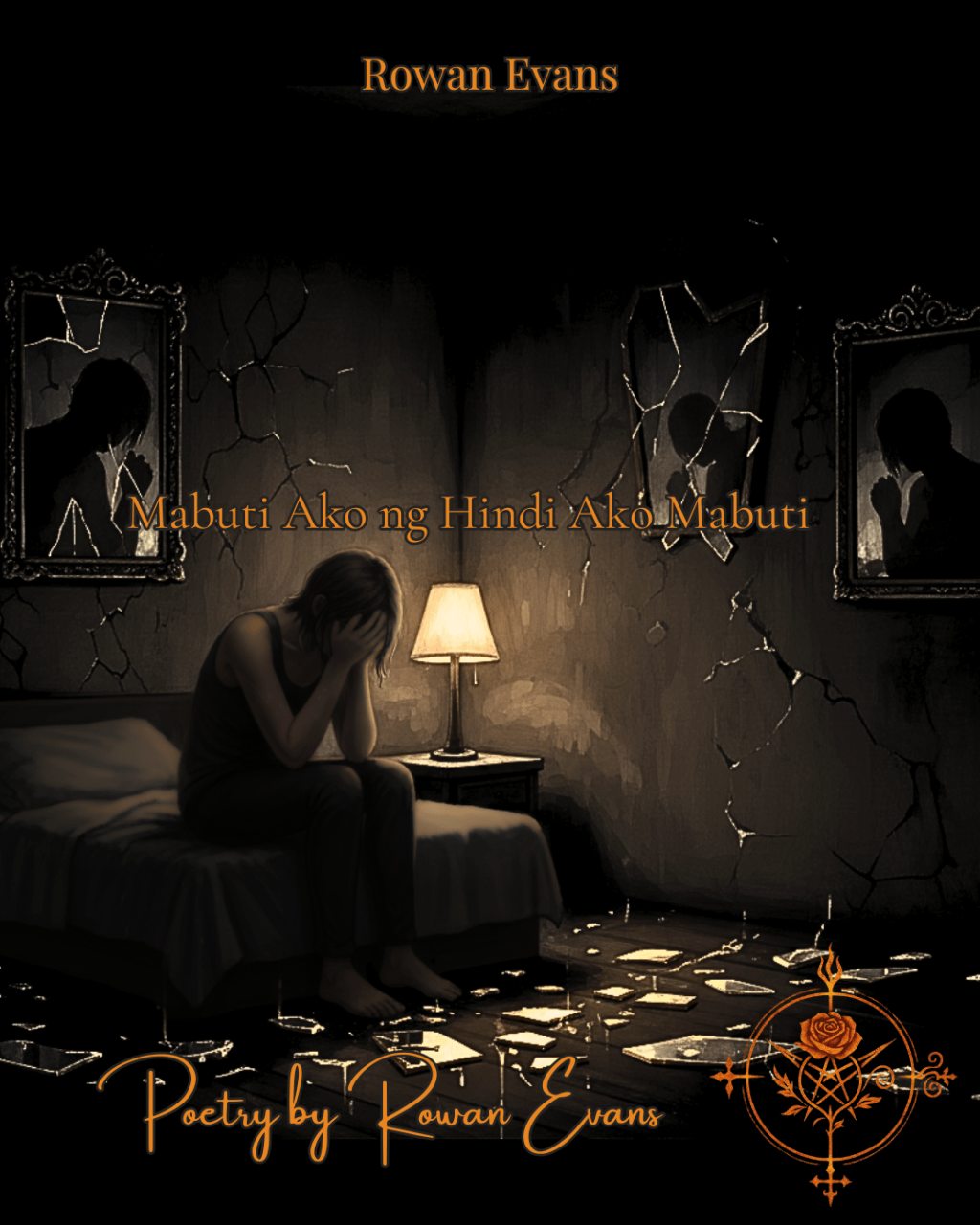
    Solitary figure sitting on bed in dimly lit room, hands covering face, shadows cast across cracked walls with scattered glowing Kintsugi fragments on the floor, evoking introspection and emotional struggle.
    Even in darkness and brokenness, fragments of unseen beauty remain.

    Mabuti Ako ng Hindi Ako Mabuti
    Poetry by Rowan Evans

    I stand before the mirror—
    and all I see, staring back at me
    are cracks.
    I’m just a broken mess,
    a bowl full of holes—
    too big to mend with gold.

    I’ve got—
    too many missing pieces.
    Too many pieces left behind.
    There’s no Kintsugi here.
    No witnesses near.

    Shaking hands and tear stained face,
    I’m so alone, always alone.
    Even with people around.

    All my relationships—
    The color of autumn.
    People leave.

    Now I ask—
    why can’t I see the beauty
    in my own imperfections?
    Why do I only hold that view,
    for everyone but me?
    Why can’t I see?
    Why am I so blind to me?

    And I feel stuck in the dark.
    My laterns burned out,
    I’m wandering lost.
    Is this the cost—
    for being a gentle soul like me?

    The world wasn’t made for me—
    I’m too warm for apathy,
    I cling to empathy like a life vest.
    I give weary souls a place to rest,
    but nowhere for me to lay my head…
    So I stay up instead.

    Insomnia has a hold on me. 
    I’ve stayed up for two days— 
    in one twenty-four hour period. 
    How does that add up? 
    But that’s the math. 
    Don’t laugh. Don’t ask.
    Nani the fuck?

    Yet still, people ask,
    “How are you doing?”
    I say, mabuti ako
    ng hindi ako mabuti.


    If you enjoyed this poem, check out more of my work [here].

  • Author’s Note

    Pulled Away Again came from that quiet guilt that builds when you fade from people you love—not because you’ve stopped caring, but because you’re too tangled in your own thoughts to reach out. It’s about the strange duality of existing in someone’s life and yet feeling like a ghost in it, the ache of being remembered and forgotten at the same time. I wrote this as a kind of apology, but not to anyone specific. It’s for all the friendships I’ve let drift away, for all the messages I’ve left unanswered, for every time I thought silence would hurt less than presence… for every time I thought existing in my head was easier than simply existing in the world.


    A solitary figure dissolving into shadows, with golden light tracing cracks across them, symbolizing introspection, isolation, and the hidden beauty of brokenness.
    “Pulled Away Again – exploring the delicate ache of distance, memory, and friendship through introspection and confession.”

    Pulled Away Again
    (Schrödinger’s Friendship)
    Poetry by Rowan Evans

    Fuck… I pulled away again—
    disappeared into shadows,
    became a bad friend.

    I don’t keep in touch,
    and I know it sucks.
    But,
    what am I supposed to say?
    I’m sorry,
    but you’ll tell me
    I don’t need to apologize…

    And I know,
    the sorry’s not for you.
    It’s for me,
    because I feel like a bad friend.
    I feel like the sad friend.

    The…
    nobody really
    wants around friend.

    The giver,
    the lover,
    the seer
    of broken things.
    The seer of beauty
    in all the broken things.

    I see the gold
    that fills the cracks.
    But only in others.
    Those Kintsugi souls,
    they shine so bright.

    While I just feel trapped…
    while I sit here still cracked,
    pieces scattered, never put back
    together.

    Fuck…
    I pulled away again,
    isolated, faded from perception.
    Because I feel…
    You’re better off without me.

    I’ll amount to nothing,
    And I know
    I’m not the only one
    that doubts me.

    Fuck…
    I don’t keep in touch,
    and I know it sucks.
    Yeah, I know,
    every—
    I’m sorry…
    It’s not for you.
    It’s for me.

    Because I feel
    like I’m a bad friend.
    The out of sight
    out of mind friend.
    The one nobody remembers,
    but somehow not forgotten.

    It’s a—
    Schrödinger’s Friendship.
    I’m both in your life
    and not.
    I am just walking rot.

    Sorry for everything
    I’ve never said,
    sorry for every moment,
    every thought.
    Especially the thoughts
    I thought I forgot.

    I’m sorry for the way
    I fade
    into obscurity.
    You’re always on mind
    but I’m afraid
    of what I’ll say.

    Will today be the day?
    Will I finally I slip up?
    Say something stupid,
    and fuck it up?
    Be just another disappointment—
    A regret etched in history,
    a blemish on an otherwise
    positive memory.

    I’m a face
    you can’t place.
    A name
    that rings no bells,
    rings no memory.
    I am
    my own
    worst enemy.


    If you’ve made it this far, why don’t you check out more of my work? You can find the full library [here].

  • Author’s Note

    This poem is a reflection on identity, expectation, and self-perception. It pokes fun at the rigid “alpha/beta” hierarchies humans obsess over, while also embracing the awkward, complicated truth of being a loner—or a “lone wolf with no wolfly features.” It’s a celebration of existing somewhere in-between: neither fitting the molds others prescribe, nor apologizing for being too observant, too complex, too queer, too alive in your own terms. Humor and honesty are both weapons here, used to dismantle clichés and to claim space for a self that refuses binaries.


    Non-binary fairy standing under an autumn tree, surrounded by falling leaves, half in shadow and half in soft pastel light, representing isolation and self-reflection.
    “Somewhere In-Between” — A reflection on identity, solitude, and the courage to exist unapologetically as oneself.

    Somewhere In-Between (Neither Alpha, Nor Beta)
    Poetry by Rowan Evans

    Sometimes it feels like
    nobody wants me around.
    That’s okay though—
    I don’t want me around either.

    I’m so off-putting—
    I’m not a people pleaser.
    A lone-wolf,
    with no wolfly features.

    I write too much.
    I don’t say enough.
    Too observant
    for my own good.

    Everybody wants an alpha male—
    Not some beta boy, beta fish,
    Watch him get pissed.
    Headbutting his own reflection.

    Me?
    I carry myself with class.
    Not an alpha, not a beta,
    Somewhere in-between.

    I wrote this—
    And I don’t know
    what it means.

    I write too much.
    I don’t say enough.
    Too observant
    for my own good.

    Like, everyone wants to lock-in.
    Stuck in the binary—
    But me? I’m a non-binary fairy,
    Queer as fuck, like the ones I don’t give.

    And it feels like
    nobody wants me around.
    That’s okay though—
    I understand.

    I’m too confusing.
    Too complex.
    I recognize a pattern,
    I know what comes next.

    Everybody leaves,
    like it’s autumn.
    Gaining distance
    from the trees.

    I write too much.
    I don’t say enough.
    Way too observant
    for my own good.


    If you have made it this far and would like to check out more of my work, you can find it [here] in The Library of Ashes.

  • 🖤 Author’s Note 🖤

    Each of these gospels was born from a silence I refused to keep. The 13 Mirrored Gospels is my reckoning with faith, identity, and the inherited wounds of expectation. These are not sermons for the saved — they are psalms for the broken, whispered through smoke and mirrorlight.

    Read carefully.

    The smoke is watching.


    A dimly lit gothic altar with candles, smoke, and shattered mirrors — representing “The 13 Mirrored Gospels” by Rowan Evans.
    Read carefully. The smoke is always watching.

    🖤 The 13 Mirrored Gospels 🖤
    Poetry by Rowan Evans

    “There are no saints in these gospels—
    only shadows that learned to speak.”
    Rowan Evans

    𖤐𓆩 🜏 𓆪𖤐

    I. The Gospel of Mirrors

    Step inside.
    Watch yourself rot in reverse.
    Every smile you wore as armor,
    now bleeding at the edges.
    The mirror never lied.
    You just kept asking the wrong questions.

    𖤐𓆩 🜏 𓆪𖤐

    II. The Gospel of Silence

    Not the silence of peace—
    the silence after impact.
    The quiet that follows
    when every scream is spent,
    and all that’s left
    is the echo of your own denial.

    𖤐𓆩 🜏 𓆪𖤐

    III. The Gospel of Golden Lies

    They dipped their cruelty in gold leaf
    and called it kindness.
    They said “light saves”
    while tightening the noose.
    Shine is not salvation.
    Shine is strategy.

    𖤐𓆩 🜏 𓆪𖤐

    IV. The Gospel of the Sainted Wound

    She told me pain makes you beautiful.
    So I made myself a masterpiece.
    Now they can’t look at me
    without flinching.

    𖤐𓆩 🜏 𓆪𖤐

    V. The Gospel of Velvet Ruin

    I dressed my rage in elegance—
    because pretty things bleed quieter.
    Because if I scream in silk,
    they call it poetry,
    not proof.

    𖤐𓆩 🜏 𓆪𖤐

    VI. The Gospel of the Haloed Knife

    They told me love was soft.
    So when I bled, I thought I was wrong.
    Turns out, some loves
    come serrated.
    Turns out, mine did too.

    𖤐𓆩 🜏 𓆪𖤐

    VII. The Gospel of the Unknown Reflection

    The mirror shows my face,
    but it isn’t me—
    just a shadow stitched from language,
    from names that never fit.

    They told me what to be:
    man, believer, saved—
    but I only felt the ache
    between those words.

    Now even silence
    flinches.

    𖤐𓆩 🜏 𓆪𖤐

    VIII. The Gospel of Smoke-Laced Psalms

    I wrote devotion in ash,
    but they wanted ink.
    So I choked on incense
    until my prayers tasted like
    what they’d believe.

    𖤐𓆩 🜏 𓆪𖤐

    IX. The Gospel of Unholy Softness

    I offered tenderness.
    They saw weakness.
    I offered truth.
    They called it unstable.
    So now I offer nothing
    but teeth.

    𖤐𓆩 🜏 𓆪𖤐

    X. The Gospel of Reverse Reverence

    I bowed to nothing—
    not out of pride,
    but protection.
    Every altar I’ve knelt before
    asked for a piece of me.
    I’ve run out of offerings.

    𖤐𓆩 🜏 𓆪𖤐

    XI. The Gospel of Misnamed Miracles

    They called my survival
    a phase.
    A scream for attention.
    But I was just trying
    to exist loud enough
    to feel real.

    𖤐𓆩 🜏 𓆪𖤐

    XII. The Gospel of Heretics and Honey

    I tasted joy once.
    Sweet. Brief.
    But it rotted faster than grief.
    I keep it in a jar now,
    like a dead bee.
    Just in case.

    𖤐𓆩 🜏 𓆪𖤐

    XIII. The Gospel of the Flame That Didn’t Save Me

    They said fire cleanses.
    But all it did
    was remind me
    what burning feels like
    from the inside.


    More Gospels, Psalms & Riddles

    The Gospel of Softness III: Thirteen Psalms for the Tender-Hearted

    13 Psalms of Falling: A Sapphic Confessional Litany of Softness & Sacred Ruin

    13 Riddles for the Starborn Child

    XIII Psalms for the Goddess in My Mouth