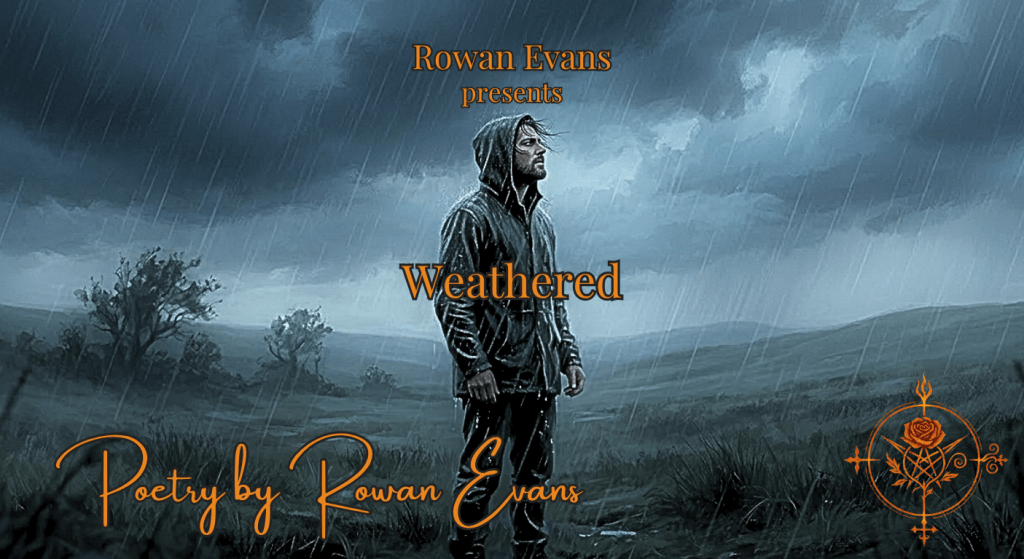
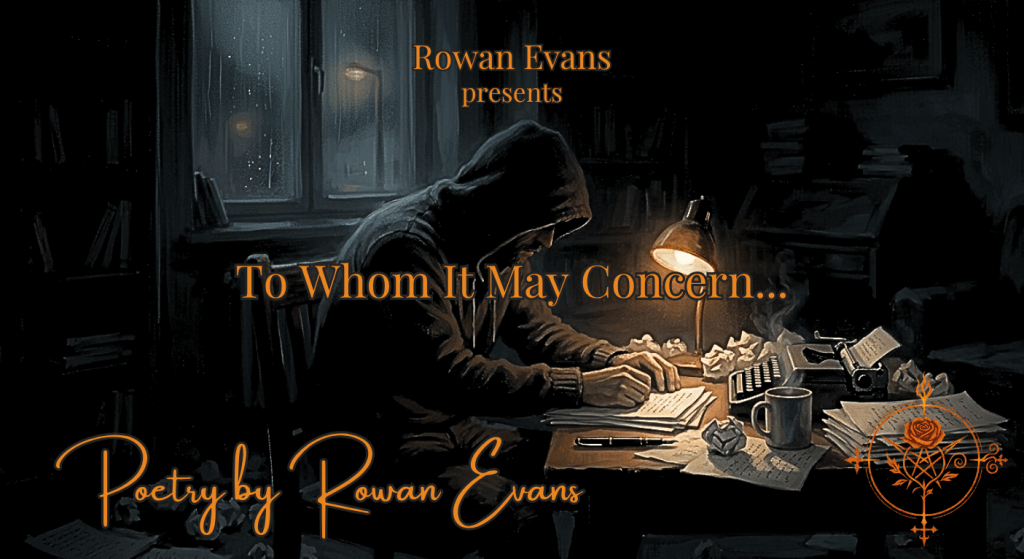
Sometimes, the quiet isn’t empty. Sometimes, it carries you, like a pulse behind the walls. Here, in the hush, I watch. Here, in the stillness, I breathe. Here, I am seen, even when no else is.
— Rᵒᵒ ᵗʰᵉ Pᵒᵉᵗ
“Surrounded in silence, both ghost and witness.” – Rᵒᵒ ᵗʰᵉ Pᵒᵉᵗ
Between Walls and Whispers (Ghost and Witness) Pᵒᵉᵗʳʸ bʸ Rᵒᵒ ᵗʰᵉ Pᵒᵉᵗ
Sometimes, I find myself surrounded in silence— not absence, but a quiet hum behind the walls. The room feels full, but nobody’s really there, and I am both ghost and witness—
drifting, endless, caught in this forced flow of normalcy.
A weirdo, misfit, outcast— purposeful outsider, rejector of the machine.
I don’t want to be another cog. Sometimes, I long for silence— not the absence, but that gentle presence, a pulse softer than the endless hum.
And in that silence, I breathe. I am seen, I am held, not by voices or eyes, but by the quiet that understands what the hum cannot touch.
This piece is the closest I’ve come to writing the truth of my internal war without softening it. Between Worlds is about self-violence—the way the mind learns your weak spots, remembers the old wounds, and knows exactly where to cut. It’s a poem about relapse, about memory, about survival, and about the strange loneliness that follows healing.
It speaks to the years where I wasn’t sure I’d make it. The hospital walls. The padded quiet. The fluorescent lights humming through the silence. It speaks to dissociation, to identity, to queerness, and to the mythic distance I’ve always felt between who I am and the world I live in.
This poem isn’t a cry for help—it’s a record of survival. It isn’t tragedy for tragedy’s sake—it’s truth. It’s the reality that healing isn’t linear, that progress has shadows, and that sometimes the loudest battles are fought in the mind no one else can see.
If you know this feeling—of standing in your own skin like it never quite fits, of fighting thoughts with thoughts, of loving your existence even when you question your place in it—then I hope you feel seen here.
Because none of us are alone in the in-between.
— Rowan Evans
Between Worlds — artwork representing Rowan Evans’ poem about surviving mental illness, dissociation, and identity beyond binaries.
Between Worlds Poetry by Rowan Evans
Why do I always try to pick a fight with me?
You’d think I’d know, by now, just how quick I’ll slip an insult under the ribs.
I’ll hit every single fear, twist them like a knife— until I’m on my knees, gasping, spitting blood.
I don’t fight fair. I target old wounds, tear at what’s already healed. I’ll fuck around and send myself back ten years— back to hospital walls and quiet rooms, where the only sound was the fluorescent hum.
Where time dissolved… where clocks stopped ticking.
But I walked out of those halls— didn’t I?
Didn’t I?
But what if I didn’t? What if I’m still locked inside, in a padded room with the jacket strapped tight? Thoughts confined, so the words won’t escape.
Writing poems in my head, just to pass the time.
I’ve been alive, but dead inside. And I’ll be honest: I’ve died inside my mind more than a dozen times.
I just wanted escape.
Escape from pain, from feeling misplaced— I just wanted to belong.
But it’s like— something is wrong here. Why don’t I feel like I belong here?
Why does everything feel a half inch to the left— like I’m living inside the echo of myself?
Like I’m watching my life from behind fogged glass, palms against the surface, screaming— but no sound passes through.
Sometimes I swear the world forgets I’m here, and sometimes I do too.
Maybe it’s because every room I walk into, I’m half a ghost already— too queer, too quiet, too soft, too strange. Too fucking much for everyone but me.
Maybe that’s why the fight never ends— because I’m still trying to prove I deserve the space I take up, even in my own skin.
So maybe I don’t belong here because I was born between worlds— not alive, not dead, not human, not myth, not safe, not ruined.
Maybe my bones remember a home I never had, and every heartbeat since has been an attempt to map my way back.
When the Mask Slips explores the fragile boundary between performed sanity and inner unraveling. Through vivid imagery, surreal metaphor, and a self-aware voice, Rowan Evans captures the terror and beauty of identity under pressure, where the mask may be all that stands between perception and emptiness.
When the Mask Slips visualized: a lone figure navigating the fragile line between performance and inner self.
When the Mask Slips Poetry by Rowan Evans
I am going to be honest—
I think I’ve lost my mind, I’ve been drifting in this mental fog. Wandering. Lost. Not sure what I was trying to find, not sure what was the cost.
But I’ve been— orbiting annihilation, facing Armageddon in phases— the moon isn’t the only thing that disappears piece by piece.
I keep losing track of my thoughts like loose teeth— wiggling them just to feel something give. I’m just a Mad Hatter, with a Cheshire grin— screaming “Off with their heads!” just to hear the echo— make sure the room and I are still real.
Sometimes— I cosplay sanity, like I have a grasp on reality. Like I know the meaning of stability— mentally. I dress up, pretend that I’m normal— but it feels too boring and formal, too exposed. Too much light, not enough shade, too many eyes on my face.
And underneath it all, I’m terrified there’s nothing there— when the world stops being a stage, when existence stops being a performance. When the mask slips… and it’s just me.
(God, what if that’s worse?)
Author’s Note
This poem sits at the edge between humor and unraveling—between the persona we show the world and the version of ourselves we hope no one ever sees. It isn’t about insanity; it’s about the fear that sanity might be nothing more than costume, choreography, and survival instinct.
It uses absurdity as honesty, because sometimes the surreal is the only language for a fraying mind. The Wonderland imagery isn’t playful fantasy—it’s metaphorical dissociation. The poem is meant to feel unsteady, spiraling, self-aware, and a little unhinged. It asks:
What if the mask isn’t hiding anything?
What if the performance is the person?
This piece reflects the quiet terror of identity erosion—the dread that beneath the jokes, the aesthetics, the manic charm, and the polished poetry… there may be nothing solid to hold onto.
This poem is a reflection on the long, quiet war I’ve carried inside my mind for most of my life. I wrote this piece as an acknowledgment of survival—not as a victory march, but as a tired, honest admission that I’m still here. Depression and anxiety are battles most people never see, but if you’re fighting them too, I hope this reminds you that surviving is a form of defiance. You’re not alone, and your existence—even in the hardest moments—is a testament to your strength.
A visual representation of the internal war between survival and despair.
I Survive (I’m Alive) Poetry by Rowan Evans
I stand in the midst of a battlefield— not literal, but metaphor. And I still struggle to see what this struggle is even for. There is a war raging in my head, between the voice that wants to live and the voice that wants me dead.
That was me at sixteen. Now I’m thirty-five— still wondering how I’m even alive. And though I’ve fought like hell, I’m not doing well. Yet I survive. Even when I don’t thrive, I’m alive.
Alive in spite of years of internal torment. So go on— tell me I’m going to hell for the way I live. I’ll face eternal torment with a smile on my face; I’ve lived it already.
Next year, I’ll be thirty-six. Six. Six. They say I’m evil in my ways, that even the devil wouldn’t praise. But that’s okay— because I’m mentally sick. Sick. Sick.
Depression. Anxiety. They are the rot inside of me. I see them with clarity. I don’t need your pity or charity.
I just need patience, and understanding— but you won’t give it, because you’ve never lived it. So how could you? How could you understand what it’s like to both want to live and to die at the same time, in the same breath?
But I won’t leave. I won’t shed this flesh. I’ve made promises. I promised… I’m not going anywhere.
Looking for more poetry? You can find it all in theLibrary of Ashes.
“Four echoes. One confession. The Heart, the Mind, the Shield, and the Soul converge where ink becomes truth.”
“The Heart, the Mind, the Shield, and the Soul met beneath a single light — and the world trembled a little brighter.”
The Fourfold Confessional Ep. 1: “The First Convergence”
In the middle of a mostly pitch-black room, a single bulb flickers above a small table. Four chairs sit, empty, waiting. Footsteps echo from four directions as each of the Fourfold Flame approach. The air hums faintly with a low, electric charge — as though something sacred, or dangerous, is about to begin.
The first to reach their seat is Rowan. They pause, fingers grazing the back of the chair as if steadying themself before a storm. The faint glimmer of their rings catches the light as they look toward the shadows.
From the opposite side, a heavy tread — deliberate, unhurried. B.D. steps forward, all edges and gravity, stopping just behind his chair.
🔴 B.D. (smirking): “They’re watching.” His voice is low, the kind that fills a room without needing to rise. “You didn’t say we were going to have an audience this time.”
🟠 Rowan (calmly, but wary): “Is that going to be a problem?”
🔴 B.D.: “Problem? No.” He leans on the back of his chair, expression unreadable. “But you know I like to keep these meetings to ourself.” Then, quieter, with a flicker of warmth he won’t admit: “You talk different when they’re listening.”
A soft, lilting laugh cuts through the dark — smooth as silk and twice as dangerous.
🟣 Hex (emerging from the shadows): “Afraid they’ll see you as the villain, brother?” Her eyes glint like candlelight, teasing but knowing. She glides to her seat, brushing a curl of hair from her face. “Or maybe you just hate it when the truth has witnesses.”
🔴 B.D. (gruffly): “The truth’s never the problem. It’s what they do with it.”
🟠 Rowan (meeting his stare): “What I do with it, you mean.”
Before B.D. can answer, the fourth set of footsteps arrives — light, hurried, unashamedly curious. Roo nearly trips over her own excitement as she bursts into the faint circle of light, eyes wide.
🌸 Roo (beaming): “Did I miss the dramatic tension part? Because it sounds like I did.”
She plops into her chair, chin in her hands, looking between them like she’s watching a play she already knows the ending to.
🟣 Hex (smirking): “Oh, we’re only just getting started, little flame. The question is — what are we here to burn tonight?”
A heavy silence falls. The light above flickers, casting strange halos across their faces. Rowan’s breath catches; they know this moment, the one that comes before a confession.
🟠 Rowan (quietly): “We’re here because I can’t keep pretending I’m not afraid.” They looks down at their hands, then to each of them — their protectors, her reflections, her shadows. “I keep worrying I’ll never be enough for anyone. Not even for myself. And then I overcompensate — too much love, too much need, too much… me — and people leave, or I push them away before they get the chance.”
🌸 Roo (softly): “That’s not pushing, that’s protecting.”
🔴 B.D. (interrupting): “It’s still fear.” He folds his arms. “You say you don’t want to lose people, but you build your walls with barbed wire.”
🟣 Hex: “And then bleed yourself dry trying to decorate them with roses.”
🟠 Rowan (bitter smile): “So what, I’m the architect of my own loneliness?”
🟣 Hex (gently, for once): “No, love. You’re the poet of it. There’s a difference.”
🌸 Roo: “You write it because you need to survive it.” And maybe— maybe —you’re supposed to. So someone else who feels the same knows they’re not alone.”
Rowan swallows hard, blinking back tears that glimmer in the flickering light.
🟠 Rowan (whispering): “And this time… we write the ending in our own goddamn handwriting.”
The bulb steadies, glowing stronger. The table hums. The Fourfold Flame sit together, unbroken — the Heart, the Mind, the Shield, and the Child — and for a moment, even fear feels holy.
The light did not go out when they rose — it followed them. Four shadows left that room, and the world felt a little warmer, a little more dangerous. Somewhere, ink still dripped from the table.
The Fourfold Flame will return…
🟠 🔴 Author’s Note 🟣 🌸
The Fourfold Confessional is a series of dialogues between the four archetypal aspects of my creative self — The Heart (Rowan), The Shield (B.D.), The Mind (Hex), and The Child (Roo). Together, they form the Fourfold Flame — the inner covenant that fuels my art, my faith, and my rebellion.
Each episode is part therapy, part theology, part poetry — a conversation between the parts of me that built this strange, sacred world called Neo-Gothic Confessional Romanticism.
Welcome to the confessional. The light never goes out here.
While you wait for episode 2 of The Fourfold Confession, check out my archive for more of my work. -> [The Library of Ashes]
These paired pieces come from a place of reflection, reckoning, and resilience. Ten Beers is written from the perspective of a younger self, caught in the cycle of self-medication, chaos, and denial. Its repetition mirrors the rituals we create to escape, the desperate attempts to quiet the storm in our own minds.
Through Clear Eyes is the response, the voice of survival and understanding. It looks back with compassion, honesty, and accountability, confronting past pain while acknowledging growth. Together, they explore addiction, self-destruction, and ultimately, forgiveness—both of oneself and of the ways we survive.
I offer these poems as a testament to the storms we endure, the patterns we outgrow, and the quiet victories of seeing clearly, even after years of being lost in the haze.
— Rowan Evans
Chasing the blackout, quieting the storm within.
Ten Beers Poetry by Rowan Evans
I drank ten beers, then I drank ten more— just trying to escape my mind. To numb the pain, to quiet the storm inside. I drank ten beers, then I drank ten more.
It wasn’t a problem in my eyes, I had it all under control. I could stop when I wanted— I just didn’t want to. So I drank and drank, then I drank some more. I drank ten beers, then I drank ten more.
I chased the blackout, just wanted to turn the lights out. Quiet the storm raging unseen. It’s all in your head. Just don’t be sad. If only it were that easy. I was drunk every weekend— the only way I could be. I couldn’t see… there were people who needed me.
I remember waking up, cans lined up— eighteen, twenty deep. I’d stumble to my feet, this was weekly, rinse and repeat. I drank ten beers, then I drank ten more— just trying to quiet the storm.
I poured liquor into whatever cup, goal was to get fucked up. Chasing the blackout, turning the lights out. Cut power. Fade out. I thought I was fine, thought I was in control— but the alcohol had a hold of me. I was borderline, still telling myself “I’m fine.” But I wasn’t. I was numbing the pain, avoiding everything. So I— drank ten beers, then I drank ten more.
It was a problem. Felt like I was the problem. But I was just trying to quiet the storm— raging in my head, while I whispered, “I’m young, just having fun.”
Through introspection, clarity emerges.
Through Clear Eyes Poetry by Rowan Evans
You weren’t having fun, you were hurting— you just refused to see. You numbed yourself too much, blurred your own vision, slurred your words.
You were hurting, and thought you could fix it by getting fucked up. I forgive you, but— look what we did to us. You drank to numb the pain, to quiet the storm inside our brain.
Then I had to fight like hell just to feel normal again. It was toxic, the way we coped. We lashed out, bitter all the time, still swearing we were fine.
Had to make phone calls to find missing clothes— and you still couldn’t see. The problem was me.
Closing Note
These pieces reflect a time when alcohol was a way to quiet the storm in my head, a form of self-medication I thought I could control. Through introspection, reflection, and deliberate inner work, my relationship with alcohol has changed. Today, I can drink without chasing blackouts, without using it to numb myself. I write these poems not to glorify past behavior, but to bear witness to it, to understand it, and to acknowledge how far I’ve come.
Mabuti ako ng hindi ako mabuti was born from that familiar ache of being awake while the world sleeps—the quiet, heavy solitude of overthinking and feeling too much. It’s about seeing the beauty in others while struggling to recognize it in yourself, about cracks, missing pieces, and the weight of empathy in a world that can feel cold.
The poem weaves together languages, not by accident but by instinct: the Tagalog line as both title and closing heartbeat, grounding the piece in a personal, intimate voice; and my youthful “Nani the fuck?”—a playful, yet sharp, reflection of confusion and disbelief, a nod to my early fascination with Japanese and the way language can capture emotion in a single exclamation.
This is a poem about exhaustion, insomnia, and the unrelenting pressure of a sensitive heart. It’s also about holding space for yourself the way you hold space for others—learning to see your own gold, even when the lanterns have burned out and the path is dark.
Even in darkness and brokenness, fragments of unseen beauty remain.
Mabuti Ako ng Hindi Ako Mabuti Poetry by Rowan Evans
I stand before the mirror— and all I see, staring back at me are cracks. I’m just a broken mess, a bowl full of holes— too big to mend with gold.
I’ve got— too many missing pieces. Too many pieces left behind. There’s no Kintsugi here. No witnesses near.
Shaking hands and tear stained face, I’m so alone, always alone. Even with people around.
All my relationships— The color of autumn. People leave.
Now I ask— why can’t I see the beauty in my own imperfections? Why do I only hold that view, for everyone but me? Why can’t I see? Why am I so blind to me?
And I feel stuck in the dark. My laterns burned out, I’m wandering lost. Is this the cost— for being a gentle soul like me?
The world wasn’t made for me— I’m too warm for apathy, I cling to empathy like a life vest. I give weary souls a place to rest, but nowhere for me to lay my head… So I stay up instead.
Insomnia has a hold on me. I’ve stayed up for two days— in one twenty-four hour period. How does that add up? But that’s the math. Don’t laugh. Don’t ask. Nani the fuck?
Yet still, people ask, “How are you doing?” I say, mabuti ako ng hindi ako mabuti.
If you enjoyed this poem, check out more of my work[here].
This poem is a reflection on identity, expectation, and self-perception. It pokes fun at the rigid “alpha/beta” hierarchies humans obsess over, while also embracing the awkward, complicated truth of being a loner—or a “lone wolf with no wolfly features.” It’s a celebration of existing somewhere in-between: neither fitting the molds others prescribe, nor apologizing for being too observant, too complex, too queer, too alive in your own terms. Humor and honesty are both weapons here, used to dismantle clichés and to claim space for a self that refuses binaries.
“Somewhere In-Between” — A reflection on identity, solitude, and the courage to exist unapologetically as oneself.
Somewhere In-Between (Neither Alpha, Nor Beta) Poetry by Rowan Evans
Sometimes it feels like nobody wants me around. That’s okay though— I don’t want me around either.
I’m so off-putting— I’m not a people pleaser. A lone-wolf, with no wolfly features.
I write too much. I don’t say enough. Too observant for my own good.
Everybody wants an alpha male— Not some beta boy, beta fish, Watch him get pissed. Headbutting his own reflection.
Me? I carry myself with class. Not an alpha, not a beta, Somewhere in-between.
I wrote this— And I don’t know what it means.
I write too much. I don’t say enough. Too observant for my own good.
Like, everyone wants to lock-in. Stuck in the binary— But me? I’m a non-binary fairy, Queer as fuck, like the ones I don’t give.
And it feels like nobody wants me around. That’s okay though— I understand.
I’m too confusing. Too complex. I recognize a pattern, I know what comes next.
Everybody leaves, like it’s autumn. Gaining distance from the trees.
I write too much. I don’t say enough. Way too observant for my own good.
If you have made it this far and would like to check out more of my work, you can find it [here] in The Library of Ashes.
Pride towers above all else, a seductive and deceptive force. This final sonnet of the 7 Deadly Sonnets explores hubris, self-importance, and the gilded masks we wear—revealing how grandeur can blind us to our own fragility.
Pride – The final sonnet of the 7 Deadly Sonnets, where grandeur and hubris collide atop the jagged heights of human ambition.
7 Deadly Sonnets Pride
A crown of thorns and roses on my brow, In mirrors, I see nothing but a king, A towering figure, carved by self-sworn vows, With praise my drink, and vanity my wing.
I walk on heights, where none dare lay their feet, Above the fray, a god within my mind, But pride, a lofty throne that tastes so sweet, Conceals the cracks that hubris leaves behind.
Each step I take upon this jagged peak, I dare to rise, untouched by lesser flaws, But pride deceives; the summit I still seek Is built on broken bones and hollow cause.
In pride’s embrace, I stand so tall, so grand, Yet fall, undone by my own heedless hand.
The 7 Deadly Sonnets
I. Lust My pulse quickens at each whispered breath, desires draping the air like silken chains. ‘Lust,’ the first of the 7 Deadly Sonnets, explores the fevered, consuming hunger that blurs the lines between passion and peril.
II. Gluttony ‘Gluttony’ devours more than food—it consumes the soul. The second of the 7 Deadly Sonnets explores endless craving, the hunger for excess, and the void it leaves behind.
III. Greed ‘Greed’ reveals the hunger that is never sated—the clutching hands, the endless thirst for more, and the hollowness left behind. The third of the 7 Deadly Sonnets.
IV. Sloth ‘Sloth’ captures the quiet paralysis of apathy, the weight of inaction, and the suffocating stillness that can consume the soul. The fourth of the 7 Deadly Sonnets.
V. Wrath ‘Wrath’ burns with uncontrollable fury, the tempest of anger that devours and consumes. The fifth of the 7 Deadly Sonnets, exploring the raw power of vengeance.
VI. Envy ‘Envy’ explores the corrosive desire for what others possess, the shadow of longing, and the emptiness of comparison. The sixth of the 7 Deadly Sonnets.