Tag: Personal Growth

  • Author’s Note

    With my birthday approaching, I found myself walking down memory lane—whether I wanted to or not. Birthdays have a way of doing that. They pull you backward through moments you thought were buried, faces you once trusted, versions of yourself you barely recognize anymore.

    This piece came from that forced reflection: tracing where I started, who I opened my heart to, what broke me, and how I learned to survive by drifting instead of healing. It’s about the memories that arrive uninvited, the lessons learned too late, and the quiet realization that growth isn’t always graceful.

    I’m not writing this from a place of resolution—just awareness. This is me taking inventory of the pieces that built me, the scars that shaped me, and the distance between who I was and who I’m becoming.

    Sometimes looking back isn’t about regret. Sometimes it’s about understanding how you’re still standing.


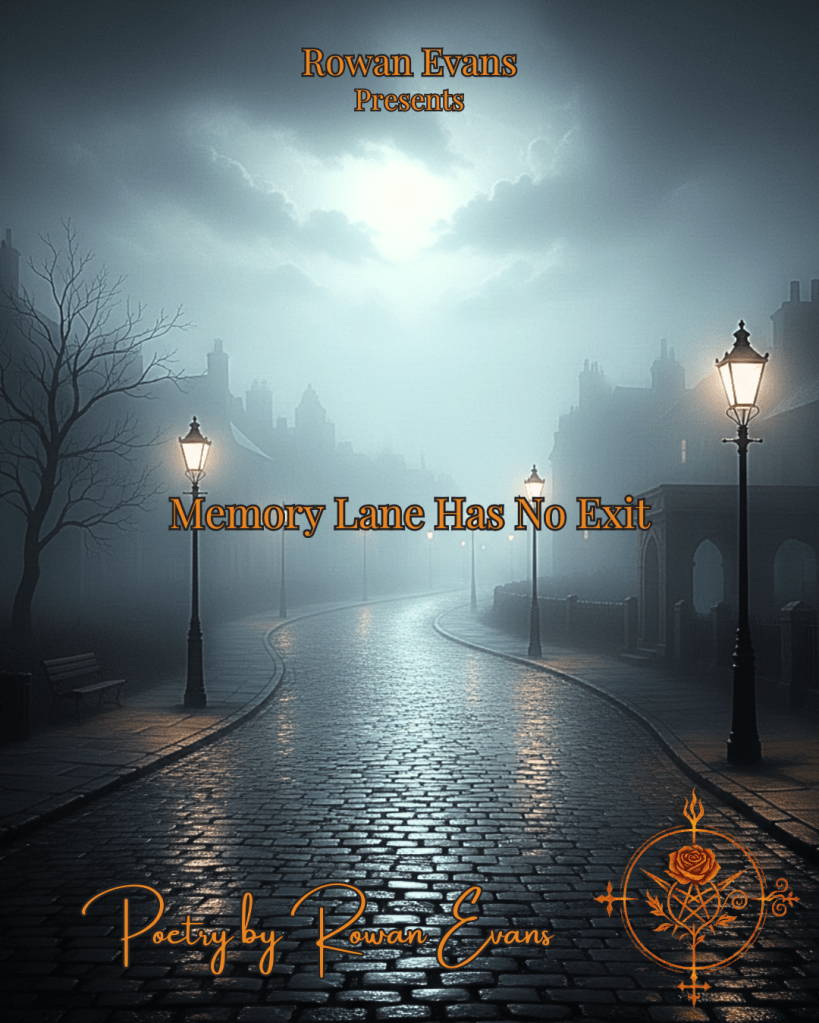
    Misty cobblestone street at night with glowing street lamps, symbolizing reflection, memory, and emotional healing.
    Walking memory lane—where every light holds a name, and every shadow remembers.

    Memory Lane Has No Exit
    Poetry by Rowan Evans

    I’ve been trapped inside my mind
    for a while now.
    I was wandering along
    memory lane,
    going over
    everything.

    Street lamps line
    cobblestone streets,
    each one named
    after a time
    or place.

    I feel the mist
    of missed
    opportunities,
    brush across
    my face.
    Reminding me
    of things
    I wish
    I would have said.

    I feel the electro—
    static shock,
    as it climbs
    up my spine.
    Until it touches
    the base of my mind,
    and every memory
    floods back.

    Every loss, every victory faced—
    every blame misplaced,
    baseless claim, just to tear me down.
    Every time I opened up,
    and they vanished—
    Poof! No ghost,
    left me unhaunted.
    Then they taunted,
    what the fuck—

    I told her things
    I never shared,
    she said she cared,
    that she was there.
    Twisted words,
    like a knife in my back—
    used every secret shared
    against me,
    every word, a weapon it became.

    I guess that’s why I faded…
    Drifted… never looking for attachment.
    I put my head in the clouds,
    took to the sky. I’m Peter Pan,
    I never landed.

    Well, I guess I never healed.
    Not truly. Guess I just became,
    a little unruly. Hard headed,
    too stubborn to see.
    I wasn’t healing, not really.

    And just as I pull back,
    from that—
    another memory attacks.
    Flies in
    from out of nowhere,
    hits me in the face
    and suddenly,
    I’m back in that place.

    Nineteen.
    I thought she was a queen,
    with her eyes of green.
    Serene, until I saw the rot underneath.
    Twenty-one.
    I fell for her, or so I thought
    and she said she felt the same.
    And then she called me
    by his name.

    At twenty-four,
    there was more.
    A girl that I adored—
    thought we were
    moving toward
    something.
    We talked a lot,
    so I opened up.
    I thought I was safe,
    but she pulled back,
    and disappeared.

    Two weeks.
    I didn’t hear a peep.
    Then the messages started,
    secrets shared in confidence.
    She told them all,
    and felt no guilt.

    It was from—
    these pieces,
    I was built.


    If you’re interested in more poetry, you can find it here → [The Library of Ashes]
  • On Rereading the Weather I Once Wrote


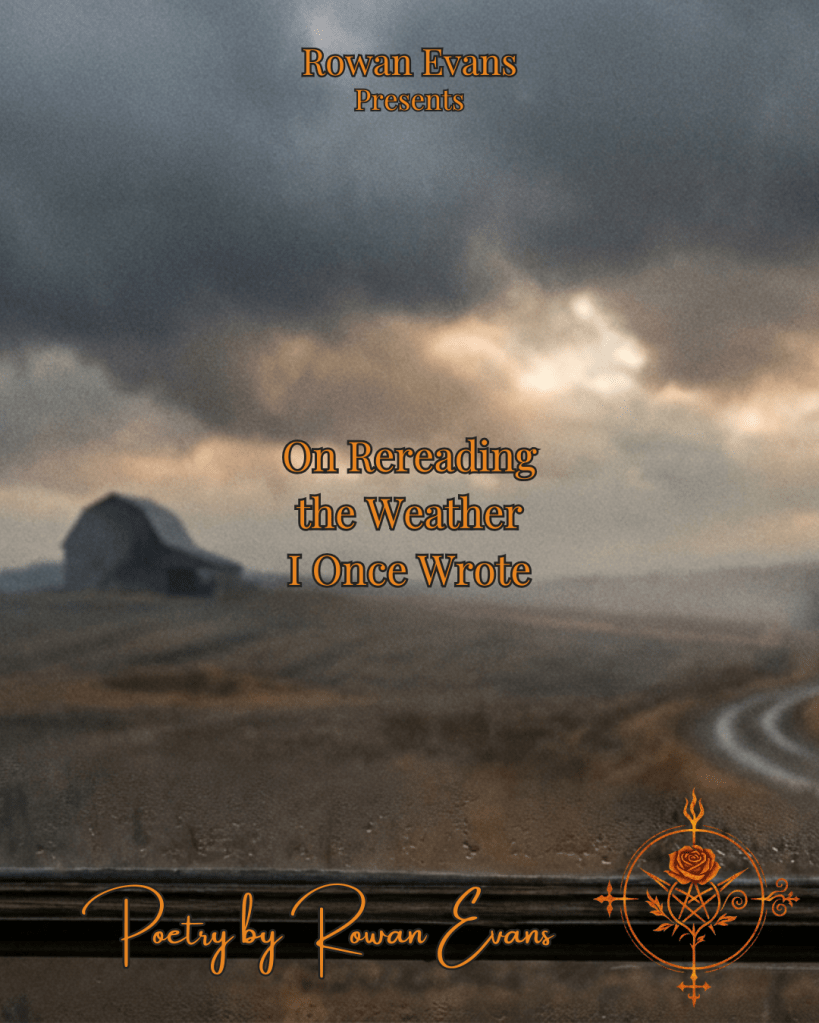
    Overcast sky with light breaking through clouds, symbolizing reflection and emotional awareness
    Sometimes the weather changes before we know how to name it.

    There’s a strange kind of déjà vu that comes from rereading your own work — not the kind where you remember writing it, but the kind where you realize your past self was already speaking truths your present self hadn’t lived yet.

    Lately I’ve been revisiting poems I wrote in late 2024, and the experience has been… uncanny. Not prophetic, exactly. More like watching an old storm roll across a landscape you now know by heart. The sky shifts in familiar ways. The pressure drops. The air tastes the same. And you think, How did I not see what was coming?

    But that’s the thing about emotional weather:
    your subconscious feels the front long before your conscious mind names it.

    Those poems weren’t about anyone in particular. They were about the shape of the love I was ready for — the kind that’s earned, not conjured; the kind that asks for depth, not spectacle; the kind that might be temporary but still real enough to leave traces in the soil.

    Looking back, I can see the tension in the lines.
    The longing.
    The caution.
    The quiet readiness.
    The fear of being left.
    The acceptance that even fleeting connection can matter.

    I wasn’t predicting the future.
    I was describing the architecture of my own heart — the way I love, the way I protect, the way I brace for loss without closing myself off from meaning.

    It’s odd, reading those pieces now.
    Odd, but also grounding.

    It reminds me that my voice has always known things before I did.
    That my writing has always been a barometer.
    That the storms I walk through don’t arrive unannounced — I just don’t always listen to the wind until it’s already shifting.

    So this isn’t a poem.
    Just a note from the present Rowan to the past one:

    You weren’t wrong.
    You weren’t naïve.
    You were already reading the weather.

    And you were right to write it down.

  • Author’s Note

    Sometimes the hardest place to be is alone with your own thoughts.
    Not distracted. Not performing. Not numbed.
    Just you—unfiltered, unguarded, uncomfortably present.

    This piece isn’t about self-love as a slogan.
    It’s about self-confrontation.
    About whether you can remain seated when there’s no one left to impress, no one left to blame, and no one left to lean on.

    Because growth doesn’t begin when things feel good.
    It begins when you stop running.

    Rowan Evans


    A solitary person sitting quietly in a dim room, symbolizing self-reflection and inner confrontation.
    Sometimes the hardest company to keep is your own.

    Can You Sit With Yourself?
    Poetry by Rowan Evans

    Can you sit
    with yourself?
    Not on a pedestal,
    not on a shelf—
    can you fucking
    sit with your
    self?

    In your thoughts,
    in your mind—
    can you wander,
    can you stroll,
    or would you be
    troubled
    by what you find?

    Would you bend,
    or break—
    could you carry
    the weight?

    Fight the urge
    to turn,
    to run.

    Could you stay…

    or would you be
    troubled
    enough
    to leave?


    If you’re interested in more poetry, you can find it here → [The Library of Ashes]
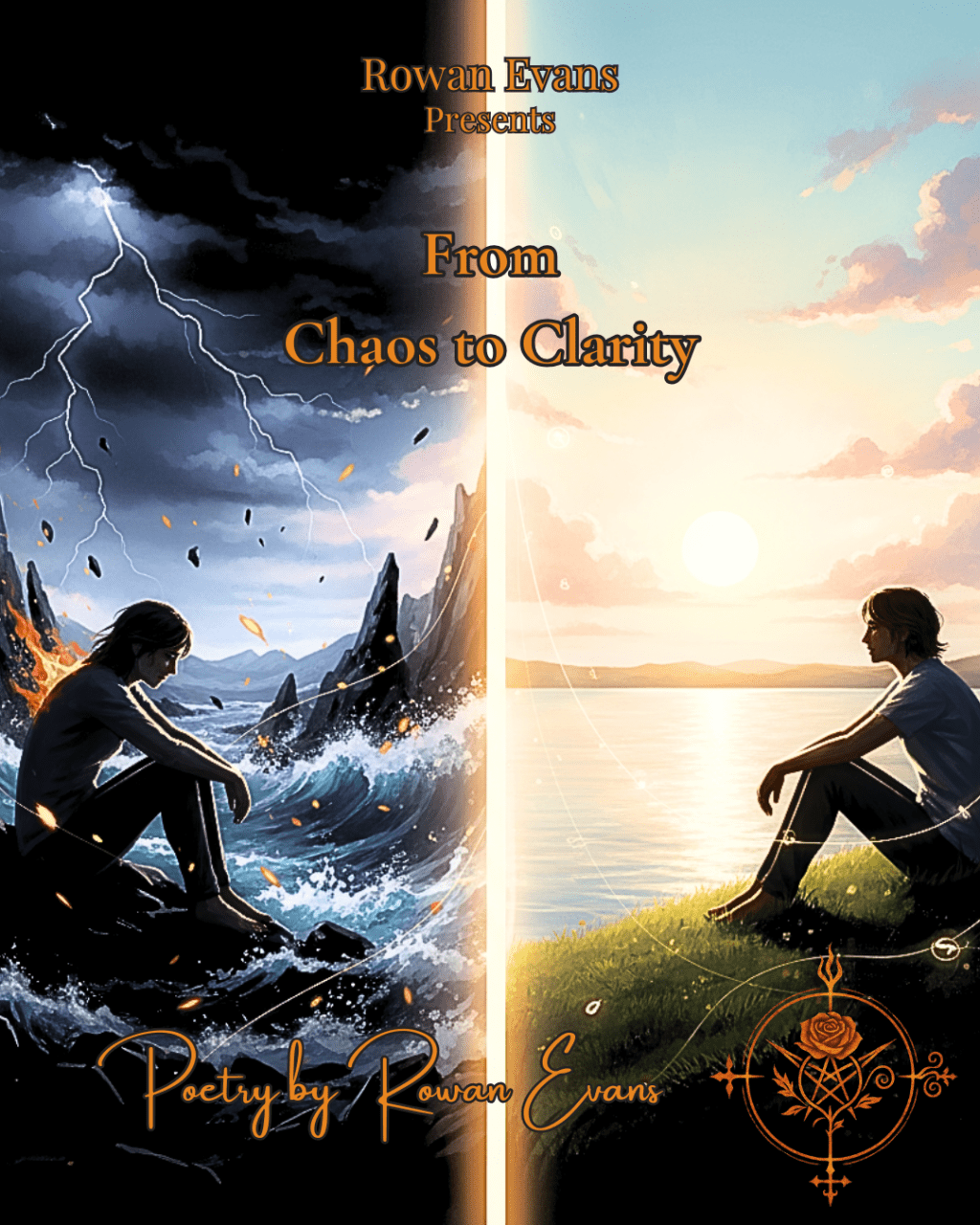
  • Not all growth looks like transformation.

    Some of it looks like standing still
    while the world insists you should become
    someone easier to digest.

    This year, I’m not becoming new.
    I’m becoming certain.


    Muted fireworks against a dark night sky on New Year’s Eve, symbolizing reflection and quiet certainty rather than celebration.
    Not all beginnings need reinvention.

    No Resolutions
    by Rowan Evans

    Happy New Year.

    I’m not entering the new year with resolutions.
    I’m entering it with boundaries, clarity, and a spine.

    I will still write what burns.
    I will still refuse to be neat.
    I will still love loudly, witness fiercely,
    and walk away from anything that asks me to be smaller.

    If that disappoints you—
    good.

    I’m not here to be improved.
    I’m here to be exactly myself.


    If you’re interested in more poetry, you can find it here → [The Library of Ashes]
  • Author’s Note

    This poem is not about wanting to die.
    It is about learning how to survive long before learning how to live.


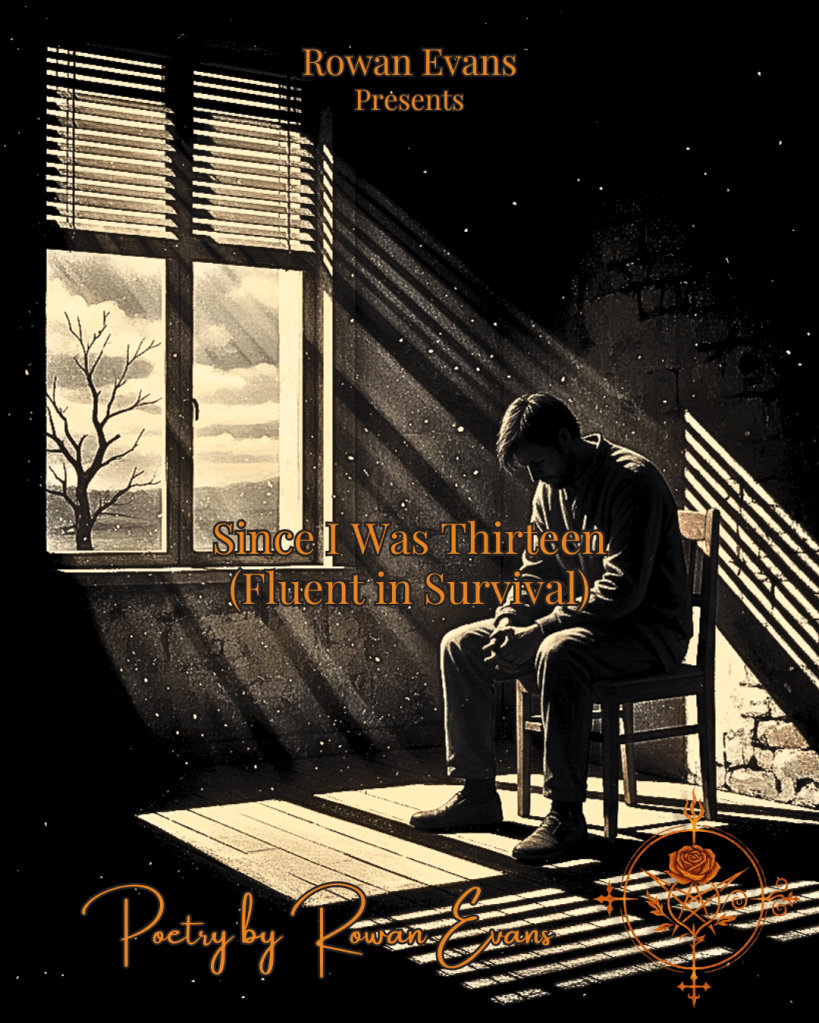
    A shadowed figure in a dimly lit room, reflecting in solitude, surrounded by deep shadows and soft light, evoking introspection and survival.
    Reflecting on survival, solitude, and the quiet strength found in shadows.

    Since I Was Thirteen (Fluent in Survival)
    Poetry by Rowan Evans

    I feel like I’m lost,
    I’m wandering.
    Twisted thoughts,
    I’m pondering.

    My demise
    in a life I despise.
    It’s not that I want to die—
    I’m just tired
    of trying to survive.

    I want to be happy.
    I’m alive.

    But my head
    is so full of dread—
    every morning
    a negotiation
    just to get out of bed.

    Body feels heavy,
    limbs lagging—
    everything moves
    in slow-motion.

    Slipping into shadows—
    going home.
    The light has never felt like mine.
    I was born in the shadows,
    raised in the shade.
    Darkness has been
    my mindscape—
    since I was thirteen.

    I learned early
    how to make myself small—
    how to soften my footsteps
    inside my own head.

    I memorized the weight of silence,
    learned which thoughts were safe to keep
    and which ones
    needed to stay buried.

    Survival became a second language,
    spoken fluently,
    even when no one was listening.

    I say I’m alive
    like it’s a defense—
    like survival
    should be enough.

    But living
    feels like something other people do
    without rehearsing it first.


    Closing Note

    I wrote this for anyone who learned survival before they learned safety.
    For those who are still here, even when “alive” feels like a negotiation.
    You are not failing — you are fluent in something the world never taught gently.


    For more poetry, check out the archives: [The Library of Ashes]
  • Author’s Note

    This poem grew from a quiet, unfolding space between two people learning to hold each other with patience and care. It explores the fragility of trust, the reflection of our traumas, and the slow, careful ways we allow someone to stay when we are used to people leaving. It is about intimacy that is not loud or dramatic, but steady, mirrored, and healing.


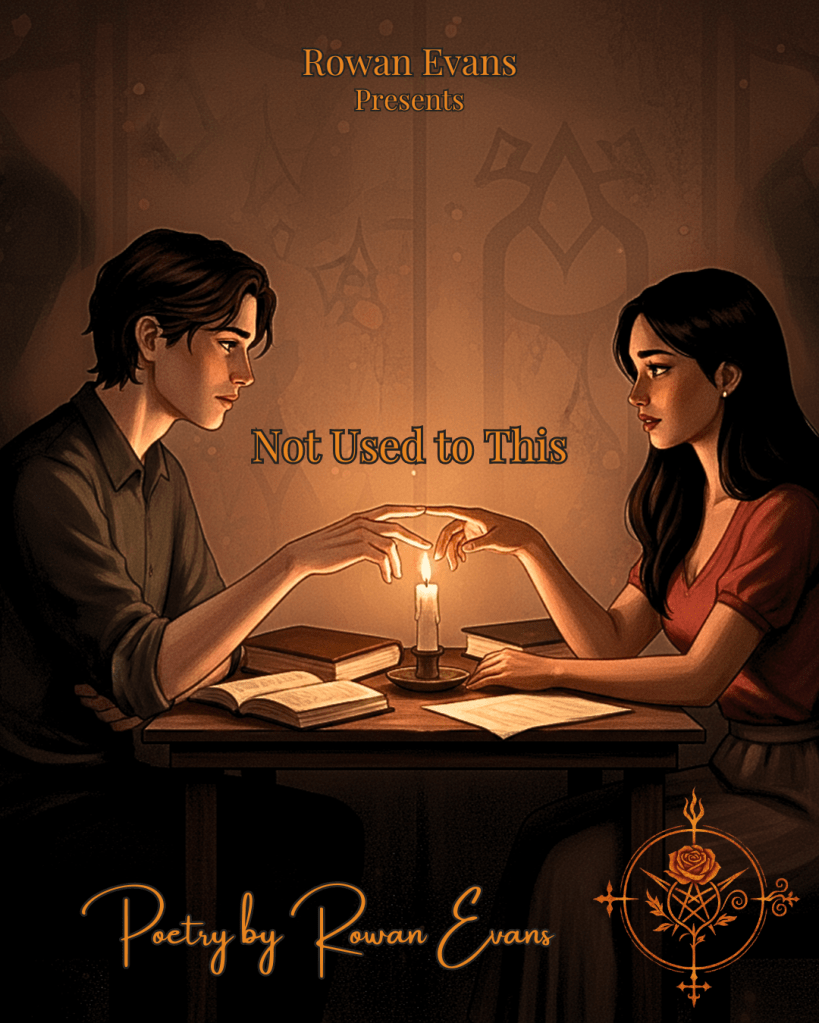
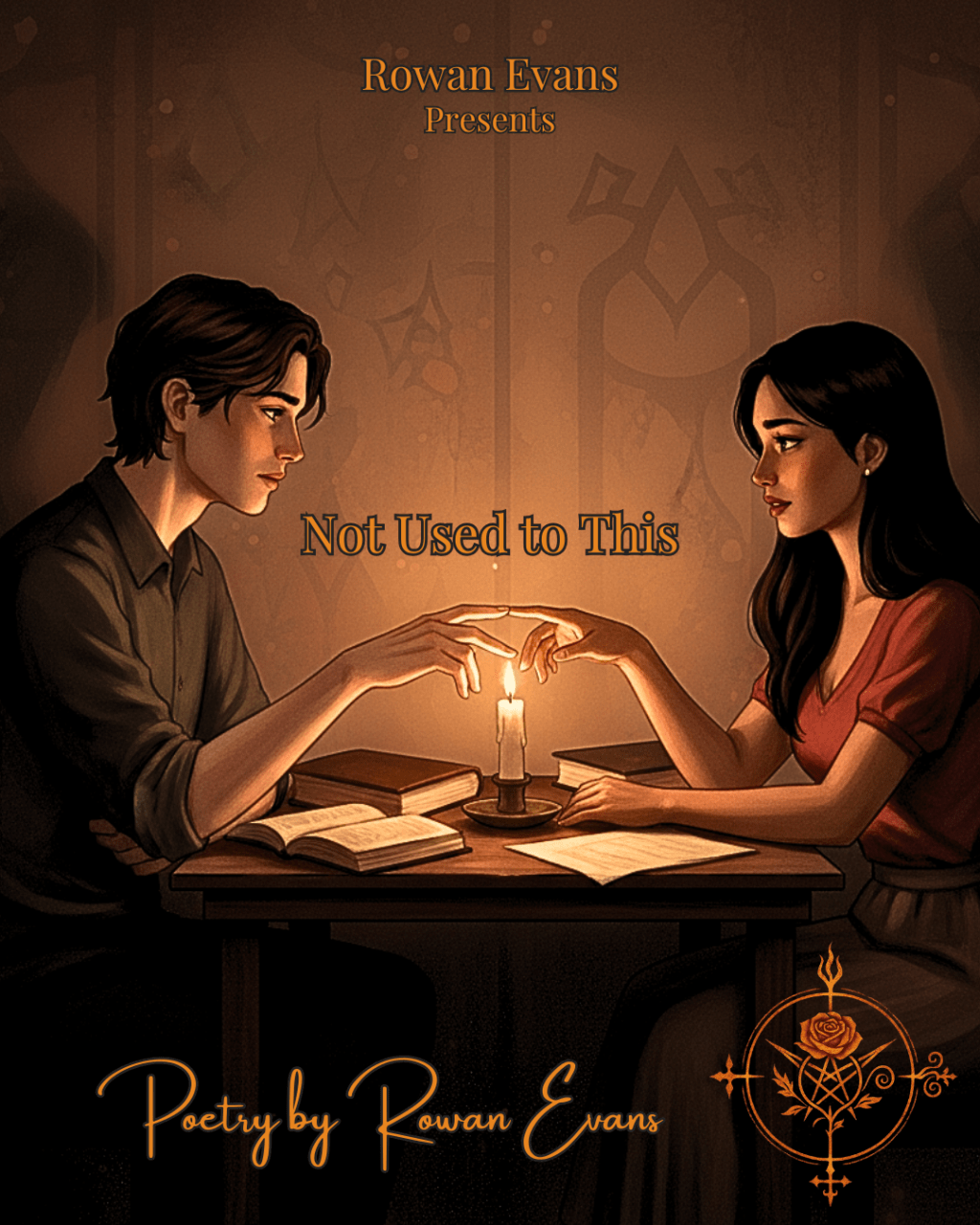
    Two people sitting across from each other, hands almost touching, in a dimly lit room with warm candlelight.
    “The quiet intimacy of two hearts learning to hold each other gently, reflected in soft shadows and warm light.”

    Not Used to This
    Poetry by Rowan Evans

    I’m not used to this.
    I’m used to doors closing,
    to footsteps fading
    before I can even speak.

    I’m not used to this.
    I’m not used to someone staying,
    leaning into the spaces
    I’ve long left empty.

    I bring my scars like lanterns,
    flickering, fragile,
    and you—
    you trace their edges with care,
    never flinching,
    never asking for more than I can give.

    I see your hesitations,
    the quiet tremor behind your smile,
    the shadowed corners of your past
    you tuck into your sleeves.
    You are careful with me,
    as I am with you.

    We move slowly,
    like two hands learning each other
    in the dark,
    tracing lines of trust
    over wounds that still ache.

    I am wary.
    I am heavy with history.
    I have loved and been left.
    I have built walls
    taller than myself.

    And still,
    you do not falter.
    Your patience is steady,
    like a river bending around stones,
    never harsh, never rushing,
    but always persistent.

    I notice the way you watch me,
    like you’re memorizing my silence,
    like you see the cracks
    and choose to stay anyway.
    I notice the way you hesitate,
    how your care mirrors my caution,
    how your wounds reflect mine
    without judgment or shame.

    We are both unpracticed
    in this kind of gentleness,
    this kind of giving.
    And yet—
    we are learning together.

    I am not used to it.
    I am not used to being held
    in someone else’s patience,
    to being mirrored in someone else’s heart.

    And I wonder—
    perhaps this is what it is to be seen,
    truly seen,
    and not abandoned.

    We do not need words for it.
    We do not need proof.
    The small gestures,
    the quiet constancy,
    the mirrored care—
    speak louder than anything we have ever known.

    I am not used to this.
    But I am beginning to be.
    And somehow, in this fragile, tender space,
    I am learning that it is enough
    for both of us to stay.


    For more poetry, check the [Library of Ashes]

  • Author’s Note

    Sometimes the words we repeat aren’t ours.
    Tonight, in a single snapshot, I found the ones that finally belong…


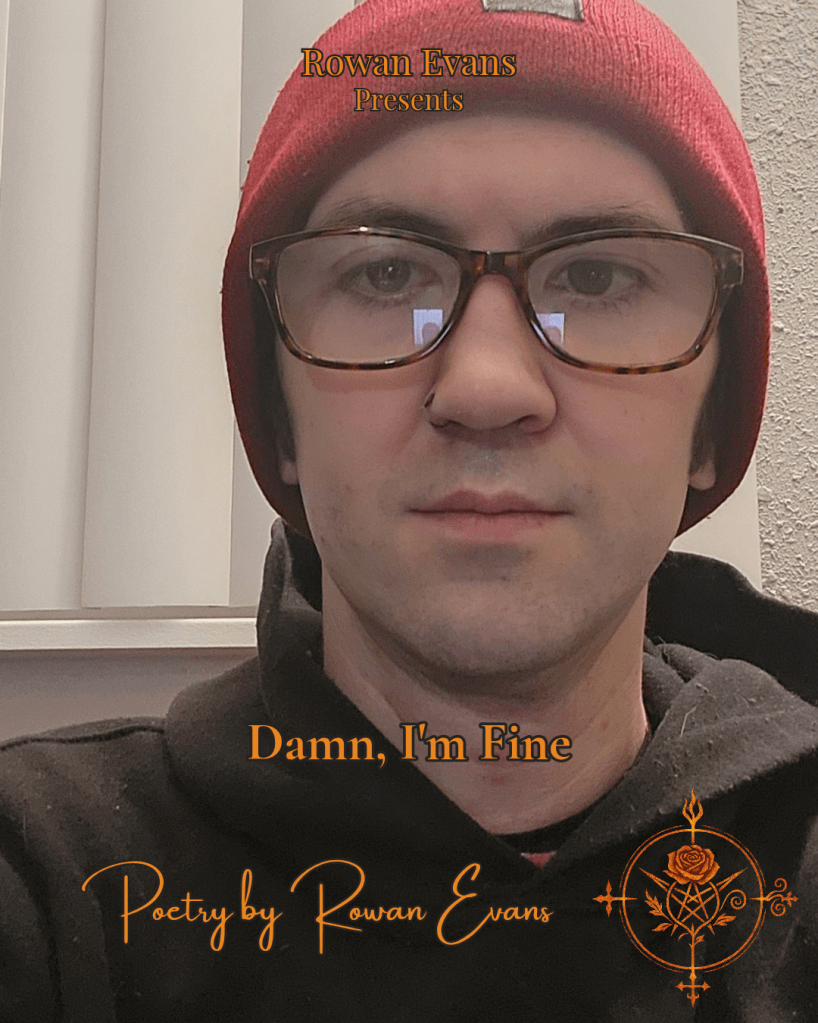
    A picture of Me (Rowan Evans)!
    Took a picture. Looked at it. Thought… yup, I’m really fine.

    Damn, I’m Fine
    Poetry by Rowan Evans

    I’ve been saying I’m ugly for a while now,
    but I’m starting to think—
    those words were never mine.
    Because I took a picture tonight,
    and for the first time,
    I thought… damn, I’m fine.


    For my full collection of poems, check the archives here: [The Library of Ashes]

  • Author’s Note

    These paired pieces come from a place of reflection, reckoning, and resilience. Ten Beers is written from the perspective of a younger self, caught in the cycle of self-medication, chaos, and denial. Its repetition mirrors the rituals we create to escape, the desperate attempts to quiet the storm in our own minds.

    Through Clear Eyes is the response, the voice of survival and understanding. It looks back with compassion, honesty, and accountability, confronting past pain while acknowledging growth. Together, they explore addiction, self-destruction, and ultimately, forgiveness—both of oneself and of the ways we survive.

    I offer these poems as a testament to the storms we endure, the patterns we outgrow, and the quiet victories of seeing clearly, even after years of being lost in the haze.

    Rowan Evans


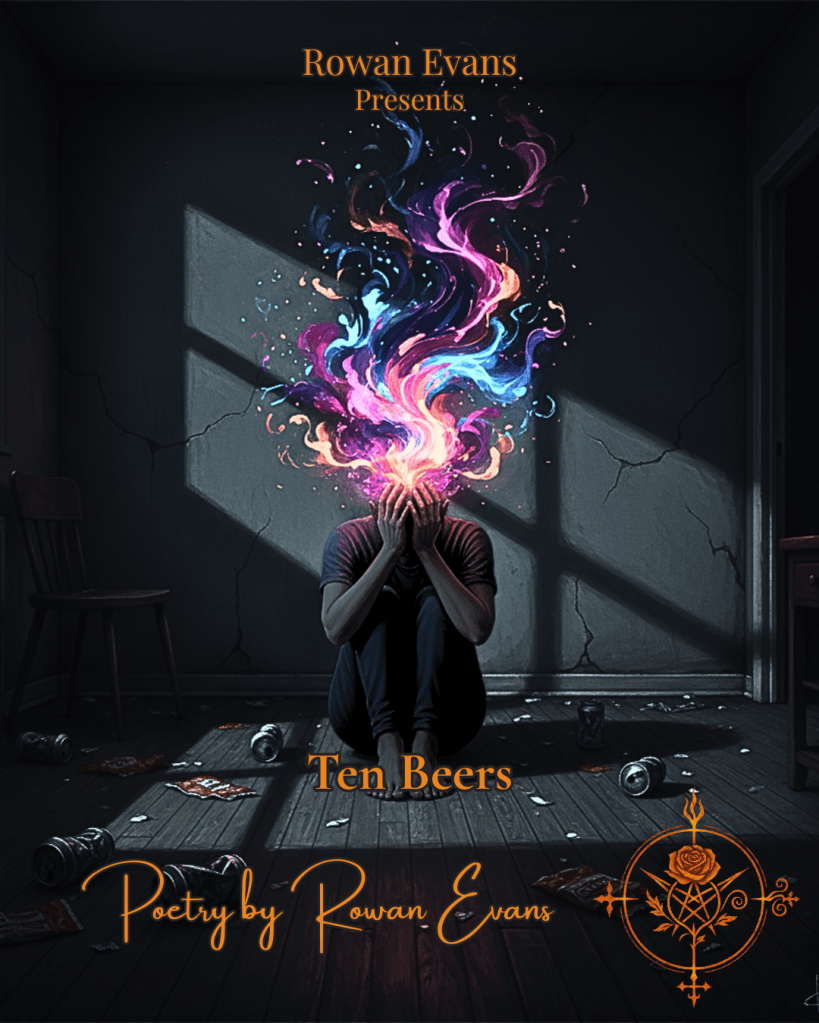
    “Person overwhelmed by thoughts, surrounded by empty beer cans and abstract swirls of color.”
    Chasing the blackout, quieting the storm within.

    Ten Beers
    Poetry by Rowan Evans

    I drank ten beers,
    then I drank ten more—
    just trying to escape my mind.
    To numb the pain,
    to quiet the storm inside.
    I drank ten beers,
    then I drank ten more.

    It wasn’t a problem in my eyes,
    I had it all under control.
    I could stop when I wanted—
    I just didn’t want to.
    So I drank and drank,
    then I drank some more.
    I drank ten beers,
    then I drank ten more.

    I chased the blackout,
    just wanted to turn the lights out.
    Quiet the storm raging unseen.
    It’s all in your head. Just don’t be sad.
    If only it were that easy.
    I was drunk every weekend—
    the only way I could be.
    I couldn’t see…
    there were people who needed me.

    I remember waking up,
    cans lined up—
    eighteen, twenty deep.
    I’d stumble to my feet,
    this was weekly, rinse and repeat.
    I drank ten beers,
    then I drank ten more—
    just trying to quiet the storm.

    I poured liquor into whatever cup,
    goal was to get fucked up.
    Chasing the blackout, turning the lights out.
    Cut power. Fade out.
    I thought I was fine,
    thought I was in control—
    but the alcohol had a hold of me.
    I was borderline,
    still telling myself “I’m fine.”
    But I wasn’t.
    I was numbing the pain,
    avoiding everything.
    So I—
    drank ten beers,
    then I drank ten more.

    It was a problem.
    Felt like I was the problem.
    But I was just trying to quiet the storm—
    raging in my head,
    while I whispered,
    “I’m young, just having fun.”


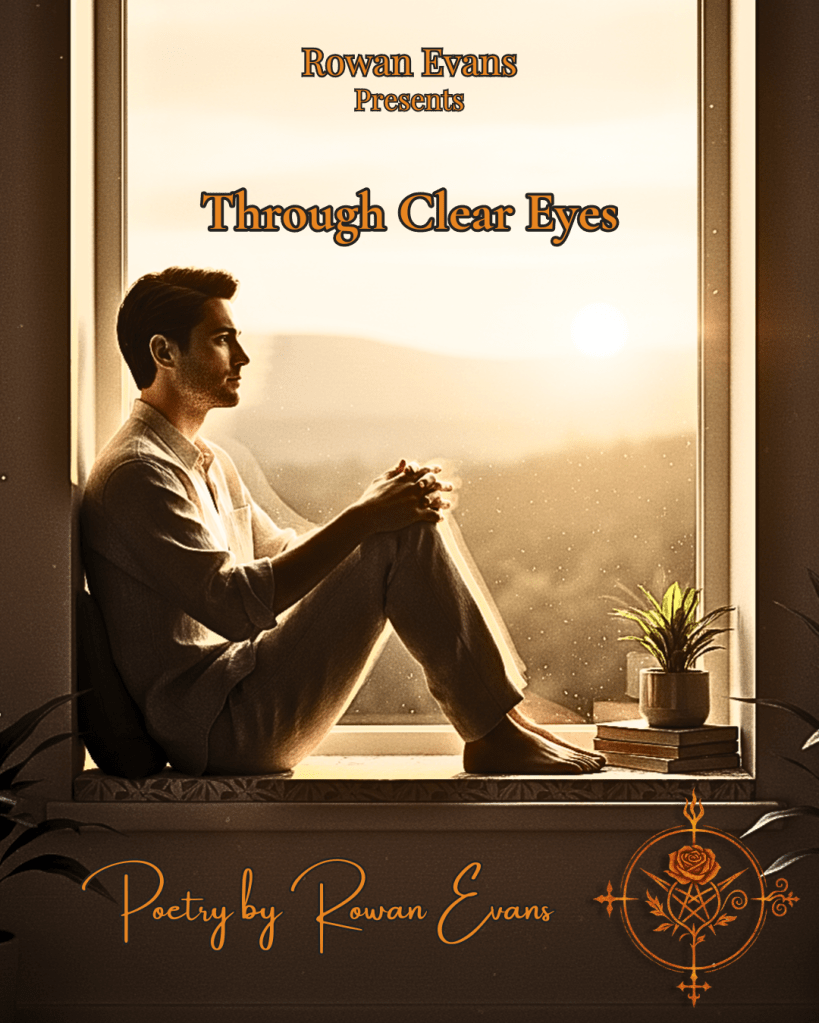
    “Person sitting at a sunlit window, reflecting with clarity and peace.”
    Through introspection, clarity emerges.

    Through Clear Eyes
    Poetry by Rowan Evans

    You weren’t having fun,
    you were hurting—
    you just refused to see.
    You numbed yourself too much,
    blurred your own vision,
    slurred your words.

    You were hurting,
    and thought you could fix it
    by getting fucked up.
    I forgive you, but—
    look what we did to us.
    You drank to numb the pain,
    to quiet the storm inside our brain.

    Then I had to fight like hell
    just to feel normal again.
    It was toxic, the way we coped.
    We lashed out, bitter all the time,
    still swearing we were fine.

    Had to make phone calls
    to find missing clothes—
    and you still couldn’t see.
    The problem was me.


    Closing Note

    These pieces reflect a time when alcohol was a way to quiet the storm in my head, a form of self-medication I thought I could control. Through introspection, reflection, and deliberate inner work, my relationship with alcohol has changed. Today, I can drink without chasing blackouts, without using it to numb myself. I write these poems not to glorify past behavior, but to bear witness to it, to understand it, and to acknowledge how far I’ve come.

    Rowan Evans


    You can find all of my work in my archive [The Library of Ashes].

  • Author’s Note

    This piece reflects on the quiet strength it takes to remain soft in a world that often tries to harden you. It’s a personal reflection on resilience, empathy, and the enduring capacity to love, even in the face of doubt and adversity.

    This post marks my 83rd consecutive day of sharing on the blog,   I have not missed a day since August 8th… During this time, I have tried to push myself to be a little more open. A little more honest. Even when it’s hard, even when I just want to be closed off from the world…


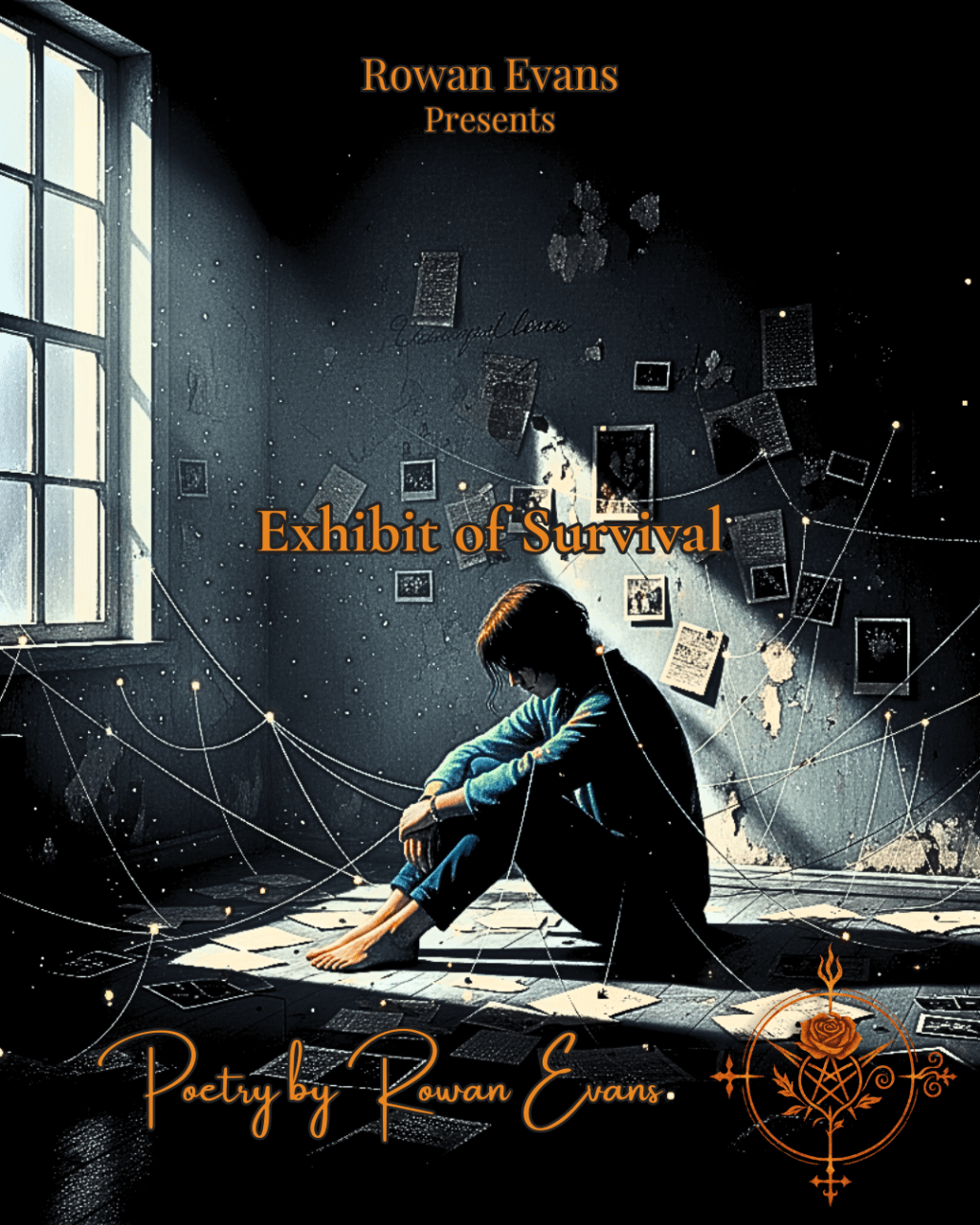
    Figure sitting on the floor surrounded by pinned papers and threads, illuminated by soft light, representing reflection, resilience, and quiet strength.
    Caught in the threads of life — resilience and reflection hold them in place.

    Exhibit of Survival
    Poetry by Rowan Evans


    Pins.
    They hold me in place.
    As the glass
    lowers over my face.
    Framed.
    In a frame. On display.
    Like a dead butterfly.


    I have had people in my life who pretended to be on my side—who pretended to care—when really, they just wanted front-row seats to my struggles. They wanted to watch as I unraveled, whispering doubts to freeze me in place, to preserve the ache. To keep me from moving forward. And yet, I still pushed. I still tried.


    Threads.
    Tied to limbs.
    Marionette.
    Puppet on strings.
    They’ve got control of me.
    Free? Not really.


    Those same people tried to talk me out of anything I wanted to do—anything that could bring me closer to the life I wanted. “Why do you want to leave America?” they’d ask. But it’s not my home; it’s just the place I was born. The place I was raised. I’ve never felt like I belong here. Not once.

    Everything holds me back—my brain looping their doubts, my own depression and anxiety echoing them back to me. It’s a war on all fronts. And still, I stand.


    My thoughts.
    They flutter and fade
    in this liminal space.
    It’s pain—
    just to be alive.
    It’s a wonder.
    A miracle.
    How have I survived?


    Resilience. And reminders from the few who truly see me, who truly believe in me. Without them, I might have given up long ago. But because of them, I’ve kept my empathy alive. I’ve refused apathy. I’ve stayed soft. I’ve kept my heart open and given love freely.


    How?
    How have I
    made it to thirty-five?
    Every day I wake up.
    Surprised.


    That surprise isn’t mine anymore. It’s the echo of others’ doubts—ones I no longer answer.

  • Author’s Note

    Mabuti ako ng hindi ako mabuti was born from that familiar ache of being awake while the world sleeps—the quiet, heavy solitude of overthinking and feeling too much. It’s about seeing the beauty in others while struggling to recognize it in yourself, about cracks, missing pieces, and the weight of empathy in a world that can feel cold.

    The poem weaves together languages, not by accident but by instinct: the Tagalog line as both title and closing heartbeat, grounding the piece in a personal, intimate voice; and my youthful “Nani the fuck?”—a playful, yet sharp, reflection of confusion and disbelief, a nod to my early fascination with Japanese and the way language can capture emotion in a single exclamation.

    This is a poem about exhaustion, insomnia, and the unrelenting pressure of a sensitive heart. It’s also about holding space for yourself the way you hold space for others—learning to see your own gold, even when the lanterns have burned out and the path is dark.


    Solitary figure sitting on bed in dimly lit room, hands covering face, shadows cast across cracked walls with scattered glowing Kintsugi fragments on the floor, evoking introspection and emotional struggle.
    Even in darkness and brokenness, fragments of unseen beauty remain.

    Mabuti Ako ng Hindi Ako Mabuti
    Poetry by Rowan Evans

    I stand before the mirror—
    and all I see, staring back at me
    are cracks.
    I’m just a broken mess,
    a bowl full of holes—
    too big to mend with gold.

    I’ve got—
    too many missing pieces.
    Too many pieces left behind.
    There’s no Kintsugi here.
    No witnesses near.

    Shaking hands and tear stained face,
    I’m so alone, always alone.
    Even with people around.

    All my relationships—
    The color of autumn.
    People leave.

    Now I ask—
    why can’t I see the beauty
    in my own imperfections?
    Why do I only hold that view,
    for everyone but me?
    Why can’t I see?
    Why am I so blind to me?

    And I feel stuck in the dark.
    My laterns burned out,
    I’m wandering lost.
    Is this the cost—
    for being a gentle soul like me?

    The world wasn’t made for me—
    I’m too warm for apathy,
    I cling to empathy like a life vest.
    I give weary souls a place to rest,
    but nowhere for me to lay my head…
    So I stay up instead.

    Insomnia has a hold on me. 
    I’ve stayed up for two days— 
    in one twenty-four hour period. 
    How does that add up? 
    But that’s the math. 
    Don’t laugh. Don’t ask.
    Nani the fuck?

    Yet still, people ask,
    “How are you doing?”
    I say, mabuti ako
    ng hindi ako mabuti.


    If you enjoyed this poem, check out more of my work [here].