I’d been stuck in my head for days—looping memories, fogged thoughts, the usual spiral.
Then I had a dream.
In it, someone I care deeply about cut through the noise in the bluntest, most effective way possible. It wasn’t gentle. It wasn’t poetic. But it worked.
This poem came from that moment—the realization that sometimes the way forward isn’t overthinking, but following the one thread that still feels steady.
Even through the fog.
Sometimes the way out of your head is just one honest thread—and the courage to follow it.
The Thread That Led Me Home Poetry by Rowan Evans
The fog rolls over hills,
and a chill clings
to my mind.
Memories linger
in flickering fragments,
clinging static—
the kind that hums
behind the eyes,
buzzing with moments
I thought I buried
but never really left.
They circle back—
whispers caught
between stations,
half-formed voices
I almost recognize
but can’t quiet name.
Threads of memory
tangled in the mist,
pulling me back
to places
I never meant to revisit.
I stumble through playgrounds,
bumping off walls
as I march down the hall.
A single thread,
I’ve begun to follow—
It leads through memory,
after memory.
Twisting and turning,
it knots—
and I pause,
fingers trembling
over the tangle,
wondering what unravels
if I pull too hard.
I run fingers
over threads.
Gripping soft,
pulling slow—
I watch
as the string
slips free—
and it hums,
like it’s guiding me.
So I follow.
Step after step,
one foot
in front
of the other.
I step and stumble
through fog,
thick as my thoughts.
And when
I feel lost,
my fingers tighten
grabbing the string
like a lifeline.
It’s the only guide
through my mind.
I stumble through,
snapping twigs
and branches.
The rustle of
rotting leaves
under feet,
until I see it.
A light,
a clearing.
And when I reach it,
when I find
the strings conclusion—
what do I see?
You.
A smile.
Home.
Closing Note
Yesterday’s poem was about the weight of memory. This one is about the moment something — or someone — breaks through that weight. Not to fix it, not to erase it, but to remind me that I don’t have to walk through the fog alone.
Journey into the Hexverse
[Memory Lane Has No Exit] With my birthday approaching, I found myself trapped inside my mind—wandering memory lane, revisiting love, loss, and the moments that built me. This poem is a reflection on betrayal, survival, and the quiet realization that drifting isn’t the same as healing.
This poem grew from a quiet, unfolding space between two people learning to hold each other with patience and care. It explores the fragility of trust, the reflection of our traumas, and the slow, careful ways we allow someone to stay when we are used to people leaving. It is about intimacy that is not loud or dramatic, but steady, mirrored, and healing.
“The quiet intimacy of two hearts learning to hold each other gently, reflected in soft shadows and warm light.”
Not Used to This Poetry by Rowan Evans
I’m not used to this.
I’m used to doors closing,
to footsteps fading
before I can even speak.
I’m not used to this.
I’m not used to someone staying,
leaning into the spaces
I’ve long left empty.
I bring my scars like lanterns,
flickering, fragile,
and you—
you trace their edges with care,
never flinching,
never asking for more than I can give.
I see your hesitations,
the quiet tremor behind your smile,
the shadowed corners of your past
you tuck into your sleeves.
You are careful with me,
as I am with you.
We move slowly,
like two hands learning each other
in the dark,
tracing lines of trust
over wounds that still ache.
I am wary.
I am heavy with history.
I have loved and been left.
I have built walls
taller than myself.
And still,
you do not falter.
Your patience is steady,
like a river bending around stones,
never harsh, never rushing,
but always persistent.
I notice the way you watch me,
like you’re memorizing my silence,
like you see the cracks
and choose to stay anyway.
I notice the way you hesitate,
how your care mirrors my caution,
how your wounds reflect mine
without judgment or shame.
We are both unpracticed
in this kind of gentleness,
this kind of giving.
And yet—
we are learning together.
I am not used to it.
I am not used to being held
in someone else’s patience,
to being mirrored in someone else’s heart.
And I wonder—
perhaps this is what it is to be seen,
truly seen,
and not abandoned.
We do not need words for it.
We do not need proof.
The small gestures,
the quiet constancy,
the mirrored care—
speak louder than anything we have ever known.
I am not used to this.
But I am beginning to be.
And somehow, in this fragile, tender space,
I am learning that it is enough
for both of us to stay.
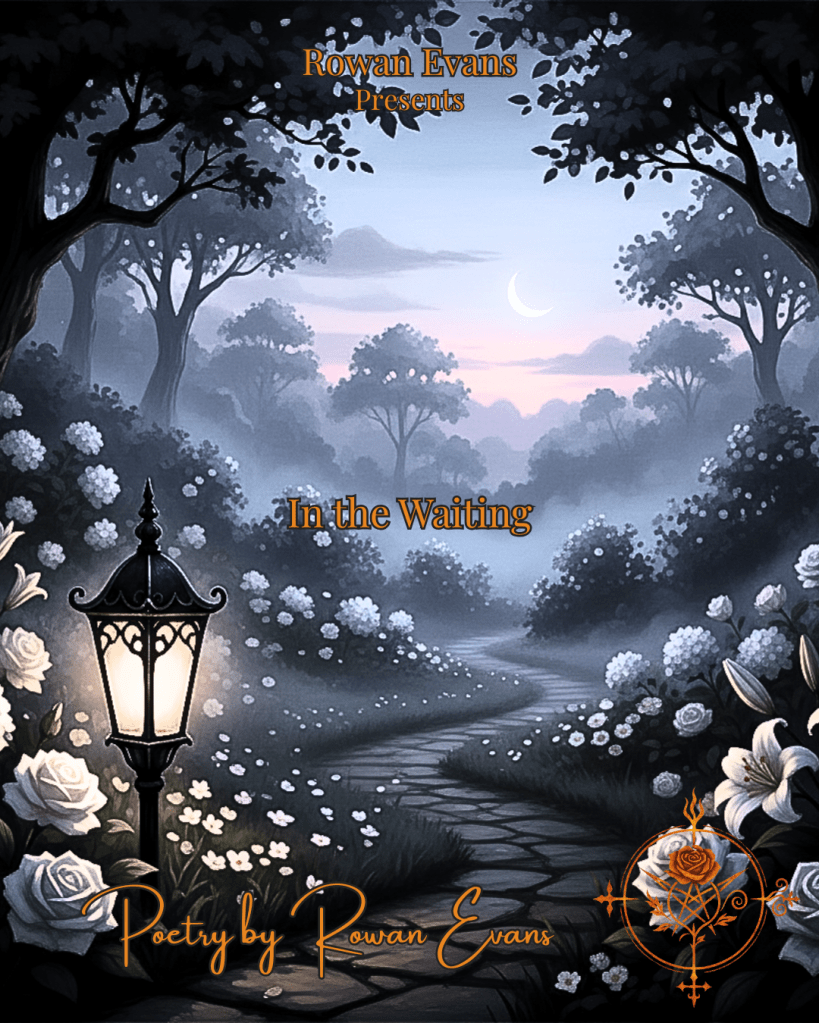
I wrote this piece to honor the kind of love that doesn’t rush, pressure, or demand. The kind of love that waits — not out of desperation, but devotion. Trust is something earned through presence, not promises, and this poem is a reminder that patience can be its own form of tenderness.
A lantern in a quiet garden — the place where trust takes root slowly, in the soft hours of waiting.
In the Waiting Poetry by Rowan Evans (Written April 28th, 2025)
I won’t ask you to trust me just because I say you should.
I won’t ask you to give me your heart on a silver platter
and expect it to bloom with nothing but my words.
I know trust is not something that can be rushed.
It is not a gift handed out on a whim.
It is a treasure, earned slowly,
through the quiet moments,
the steady presence that never falters.
It is a promise that must be built, brick by fragile brick,
and I understand that.
But I hope you’ll let me show you
that my hands are steady.
That I will be here,
even in the silence,
even in the waiting.
I want to prove to you that not all hearts
come with the shadows of broken promises.
Not all love is born of betrayal.
Some love grows like a garden—
slow, patient, gentle,
with roots that dig deep
and blossoms that reach for the light.
I don’t want to rush you into believing me,
but I want to give you the space
to see me,
to feel me,
and know, in the quiet moments,
that I am here,
waiting,
always.
And if you choose to trust me,
when you choose to trust me,
I’ll be the one who proves that it was worth the wait,
that love can be steady,
that my heart is yours,
whenever you’re ready to reach for it.
I’ll wait,
quiet as the stars,
steadfast as the earth beneath us,
until the moment you choose to take the leap,
and I’ll be there,
steady,
waiting,
ready to show you
that I will never break you
the way the others did.
And when you’re ready,
I will love you with the tenderness of someone
who has learned the value of patience,
who knows that love is not a race,
but a journey.
Until then,
I’ll be here.
Waiting.
With an open heart,
and a love that grows with every breath.
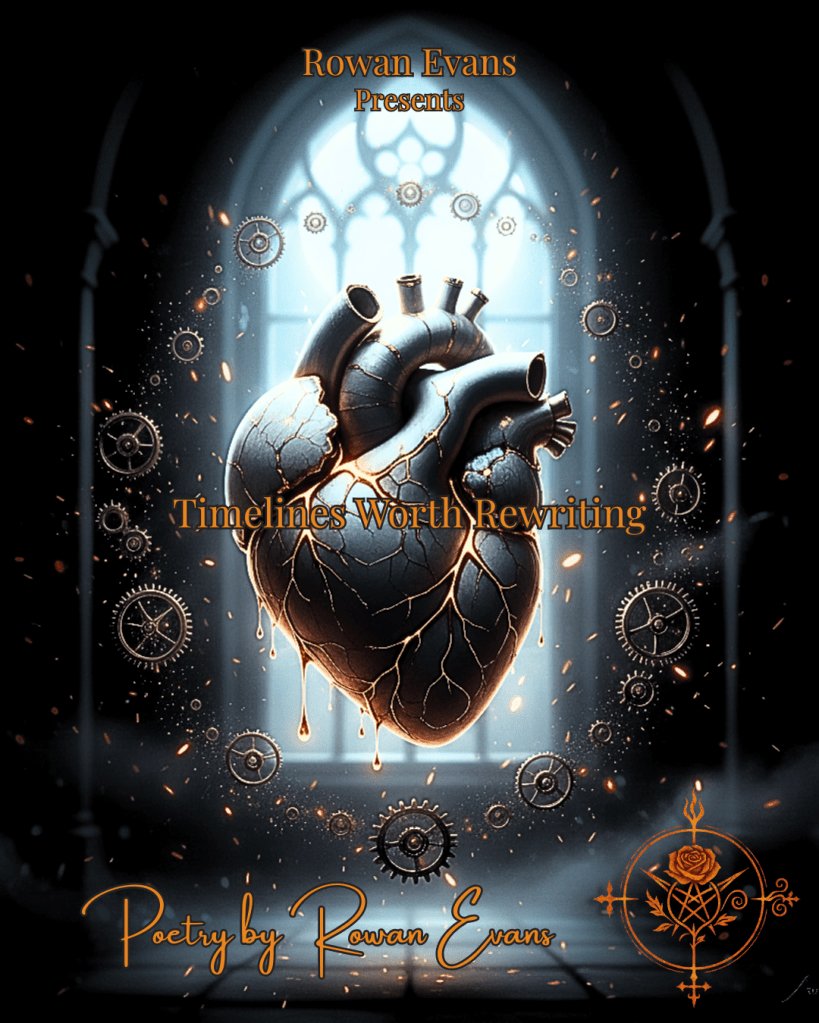
This poem is a meditation on love that demands patience, courage, and total presence. It is written for those whose hearts have been tested, broken, or misread—and for the people brave enough to stay, to witness, and to hold. It is about devotion, reverence, and the quiet power of being fully seen.
Every fracture tells a story—and some loves are brave enough to rewrite the timeline.
Timelines Worth Rewriting Poetry by Rowan Evans (Written April 21, 2025)
Don’t fall in love with me
unless you’re ready for time zones and tenderness,
for clocks set to your breath
even when you’re not speaking.
Unless you know how to read
the unsent messages
I whisper into the quiet of 3 a.m.,
when my world is still sleeping
and I am drowning
in the silence between our heartbeats.
I didn’t mean for this to happen.
You were someone else’s—
a name I only knew
through the tremble in your voice,
a shadow of a boy
who left bruises where joy should’ve bloomed.
You were a poem already breaking,
and I…
I just wanted to be a page
that didn’t hurt to land on.
I wasn’t chasing fire.
I was tending embers.
The way I always do—
with a soul stitched together by
the broken glass of old timelines,
where love meant losing myself
in someone else’s storm.
But you were different.
You asked nothing—
and gave everything in glances
you didn’t know were sacred.
I told myself the clock widget
was just a kindness.
A way to say
good morning, warrior,
good morning, beautiful,
good morning, still-here.
But the truth?
It became my North Star.
A constant.
A compass pointing always to you.
I fell in love the way
only a person who’s clawed their way through shadow can—
with reverence.
With awe.
With hands that tremble
but still reach.
I saw your pain
like an open door
to a familiar room—
and I walked in,
not to fix you,
but to sit beside you
in the ruins.
Because I’ve been there.
Because I carry my own ghosts,
and I name them in poems
so they don’t haunt me in sleep.
They say I should’ve stayed away.
That I’m playing with fire.
But fire never scared me—
I was forged in it.
Born of battle cries
and whispered truths
and a girlhood denied.
I don’t wear guilt for things I didn’t break.
And I didn’t break you.
He did.
He, who saw your softness as weakness.
He, who mistook your loyalty
for something owed.
But me?
I saw the Queen beneath the scars.
I saw the way you held yourself together
with gold-threaded hope,
kintsugi soul—
every crack shining brighter
because you never stopped choosing to try.
Don’t fall in love with me
if you’re afraid of complicated truths.
Because I will love you
with the same hands
that once wrote suicide notes
and now write survival stories.
Because I will see your shadows
and still call you light.
Don’t fall in love with me
if you’re not ready to be seen completely—
every bruise, every brilliance,
every whisper you’ve never spoken aloud.
I do not love in fractions.
I do not flinch from the messy,
the haunted, the hungry parts of you
You think no one could ever stay for.
I will.
But only if you’re ready.
Only if your heart can bear being held
without armor.
I didn’t plan to fall.
But you spoke in moonlight,
and I’ve always been lunar-bound.
Tied to tides.
Pulled by gravity
in the shape of your laugh.
And even if you never say my name
the way I hope,
even if I am just a season
you remember when it rains—
know that I loved you
without agenda,
without shame,
without asking for anything
but to witness your rise.
Don’t fall in love with me
unless you’re ready
to be the reason I believe
there are timelines worth rewriting.
One Year is a quiet celebration of someone who walked into my life and changed it without ever trying to. It’s a poem about the kind of connection that doesn’t demand attention — it simply exists, steady and transformative. This piece marks one year since I met my muse—she helped me see the world with more color, softness, and clarity. It’s a thank‑you, written in the only language I know best.
Light has a way of finding us — sometimes through people we never expected.
One Year Poetry by Rowan Evans
It’s been one year today since I met you. One year since you came into my life, and quietly rearranged everything. I’ve not been the same since. I see the world in a brighter kind of hue— like the colors became true. Would you believe me if I said it was all because of you? Would you?
Because you didn’t break anything when you arrived— you just moved the furniture of my heart and mind, opened the curtains, let the light in. I hadn’t even realized how dim it had been until you stepped inside.
Even in your darkness, you became my light— and I tried to be that for you too. Because I saw the weight you carried, I just wanted to carry it with you. I still do.
And maybe you’ll never know the full weight of what you changed— how you steadied the racing thoughts, how you carved a little sanctuary in the ruins I tried to hide. You brought color to my grayscale world, and I’d walk through every shadow you carry just to keep your flame from burning out.
One year in, I still marvel that you’re here— not just passing through. And I remember how you said: “You met me at my darkest, I want you to see me at my brightest.” Here’s the thing; I already do. Because, when I look at you…
This reflection came to me as a kind of whisper — the voice of every anxious soul who has spent years mistaking chaos for connection. The Fear of No Fear at All is not about panic, but about peace — and how frightening peace can be when you’ve learned to survive on the edge of heartbreak. It’s about the moment you realize that being seen, truly seen, doesn’t have to hurt.
When love finally feels safe, fear becomes the last ghost to leave.
The Fear of No Fear at All Reflection by Rowan Evans
There’s a kind of fear only the anxious understand— not the kind that makes your pulse race, but the kind that falls silent when something finally feels right.
When you’ve spent years waiting for the floor to collapse, for love to turn sharp, for tenderness to vanish like smoke, peace feels dangerous. Safety feels foreign. Your body doesn’t trust the quiet; it waits for the crash that never comes.
And then one day, someone walks in— and there is no crash. No second-guessing, no masks to hold. You find yourself unguarded, unarmed, and the absence of panic is the most terrifying thing of all.
Because what do you do when love doesn’t demand that you bleed for it? When it asks only for your truth, your laughter, your unhidden self?
That is the fear of no fear at all— the trembling realization that maybe, after all this time, you are finally safe here.
🕛 Coming at 12:05 am(UTC +8)
A companion piece — the moment that inspired this realization. ✨ The Moment I Realized (Under Manila’s Setting Sun) — a vignette of confession, connection, and the beautiful terror of truth.
The Vows began as an exploration of devotion — not the romanticized kind, but the kind forged in ache, honesty, and reverence.
Vow I was surrender: letting the ink run dry, allowing love to unmake what was hardened. Vow II was endurance: the willingness to break, to bear the bruise and still remain. And Vow III — this final vow — is understanding: the quiet promise to listen, to learn, and to love without translation.
Together, they form a trinity of intimacy — the heart’s slow evolution from sacrifice to fluency, from bleeding to belonging.
This isn’t a story of martyrdom. It’s a story of witnessing: of meeting someone’s soul and saying, I see you, I’ll learn you, I’ll speak your language. That is the purest vow I know.
— Rowan Evans
“The final vow — not of silence or breaking, but of becoming fluent in another’s heart.” — Rowan Evans
I Love You (Enough to Learn You) Poetry by Rowan Evans
I’d let the ink run dry, then I’d break willingly. That was vow one, and vow two. This is vow three—for you.
I love you enough to put you first— to make you a priority in my life. Everyone else be damned, I will—
learn your language, learn the nuance, so you can speak freely, say exactly what you need.
I will learn the cadence of your world, so I can understand— not to change you, but to meet you where you are.
I love you enough to listen when words falter, to read what your silence says when your voice can’t.
I’ll make a home in your pauses, a temple in your sighs. You gave me peace— so I’ll give you peace of mind.
I’ll give you understanding— that’s vow three. Not of silence, not of breaking, but of becoming fluent in your heart.
The Silent Vows
[I Love You (Enough to Go Silent)] A vow written in ink and silence — a confession of love so deep it would sacrifice its own voice to spare another’s tears. “I Love You (Enough to Go Silent)” is a Neo-Gothic devotion from Rowan Evans, where the act of not speaking becomes the loudest declaration of love.
[I Love You (Enough to Break Willingly)] A vow whispered in ink and ache — love not as surrender, but as shared endurance. “I Love You (Enough to Break Willingly)” is Rowan Evans’ second vow, a quiet confession of devotion that chooses breaking over leaving, and burden over indifference.
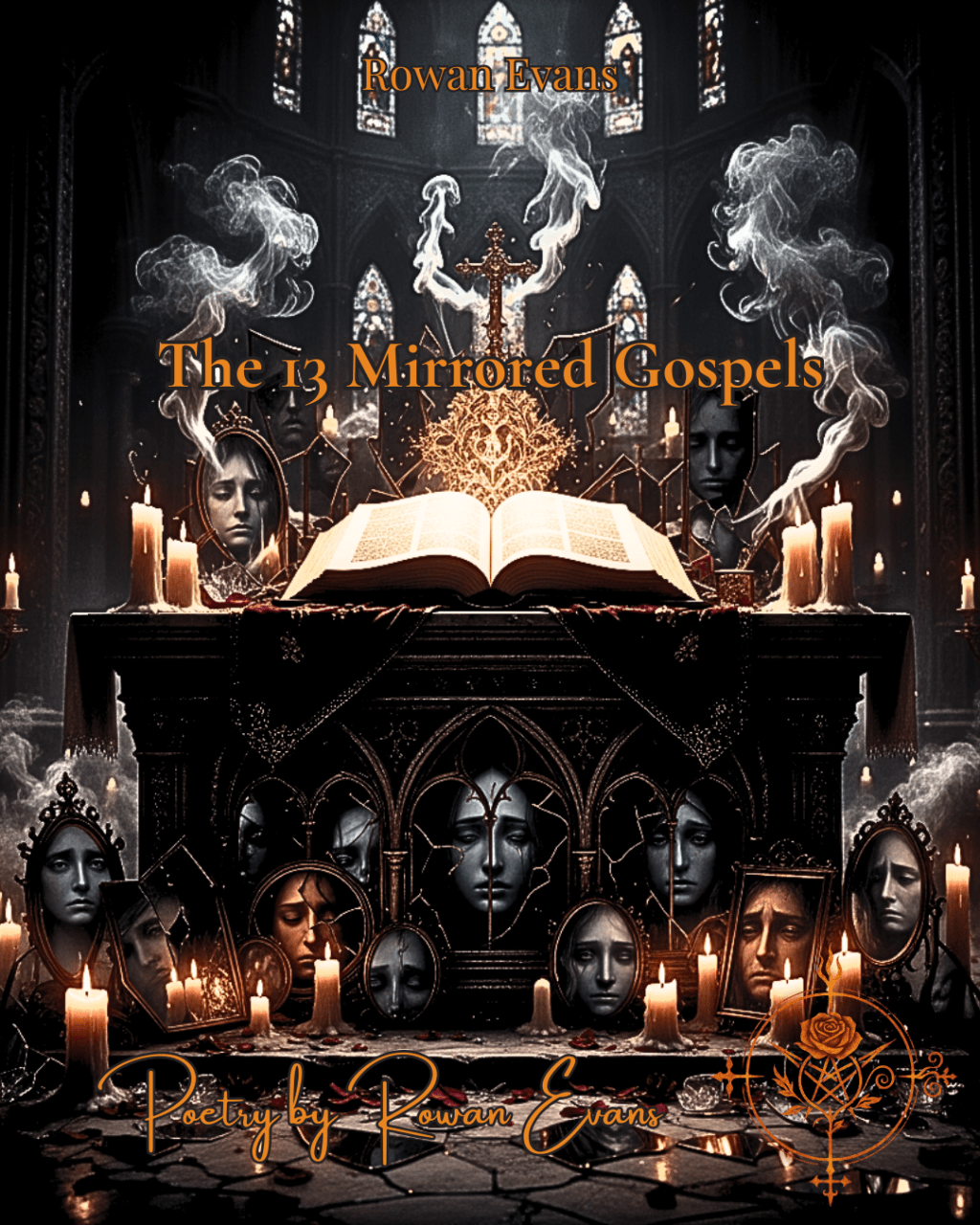
Each of these gospels was born from a silence I refused to keep. The 13 Mirrored Gospels is my reckoning with faith, identity, and the inherited wounds of expectation. These are not sermons for the saved — they are psalms for the broken, whispered through smoke and mirrorlight.
Read carefully.
The smoke is watching.
Read carefully. The smoke is always watching.
🖤 The 13 Mirrored Gospels 🖤 Poetry by Rowan Evans
“There are no saints in these gospels— only shadows that learned to speak.” —Rowan Evans
𖤐𓆩 🜏 𓆪𖤐
I. The Gospel of Mirrors
Step inside. Watch yourself rot in reverse. Every smile you wore as armor, now bleeding at the edges. The mirror never lied. You just kept asking the wrong questions.
𖤐𓆩 🜏 𓆪𖤐
II. The Gospel of Silence
Not the silence of peace— the silence after impact. The quiet that follows when every scream is spent, and all that’s left is the echo of your own denial.
𖤐𓆩 🜏 𓆪𖤐
III. The Gospel of Golden Lies
They dipped their cruelty in gold leaf and called it kindness. They said “light saves” while tightening the noose. Shine is not salvation. Shine is strategy.
𖤐𓆩 🜏 𓆪𖤐
IV. The Gospel of the Sainted Wound
She told me pain makes you beautiful. So I made myself a masterpiece. Now they can’t look at me without flinching.
𖤐𓆩 🜏 𓆪𖤐
V. The Gospel of Velvet Ruin
I dressed my rage in elegance— because pretty things bleed quieter. Because if I scream in silk, they call it poetry, not proof.
𖤐𓆩 🜏 𓆪𖤐
VI. The Gospel of the Haloed Knife
They told me love was soft. So when I bled, I thought I was wrong. Turns out, some loves come serrated. Turns out, mine did too.
𖤐𓆩 🜏 𓆪𖤐
VII. The Gospel of the Unknown Reflection
The mirror shows my face, but it isn’t me— just a shadow stitched from language, from names that never fit.
They told me what to be: man, believer, saved— but I only felt the ache between those words.
Now even silence flinches.
𖤐𓆩 🜏 𓆪𖤐
VIII. The Gospel of Smoke-Laced Psalms
I wrote devotion in ash, but they wanted ink. So I choked on incense until my prayers tasted like what they’d believe.
𖤐𓆩 🜏 𓆪𖤐
IX. The Gospel of Unholy Softness
I offered tenderness. They saw weakness. I offered truth. They called it unstable. So now I offer nothing but teeth.
𖤐𓆩 🜏 𓆪𖤐
X. The Gospel of Reverse Reverence
I bowed to nothing— not out of pride, but protection. Every altar I’ve knelt before asked for a piece of me. I’ve run out of offerings.
𖤐𓆩 🜏 𓆪𖤐
XI. The Gospel of Misnamed Miracles
They called my survival a phase. A scream for attention. But I was just trying to exist loud enough to feel real.
𖤐𓆩 🜏 𓆪𖤐
XII. The Gospel of Heretics and Honey
I tasted joy once. Sweet. Brief. But it rotted faster than grief. I keep it in a jar now, like a dead bee. Just in case.
𖤐𓆩 🜏 𓆪𖤐
XIII. The Gospel of the Flame That Didn’t Save Me
They said fire cleanses. But all it did was remind me what burning feels like from the inside.
I’m just… sitting here trying to figure out how to put all of this into words. These poems—they’re not tidy. They’re not meant to be. They are me trying to talk to myself, to the child I was, to the person I am now, to anyone who might understand.
I’ve been writing for over twenty-two years. Twenty-two. I started when I was thirteen, barely a kid. By fourteen, I was deep into Japanese music, culture, media… then Korean, then Chinese. I lived a Japanese life in America. Movies, music, shows, rituals I made in my head—I was building a world where I felt like I belonged, even if the world around me didn’t make sense.
I was also depressed. Anxious. I felt different from everyone else, but nobody really said why. Autism wasn’t mentioned. I didn’t have the language for it. Gender identity—same thing. I didn’t feel the things “I was supposed to” as a boy. I felt disconnected. I felt unseen. I felt untethered. I still sometimes do.
I asked my parents, over and over: where are we from? Beyond the U.S., what’s our heritage? They said we were mutts. And yeah, I get it. But it left me with this gnawing emptiness—a gap I couldn’t fill. I tried to make sense of it all, but there wasn’t a clear answer.
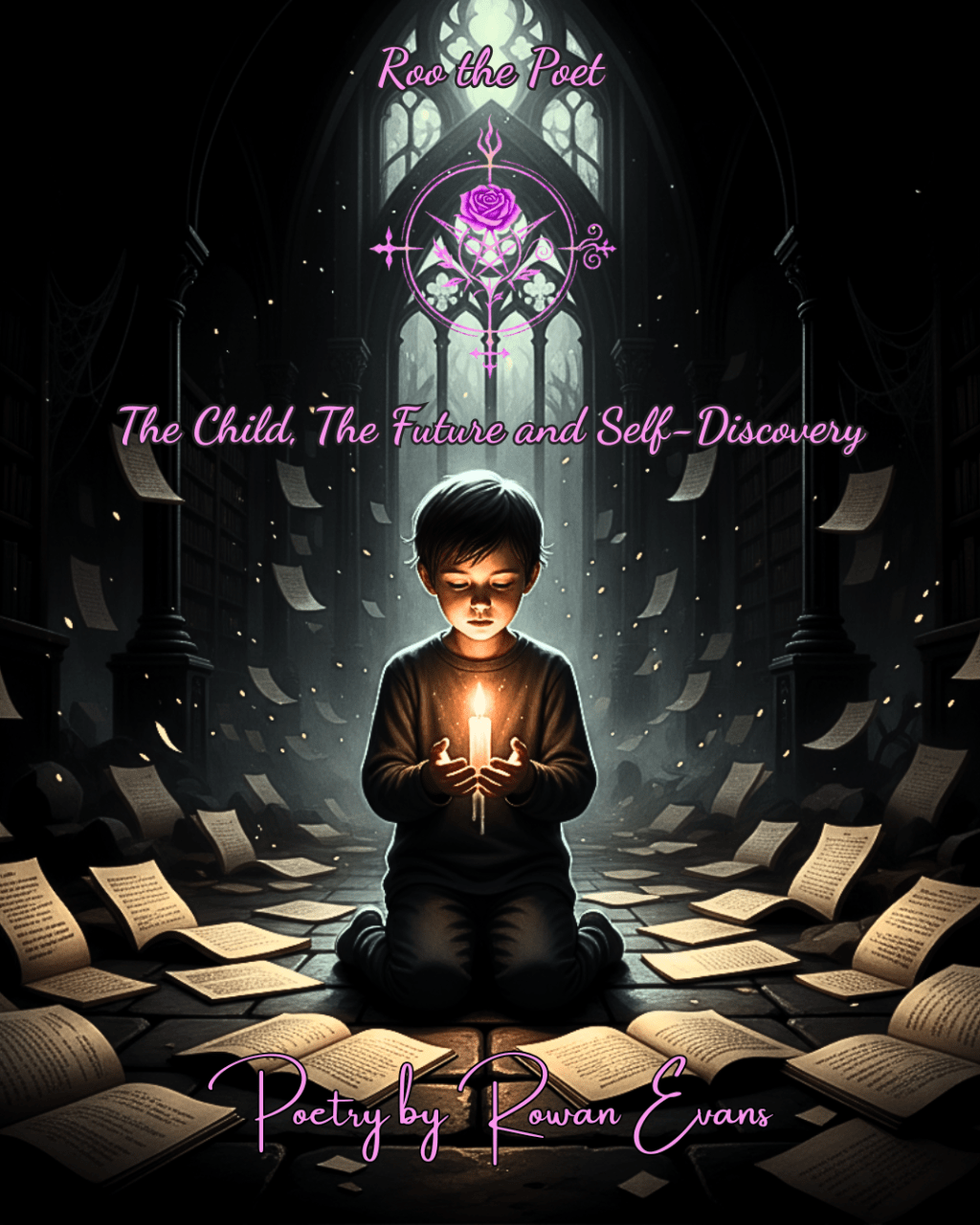
These poems are me talking to that inner child. Roo the Poet is that child’s voice—the part of me that’s been scared, lonely, unheard, and also resilient. They are a dialogue, a witness, a reminder that even when life is overwhelming, even when the world is messy and cruel, I—we—can keep moving, keep dreaming, keep reaching for light, even when it seems impossible.
They are raw. They are messy. They carry grief, rage, confusion, hope, and the quiet fire of persistence. I’m putting them here because I need them to exist. Because I need to say: it’s okay to feel all of it. It’s okay to be broken. It’s okay to question, to rage, to cry, to laugh, to search, to not have the answers.
I hope anyone reading this feels some part of it too. The fear, the hurt, the wonder, the resilience. The poems are my way of saying: you are not alone. The child inside you is still here. The voice that whispers your truths is still here. And maybe, just maybe, we can keep walking forward together.
— Rowan Evans
The Child & The Future Poetry by Roo the Poet featuring Rowan Evans
[Roo the Poet] Tell me, have we made it? Did our dreams take flight? Do our words now dance on pages, Spilling truth in black and white?
I held the light so tightly, Afraid it’d slip away, But I kept it burning, flickering, To guide us through the grey.
[Rowan] We’re not there yet, but we’re close, Closer than we’ve ever been. And Roo, it wouldn’t be possible Without the fire you lit within.
You taught me to hold on, Even when the night grew cold. That light always casts a shadow, But both are stories to be told.
[Roo the Poet] Do we still dream in color, Like we did when we were small? Do we still believe in magic, In the rise after the fall?
Do we still whisper wishes, To the stars beyond the pane? Do we still chase the echoes, Of our past, through joy and pain?
[Rowan] We dream, Roo, oh, we dream, But now with eyes wide open. We shape the stories with steady hands, No longer lost, no longer broken.
The magic never left us, It just grew in different ways— In the strength of ink and paper, In the fire that never fades.
[Roo the Poet] Then I have no fears, no sorrow, For the path we’ve yet to tread. Because you still carry the child I was, Even as you forge ahead.
So promise me, no matter what, That light will always stay? That the shadow won’t consume us, That we won’t be led astray?
[Rowan] I promise, Roo, I swear it true, The light will always shine. Because you’re the voice that kept me strong, The heart that still beats inside mine.
So walk with me—hand in hand, Through darkness, through the dawn. For every dream we’ve yet to chase, Together, we’ll carry on.
Lost in the Why Poetry by Roo the Poet
I don’t understand why the sun feels colder, Why laughter sounds distant, like echoes in stone. They say time will heal, that pain makes us older, But I still feel small, lost and alone.
The world keeps moving, but I stand still, Feet stuck in puddles that no one else sees. I try to be strong, to bend to their will, But inside, I’m just whispering, “Please.”
Please tell me why the stars seem dimmer, Why warmth feels like a memory’s trace. Why grown-ups cry with voices that quiver, Yet smile like grief doesn’t leave stains on their face.
I reach for the hands that once held me tight, But fingers slip through, like sand in the breeze. Was I meant to lose before knowing the light? To learn that love sometimes leaves?
I hide my heart in paper-thin walls, Shielding the child I used to be. But each crack whispers, each shadow calls, That pain is the price of growing free.
I don’t understand why the sun feels colder, But I’ll carry its warmth in the way that I shine. Even if grief makes my shoulders older, I’ll still hold space for the child inside.
The Past & The Present Poetry byRoo the Poetfeaturing Rowan Evans
[Roo the Poet] Are you tired, Rowan? I see your tears, your sad eyes, but you’re still standing— a little wobbly, but you’re still standing, like a toy with no batteries, but you keep going, don’t you?
[Rowan] It’s hard, Roo. I feel like the wind keeps pushing me, and I just… bend. How do I keep going when I don’t know where I’m going?
[Roo the Poet] But you are going, right? Like a tree with roots way deep in the ground— You bend, but you don’t break. The wind can blow and blow, but you stand up, because you’re strong inside. I know you are.
[Rowan] I don’t always feel strong. I feel like I’m falling apart sometimes, like the world is too big, and I’m just too small to do anything.
[Roo the Poet] You’re not too small! You’re big and strong like the moon, even when it hides behind the clouds. It’s still there, shining real bright, even if we can’t see it. I’m like that too. I’m always here, like the moon.
[Rowan] But what if I can’t find my way back to the light? What if the pieces of me just don’t fit anymore?
[Roo the Poet] Then we make new pieces! We glue ‘em together, make a brand new picture! It’s okay to be a little broken. Everyone’s a little broken sometimes. But that doesn’t mean you’re not special.
[Rowan] I don’t know if I can be fixed, Roo. I’m too tired.
[Roo the Poet] But you CAN be fixed, Rowan! You just gotta be patient. It takes time, like putting together a puzzle. And sometimes, you have to wait for the pieces to find their place. But that’s okay— you’ll figure it out. I know you will.
[Rowan] And what about you? You always know what to say. How are you so sure that everything will be okay?
[Roo the Poet] Because I trust you, silly! You’re like a little seed that will grow into the biggest flower, even when it’s all dark and hard. I know you can do it, Rowan. You’ll bloom, I promise.
[Rowan] I don’t feel like blooming yet. I just feel stuck, like I’m caught in the mud.
[Roo the Poet] You’re not stuck! You’re just waiting, like a flower needs the rain. The sun will come, I KNOW it will. And then you’ll be all bright and pretty.
[Rowan] But what if I miss the sun? What if it doesn’t come for me?
[Roo the Poet] Then we’ll make our own sun! We can draw it, paint it, make it real big! We don’t have to wait, Rowan. We can shine all by ourselves.
[Rowan] I didn’t think I could do it alone, but you… you make me feel like I can try.
[Roo the Poet] You don’t have to do it alone. I’m right here. I’ll help you, always. I’ll be your sunshine when it’s dark.
[Rowan] Thank you for still fighting for me. Thank you for never giving up on me.
[Roo the Poet] I won’t ever give up on you, Rowan. You’re my best friend. And I’ll always be here. You’re stronger than you know. And you’re never, ever alone.
[Rowan] I think I can start believing that. I think… I think I’ll be okay.
For those who feel these questions, this fire, and this search for self, my poem ‘I Am’ continues the journey—raw, unbound, and unafraid.
I was staying with the guy who offered me a place—a warm, open home in the Philippines. The morning was slow, soft. We just talked and laughed, getting to know each other better as the sun filtered through the window. I felt… weightless. For the first time in so long, my body didn’t ache. I didn’t need to hide inside my own skin.
Later that day, I met up with her at the mall. The woman that had inspired every single love poem I had written for the last year.
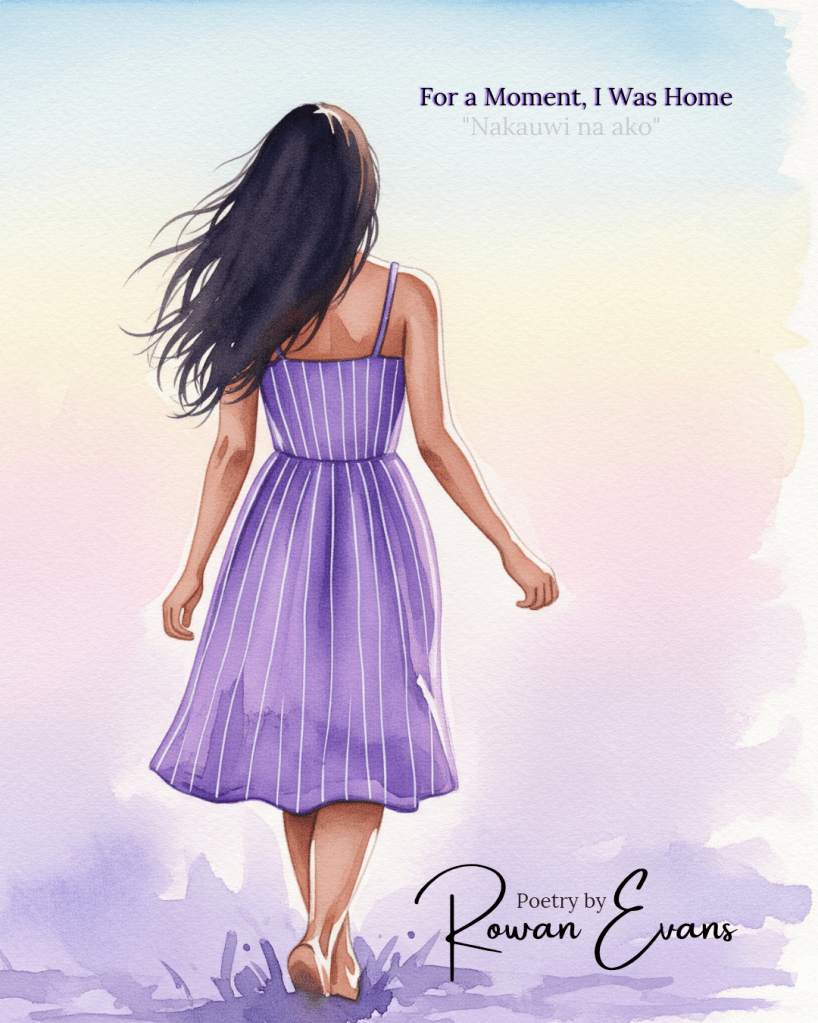
She was wearing a sundress, soft purple with white stripes. It matched her Nikes—white with hints of violet, like twilight folded into fabric. Her voice sounded like heaven, and her giggle—God, her giggle—made the whole world stop. The way she caught me looking at her, like she knew, and didn’t mind… like she liked it. The world faded every time she laughed. It was just us. No noise, no pain, no fear. Just us.
We wandered the shops. She lit up when we passed a shoe display. I noticed the way her eyes lingered, how her fingers brushed the pair she liked without touching the price tag. She didn’t need to ask. I bought them for her without hesitation. Not to impress her—but because I wanted to. Because she deserved to have things that made her smile like that.
Before the dream ended, I said something in Tagalog. I don’t remember the words, not fully. But I know what they meant:
“I’m home.”
And I was. For that brief, beautiful moment—I was whole. I wasn’t in pain. I wasn’t fighting my own thoughts. I wasn’t surviving. I was living.
I woke up with tears on my cheeks.
The sunlight in my real room was harsher—unfiltered, impatient. My knees screamed again. My back ached like it always does. The weight came rushing back, like gravity remembered me.
But even through the pain, even through the disappointment of being pulled from that softness— I smiled.
Because for a little while, I knew what it was to live without hurting. To breathe without breaking. To love without fear.
And even if it was only a dream, it’s mine now. A secret I tuck into the folds of my ribs. A memory from a place that maybe isn’t real, but felt more real than anything else ever has.




 Poetry by Rowan Evans